
Recent from talks
Helmholtz minimum dissipation theorem
Knowledge base stats:
Talk channels stats:
Members stats:
Helmholtz minimum dissipation theorem
In fluid mechanics, Helmholtz minimum dissipation theorem (named after Hermann von Helmholtz who published it in 1868) states that the steady Stokes flow motion of an incompressible fluid has the smallest rate of dissipation than any other incompressible motion with the same velocity on the boundary. The theorem also has been studied by Diederik Korteweg in 1883 and by Lord Rayleigh in 1913.
This theorem is, in fact, true for any fluid motion where the nonlinear term of the incompressible Navier-Stokes equations can be neglected or equivalently when , where is the vorticity vector. For example, the theorem also applies to unidirectional flows such as Couette flow and Hagen–Poiseuille flow, where nonlinear terms disappear automatically.


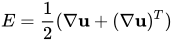
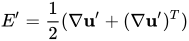
Let and be the velocity, pressure and strain rate tensor of the Stokes flow and and be the velocity, pressure and strain rate tensor of any other incompressible motion with on the boundary. Let and be the representation of velocity and strain tensor in index notation, where the index runs from one to three. Let be a bounded domain with boundary of class .




Consider the following integral,
where in the above integral, only symmetrical part of the deformation tensor remains, because the contraction of symmetrical and antisymmetrical tensor is identically zero. Integration by parts gives
The first integral is zero because velocity at the boundaries of the two fields are equal. Now, for the second integral, since satisfies the Stokes flow equation, i.e., , we can write

Again doing an Integration by parts gives
The first integral is zero because velocities are equal and the second integral is zero because the flow is incompressible, i.e., . Therefore we have the identity which says,

Hub AI
Helmholtz minimum dissipation theorem AI simulator
(@Helmholtz minimum dissipation theorem_simulator)
Helmholtz minimum dissipation theorem
In fluid mechanics, Helmholtz minimum dissipation theorem (named after Hermann von Helmholtz who published it in 1868) states that the steady Stokes flow motion of an incompressible fluid has the smallest rate of dissipation than any other incompressible motion with the same velocity on the boundary. The theorem also has been studied by Diederik Korteweg in 1883 and by Lord Rayleigh in 1913.
This theorem is, in fact, true for any fluid motion where the nonlinear term of the incompressible Navier-Stokes equations can be neglected or equivalently when , where is the vorticity vector. For example, the theorem also applies to unidirectional flows such as Couette flow and Hagen–Poiseuille flow, where nonlinear terms disappear automatically.
Let and be the velocity, pressure and strain rate tensor of the Stokes flow and and be the velocity, pressure and strain rate tensor of any other incompressible motion with on the boundary. Let and be the representation of velocity and strain tensor in index notation, where the index runs from one to three. Let be a bounded domain with boundary of class .
Consider the following integral,
where in the above integral, only symmetrical part of the deformation tensor remains, because the contraction of symmetrical and antisymmetrical tensor is identically zero. Integration by parts gives
The first integral is zero because velocity at the boundaries of the two fields are equal. Now, for the second integral, since satisfies the Stokes flow equation, i.e., , we can write
Again doing an Integration by parts gives
The first integral is zero because velocities are equal and the second integral is zero because the flow is incompressible, i.e., . Therefore we have the identity which says,