Hubbry Logo
Strain-rate tensorStrain-rate tensorMain
Open search
Strain-rate tensor
Community hub
Strain-rate tensor
logo
8 pages, 0 posts
0 subscribers
Be the first to start a discussion here.
Strain-rate tensor
Strain-rate tensor
from Wikipedia
A two-dimensional flow that, at the highlighted point, has only a strain rate component, with no mean velocity or rotational component.

In continuum mechanics, the strain-rate tensor or rate-of-strain tensor is a physical quantity that describes the rate of change of the strain (i.e., the relative deformation) of a material in the neighborhood of a certain point, at a certain moment of time. It can be defined as the derivative of the strain tensor with respect to time, or as the symmetric component of the Jacobian matrix (derivative with respect to position) of the flow velocity. In fluid mechanics it also can be described as the velocity gradient, a measure of how the velocity of a fluid changes between different points within the fluid.[1] Though the term can refer to a velocity profile (variation in velocity across layers of flow in a pipe),[2] it is often used to mean the gradient of a flow's velocity with respect to its coordinates.[3] The concept has implications in a variety of areas of physics and engineering, including magnetohydrodynamics, mining and water treatment.[4][5][6]

The strain rate tensor is a purely kinematic concept that describes the macroscopic motion of the material. Therefore, it does not depend on the nature of the material, or on the forces and stresses that may be acting on it; and it applies to any continuous medium, whether solid, liquid or gas.

On the other hand, for any fluid except superfluids, any gradual change in its deformation (i.e. a non-zero strain rate tensor) gives rise to viscous forces in its interior, due to friction between adjacent fluid elements, that tend to oppose that change. At any point in the fluid, these stresses can be described by a viscous stress tensor that is, almost always, completely determined by the strain rate tensor and by certain intrinsic properties of the fluid at that point. Viscous stress also occur in solids, in addition to the elastic stress observed in static deformation; when it is too large to be ignored, the material is said to be viscoelastic.

Dimensional analysis

[edit]

By performing dimensional analysis, the dimensions of velocity gradient can be determined. The dimensions of velocity are , and the dimensions of distance are . Since the velocity gradient can be expressed as . Therefore, the velocity gradient has the same dimensions as this ratio, i.e., .

In continuum mechanics

[edit]

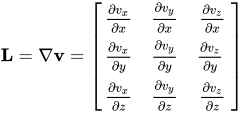
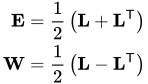
In 3 dimensions, the gradient of the velocity is a second-order tensor which can be expressed as the matrix : can be decomposed into the sum of a symmetric matrix and a skew-symmetric matrix as follows is called the strain rate tensor and describes the rate of stretching and shearing. is called the spin tensor and describes the rate of rotation.[7]

Relationship between shear stress and the velocity field

[edit]

Sir Isaac Newton proposed that shear stress is directly proportional to the velocity gradient:[8]

The constant of proportionality, , is called the dynamic viscosity.

Formal definition

[edit]

Consider a material body, solid or fluid, that is flowing and/or moving in space. Let v be the velocity field within the body; that is, a smooth function from R3 × R such that v(p, t) is the macroscopic velocity of the material that is passing through the point p at time t.

The velocity v(p + r, t) at a point displaced from p by a small vector r can be written as a Taylor series: where v the gradient of the velocity field, understood as a linear map that takes a displacement vector r to the corresponding change in the velocity.

A velocity field
Total field v(p + r).
Constant part
Constant part v(p).
Linear part
Linear part (∇v)(p, t)(r).
Non-linear residual
Non-linear residual.
The velocity field v(p + r, t) of an arbitrary flow around a point p (red dot), at some instant t, and the terms of its first-order Taylor approximation about p. The third component of the velocity (out of the screen) is assumed to be zero everywhere.

In an arbitrary reference frame, v is related to the Jacobian matrix of the field, namely in 3 dimensions it is the 3 × 3 matrix where vi is the component of v parallel to axis i and jf denotes the partial derivative of a function f with respect to the space coordinate xj. Note that J is a function of p and t.

In this coordinate system, the Taylor approximation for the velocity near p is or simply

if v and r are viewed as 3 × 1 matrices.

Symmetric and antisymmetric parts

[edit]
Symmetric part
The symmetric part E(p, t)(r) (strain rate) of the linear term of the example flow.
Antisymmetric part
The antisymmetric part R(p, t)(r) (rotation) of the linear term.

Any matrix can be decomposed into the sum of a symmetric matrix and an antisymmetric matrix. Applying this to the Jacobian matrix with symmetric and antisymmetric components E and R respectively:

This decomposition is independent of coordinate system, and so has physical significance. Then the velocity field may be approximated as that is,

The antisymmetric term R represents a rigid-like rotation of the fluid about the point p. Its angular velocity is

The product ∇ × v is called the vorticity of the vector field. A rigid rotation does not change the relative positions of the fluid elements, so the antisymmetric term R of the velocity gradient does not contribute to the rate of change of the deformation. The actual strain rate is therefore described by the symmetric E term, which is the strain rate tensor.

Shear rate and compression rate

[edit]
Scalar part (expansion)
The spherical part S(p, t)(r) (uniform expansion, or compression, rate) of the strain rate tensor E(p, t)(r).
Traceless part (shear)
The deviatoric part D(p, t)(r) (shear rate) of the strain rate tensor E(p, t)(r).

The symmetric term E (the rate-of-strain tensor) can be broken down further as the sum of a scalar times the unit tensor, that represents a gradual isotropic expansion or contraction; and a traceless symmetric tensor which represents a gradual shearing deformation, with no change in volume:[9]

That is,

Here δ is the unit tensor, such that δij is 1 if i = j and 0 if ij. This decomposition is independent of the choice of coordinate system, and is therefore physically significant.

The trace of the expansion rate tensor is the divergence of the velocity field: which is the rate at which the volume of a fixed amount of fluid increases at that point.

The shear rate tensor is represented by a symmetric 3 × 3 matrix, and describes a flow that combines compression and expansion flows along three orthogonal axes, such that there is no change in volume. This type of flow occurs, for example, when a rubber strip is stretched by pulling at the ends, or when honey falls from a spoon as a smooth unbroken stream.

For a two-dimensional flow, the divergence of v has only two terms and quantifies the change in area rather than volume. The factor 1/3 in the expansion rate term should be replaced by 1/2 in that case.

Examples

[edit]

The study of velocity gradients is useful in analysing path dependent materials and in the subsequent study of stresses and strains; e.g., Plastic deformation of metals.[3] The near-wall velocity gradient of the unburned reactants flowing from a tube is a key parameter for characterising flame stability.[5]: 1–3  The velocity gradient of a plasma can define conditions for the solutions to fundamental equations in magnetohydrodynamics.[4]

Fluid in a pipe

[edit]

Consider the velocity field of a fluid flowing through a pipe. The layer of fluid in contact with the pipe tends to be at rest with respect to the pipe. This is called the no slip condition.[10] If the velocity difference between fluid layers at the centre of the pipe and at the sides of the pipe is sufficiently small, then the fluid flow is observed in the form of continuous layers. This type of flow is called laminar flow.

The flow velocity difference between adjacent layers can be measured in terms of a velocity gradient, given by . Where is the difference in flow velocity between the two layers and is the distance between the layers.

See also

[edit]

References

[edit]
Revisions and contributorsEdit on WikipediaRead on Wikipedia
from Grokipedia
The strain-rate tensor, also known as the deformation-rate tensor or rate-of-strain tensor, is a second-order in that quantifies the instantaneous rate of deformation of a continuous medium, excluding rigid-body rotations. It is mathematically defined as the symmetric part of the velocity gradient tensor L=v\mathbf{L} = \nabla \mathbf{v}, expressed in Cartesian coordinates as Dij=12(vixj+vjxi),D_{ij} = \frac{1}{2} \left( \frac{\partial v_i}{\partial x_j} + \frac{\partial v_j}{\partial x_i} \right), where v\mathbf{v} is the field and xix_i are spatial coordinates; the diagonal components represent rates of extension or compression, while off-diagonal components capture shear rates. This tensor arises naturally from the decomposition of the velocity gradient into symmetric (deformation) and antisymmetric (rotation) parts, ensuring it has only six independent components due to (Dij=DjiD_{ij} = D_{ji}) and real eigenvalues corresponding to principal strain rates. In , it describes the time derivative of the infinitesimal strain tensor, ε˙ij\dot{\varepsilon}_{ij}, linking applied stresses to deformation rates in viscoelastic materials via constitutive relations. For fluids, particularly Newtonian viscous fluids, the tensor plays a central role in the formulation, T=pI+2μD\mathbf{T} = -p \mathbf{I} + 2\mu \mathbf{D}, where pp is , μ\mu is dynamic , and I\mathbf{I} is the identity tensor; the trace tr(D)\operatorname{tr}(\mathbf{D}) governs volumetric changes, while the deviatoric part drives shear stresses. The strain-rate tensor's invariance under coordinate transformations makes it essential for analyzing material behavior in diverse applications, from to , including the Navier-Stokes equations where it determines viscous dissipation. Its properties, such as positive semi-definiteness in certain contexts, facilitate the study of energy dissipation rates, computed as T:D\mathbf{T} : \mathbf{D} (double contraction), which quantifies mechanical work converted to heat in deforming continua.

Fundamentals

Dimensional Analysis

The strain-rate tensor serves as a measure of the rate of deformation in continuum media, where each of its components carries dimensions of inverse time, denoted as [T]^{-1}, which aligns with frequency units such as s^{-1} in the (SI). This dimensional characteristic arises from the tensor's origin in field gradients, where a component (dimensions [L T^{-1}]) differentiated with respect to a spatial coordinate (dimensions [L]) results in [T^{-1}]. Strain itself is dimensionless as a ratio of length changes, so its time derivative inherently scales with 1/time, emphasizing the tensor's role in capturing temporal rates of geometric distortion without inherent length or mass dependencies. The tensor's components further illustrate this uniformity in scaling. Normal strain-rate components along the principal axes, such as ϵ˙xx=ux\dot{\epsilon}_{xx} = \frac{\partial u}{\partial x}, ϵ˙yy=vy\dot{\epsilon}_{yy} = \frac{\partial v}{\partial y}, and ϵ˙zz=wz\dot{\epsilon}_{zz} = \frac{\partial w}{\partial z}, each represent linear deformation rates and possess units of s^{-1}. Similarly, shear strain-rate components, exemplified by ϵ˙xy=12(uy+vx)\dot{\epsilon}_{xy} = \frac{1}{2} \left( \frac{\partial u}{\partial y} + \frac{\partial v}{\partial x} \right), maintain the same [T]^{-1} dimensions, as the averaging does not alter the underlying velocity gradient scaling. This consistent dimensionality across all nine components in ensures the tensor's invariance under coordinate transformations while facilitating direct comparisons of deformation rates in various directions. In simulations and theoretical modeling, the [T]^{-1} scaling of the strain-rate tensor underpins non-dimensionalization techniques to isolate dominant physical effects. A key example is the , defined as Re=ρULμ\mathrm{Re} = \frac{\rho U L}{\mu}, which ratios inertial forces (ρU2/L\rho U^2 / L) to viscous forces (μU/L2\mu U / L^2), where the viscous term implicitly involves strain rates on the order of U/LU/L. This relation highlights how strain-rate magnitudes govern the balance between convective acceleration and diffusive momentum transport, enabling scaled analyses in without loss of physical insight. The emphasis on dimensional consistency for the strain-rate tensor traces back to early continuum mechanics developments. In the 1820s, Claude-Louis Navier introduced viscous terms proportional to deformation rates in his equations of motion, using molecular arguments to dimensionally match stress ([M L^{-1} T^{-2}]) with dynamic viscosity times strain rate (μϵ˙\mu \dot{\epsilon}). George Stokes later refined this in 1845, providing a more rigorous formulation ensuring the full Navier-Stokes equations balanced across all terms, from pressure gradients to inertial accelerations. These foundational formulations established the tensor's dimensional framework, influencing subsequent derivations in viscous flow theory.

Velocity Gradient Tensor

In , the velocity gradient tensor, denoted L\mathbf{L}, is defined as the of the v\mathbf{v}, expressed as L=v\mathbf{L} = \nabla \mathbf{v}. In , this is generally written as L=v\mathbf{L} = \nabla \mathbf{v}, where the operator \nabla acts on the spatial coordinates. In Cartesian coordinates, the components of L\mathbf{L} are given by Lij=vixj,L_{ij} = \frac{\partial v_i}{\partial x_j}, where viv_i are the components of the field and xjx_j are the spatial coordinates. This tensorial representation captures the spatial variation of in a second-order tensor form. Physically, the velocity gradient tensor describes how the velocity field changes over distances in space, thereby encoding the local of motion in a continuum. It encompasses both the deformative aspects, such as stretching and shearing, and the rigid rotational components inherent in the flow or deformation of material elements. For an dx\mathrm{d}\mathbf{x}, the across it is dv=Ldx\mathrm{d}\mathbf{v} = \mathbf{L} \cdot \mathrm{d}\mathbf{x}, illustrating how L\mathbf{L} governs the differential motion within the continuum. As a foundational kinematic in , the velocity gradient tensor provides the basis for analyzing infinitesimal changes in velocity across space, essential for deriving rates of deformation in both fluids and solids. The components of L\mathbf{L} possess dimensions of inverse time, [T]^{-1}, reflecting the scaling of velocity differences per unit length.

Formal Definition and Properties

Strain-Rate Tensor Components

The strain-rate tensor, often denoted as D\mathbf{D}, is formally defined as the symmetric portion of the velocity gradient tensor L=v\mathbf{L} = \nabla \mathbf{v}, where v\mathbf{v} is the field of the continuum. It is expressed in coordinate-free notation as D=12(L+LT).\mathbf{D} = \frac{1}{2} \left( \mathbf{L} + \mathbf{L}^T \right). This definition captures the rate at which neighboring material elements deform relative to one another, excluding rigid-body . In three-dimensional Cartesian coordinates, with velocity components uu, vv, and ww corresponding to the xx, yy, and zz directions, the nine components of D\mathbf{D} take the explicit form Dxx=ux,Dyy=vy,Dzz=wz,Dxy=Dyx=12(uy+vx),Dxz=Dzx=12(uz+wx),Dyz=Dzy=12(vz+wy).\begin{aligned} D_{xx} &= \frac{\partial u}{\partial x}, \\ D_{yy} &= \frac{\partial v}{\partial y}, \\ D_{zz} &= \frac{\partial w}{\partial z}, \\ D_{xy} = D_{yx} &= \frac{1}{2} \left( \frac{\partial u}{\partial y} + \frac{\partial v}{\partial x} \right), \\ D_{xz} = D_{zx} &= \frac{1}{2} \left( \frac{\partial u}{\partial z} + \frac{\partial w}{\partial x} \right), \\ D_{yz} = D_{zy} &= \frac{1}{2} \left( \frac{\partial v}{\partial z} + \frac{\partial w}{\partial y} \right). \end{aligned} The symmetry D=DT\mathbf{D} = \mathbf{D}^T implies only six independent components, corresponding to three normal strain rates and three shear strain rates. The trace of the , tr(D)=Dxx+Dyy+Dzz=v\operatorname{tr}(\mathbf{D}) = D_{xx} + D_{yy} + D_{zz} = \nabla \cdot \mathbf{v}, quantifies the dilatation or volumetric strain rate, which indicates the rate of local volume change in the material. As a second-order tensor, D\mathbf{D} transforms under rotation of the coordinate system via D=RDRT\mathbf{D}' = \mathbf{R} \mathbf{D} \mathbf{R}^T, where R\mathbf{R} is the proper orthogonal rotation tensor; this ensures that the tensor's symmetry and key physical properties remain invariant across coordinate frames.

Decomposition into Symmetric and Antisymmetric Parts

The velocity gradient tensor L=v\mathbf{L} = \nabla \mathbf{v} can be uniquely decomposed into a symmetric part, known as the strain-rate tensor D\mathbf{D}, and an antisymmetric part, known as the rotation tensor W\mathbf{W}, such that L=D+W\mathbf{L} = \mathbf{D} + \mathbf{W}. The strain-rate tensor is defined as D=12(L+LT)\mathbf{D} = \frac{1}{2} (\mathbf{L} + \mathbf{L}^T), while the rotation tensor is W=12(LLT)\mathbf{W} = \frac{1}{2} (\mathbf{L} - \mathbf{L}^T). This decomposition separates the contributions of deformation and rotation in the local fluid motion. The components of the rotation tensor W\mathbf{W} are given by Wij=12(vixjvjxi)W_{ij} = \frac{1}{2} \left( \frac{\partial v_i}{\partial x_j} - \frac{\partial v_j}{\partial x_i} \right). For example, in the xyxy-plane, Wxy=12(uyvx)W_{xy} = \frac{1}{2} \left( \frac{\partial u}{\partial y} - \frac{\partial v}{\partial x} \right). This tensor is closely related to the vorticity vector ω=×v\boldsymbol{\omega} = \nabla \times \mathbf{v}, which quantifies the local rotation of fluid elements; in three dimensions, the vorticity components are extracted from W\mathbf{W} via ωk=ϵkijWij\omega_k = -\epsilon_{kij} W_{ij}, where ϵkij\epsilon_{kij} is the Levi-Civita symbol. Specifically, for the zz-component in two dimensions, ωz=2Wxy\omega_z = -2 W_{xy}. Physically, the strain-rate tensor D\mathbf{D} describes the rate of change in shape (through shearing) and volume (through dilatation) of a element, representing pure deformation without . In contrast, the rotation tensor W\mathbf{W} captures the rigid-body of the element, which does not involve any deformation or change in shape. This distinction arises because symmetric tensors like D\mathbf{D} affect relative positions through stretching and compression, while antisymmetric tensors like W\mathbf{W} correspond to equivalent to a skew-symmetric operator. The decomposition L=D+W\mathbf{L} = \mathbf{D} + \mathbf{W} is invariant under orthogonal coordinate transformations, as L\mathbf{L}, D\mathbf{D}, and W\mathbf{W} all transform as second-order tensors, thereby preserving the properties and the separation into deformation and components regardless of the chosen frame.

Applications in Mechanics

Role in

In fluid dynamics, the , denoted as D\mathbf{D}, quantifies the rate of deformation in the field and directly influences the viscous stresses that govern flow behavior, particularly in viscous flows where momentum transport occurs through molecular interactions. This tensor emerges as the symmetric part of the velocity gradient, capturing the stretching and shearing motions essential for modeling energy dissipation in fluids. Historically, Sir George Gabriel Stokes incorporated the into the equations of motion for viscous fluids in 1845, deriving what are now known as the Navier-Stokes equations by adding rate-dependent viscous terms to Euler's inviscid equations, thereby establishing as a fundamental property dependent on deformation rates. For Newtonian fluids, the constitutive relation links the deviatoric part of the Cauchy stress tensor τ\boldsymbol{\tau} linearly to the strain-rate tensor via τ=2μD\boldsymbol{\tau} = 2\mu \mathbf{D}, where μ\mu is the dynamic viscosity coefficient, assumed constant and independent of the deformation rate. This relation implies that viscous stresses arise solely from the symmetric deformation, with no contribution from rigid-body rotation. The complete Cauchy stress tensor σ\boldsymbol{\sigma} for such fluids is then σ=pI+2μD\boldsymbol{\sigma} = -p \mathbf{I} + 2\mu \mathbf{D} in the incompressible case, or more generally for compressible flows, σ=pI+2μD+λ(trD)I\boldsymbol{\sigma} = -p \mathbf{I} + 2\mu \mathbf{D} + \lambda (\operatorname{tr} \mathbf{D}) \mathbf{I}, where pp is the pressure, I\mathbf{I} is the identity tensor, λ\lambda is the second viscosity coefficient, and bulk viscosity effects account for volumetric changes. In non-Newtonian fluids, where viscosity varies with deformation rate, the strain-rate tensor's role extends to generalized models that capture shear-thinning or shear-thickening behaviors. A common example is the power-law fluid model, where the effective viscosity depends on the shear rate magnitude γ˙=2D:D\dot{\gamma} = \sqrt{2 \mathbf{D} : \mathbf{D}}
Add your contribution
Related Hubs
User Avatar
No comments yet.