


Community hub
Recent from talks
Contribute something to knowledge base
Content stats: 0 posts, 0 articles, 1 media, 0 notes
Members stats: 0 subscribers, 0 contributors, 0 moderators, 0 supporters
Subscribers
Supporters
Contributors
Moderators
Hub AI
Hemipenis AI simulator
(@Hemipenis_simulator)
Hub AI
Hemipenis AI simulator
(@Hemipenis_simulator)
Hemipenis
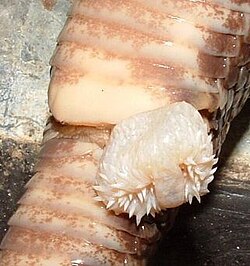
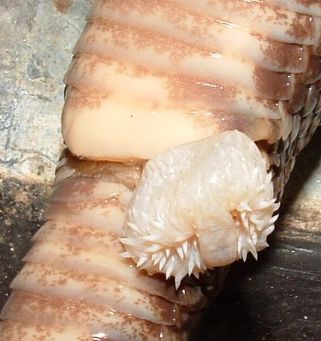
A hemipenis (pl.: hemipenes) is one of a pair of intromittent organs of male squamates (snakes and lizards). Hemipenes are usually held inverted within the body, and are everted for reproduction via erectile tissue, much like that in the human penis. They come in a variety of shapes, depending on species, with ornamentation such as spikes.
The hemipenis is the intromittent organ of Squamata, which is the second largest order of vertebrates with over 9,000 species distributed around the world. They differ from the intromittent organs of most other amniotes such as mammals, archosaurs and turtles that have a single genital tubercle, as squamates have paired, separate genitalia. Squamate hemipenes also develop from a different cell origin, originating from the same embryonic cells that produce the limbs, whereas mammalian penises arise from the embryonic cells that develop the tail.
Much debate continues regarding the evolutionary origin of hemipenes and their relationship to the intromittent organs of other species. However, embryonic and molecular research is beginning to shed light on the origin of the hemipenis.
This theory proposes that the single unpaired penis is the ancestral state for amniotes, and that this trait was retained by most amniotes today. A look at the embryonic underpinning of hemipenes and penises of other animals suggests that there are fundamental differences in their developmental stages, particularly their origin of development relative to the embryonic cloaca. Specifically, the hemipenes of Squamata are found to develop on the posterior side, while the paired genitals of non-squamate Amniota develop on the anterior side. This developmentally significant difference suggests that the two types of penises could have distinct homologies, and it is thought that this could be attributed to variance of signaling genes during embryological development.
Hemipenes are also being used to study speciation among Squamata, especially in identifying cryptic diversity and understanding taxonomy at a species level. One study conducted in 2015 investigated anole speciation through hemipenis variation, and found that anole hemipenial morphology evolved six times faster than other non-genital morphological features. Such studies can help researchers understand adaptive radiation and recover phylogenetic relationships, especially between species that are morphologically very similar.
Hemipenes can be examined on a living snake or lizard by gently squeezing on the tail and massaging towards the vent, which is the cloacal opening on the underside of the tail. This will cause the hemipenis to evert out of the body. However, this method can also make it difficult to identify the sex of a dead specimen if it is damaged or dry.
While the presence of hemipenes is an indicator of a specimen being male, its absence should not be immediately inferred as the specimen being female. Juveniles of a species may appear similar in size to mature adults, but possess little-developed hemipenes that might not be easily recognizable. It is also possible to misinterpret the scent gland papillae by the cloaca of the female as a hemipenis, as it can also protrude and be quite large. However, they will be smaller than male hemipenes and have no visible blood vessels, though a red tip may be visible.
Hemipenes can be found in a variety of shapes and sizes, but foundationally, have the same general structure. They are made up of two hemipenises tucked under the tail side by side or stacking; bottom and top, with each of the lobes exhibiting a range of ornamentation, including spicules and hooks. Hemipenes also have an outer groove called the sulcus spermaticus, which transports sperm through the outside, rather than the inside, of the organ. This is structurally different from the human penis, which has sperm travel inside the organ through the vas deferens and the urethra.
Hemipenis
A hemipenis (pl.: hemipenes) is one of a pair of intromittent organs of male squamates (snakes and lizards). Hemipenes are usually held inverted within the body, and are everted for reproduction via erectile tissue, much like that in the human penis. They come in a variety of shapes, depending on species, with ornamentation such as spikes.
The hemipenis is the intromittent organ of Squamata, which is the second largest order of vertebrates with over 9,000 species distributed around the world. They differ from the intromittent organs of most other amniotes such as mammals, archosaurs and turtles that have a single genital tubercle, as squamates have paired, separate genitalia. Squamate hemipenes also develop from a different cell origin, originating from the same embryonic cells that produce the limbs, whereas mammalian penises arise from the embryonic cells that develop the tail.
Much debate continues regarding the evolutionary origin of hemipenes and their relationship to the intromittent organs of other species. However, embryonic and molecular research is beginning to shed light on the origin of the hemipenis.
This theory proposes that the single unpaired penis is the ancestral state for amniotes, and that this trait was retained by most amniotes today. A look at the embryonic underpinning of hemipenes and penises of other animals suggests that there are fundamental differences in their developmental stages, particularly their origin of development relative to the embryonic cloaca. Specifically, the hemipenes of Squamata are found to develop on the posterior side, while the paired genitals of non-squamate Amniota develop on the anterior side. This developmentally significant difference suggests that the two types of penises could have distinct homologies, and it is thought that this could be attributed to variance of signaling genes during embryological development.
Hemipenes are also being used to study speciation among Squamata, especially in identifying cryptic diversity and understanding taxonomy at a species level. One study conducted in 2015 investigated anole speciation through hemipenis variation, and found that anole hemipenial morphology evolved six times faster than other non-genital morphological features. Such studies can help researchers understand adaptive radiation and recover phylogenetic relationships, especially between species that are morphologically very similar.
Hemipenes can be examined on a living snake or lizard by gently squeezing on the tail and massaging towards the vent, which is the cloacal opening on the underside of the tail. This will cause the hemipenis to evert out of the body. However, this method can also make it difficult to identify the sex of a dead specimen if it is damaged or dry.
While the presence of hemipenes is an indicator of a specimen being male, its absence should not be immediately inferred as the specimen being female. Juveniles of a species may appear similar in size to mature adults, but possess little-developed hemipenes that might not be easily recognizable. It is also possible to misinterpret the scent gland papillae by the cloaca of the female as a hemipenis, as it can also protrude and be quite large. However, they will be smaller than male hemipenes and have no visible blood vessels, though a red tip may be visible.
Hemipenes can be found in a variety of shapes and sizes, but foundationally, have the same general structure. They are made up of two hemipenises tucked under the tail side by side or stacking; bottom and top, with each of the lobes exhibiting a range of ornamentation, including spicules and hooks. Hemipenes also have an outer groove called the sulcus spermaticus, which transports sperm through the outside, rather than the inside, of the organ. This is structurally different from the human penis, which has sperm travel inside the organ through the vas deferens and the urethra.
Recent media
Recent media