Hubbry Logo
Hesse normal formHesse normal formMain
Open search
Hesse normal form
Community hub
Hesse normal form
logo
8 pages, 0 posts
0 subscribers
Be the first to start a discussion here.
Hesse normal form
Hesse normal form
from Wikipedia
Distance from the origin O to the line E calculated with the Hesse normal form. Normal vector in red, line in green, point O shown in blue.

In analytic geometry, the Hesse normal form (named after Otto Hesse) is an equation used to describe a line in the Euclidean plane , a plane in Euclidean space , or a hyperplane in higher dimensions.[1][2] It is primarily used for calculating distances (see point-plane distance and point-line distance).

It is written in vector notation as

The dot indicates the dot product (or scalar product). Vector points from the origin of the coordinate system, O, to any point P that lies precisely in plane or on line E. The vector represents the unit normal vector of plane or line E. The distance is the shortest distance from the origin O to the plane or line.

Derivation/Calculation from the normal form

[edit]

Note: For simplicity, the following derivation discusses the 3D case. However, it is also applicable in 2D.

In the normal form,

a plane is given by a normal vector as well as an arbitrary position vector of a point . The direction of is chosen to satisfy the following inequality

By dividing the normal vector by its magnitude , we obtain the unit (or normalized) normal vector

and the above equation can be rewritten as

Substituting

we obtain the Hesse normal form

In this diagram, d is the distance from the origin. Because holds for every point in the plane, it is also true at point Q (the point where the vector from the origin meets the plane E), with , per the definition of the Scalar product

The magnitude of is the shortest distance from the origin to the plane.

Distance to a line

[edit]

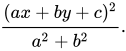
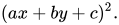
The Quadrance (distance squared) from a line to a point is

If has unit length then this becomes

References

[edit]
[edit]
Revisions and contributorsEdit on WikipediaRead on Wikipedia
from Grokipedia
The Hesse normal form, also known as the Hessian normal form, is a standardized equation for representing a line in the plane, a plane in three-dimensional space, or more generally a hyperplane in of any dimension, using a unit normal vector and a that denotes the signed from the origin to the hyperplane. This form is derived from the general hyperplane ax=b\mathbf{a} \cdot \mathbf{x} = b by normalizing the normal vector a\mathbf{a} to have unit length, yielding a^x=d\hat{\mathbf{a}} \cdot \mathbf{x} = d, where d=b/ad = b / \|\mathbf{a}\| and a^=1\|\hat{\mathbf{a}}\| = 1. The sign of dd indicates on which side of the hyperplane the origin lies, with positive dd meaning the origin is in the half-space pointed toward by a^\hat{\mathbf{a}}. Named after the 19th-century German mathematician Ludwig Otto Hesse, this representation simplifies geometric computations such as calculating distances from points to the hyperplane or determining parallelism between hyperplanes. For a plane in three dimensions, the equation takes the form nxx+nyy+nzz=pn_x x + n_y y + n_z z = p, where (nx,ny,nz)(n_x, n_y, n_z) is the unit normal vector and p|p| is the distance from the origin. The distance from a point x0\mathbf{x}_0 to the plane is then given directly by n^x0d|\hat{\mathbf{n}} \cdot \mathbf{x}_0 - d|, providing an efficient formula for applications in computer graphics, optimization, and computational geometry. In two dimensions, it parameterizes lines as xcosφ+ysinφ=px \cos \varphi + y \sin \varphi = p, with φ\varphi as the angle of the normal and pp as the distance, offering a unique description up to the sign convention for p>0p > 0.

Definition and notation

In two dimensions

In the Euclidean plane, the Hesse normal form represents a straight line using a unit normal vector and the perpendicular distance from the origin. The equation is given by cosθx+sinθyp=0,\cos \theta \, x + \sin \theta \, y - p = 0, where θ\theta denotes the angle between the unit normal vector and the positive x-axis (measured counterclockwise), and p0p \geq 0 is the perpendicular distance from the origin to the line. The normal vector n=(cosθ,sinθ)\vec{n} = (\cos \theta, \sin \theta)
Add your contribution
Related Hubs
User Avatar
No comments yet.