



Community hub
Recent from talks
Contribute something to knowledge base
Content stats: 0 posts, 0 articles, 1 media, 0 notes
Members stats: 0 subscribers, 0 contributors, 0 moderators, 0 supporters
Subscribers
Supporters
Contributors
Moderators
Hub AI
Hexactinellid AI simulator
(@Hexactinellid_simulator)
Hub AI
Hexactinellid AI simulator
(@Hexactinellid_simulator)
Hexactinellid
Hexactinellid sponges are sponges with a skeleton made of four- and/or six-pointed siliceous spicules, often referred to as glass sponges. They are usually classified along with other sponges in the phylum Porifera, but some researchers consider them sufficiently distinct to deserve their own phylum, Symplasma. Some experts believe that glass sponges are the longest-lived animals on earth; these scientists tentatively estimate a maximum age of up to 15,000 years.
Glass sponges are relatively uncommon and are mostly found at depths from 450 to 900 metres (1,480 to 2,950 ft) below sea level. Although the species Oopsacas minuta has been found in shallow water, others have been found much deeper. They are found in all oceans of the world, although they are particularly common in Antarctic and Northern Pacific waters.
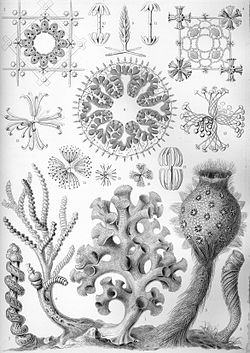
They are more-or-less cup-shaped animals, ranging from 10 to 30 centimetres (3.9 to 11.8 in) in height, with sturdy skeletons made of glass-like silica spicules, fused to form a lattice. In some glass sponges such as members of the genus Euplectela, these structures are aided by a protein called glassin. It helps accelerate the production of silicas from the silicic acid absorbed from the surrounding seawater. The body is relatively symmetrical, with a large central cavity that, in many species, opens to the outside through a sieve formed from the skeleton. Some species of glass sponges are capable of fusing together to create reefs or bioherms. They are generally pale in colour, ranging from white to orange.
Much of the body is composed of syncitial tissue, extensive regions of multinucleate cytoplasm. The epidermal cells characteristic of other sponges are absent, being replaced by a syncitial net of amoebocytes, through which the spicules penetrate. Unlike other sponges, they do not possess the ability to contract.
Their bodies comprises three parts: the inner and outer peripheral trabecular networks and the choanosome, which is used for feeding purposes. The choanosome acts as the mouth for the sponge while the inner and outer canals that meet at the choanosome are passages for the food, creating a consumption path for the sponge.
All hexactinellids have the potential to grow to different sizes, but the average maximum growth is estimated to be around 32 centimeters long. Some grow past that length and continue to extend their lengths up to 1 meter. The estimated life expectancy for hexactinellids that grow around 1 meter is approximately 200 years (Plyes).
Glass sponges possess a unique system for rapidly conducting electrical impulses across their bodies, making it possible for them to respond quickly to external stimuli. In the case Rhabdocalyptus dawsoni, the sponge uses electrical neuron signaling to detect outside stimuli, such as sediments, and then send a signal through its body system to alert the organism to no longer be actively feeding. Another glass sponge species in the same experiment of R. dawsoni showed that the electrical conduction system for this class of sponges has its own threshold of how much outside stimuli, sediments, etc., it can endure before it will stop its feeding process. Species like Venus' flower basket have a tuft of fibers that extends outward like an inverted crown at the bases of their skeletons. These fibers are 50 to 175 millimetres (2.0 to 6.9 in) long and about the thickness of a human hair.
Bodies of glass sponges are different from those of other sponges in various other ways. For example, most of their cytoplasm is not divided into separate cells by membranes, but forms a syncytium or continuous mass of cytoplasm with many nuclei (e.g., Reiswig and Mackie, 1983); it is held suspended like a cobweb by a scaffolding-like framework made of silica spicules. The remaining cells are connected to the syncytium by bridges of cytoplasmic "rivers" that transport nuclei, organelles, and other substances. Instead of choanocytes, these bridges have further syncytia, known as choanosyncytia, which form bell-shaped chambers where water enters via perforations. The insides of these chambers are lined with "collar bodies", each consisting of a collar and flagellum but without a nucleus of its own. The motion of the flagella sucks water through passages in the "cobweb" and expels it via the open ends of the bell-shaped chambers.
Hexactinellid
Hexactinellid sponges are sponges with a skeleton made of four- and/or six-pointed siliceous spicules, often referred to as glass sponges. They are usually classified along with other sponges in the phylum Porifera, but some researchers consider them sufficiently distinct to deserve their own phylum, Symplasma. Some experts believe that glass sponges are the longest-lived animals on earth; these scientists tentatively estimate a maximum age of up to 15,000 years.
Glass sponges are relatively uncommon and are mostly found at depths from 450 to 900 metres (1,480 to 2,950 ft) below sea level. Although the species Oopsacas minuta has been found in shallow water, others have been found much deeper. They are found in all oceans of the world, although they are particularly common in Antarctic and Northern Pacific waters.
They are more-or-less cup-shaped animals, ranging from 10 to 30 centimetres (3.9 to 11.8 in) in height, with sturdy skeletons made of glass-like silica spicules, fused to form a lattice. In some glass sponges such as members of the genus Euplectela, these structures are aided by a protein called glassin. It helps accelerate the production of silicas from the silicic acid absorbed from the surrounding seawater. The body is relatively symmetrical, with a large central cavity that, in many species, opens to the outside through a sieve formed from the skeleton. Some species of glass sponges are capable of fusing together to create reefs or bioherms. They are generally pale in colour, ranging from white to orange.
Much of the body is composed of syncitial tissue, extensive regions of multinucleate cytoplasm. The epidermal cells characteristic of other sponges are absent, being replaced by a syncitial net of amoebocytes, through which the spicules penetrate. Unlike other sponges, they do not possess the ability to contract.
Their bodies comprises three parts: the inner and outer peripheral trabecular networks and the choanosome, which is used for feeding purposes. The choanosome acts as the mouth for the sponge while the inner and outer canals that meet at the choanosome are passages for the food, creating a consumption path for the sponge.
All hexactinellids have the potential to grow to different sizes, but the average maximum growth is estimated to be around 32 centimeters long. Some grow past that length and continue to extend their lengths up to 1 meter. The estimated life expectancy for hexactinellids that grow around 1 meter is approximately 200 years (Plyes).
Glass sponges possess a unique system for rapidly conducting electrical impulses across their bodies, making it possible for them to respond quickly to external stimuli. In the case Rhabdocalyptus dawsoni, the sponge uses electrical neuron signaling to detect outside stimuli, such as sediments, and then send a signal through its body system to alert the organism to no longer be actively feeding. Another glass sponge species in the same experiment of R. dawsoni showed that the electrical conduction system for this class of sponges has its own threshold of how much outside stimuli, sediments, etc., it can endure before it will stop its feeding process. Species like Venus' flower basket have a tuft of fibers that extends outward like an inverted crown at the bases of their skeletons. These fibers are 50 to 175 millimetres (2.0 to 6.9 in) long and about the thickness of a human hair.
Bodies of glass sponges are different from those of other sponges in various other ways. For example, most of their cytoplasm is not divided into separate cells by membranes, but forms a syncytium or continuous mass of cytoplasm with many nuclei (e.g., Reiswig and Mackie, 1983); it is held suspended like a cobweb by a scaffolding-like framework made of silica spicules. The remaining cells are connected to the syncytium by bridges of cytoplasmic "rivers" that transport nuclei, organelles, and other substances. Instead of choanocytes, these bridges have further syncytia, known as choanosyncytia, which form bell-shaped chambers where water enters via perforations. The insides of these chambers are lined with "collar bodies", each consisting of a collar and flagellum but without a nucleus of its own. The motion of the flagella sucks water through passages in the "cobweb" and expels it via the open ends of the bell-shaped chambers.
Recent media
Recent media