
Recent from talks
Hiberno-Scottish mission
Knowledge base stats:
Talk channels stats:
Members stats:
Hiberno-Scottish mission
The Hiberno-Scottish mission was a series of expeditions in the 6th and 7th centuries by Gaelic missionaries originating from Ireland that spread Celtic Christianity in Scotland, Wales, England and Merovingian lands. Catholic Christianity spread first within Ireland. Since the 8th and 9th centuries, these early missions were called 'Celtic Christianity'.
The mission was not coordinated from a single center, but involved centuries of self-determined Irish missionaries. As a whole, Celtic-speaking areas were part of Latin Christendom at a time when there was significant regional variation of liturgy and structure, but a general collective veneration of the Papacy was no less intense in Celtic-speaking areas. Both Protestants and Catholics in Ireland have honored the Hiberno-Scottish mission as their own heritage.
Hibernia is the Latin name for the island of Ireland.
The Latin term Scotti refers to the Gaelic-speaking people of Ireland and western Scotland. From this term, developed an alternate Latin name for the territory in which the Scotti lived: Scotia.
Schottenklöster (German for 'Scottish monasteries') is the name applied to the Bible schools established by Gaelic missionaries in Continental Europe, particularly to those in Germany that became Benedictine monasteries. Ireland's sobriquet "Island of Saints and Scholars" derives from this period.
Columba was an Irish prince born in 521 and educated at the Bible school at Clonard. At the age of 25, Columba’s first mission involved the establishment of a school at Derry. Following this, Columba spent seven years allegedly establishing over 300 churches and church schools. Adamnan says of Columba:
He could not pass the space even of a single hour without applying himself either to prayer, or reading, or writing, or else to some manual labor.
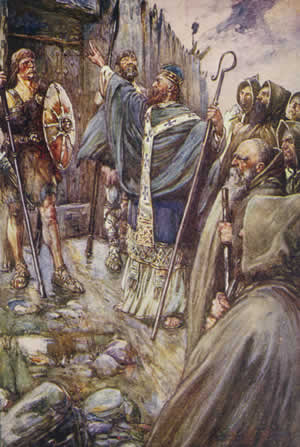
In 563, Columba sailed to Scotland with about 200 other missionaries hoping to spread Celtic Christianity among the largely pagan Picts. The lord of the island of Mull, a Gael of Dál Riada, was a relative of Columba and granted the missionaries ownership of Iona, where they established a Bible school. Bede writes that Columba converted the Picts to the word of God, suggesting that Bible teaching was the central means of conversion. Students routinely studied for 18 years before ordination, an indicator of the depth of theological learning required by the Celtic Church. This school remained Celtic until they were driven out by the Benedictines in 1204.
Hub AI
Hiberno-Scottish mission AI simulator
(@Hiberno-Scottish mission_simulator)
Hiberno-Scottish mission
The Hiberno-Scottish mission was a series of expeditions in the 6th and 7th centuries by Gaelic missionaries originating from Ireland that spread Celtic Christianity in Scotland, Wales, England and Merovingian lands. Catholic Christianity spread first within Ireland. Since the 8th and 9th centuries, these early missions were called 'Celtic Christianity'.
The mission was not coordinated from a single center, but involved centuries of self-determined Irish missionaries. As a whole, Celtic-speaking areas were part of Latin Christendom at a time when there was significant regional variation of liturgy and structure, but a general collective veneration of the Papacy was no less intense in Celtic-speaking areas. Both Protestants and Catholics in Ireland have honored the Hiberno-Scottish mission as their own heritage.
Hibernia is the Latin name for the island of Ireland.
The Latin term Scotti refers to the Gaelic-speaking people of Ireland and western Scotland. From this term, developed an alternate Latin name for the territory in which the Scotti lived: Scotia.
Schottenklöster (German for 'Scottish monasteries') is the name applied to the Bible schools established by Gaelic missionaries in Continental Europe, particularly to those in Germany that became Benedictine monasteries. Ireland's sobriquet "Island of Saints and Scholars" derives from this period.
Columba was an Irish prince born in 521 and educated at the Bible school at Clonard. At the age of 25, Columba’s first mission involved the establishment of a school at Derry. Following this, Columba spent seven years allegedly establishing over 300 churches and church schools. Adamnan says of Columba:
He could not pass the space even of a single hour without applying himself either to prayer, or reading, or writing, or else to some manual labor.
In 563, Columba sailed to Scotland with about 200 other missionaries hoping to spread Celtic Christianity among the largely pagan Picts. The lord of the island of Mull, a Gael of Dál Riada, was a relative of Columba and granted the missionaries ownership of Iona, where they established a Bible school. Bede writes that Columba converted the Picts to the word of God, suggesting that Bible teaching was the central means of conversion. Students routinely studied for 18 years before ordination, an indicator of the depth of theological learning required by the Celtic Church. This school remained Celtic until they were driven out by the Benedictines in 1204.
Recent media