Hubbry Logo
ColumbaColumbaMain
Open search
Columba
Community hub
Columba
logo
8 pages, 0 posts
0 subscribers
Be the first to start a discussion here.
Columba
Columba
from Wikipedia
Not found
Revisions and contributorsEdit on WikipediaRead on Wikipedia
from Grokipedia
Columba, known in Irish as Colmcille (c. 521–597), was an Irish abbot and missionary of royal descent from the Cenél Conaill branch of the Uí Néill dynasty, who founded the influential monastery on the Isle of Iona in 563 after his exile from Ireland. Born in Gartan, County Donegal, he established early monastic foundations in Ireland, including at Derry and Durrow, before departing amid political turmoil following the Battle of Cúl Dreimne in 561, traditionally linked to a dispute over copying a sacred manuscript. From Iona, under the patronage of Dál Riata king Áedán mac Gabráin, Columba directed evangelistic efforts that contributed to the Christianization of the Picts and Scots, notably through his audience with King Bridei son of Maelchon at Inverness, marking a pivotal step in supplanting pagan practices in northern Britain. His legacy, preserved primarily in Adomnán's late 7th-century Vita Columbae, encompasses not only monastic expansion—with daughter houses influencing sites like Lindisfarne—but also scholarly and poetic contributions, though hagiographic elements interweave verifiable missionary achievements with accounts of prophetic visions and miracles, reflecting the era's blend of history and legend. Columba died at Iona on 9 June 597, reportedly while transcribing a Psalter, and his cult rapidly elevated him to one of Ireland's three patron saints alongside Patrick and Brigid.

Early Life in Ireland

Birth and Ancestry

Columba, known in Irish as Colum Cille, was traditionally born on 7 521 at Gartan in , , a location associated with early monastic sites linked to his memory. This date and place derive primarily from hagiographical traditions recorded centuries later, such as in the 7th-century Vita Columbae by and medieval , with no surviving contemporary records to verify them precisely. Alternative estimates place his birth around 520 AD, reflecting the imprecision of early medieval dating methods reliant on regnal years and Easter tables. His father was Fedlimid (or Feidlimid), a member of the Cenél Conaill branch of the , a powerful Gaelic kindred claiming sovereignty over northwest . Fedlimid's lineage traced to Fergus Cenn nDéssi, positioning Columba as a great-great-grandson of (), the semi-legendary 5th-century and eponymous progenitor of the dynasties through whom multiple Irish royal lines asserted descent. Genealogical records, preserved in annals like the and synthetic histories such as the , support this connection, though they blend historical kin ties with mythic amplification to legitimize royal claims. Columba's mother, (or Ethne), belonged to a family of regional chieftains, possibly linked to the or other royals, conferring additional prestige that underscored his upbringing amid Ireland's aristocratic warrior-scholar class. This dual royal heritage from both parents aligned with the era's custom of monastic founders emerging from elite lineages, enabling Columba's later influence in ecclesiastical and political spheres without direct inheritance of kingship.

Education and Monastic Formation

Columba, born around 521 AD into the royal dynasty in Gartan, , demonstrated early aptitude for scholarship and clerical pursuits. After initial instruction in letters, likely under local priests including the cleric who baptized him, he entered monastic life in his youth. His formal monastic formation began at the school of Movilla (Magh Bile) in under Abbot Finnian, who had trained at Saint Ninian's Candida Casa in ; there, Columba advanced as a and received foundational training in ascetic discipline and scripture. Subsequently, Columba transferred to Clonard Abbey in , studying under another Finnian, a leading educator influenced by Welsh through figures like and . This center hosted up to 3,000 scholars, emphasizing rigorous scriptural study, prayer, and communal labor. Columba was ordained priest there, possibly by Bishop Etchen around 551 AD, and was reckoned among Finnian's "," a group including saints like Comgall and Brendan that later propagated monastic foundations across . At Clonard, he deepened his expertise in , , and possibly Latin and , preparing for his role as and , though traditions of additional bardic training under figures like Gemman remain unverified in primary accounts. This period solidified Columba's commitment to the Celtic monastic model, blending eremitic solitude with cenobitic community, manual work, and evangelistic zeal, distinct from continental Roman practices in its emphasis on peregrinatio (wandering pilgrimage) and familial clan structures within monasteries. By the mid-550s, having completed his formation, he began establishing his own monastic cells, such as at Derry and Durrow, applying the ascetic rigor learned under his mentors.

Early Scriptural and Scholarly Activities

Columba's early scriptural activities were rooted in the monastic tradition of studying and transcribing sacred texts to preserve and disseminate Christian doctrine . Following his education under figures such as Finnian of Clonard, he engaged in the laborious practice of copying manuscripts by hand, a cornerstone of early medieval scholarship that ensured the survival of Latin biblical works amid limited printing capabilities. This involved meticulous work with , inks derived from natural pigments, and quills, often in scriptoria where monks labored in silence to replicate texts like the and Gospels. A pivotal instance occurred during his time at Finnian of Movilla's , where Columba transcribed a from a valuable exemplar in the abbot's possession, producing what became known as the Cathach (Latin for "battler"). This , comprising 30:10 to 105:13 in an typical of the , exemplifies early Irish insular artistry with its distinctive lettering and lack of illumination in the surviving fragments. Retained by Columba rather than returned, it highlighted tensions over in an when books were scarce and labor-intensive artifacts, sometimes used as relics or talismans in battle. The Cathach endured as a of Columba's Cenél Conaill kin, encased in cumdachs (ornate shrines) by the , underscoring its dual role in devotion and identity. These endeavors reflected broader scholarly engagement, including potential composition of hymns and poetic reflections on scripture, though direct attributions remain uncertain due to oral traditions and later compilations. Adomnán's Vita Columbae, drawing from earlier testimonies, portrays Columba as profoundly versed in biblical lore from youth, with prophetic insights tied to scriptural meditation, yet prioritizes miraculous elements over detailed academic output. Such activities positioned him as a key figure in Ireland's nascent Christian intellectual culture, bridging learning with Gaelic before escalating disputes prompted his .

The Cul Dreimne Controversy and Exile

Dispute over the Cathach Psalter

The dispute originated when Columba, while associated with St. Finnian of Movilla Abbey, gained access to Finnian's —a containing the Book of Psalms—and produced an unauthorized copy for his own instructional purposes. Accounts describe Columba completing the transcription secretly, possibly at night under miraculous illumination, without Finnian's explicit consent to retain the duplicate. Upon discovering the copy, Finnian asserted ownership over both the original and the reproduction, demanding its surrender on the grounds that the duplicate diminished the value of his sole possession. Columba refused, arguing that knowledge ought to be disseminated freely, which escalated the matter into a formal legal confrontation. The conflict was arbitrated by Diarmait mac Cerbaill, the High King of Ireland circa 560, who ruled in Finnian's favor with the proverbial judgment: "Le gach bó a bóin, agus le gach leabhair a leabhair" ("To every cow belongs its calf, and to every book its copy"), affirming that the owner of the original held rights to any derivative. This Brehon law-inspired principle reflected early Irish emphases on proprietary integrity in tangible goods, though its application to manuscripts marked a novel extension. Columba's rejection of the verdict fueled subsequent tensions, but the copy he retained—later enshrined as the Cathach Psalter—survives as Ireland's oldest extant manuscript, dated paleographically to the late 6th century and housed at the Royal Irish Academy.

The Battle of Cul Dreimne

The Battle of Cúl Dreimhne, also known as the Battle of the Book, occurred in 561 AD in the of Cairpre Drom Cliabh, located in what is now , . It arose directly from the escalating dispute between Columba and Finnian of Movilla over ownership of a copied , after King ruled in Finnian's favor, decreeing that "to every cow its calf, and to every book its copy," thereby awarding the transcript to the original's owner. Columba, refusing to comply, invoked the support of his kin from the Cenél Conaill branch of the dynasty, mobilizing them against Diarmait's forces to assert control over the . The conflict pitted Columba's clan allies, leveraging their regional power in , against Diarmait's royal authority, which extended over multiple túatha in the Connacht-Leinster border area. Contemporary , such as the , record the battle's occurrence under the year 561, noting significant casualties without specifying sides, though later traditions attribute victory to Columba's faction. Estimates of deaths vary, with hagiographic accounts claiming around 3,000 lives lost, a figure likely inflated for dramatic effect in medieval narratives emphasizing the event's gravity. Adomnán's Vita Columbae, composed circa 697–700 AD, alludes to Columba's prophetic role in the battle—foreseeing victory through prayer and psalm recitation—but omits granular military details, reflecting its hagiographic focus on divine intervention rather than secular . This source, while invaluable for Columban tradition, blends miracle with fact, as Adomnán drew from earlier oral testimonies preserved at ; cross-referencing with annalistic entries confirms the battle's historicity but underscores interpretive biases toward portraying Columba as a divinely favored warrior-monk. The outcome secured Columba's possession of the copy, later venerated as the Cathach (a battle-book for the O'Donnell clan), yet it marked a turning point, amplifying calls for Columba's amid the bloodshed.

Self-Imposed Exile as Penance

Following the Battle of Cúl Dreimhne in approximately 561, traditional Irish hagiographic accounts describe Columba as experiencing profound remorse for the approximately 3,000 deaths attributed to the conflict over the Cathach Psalter. These narratives, drawing from later medieval traditions rather than contemporary records, portray him consulting his , the Molaise of Leighlin, who imposed a of perpetual from to atone for the bloodshed. The prescribed required Columba to depart his and evangelize among pagans, vowing to convert a number of souls equivalent to those lost in the battle—often specified as 3,000—to balance the scales of . This self-imposed exile is characterized in these sources as a voluntary act of peregrinatio pro Christo, a monastic pilgrimage for Christ's sake, though explicitly framed as in response to the violence. Primary by , Columba's ninth successor as abbot of (written c. 697–700), omits any direct causal link to the battle or explicit , instead presenting the departure as a divinely inspired missionary journey undertaken in Columba's 42nd year, around 563. 's account, based on earlier testimonies from monks, emphasizes Columba's prophetic visions and reluctance to leave only after assurances of fruitful labor abroad, suggesting the penitential motive emerged in retrospective Irish lore to reconcile his warrior-kin heritage with saintly ideals. Historians note this tradition's alignment with Irish monastic practices of voluntary for spiritual purification, but question its given the absence in and potential embellishment to elevate Columba's sanctity. In 563, Columba departed Ireland with twelve companions in a , a traditional wicker-framed boat covered in hides, sailing from the county of Donegal toward the Scottish coast. Initial landings in the Scottish mainland proved unsatisfactory, as Columba reportedly glimpsed Ireland's shores and felt drawn back; he then selected the Isle of , where visibility of his homeland was obstructed, fulfilling the exile's rigor. This choice underscored the penance's severity, severing ties to kin and clan amid Ireland's túatha (tribal) obligations, and marked the transition from Irish monastic founder to missionary pioneer in . The exile's success is later gauged in traditions by Columba's conversions among the and Scots, purportedly fulfilling the soul-for-soul redemption.

Mission to Scotland

Arrival and Establishment on Iona

In 563, Columba arrived on the island of in the with twelve companions, having sailed from in a small as part of his self-imposed exile following the Battle of Cúl Dreimhne. The group first made landfall in the territory of , possibly at Dunaverty in , before proceeding to , which offered isolation suitable for monastic life amid the Gaelic-speaking population already partially Christianized. The island was granted to Columba by Conall mac Comgaill, king of (r. c. 558–574), a kinsman who provided territorial support for the settlement, as recorded in associating the donation with the monastery's foundation. This grant positioned Iona strategically on the frontier between and Pictish territories, facilitating missionary outreach while securing autonomy under royal patronage. Columba promptly established a monastic community on , constructing initial timber structures including a church, , and cells, governed by a rule emphasizing , scriptural study, and evangelization modeled on Irish traditions. Adomnán's Vita Columbae, composed c. 697–700 by Iona's ninth , portrays the site as divinely chosen, with Columba envisioning its future prominence despite its modest scale, though the hagiographic account prioritizes miracles over administrative details. The rapidly became a hub for copying manuscripts and training missionaries, laying foundations for Celtic Christianity's expansion into northern Britain, though early records note tensions with local druidic practices.

Encounters with Pictish King Brude

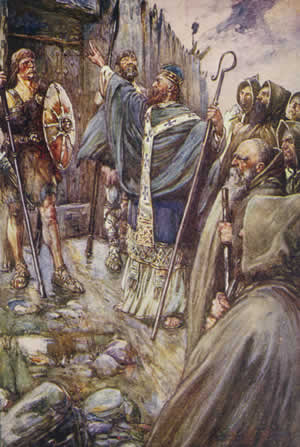
Columba's initial encounter with Bridei mac Maelchon, king of the , took place shortly after the establishment of in 563 AD, likely around 565 AD, as he journeyed inland from the to the Pictish royal stronghold near . According to Adomnán's Vita Columbae (composed c. 697–700 AD), the missionary required interpreters to communicate with the Pictish court, reflecting linguistic barriers between Gaelic speakers and the Picts, whose language remains undeciphered but distinct from Irish. Upon arrival, Bridei, described as haughty in his royal pride, initially refused to open the fortress gates to Columba and his companions, but after the saint made the and blessed the entrance, the gate's bolt reportedly withdrew of its own accord, allowing entry. During this visit, Columba engaged with Bridei's foster-father and chief , Broichan, who practiced pagan and held a Gaelic bondwoman captive; recounts Columba prophesying and demanding her release, followed by a miraculous that compelled compliance when Broichan hesitated. These interactions, framed in 's hagiographical narrative, portray Columba asserting Christian authority over Pictish , though the text does not explicitly state that Bridei converted to —only that the king showed respect and permitted activity among the . Later traditions, such as Bede's Ecclesiastical History (c. 731 AD), amplify this to claim Columba successfully converted Bridei and his northern Pictish subjects from , possibly drawing on Pictish oral accounts or Iona's evolving legacy rather than 's more restrained report. Subsequent encounters are implied through ongoing relations, including Columba's reputed role in securing safe passage for missionaries and establishing churches in Pictish territories with royal sanction, though primary evidence remains confined to Adomnán's miracle-laden anecdotes without corroboration from contemporary Pictish records or . The royal fort's , possibly Craig Phadrig hillfort overlooking the , aligns with descriptions of proximity to the River Ness, where Adomnán also places a separate involving a water beast. Historians note that while these accounts from Adomnán, an abbot over a century removed, privilege causation, the encounters likely reflect real diplomatic efforts amid Pictish-Scot tensions, with Christianity's spread among the occurring gradually post-Columba rather than as an immediate royal endorsement.

Initial Conversions and Challenges

Following the establishment of the Iona monastery in 563, Columba directed initial missionary efforts toward the Gaelic-speaking kingdom of , where cultural and linguistic ties to facilitated early acceptance among elites; King Conall mac Comgall's grant of the island itself reflects this patronage, enabling baptisms and the integration of Christian practices into local lordships. Adomnán's Vita Columbae records Columba baptizing individuals and households in peripheral regions, such as the pagan Emchath in Glen Urquhart (near ), who converted with his son before death, marking one of the documented early Pictish-area conversions. Among the , conversions proceeded unevenly; describes Columba blessing a harmful spring in Pictland, rendering it potable and prompting local adherence to , alongside the persuasion of peasant families through direct intervention. These accounts, however, blend hagiographical elements with plausible missionary outreach, as empirical evidence for widespread baptism remains limited to monastic traditions rather than independent chronicles. Bede's Ecclesiastical credits Columba with solidifying faith among the northern Irish ( Scots) but notes Pictish persistence in paganism until the eighth century, suggesting Iona's role was foundational yet indirect for Picts. Key challenges included druidic antagonism, as Adomnán recounts opposition near King Brude's fortress where pagan priests attempted to silence Columba's psalmody, reflecting broader ritual rivalries. Linguistic differences required interpreters for Pictish Brittonic speakers, hindering unmediated preaching, while entrenched customs and sporadic hostility from non-elite pagans—evident in tales of wicked plunderers defying monastic authority—compounded isolation in rugged terrain. Despite these, Iona's strategic position across the enabled gradual expansion, with daughter houses emerging by the late sixth century to sustain outreach.

Monastic Foundations and Daily Life

Structure of Iona Abbey

The monastery founded by Columba on in AD 563 consisted of modest, perishable structures centered around a timber-built oratory serving as the focal point for communal and . Surrounding this were individual monks' cells, simple huts constructed from wattle-and-daub walls with thatched roofs, accommodating Columba and his initial twelve companions in a clustered, village-like arrangement typical of early Celtic monastic sites. Archaeological evidence, including postholes from excavations, confirms the use of timber frameworks for these buildings, with no stone constructions surviving from the due to the materials' impermanence. The site was demarcated by a vallum—a defensive boundary formed by earthen banks flanking a deep —enclosing the core monastic area and distinguishing it from surrounding farmland and grazing lands. A key feature was Columba's personal cell at Tòrr an Aba (the "mound of the abbot"), a wattle-and-timber reinforced with stakes, radiocarbon-dated to AD 540–650 through analysis of charcoal samples, aligning precisely with his lifetime (AD 521–597). This structure, likely used for private , study, and possibly manuscript work such as the Cathach Psalter, exemplifies the austere, functional design of early cells, emphasizing seclusion within the communal setting. Communal facilities were rudimentary, inferred from broader Celtic traditions to include open spaces for manual labor, scriptoria for copying texts, and guesthouses for visitors, all integrated without the later enclosed of Benedictine abbeys. Fragments of early medieval window glass from excavations suggest some sophistication in glazing for illumination, challenging assumptions of entirely primitive construction. The overall layout prioritized spiritual discipline over architectural grandeur, fostering a self-sustaining reliant on , , and craftsmanship.

Expansion to Daughter Monasteries

Under Columba's oversight from , several daughter monasteries were established in to propagate monastic and among the Gaelic and Pictish populations. These foundations, often small communities or hermitages under Iona's , included sites on Hinba—an island likely near Mull or in the —where Columba personally directed the construction of a church and monastic settlement, serving as a primary outpost for retreats and missionary activities. Adomnán's Vita Columbae, drawing from earlier testimonies, describes Columba's visits to Hinba for prayer and governance, emphasizing its role as a key extension of Iona's rule. Another significant daughter house was Mag Lunge (or Mag Luinge) on the Isle of , placed under the leadership of Baithéne, Columba's close kin and eventual successor as of . This site functioned as a coastal hermitage and base, facilitating outreach to western Scottish islands and mainland kin-groups. 's monastery supported copying of manuscripts and ascetic practices aligned with 's traditions, though it remained subordinate in the emerging Columban federation. While primary expansion focused on to consolidate influence post-563 arrival, Columba maintained ties to Irish foundations like Durrow (Dairmag), traditionally attributed to his founding around 553–556 before , which later integrated into Iona's oversight network through familial and regulatory links. These daughter houses collectively numbered fewer than a dozen under direct Columban control during his lifetime, prioritizing spiritual formation over territorial dominance, as evidenced by Adomnán's accounts of delegated abbots and shared relics. Expansion relied on appointments and voluntary ascetic migration, fostering a decentralized yet unified monastic system resistant to secular interference.

Monastic Rule and Practices

The monastic community established by Columba on Iona in 563 AD adhered to the ascetic traditions of early Irish Christianity, emphasizing communal living under the authority of an abbot without a formal written rule attributed directly to Columba himself. Practices drew from broader Celtic monasticism, which integrated rigorous prayer, manual labor, scriptural study, and obedience as pathways to spiritual discipline and evangelization, reflecting a peregrinatio pro Christo ethos of voluntary exile for Christ's sake. Adomnán's Vita Columbae, composed around 697–700 AD, portrays these as fostering a holy community oriented toward heavenly reward, with Columba modeling fervent prayer and oversight of monks' duties. Daily routines centered on the , including nocturnal vigils in the church, psalmody—Columba's voice reportedly audible at a distance during recitation—and regular celebration of the . Monks engaged in physical labor such as fishing, farming, harvesting, building structures, and gathering materials, balancing (prayer and work) to sustain the self-sufficient of approximately 12 initial companions expanding into a hierarchical structure with roles like priors, stewards, and attendants. Scriptural transcription and teaching formed intellectual pursuits, preserving learning amid ascetic isolation. Obedience to the was paramount, with prompt adherence to commands—such as preparing voyages or guest quarters—enforced as a core discipline; disobedience invited rebuke, and visions or revelations were prohibited from disclosure during Columba's lifetime to maintain communal focus. involved , isolation, or extended terms like seven or twelve years for grave sins, underscoring causal links between personal sanctification and communal holiness. extended to pilgrims and , often interrupting fasts, highlighted Iona's role as a hub blending enclosure with outreach. These practices influenced daughter houses across and , prioritizing ascetic rigor over institutional uniformity, though later medieval developments introduced more formalized rules. Adomnán's account, while hagiographical, aligns with archaeological evidence of Iona's early timber-and-thatch cells and oratory, supporting a austere, evangelistic distinct from continental Benedictine models.

Attributed Writings and Intellectual Contributions

Poetry and Hymns

Several Latin hymns are traditionally ascribed to Columba, though their direct authorship remains uncertain and is subject to scholarly debate, with some analyses suggesting composition by his immediate successors or later Ionan scribes in the seventh century. The most prominent is the Altus Prosator ("Tall Creator"), an comprising 23 stanzas, each commencing with a successive letter of the Latin alphabet from A to X (skipping W, Y, Z as absent in ). This work extols the Trinity's unity, recounts creation from nothing, and culminates in eschatological themes of and , emphasizing God's eternity and : "Altus Prosator, vetustissimus / Exxistus, sine origine dierum, / A principio sine principio" ("High Creator, most ancient / Existing, without origin of days, / Without beginning from the beginning"). Manuscripts preserving it date from the eighth to eleventh centuries, linking it to Iona's tradition. Another attributed Latin hymn is Adiutor Laborantium ("Helper of the Toiling"), also and structured in alphabetic stanzas, invoking divine aid for laborers and pilgrims while praising Christ's redemptive work. It reflects monastic themes of toil and , with lines such as pleas for amid daily struggles. Tradition credits Columba with its composition, possibly for liturgical use at , but like Altus Prosator, it survives in later medieval copies without contemporary verification. In addition to Latin works, Irish Gaelic poems are ascribed to Columba, underscoring his filid (bardic poet) training in . One such is the farewell verse Columcille cecinit (or "In exile"), expressing poignant attachment to his homeland upon departing for around 563: lines evoke tears for Derry and longing for 's hills, blending personal exile with spiritual resolve. Another, set on , conveys contentment in isolation—"Delightful to me the salty sea, that I might gaze upon "—portraying the island's rocky solitude as a site for and divine encounter. These Gaelic attributions, preserved in and later collections like the Liber Hymnorum, align with hagiographical accounts of Columba's poetic gifts but lack firm dating, potentially incorporating later interpolations. Overall, these works highlight Columba's synthesis of metrics with Celtic oral traditions, influencing early medieval hymnody despite attribution challenges.

Manuscript Tradition and the Book of Kells Question

The manuscript tradition associated with Columba emphasizes his reputation as a prolific during his lifetime (c. 521–597 AD), with hagiographical accounts claiming he personally copied as many as 300 codices, including scriptural texts and liturgical works, which contributed to the dissemination of Christian writings in early medieval and . This tradition is rooted in contemporary and near-contemporary sources like Adomnán's Vita Columbae (composed c. 697–700 AD), which portrays Columba laboring over manuscripts by candlelight or , underscoring the monastic emphasis on scriptoria as centers of learning and piety. However, direct attribution of surviving manuscripts to Columba's hand remains speculative, as paleographic analysis identifies early Insular majuscule script in relics from his era, but definitive authorship requires corroboration beyond legend. The Cathach of St. Columba, an incomplete containing 30:13 to 105:13 in a Gallican version, represents the earliest surviving Irish manuscript potentially linked to him, dated paleographically to the late 6th or early . Tradition holds that Columba transcribed it hastily in one night from a volume lent by St. Finnian of Movilla, illuminated by a miraculous , sparking a property dispute that legendarily precipitated his exile to in 563 AD; this narrative, recorded in 16th-century sources like Manus O'Donnell's Betha Colaim Chille, served to sacralize the artifact as a talismanic "battler" (cathach) for the O'Donnell , preserved in a cumdach from the . Scholarly consensus views the Cathach as originating from Columba's monastic circle, exemplifying proto-Insular script's development, though its exact —possibly Derry or another Irish foundation—highlights the challenges in verifying personal authorship amid the era's oral-hagiographical transmission. The "Book of Kells Question" pertains to longstanding claims associating the renowned 9th-century illuminated Gospel codex (Codex Cenannensis) with Columba, often dubbed the "Book of Columba" in medieval inventories, despite radiocarbon and stylistic evidence dating its production to c. 800 AD, over two centuries after his death. This manuscript, featuring intricate Celtic knotwork and evangelist portraits in Latin Vulgate text, emerged from the Columban monastic network—likely initiated at , which Columba founded in 563 AD, before relocation to Kells amid Viking raids c. 806–814 AD—reflecting the artistic and scribal legacy of his familia rather than direct involvement. The earliest documented link appears in an 1007 AD reference to the "Great Gospel of Colum Cille," preserved in , suggesting retrospective attribution to enhance the monastery's prestige, a common hagiographical practice; modern analysis attributes its script and illumination to a collaborative effort by Irish-Scottish monks, with influences from continental models, but rejects Columba's personal authorship due to chronological impossibility and the absence of 6th-century precedents for such opulent decoration. This question illustrates tensions between pious tradition and empirical , where monastic claims of apostolic continuity bolstered institutional authority amid post-Roman cultural fragmentation.

Influence on Celtic Learning

The monastery founded by Columba on in 563 AD transplanted the Irish monastic tradition of education, which prioritized Latin literacy, theological study, and scribal activity, into the Scottish and Pictish contexts. This model, drawn from Columba's prior training under figures like Finnian of Movilla and Finnian of Clonard, emphasized communal learning within a equipped for copying texts on wax tablets and , fostering a community skilled in Scripture and ecclesiastical writings. Iona rapidly emerged as a pivotal hub for Celtic scholarship, training who preserved Christian knowledge through manuscript production and served as educators in affiliated houses. Successor abbots, such as Baithen (d. 600 AD), renowned for his deep scriptural expertise, upheld this focus, while (abbot c. 679–704 AD) exemplified its fruits by composing the Vita Columbae (c. 697–700 AD), a hagiographical yet scholarly text drawing on earlier records to document Columba's life and 's intellectual milieu. This influence radiated outward, with Iona-educated missionaries like (d. 651 AD) establishing similar learning centers at in 635 AD, where monastic education integrated Celtic practices of rigorous study and evangelism, aiding the Christianization of and sustaining textual traditions amid Viking disruptions starting in 795 AD. Iona's role thus bolstered the broader Celtic Christian network's capacity to maintain literacy and doctrinal continuity in an era of fragmented European scholarship.

Miracles, Prophecies, and Hagiographical Accounts

Key Miracles from Adomnán's Vita

Adomnán's Vita Columbae, composed around 697–700 CE by the ninth abbot of , organizes miracles attributed to Columba into Book II under miracula virtutum, emphasizing divine power manifested in control over , , and adversarial forces. These accounts, purportedly based on eyewitness testimonies from earlier sources like Cumméne's lost vita and Iona's oral traditions, number over 80 episodes aimed at monastic edification and establishing Columba's sanctity. A widely recounted miracle occurs during Columba's visit to the Pictish king Bridei, when a swimmer named Lugne Mocumin was attacked by a water beast in the River Ness. From the riverbank, Columba invoked the cross and commanded the creature to "go no more" harm, causing it to retreat submerged beneath the brethren and heathens present, who then crossed safely. As a youth serving under Bishop Findbarr in Ireland, Columba is said to have transformed spring water into wine for Mass when sacramental wine ran short, an act observed by the bishop and attending ministers during a festival. Columba blessed a poisonous venerated by , neutralizing its lethality and enabling it to cure ailments, despite opposition from local druids; his companions and the heathens witnessed the spring's subsequent healing properties. In maritime contexts, Columba's prayers reportedly calmed a violent storm threatening sailors, instantly stilling the waves, and directed favorable winds for separate voyages by monks Baithene and Columban on the same day. Healing miracles include dispatching blessed water from to restore a woman's shattered thigh in , allowing her to walk and live another 23 years, and providing fire-surviving salt that cured a woman's when applied. Other interventions encompass expelling a from an unblessed milk pail, refilling it abundantly for the youth Columban, and accelerating a late-sown corn harvest in to ripen weeks early, averting famine for peasant Findchan and neighbors. These narratives, while central to Adomnán's portrayal of Columba as an apostolic figure, reflect hagiographical conventions prioritizing spiritual exemplars over empirical verification, with no contemporary non-ecclesiastical sources attesting the events.

Prophetic Visions and Claims

Adomnán's Vita Columbae, composed around 697 AD, devotes its first book to Columba's prophetic revelations, portraying him as possessing foresight into future events, human fates, and divine interventions. These accounts, drawn from oral traditions and earlier writings preserved at , include predictions of battles, personal destinies, and natural phenomena, often verified by subsequent occurrences as reported by witnesses. Supernatural elements feature prominently, such as visions of angels and luminous manifestations, emphasizing Columba's with heavenly realms. Specific prophecies encompassed foreknowledge of individual deaths and life spans. For instance, Columba predicted that one boy, the son of Meldan, would die within a week, while another, Ernan son of Glasderc, would live to see his grandchildren; both outcomes materialized as stated. He foretold the sudden death of Feradach before the man could consume prepared swine flesh in autumn, which occurred precisely as the individual reached for the food. Similarly, Columba prophesied the demise of a plunderer named Joan and his crew in a between the islands of Malean and Colosus after they disregarded him, with the event transpiring that same day. Columba's visions extended to angelic presences and protections. Witnesses reported seeing him pray amid a multitude of angels in white robes on 's western plain, an event that led to the site being named Cnoc Angel. He commanded an angel to rescue a falling from a building in Derry, demonstrating supernatural intervention that prevented injury. During on Hinba, observers including St. Brenden beheld a column of fiery light descending upon Columba's head, persisting through the consecration. Angels were also depicted escorting souls, as when Columba envisioned them bearing Brito's soul heavenward immediately after his death on . Prophetic insights into larger events included military outcomes and environmental signs. Columba foresaw King Aidan's victory in the Battle of the Miathi, specifying the slaying of 303 enemies, which aligned with the reported results. He envisioned the destruction of a Roman city by sulphurous , later corroborated by Gallican sailors who described thousands perishing in the calamity. Regarding natural forces, Columba predicted calm seas enabling St. Cainnech's arrival despite contrary winds, and favorable winds for separate voyages by Baithene and Columban, both fulfilling his words through prayer-induced changes. He blessed , prophesying that no poisonous reptiles would harm inhabitants who adhered to Christ's commandments, a claim tied to the island's reputed absence of such creatures. Columba's self-referential prophecies highlighted his anticipated departure. He revealed visions of angels prepared to convey his soul after thirty years in Britain, delayed by four years due to intercessory prayers, culminating in signs at his passing, including a pillar of . These hagiographical narratives, while attributing divine , rely on Adomnán's compilation of testimonies from Columba's contemporaries and successors.

Historical Skepticism and Alternative Explanations

Scholars approach the accounts in Adomnán's Vita Columbae with considerable skepticism, viewing them as conventional hagiographic devices rather than verifiable historical events. Composed around 697, over a century after Columba's death in 597, the text organizes its content into thematic books on prophecies, miracles of power, and visions, primarily to establish Columba's credentials as a worthy of and to bolster the prestige of 's monastic community amid contemporary ecclesiastical rivalries. This structure prioritizes edification over chronology, drawing on earlier compilations like Cumméne's lost Book of Virtues (c. 660s), but lacks independent corroboration from secular annals, which record Columba's foundational role at Iona in 563 yet omit any miraculous feats. The miracles, such as healings, storm-calming, and bi-location, align closely with biblical precedents and continental saints' lives, like those of , indicating literary emulation to confer "continental status" on Columba rather than eyewitness reportage. Prophetic visions, including foreknowledge of battles or deaths, are typically explained by historians as retrospective attributions—events retrofitted to Columba's reputation—or as shrewd political insights amplified through oral transmission, given the abbot's documented involvement in Irish-Pictish . Angelic encounters and resurrections, meanwhile, reflect ascetic ideals of monastic purity but strain credulity absent empirical traces, such as archaeological evidence of extraordinary phenomena at or associated sites. Alternative naturalistic interpretations predominate in rigorous analysis: healings may stem from psychosomatic recovery, herbal remedies, or effects common in pre-modern ; environmental events like sudden weather shifts could be coincidental and mythologized; and the famed "water beast" expulsion—often linked to lore—likely incorporates indigenous Pictish folklore of river guardians, repurposed to symbolize Christianity's dominion over . These narratives, while rooted in genuine traditions about Columba's missionary zeal, served institutional aims, including cult promotion during Viking incursions (post-795) and disputes over Roman vs. Celtic church practices, as evidenced by Adomnán's own De Locis Sanctis aligning Iona with broader . Such embellishments, typical of early medieval vitae, underscore the text's value for over literal biography, with source credibility tempered by its devotional bias and generational distance from events.

Death and Succession

Final Days and Prophecy of Death

In the weeks preceding his death, Columba experienced a vision foretelling his departure, as recorded in Adomnán's Vita Columbae, composed around 697 based on accounts from earlier witnesses including Failbe, Columba's immediate successor as . Adomnán attributes to Columba a that his would occur after completing fifty years of labor in Britain, aligning with the year 597, when Columba was approximately 76 years old. This prediction, relayed through the saint's conversations with attendants, emphasized a peaceful passing rather than through battle or misfortune, consistent with hagiographical motifs emphasizing divine foreknowledge but lacking independent corroboration beyond monastic tradition. On Saturday, June 8, 597—the eve of —Columba, sensing his end imminent, walked to the western granary of the monastery, where he blessed the stored grain against future scarcity and took symbolic leave of his , which reportedly neighed in sorrow. Returning to the , he continued transcribing a , completing the verse from (Vulgate): "They that trust in the Lord shall be as Mount Sion," before declaring the task unfinished due to impending interruption. describes Columba then proceeding to the church for evening , where he prostrated himself before the altar, emerging to bless the assembled monks from the doorway with arms outstretched, invoking perpetual unity and divine favor upon the community. That evening, supported by his attendant Diarmait, Columba returned to his hut, where weakness overtook him. recounts a final vision in which Columba perceived angelic hosts descending to escort his , initially delayed by demonic opposition but ultimately prevailing, prompting the saint's exclamation of at their . At midnight on June 9, as the monks chanted the 33rd Psalm in the church, Columba expired peacefully in Diarmait's arms, his face reportedly radiant. The observed a pillar of rising from the church, interpreted as a sign, though notes this as from the brethren, subject to the interpretive lens of seventh-century monastic . Columba's body was prepared for , with fulfilled in the absence of violence or , underscoring the Vita's portrayal of a sanctified culmination to his missionary life.

Burial and Immediate Successors

Columba died on Saturday, June 9, 597 AD, at the monastery of Iona, shortly after completing his final circuit of the island and blessing its inhabitants from the church bell tower. According to Adomnán's Vita Sancti Columbae, composed circa 697–700 AD by the ninth abbot of Iona, Columba passed away in his small hut adjacent to the monastic church, surrounded by his monks; his body was then carried into the church amid communal mourning, where it remained until burial two days later on June 11. The burial occurred in the monastic cemetery known as Reilig Òdhrain (Oran's Cemetery), located near the abbey church on Iona, in accordance with Columban monastic tradition; this site, established early in Columba's tenure, served as the primary resting place for the community's abbots and monks. Adomnán's account, drawing on earlier oral testimonies from Columba's contemporaries, emphasizes the saint's peaceful death and the monks' veneration of his remains, though as a hagiographical text, it incorporates supernatural elements such as visions preceding the event. Columba's immediate successor as abbot was Baithéne mac Brénainn, his cousin, foster-son, and devoted disciple, whom records as having been designated by Columba himself during his final days to ensure continuity of leadership. Baithéne, who had served as prior of the daughter monastery on Hinba, assumed the abbacy in 597 AD and led for approximately three years until his death in 600 AD, maintaining the strict ascetic discipline and missionary focus established by Columba. Following Baithéne's passing, the abbacy passed to Conin mac Conaill (600–624 AD), a kinsman from the Cenél Conaill lineage, under whom the continued to expand its influence across the Pictish and Scottish territories despite emerging tensions with Roman ecclesiastical practices. This early succession pattern, as analyzed in historical studies of Columban institutions, favored familial ties within the kindred to preserve doctrinal and administrative coherence, though it later contributed to regional fragmentation of the familia Columbae. Viking raids beginning in 795 AD eventually necessitated the relocation of Columba's relics to and for safekeeping, but the original burial site on retained symbolic importance as a center.

Legacy and Historical Assessment

Spread of Christianity in Scotland

Saint Columba arrived on the island of in AD 563, establishing a that served as the primary base for Christian activity among the Scots of and the in northern Britain. Invited by King Conall mac Comgaill of , Columba's community on quickly grew into a center for , training monks who extended Christian influence inland and northward. Archaeological evidence, including early Christian burials and inscribed stones on dated to the late 6th century, supports the monastery's role as an institutional hub for the faith's dissemination. A pivotal event in the conversion of the occurred around AD 565, when Columba traveled to the royal fort of King Bridei mac Maelchon near , as recorded in Adomnán's Vita Columbae (composed circa AD 697). Despite initial Pictish and linguistic barriers—requiring interpreters—Columba secured Bridei's favor, obtaining royal permission to preach and establish missions throughout Pictish territories. The Vita portrays this encounter as foundational, with Bridei allegedly granting land for a church at Ongul (possibly near ), though hagiographical elements, such as miracle accounts, suggest embellishment to emphasize Columba's apostolic authority. Independent corroboration is limited, but later Pictish king lists and Bede's Ecclesiastical History (AD 731) affirm Columba's association with the dynasty's , aligning the with the by the . From , Columban missionaries founded daughter houses, such as those at Kingarth on Bute and Abernethy in Pictland, facilitating the integration of into local elites by the early . This network promoted monastic learning, Latin , and ascetic practices distinct from emerging Roman influences, sustaining Gaelic in until the of Birr (AD 697) and beyond. While pre-existing Christian pockets existed from St. Ninian's 5th-century missions in southern Pictland, Columba's efforts catalyzed widespread adoption among northern , evidenced by the proliferation of Class I symbol stones incorporating Christian motifs post-600 AD. Adomnán's account, drawing from earlier testimonies, underscores Iona's enduring prestige, though modern historians caution that Columba's direct conversions were likely modest compared to institutional legacies.

Political and Cultural Influence

Saint Columba exerted political influence through diplomatic engagements with regional rulers in 6th-century , particularly the kings of and the . He secured a grant for the establishment of the monastery from Conall mac Comgall, king of , around 563 AD, enabling a stable base for missionary activities in territories contested between Irish Gaels and . Adomnán's Vita Columbae, composed circa 700 AD, portrays Columba advising and blessing , Conall's successor, prior to military campaigns, suggesting a role in legitimizing 's expansion, though these accounts blend hagiographical elements with historical diplomacy. Columba's encounter with Bridei mac Maelchon, king of the , occurred around 565 AD near , possibly at Craig Phadrig fort, where he reportedly persuaded the king to permit Christian preaching among the . While claims Bridei's conversion, Pictish king lists and Bede's Ecclesiastical History (completed 731 AD) echo this influence but lack independent corroboration beyond monastic traditions, indicating pragmatic alliances rather than miraculous persuasion; Bridei tolerated Iona's monks for potential administrative and cultural benefits. This engagement helped integrate Christian elements into Pictish governance without disrupting tribal sovereignties, as Columba respected local kings' authority. Culturally, Columba's foundation propagated Irish monastic traditions, fostering characterized by eremitic practices, vernacular liturgy, and communal scholarship distinct from Roman norms. The monastery served as a preserving Gaelic manuscripts and training missionaries who extended influence to and the , embedding Christian motifs in emerging identity. By the , 's abbots mediated church synods, shaping ecclesiastical structures amid Gaelic-Pictish interactions, though later Romanizing reforms diminished its unique Insular character. Columba's legacy thus bridged pagan Celtic customs with , promoting literacy and moral codes that influenced medieval Scottish kingship and law.

Scholarly Debates on Historicity and Impact

Scholars widely accept the of Columba as a 6th-century Irish who founded the monastery on around 563 CE, based on 's Vita Columbae (composed c. 697–700 CE) and corroborating references in Bede's Ecclesiastical History of the (completed 731 CE). , as ninth of , drew from earlier written records and eyewitness testimonies preserved at the monastery, providing a framework for Columba's exile from amid clan conflicts, his establishment of as a base for activity among the Scotti of , and his death on June 9, 597 CE. However, the Vita's extensive narratives—such as Columba's prophetic visions, exorcisms, and nature miracles—prompt debate over its reliability as a , with critics arguing these elements serve hagiographical purposes to exalt Iona's founder and legitimize the monastery's authority rather than report empirical events. Skepticism intensifies regarding specific episodes, including Columba's audience with Pictish king Bridei mac Maelchon (r. c. 554–584 CE) at his fort near , described in the Vita as a tense encounter where Columba's allegedly secured royal tolerance for preaching. While the meeting's occurrence aligns with broader 6th-century Gaelic-Pictish interactions evidenced in and king lists, the supernatural claims (e.g., Columba banishing a water monster) are dismissed by secular historians as accretions, potentially retrojected to symbolize Christian triumph over . Bede's account diverges, portraying Columba's mission as focused on northern while attributing southern Pictish conversion to an earlier Irish cleric, suggesting Adomnán may have amplified Columba's role to counter rival narratives from . Some scholars, noting Adomnán's access to Iona's archives, defend a historical kernel in these tales, interpreting as stylized reports of charismatic influence or natural phenomena rationalized through monastic . Academic tendencies to prioritize naturalistic explanations may reflect broader secular biases in , undervaluing the worldview where divine intervention was presumed causal in early medieval conversions. On impact, consensus holds that Columba's catalyzed the entrenchment of Celtic in Gaelic , training missionaries who established daughter houses across and beyond, fostering literacy, scriptural preservation, and ecclesiastical structures that endured until the 12th-century diocesan reforms. Yet debates persist over his direct role in Pictish : the Vita claims foundational influence via Bridei, but archaeological and textual evidence indicates pre-existing Christian contacts in southern Pictland by the mid-6th century, with widespread adoption occurring gradually under Columba's successors and Roman-influenced missions post-663 . Politically, Columba's depicted interventions—such as anointing Aidan mac Gabráin as king of c. 574 CE—highlight monastic leverage in royal succession, but historians caution that such prophetic authority likely exaggerates Iona's retrospective self-positioning amid 7th-century power struggles. Quantitatively, Iona's produced artifacts like high crosses and gospel books, influencing , though claims of Columba as "Apostle of the " or fail rigorous scrutiny, as persisted in northern regions until the . Overall, Columba's legacy lies more in institutionalizing ascetic, eremitical suited to peripheral kingdoms than in mass conversions, with his impact amplified by Adomnán's text as a tool for Iona's continental .

Modern Veneration and Criticisms

Saint Columba remains venerated in the Catholic Church, Eastern Orthodox Church, and Anglican Communion, with his feast day observed on June 9 annually. Celebrations include masses, processions, and cultural events, as seen in Derry, Northern Ireland, where 2024 festivities featured community gatherings and a principal Mass at St. Eugene's Cathedral attended by hundreds. In Scotland, the 2021 quincentennial of his birth prompted national commemorations, including exhibitions at Historic Environment Scotland sites highlighting his role in Gaelic monasticism. He is invoked as patron saint of poets, reflecting traditions of his own versification in Irish lore. Pilgrimages to , site of his founded in 563, persist as a focal point of devotion, drawing thousands yearly for spiritual retreats organized by the ecumenical . Weekly guided pilgrimages traverse the island's sacred sites, emphasizing reflection amid its natural isolation, with programs incorporating Celtic spirituality, meditation, and communal worship. These modern practices blend with contemporary , though attendance surged post-2021 anniversary events. Criticisms of Columba's veneration arise primarily from secular and Protestant perspectives, which dismiss hagiographic accounts in Adomnán's Vita Columbae (c. 700) as embellished legends lacking empirical corroboration, prioritizing verifiable monastic foundations over supernatural claims. Some scholars and commentators highlight contradictions in his legacy, portraying him not solely as a pacific evangelist but as a clan warrior exiled after the 561 Battle of Cúl Dreimne, where his side's victory reportedly cost 3,000 lives, challenging idealized narratives of early Christian . Post-Reformation Protestant traditions curtailed saint cults, viewing devotions like relic veneration—historically tied to Columba's remains on until their 849 dispersal—as superstitious, a stance echoed in modern evangelical critiques of Catholic practices. Academic sources, often from institutions with secular leanings, further question the causal extent of his personal influence on Pictish conversions, attributing broader to gradual socio-political shifts rather than individual apostolic feats.

References

Add your contribution
Related Hubs
User Avatar
No comments yet.