
Recent from talks
History of Central Asia
Knowledge base stats:
Talk channels stats:
Members stats:
History of Central Asia
The history of Central Asia concerns the history of the various peoples that have inhabited Central Asia. The lifestyle of such people has been determined primarily by the area's climate and geography. The aridity of the region makes agriculture difficult and distance from the sea cut it off from much trade. Thus, few major cities developed in the region. Nomadic horse peoples of the steppe dominated the area for millennia.
Relations between the steppe nomads and the settled people in and around Central Asia were marked by conflict. The nomadic lifestyle was well suited to warfare, and the steppe horse riders became some of the most militarily potent people in the world, due to the devastating techniques and ability of their horse archers. Periodically, tribal leaders or changing conditions would cause several tribes to organize themselves into a single military force, which would then often launch campaigns of conquest, especially into more 'civilized' areas. A few of these types of tribal coalitions included the Huns' invasion of Europe, various Turkic migrations into Transoxiana and most notably the Mongol conquest of much of Eurasia.
The dominance of the nomads ended in the 16th century as firearms allowed settled people to gain control of the region. The Russian Empire, the Qing dynasty of China, and other powers expanded into the area and seized the bulk of Central Asia by the end of the 19th century. After the Russian Revolution of 1917, the Soviet Union incorporated most of Central Asia; only Mongolia and Afghanistan remained nominally independent, although Mongolia existed as a Soviet satellite state and Soviet troops invaded Afghanistan in the late 20th century. The Soviet areas of Central Asia saw much industrialization and construction of infrastructure, but also the suppression of local cultures and a lasting legacy of ethnic tensions and environmental problems.
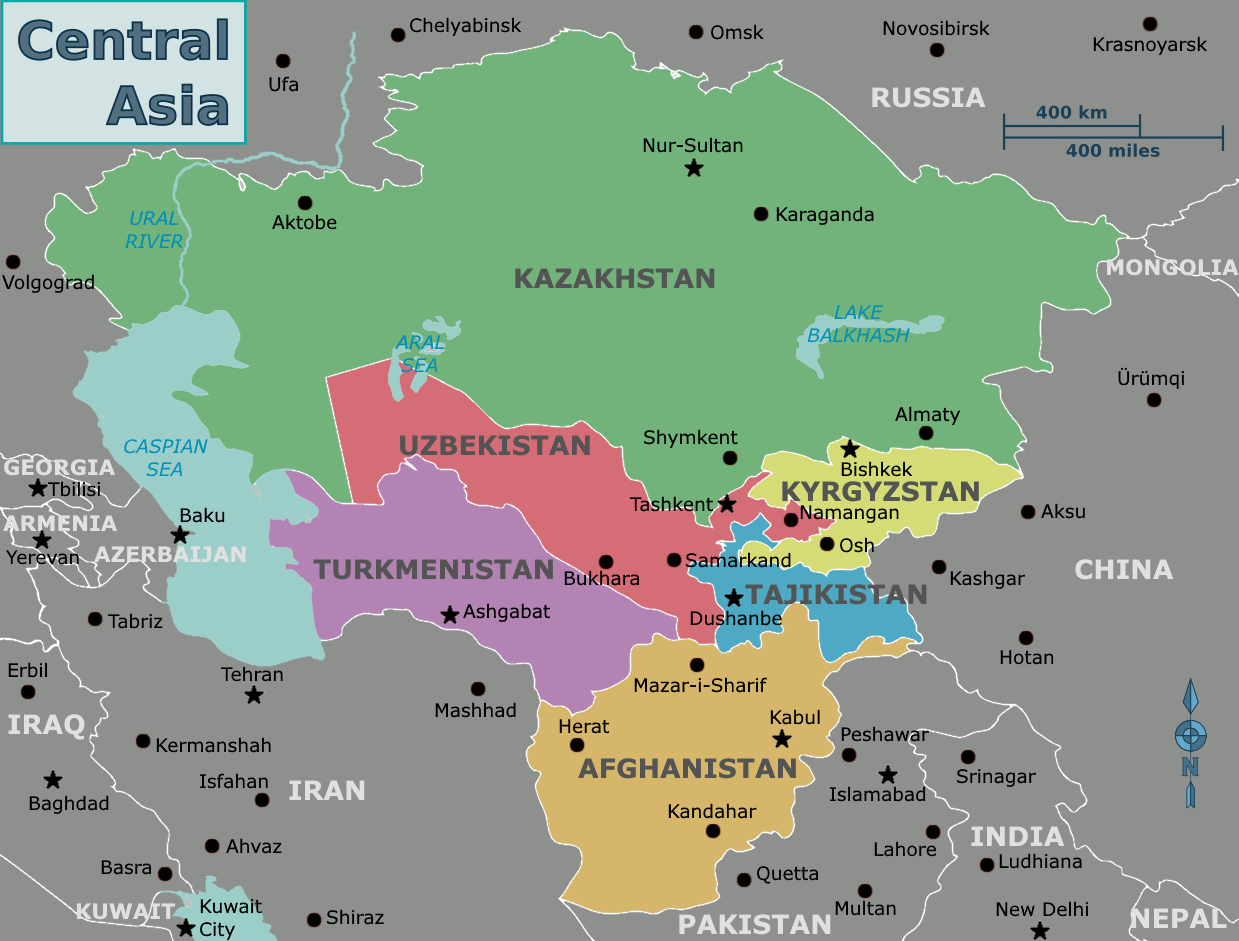
With the collapse of the Soviet Union in 1991, five Central Asian countries gained independence — Kazakhstan, Uzbekistan, Turkmenistan, Kyrgyzstan, and Tajikistan. In all of the new states, former Communist Party officials retained power as local strongmen, with the partial exception of Kyrgyzstan which, despite ousting three post-Soviet presidents in popular uprisings, has as yet been unable to consolidate a stable democracy.
Homo sapiens reached Central Asia by 50,000 to 40,000 years ago. The Tibetan Plateau is thought to have been reached by 38,000 years ago. The currently oldest modern human sample found in northern Central Asia, is a 45,000-year-old remain, which was genetically closest to ancient and modern East Asians, but his lineage died out quite early.
Paleolithic Central Asia was characterized by a distinctive but deeply European-related population (Ancient North Eurasian), with subsequent geneflow from Paleo-Siberians, contributing East Asian-related ancestry towards Paleolithic Central Asians. During the Bronze Age, ancient Central Asia received various migration events from Europe and the Middle East, associated with Indo-Europeans. Bronze Age Central Asia consisted largely of Iranian peoples, with some groups being of Paleo-Siberian and Samoyedic (Uralic) origin. Since the early Iron Age, Central Asia received noteworthy amounts of migration from East Asian-related populations, and became increasingly diverse. The Turkic peoples slowly replaced and assimilated the previous Iranian-speaking locals, turning the population of Central Asia from largely Iranian, into primarily of East Asian descent. Modern Central Asians are characterized by both West-Eurasian and East-Eurasian ancestry, with the majority being of primarily East Asian ancestry, and can be linked to expanding Turkic peoples outgoing from Mongolia and Northeast Asia.
The term Ceramic Mesolithic is used of late Mesolithic cultures of Central Asia, during the 6th to 5th millennia BC (in Russian archaeology, these cultures are described as Neolithic even though farming is absent). It is characterized by its distinctive type of pottery, with point or knob base and flared rims, manufactured by methods not used by the Neolithic farmers. The earliest manifestation of this type of pottery may be in the region around Lake Baikal in Siberia. It appears in the Elshan or Yelshanka or Samara culture on the Volga in Russia by about 7000 BC. and from there spread via the Dnieper-Donets culture to the Narva culture of the Eastern Baltic.
The Botai culture (c. 3700–3100 BC) is suggested to be the earliest culture to have domesticated the horse. The four analyzed Botai samples had about 2/3 European-related and 1/3 East Asian-related ancestry. The Botai samples also showed high affinity towards the Mal'ta boy sample in Siberia.
Hub AI
History of Central Asia AI simulator
(@History of Central Asia_simulator)
History of Central Asia
The history of Central Asia concerns the history of the various peoples that have inhabited Central Asia. The lifestyle of such people has been determined primarily by the area's climate and geography. The aridity of the region makes agriculture difficult and distance from the sea cut it off from much trade. Thus, few major cities developed in the region. Nomadic horse peoples of the steppe dominated the area for millennia.
Relations between the steppe nomads and the settled people in and around Central Asia were marked by conflict. The nomadic lifestyle was well suited to warfare, and the steppe horse riders became some of the most militarily potent people in the world, due to the devastating techniques and ability of their horse archers. Periodically, tribal leaders or changing conditions would cause several tribes to organize themselves into a single military force, which would then often launch campaigns of conquest, especially into more 'civilized' areas. A few of these types of tribal coalitions included the Huns' invasion of Europe, various Turkic migrations into Transoxiana and most notably the Mongol conquest of much of Eurasia.
The dominance of the nomads ended in the 16th century as firearms allowed settled people to gain control of the region. The Russian Empire, the Qing dynasty of China, and other powers expanded into the area and seized the bulk of Central Asia by the end of the 19th century. After the Russian Revolution of 1917, the Soviet Union incorporated most of Central Asia; only Mongolia and Afghanistan remained nominally independent, although Mongolia existed as a Soviet satellite state and Soviet troops invaded Afghanistan in the late 20th century. The Soviet areas of Central Asia saw much industrialization and construction of infrastructure, but also the suppression of local cultures and a lasting legacy of ethnic tensions and environmental problems.
With the collapse of the Soviet Union in 1991, five Central Asian countries gained independence — Kazakhstan, Uzbekistan, Turkmenistan, Kyrgyzstan, and Tajikistan. In all of the new states, former Communist Party officials retained power as local strongmen, with the partial exception of Kyrgyzstan which, despite ousting three post-Soviet presidents in popular uprisings, has as yet been unable to consolidate a stable democracy.
Homo sapiens reached Central Asia by 50,000 to 40,000 years ago. The Tibetan Plateau is thought to have been reached by 38,000 years ago. The currently oldest modern human sample found in northern Central Asia, is a 45,000-year-old remain, which was genetically closest to ancient and modern East Asians, but his lineage died out quite early.
Paleolithic Central Asia was characterized by a distinctive but deeply European-related population (Ancient North Eurasian), with subsequent geneflow from Paleo-Siberians, contributing East Asian-related ancestry towards Paleolithic Central Asians. During the Bronze Age, ancient Central Asia received various migration events from Europe and the Middle East, associated with Indo-Europeans. Bronze Age Central Asia consisted largely of Iranian peoples, with some groups being of Paleo-Siberian and Samoyedic (Uralic) origin. Since the early Iron Age, Central Asia received noteworthy amounts of migration from East Asian-related populations, and became increasingly diverse. The Turkic peoples slowly replaced and assimilated the previous Iranian-speaking locals, turning the population of Central Asia from largely Iranian, into primarily of East Asian descent. Modern Central Asians are characterized by both West-Eurasian and East-Eurasian ancestry, with the majority being of primarily East Asian ancestry, and can be linked to expanding Turkic peoples outgoing from Mongolia and Northeast Asia.
The term Ceramic Mesolithic is used of late Mesolithic cultures of Central Asia, during the 6th to 5th millennia BC (in Russian archaeology, these cultures are described as Neolithic even though farming is absent). It is characterized by its distinctive type of pottery, with point or knob base and flared rims, manufactured by methods not used by the Neolithic farmers. The earliest manifestation of this type of pottery may be in the region around Lake Baikal in Siberia. It appears in the Elshan or Yelshanka or Samara culture on the Volga in Russia by about 7000 BC. and from there spread via the Dnieper-Donets culture to the Narva culture of the Eastern Baltic.
The Botai culture (c. 3700–3100 BC) is suggested to be the earliest culture to have domesticated the horse. The four analyzed Botai samples had about 2/3 European-related and 1/3 East Asian-related ancestry. The Botai samples also showed high affinity towards the Mal'ta boy sample in Siberia.
Recent media