
Recent from talks
History of the Tesla coil
Knowledge base stats:
Talk channels stats:
Members stats:
History of the Tesla coil
Nikola Tesla patented the Tesla coil circuit on April 25, 1891. and first publicly demonstrated it May 20, 1891 in his lecture "Experiments with Alternate Currents of Very High Frequency and Their Application to Methods of Artificial Illumination" before the American Institute of Electrical Engineers at Columbia College, New York. Although Tesla patented many similar circuits during this period, this was the first that contained all the elements of the Tesla coil: high voltage primary transformer, capacitor, spark gap, and air core "oscillation transformer".
From Tesla's time until the 1930s Tesla coils were widely used in radio transmitters, quack electrotherapy, and experiments in wireless power transmission, and more recently in movies and show business.
During the Industrial Revolution the electrical industry exploited direct current (DC) and low frequency alternating current (AC), but not much was known about frequencies above 20 kHz, what are now called radio frequencies. In 1887, four years previously, Heinrich Hertz had discovered Hertzian waves (radio waves), electromagnetic waves which oscillated at very high frequencies. This attracted much attention, and a number of researchers began experimenting with high frequency currents.
Tesla's background was in the new field of alternating current power systems, so he understood transformers and resonance. In 1888 he decided that high frequencies were the most promising field for research, and set up a laboratory at 33 South Fifth Avenue, New York for researching them, initially repeating Hertz's experiments.
He first developed alternators as sources of high frequency current, but by 1890 found they were limited to frequencies of about 20 kHz. In search of higher frequencies he turned to spark-excited resonant circuits. Tesla's innovation was in applying resonance to transformers. Transformers functioned differently at high frequencies than at the low frequencies used in power systems; the iron core in low frequency transformers caused energy losses due to eddy currents and hysteresis. Tesla and Elihu Thomson independently developed a new type of transformer without an iron core, the "oscillation transformer", and the Tesla coil circuit to drive it to produce high voltages.
Tesla invented the Tesla coil during efforts to develop a "wireless" lighting system, with gas discharge light bulbs that would glow in an oscillating electric field from a high voltage, high frequency power source. For a high frequency source Tesla powered a Ruhmkorff coil (induction coil) with his high frequency alternator. He found that the core losses due to the high frequency current overheated the iron core in the Ruhmkorff coil and melted the insulation between the primary and secondary windings. To fix this problem Tesla changed the design so that there was an air gap instead of insulating material between the windings, and made the iron core adjustable so it could be moved in or out of the coil He eventually found the highest voltages could be produced when the iron core was omitted. Tesla also found he needed to put the capacitor normally used in the Ruhmkorff circuit between his alternator and the coil's primary winding to avoid burning out the coil. By adjusting the coil and capacitor Tesla found he could take advantage of the resonance set up between the two to achieve even higher frequencies. He found that the highest voltages were generated when the "closed" primary circuit with the capacitor was in resonance with the "open" secondary winding.
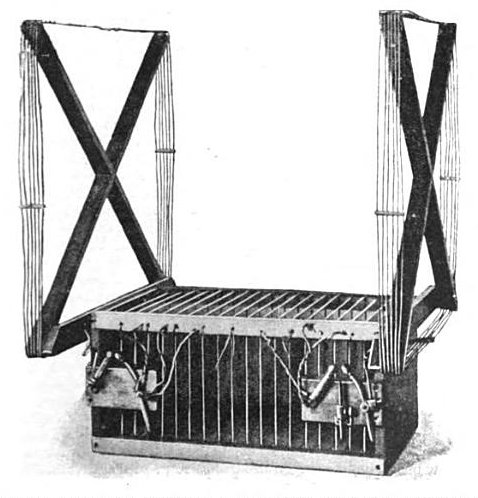
Tesla was not the first to invent this circuit. Henry Rowland built a spark-excited resonant transformer circuit (above) in 1889 and Elihu Thomson had experimented with similar circuits in 1890, including one which could produce 64 inch (1.6 m) sparks, and other sources confirm Tesla was not the first. However he was the first to see practical applications for it and patent it. Tesla did not perform detailed mathematical analyses of the circuit, relying instead on trial and error and his intuitive understanding of resonance. He even realized that the secondary coil functioned as a quarter-wave resonator; he specified the length of the wire in the secondary coil must be a quarter wavelength at the resonant frequency. The first mathematical analyses of the circuit were done by Anton Oberbeck (1895) and Paul Drude (1904).
A charismatic showman and self-promoter, in 1891-1893 Tesla used the Tesla coil in dramatic public lectures demonstrating the new science of high voltage, high frequency electricity. The radio frequency AC electric currents produced by a Tesla coil did not behave like the DC or low frequency AC current scientists of the time were familiar with. In lectures at Columbia College May 20, 1891, scientific societies in Britain and France during an 1892 European speaking tour, the Franklin Institute, Philadelphia in February 1893, and the National Electric Light Association, St. Louis in March 1893, he impressed audiences with spectacular brush discharges and streamers, heated iron by induction heating, showed RF current could pass through insulators and be conducted by a single wire without a return path, and powered light bulbs and motors without wires. He demonstrated that high frequency currents often did not cause the sensation of electric shock, applying hundreds of thousands of volts to his own body, causing his body to light up with a glowing corona discharge in the darkened room. These lectures introduced the "Tesla oscillator" to the scientific community, and made Tesla internationally famous.
Hub AI
History of the Tesla coil AI simulator
(@History of the Tesla coil_simulator)
History of the Tesla coil
Nikola Tesla patented the Tesla coil circuit on April 25, 1891. and first publicly demonstrated it May 20, 1891 in his lecture "Experiments with Alternate Currents of Very High Frequency and Their Application to Methods of Artificial Illumination" before the American Institute of Electrical Engineers at Columbia College, New York. Although Tesla patented many similar circuits during this period, this was the first that contained all the elements of the Tesla coil: high voltage primary transformer, capacitor, spark gap, and air core "oscillation transformer".
From Tesla's time until the 1930s Tesla coils were widely used in radio transmitters, quack electrotherapy, and experiments in wireless power transmission, and more recently in movies and show business.
During the Industrial Revolution the electrical industry exploited direct current (DC) and low frequency alternating current (AC), but not much was known about frequencies above 20 kHz, what are now called radio frequencies. In 1887, four years previously, Heinrich Hertz had discovered Hertzian waves (radio waves), electromagnetic waves which oscillated at very high frequencies. This attracted much attention, and a number of researchers began experimenting with high frequency currents.
Tesla's background was in the new field of alternating current power systems, so he understood transformers and resonance. In 1888 he decided that high frequencies were the most promising field for research, and set up a laboratory at 33 South Fifth Avenue, New York for researching them, initially repeating Hertz's experiments.
He first developed alternators as sources of high frequency current, but by 1890 found they were limited to frequencies of about 20 kHz. In search of higher frequencies he turned to spark-excited resonant circuits. Tesla's innovation was in applying resonance to transformers. Transformers functioned differently at high frequencies than at the low frequencies used in power systems; the iron core in low frequency transformers caused energy losses due to eddy currents and hysteresis. Tesla and Elihu Thomson independently developed a new type of transformer without an iron core, the "oscillation transformer", and the Tesla coil circuit to drive it to produce high voltages.
Tesla invented the Tesla coil during efforts to develop a "wireless" lighting system, with gas discharge light bulbs that would glow in an oscillating electric field from a high voltage, high frequency power source. For a high frequency source Tesla powered a Ruhmkorff coil (induction coil) with his high frequency alternator. He found that the core losses due to the high frequency current overheated the iron core in the Ruhmkorff coil and melted the insulation between the primary and secondary windings. To fix this problem Tesla changed the design so that there was an air gap instead of insulating material between the windings, and made the iron core adjustable so it could be moved in or out of the coil He eventually found the highest voltages could be produced when the iron core was omitted. Tesla also found he needed to put the capacitor normally used in the Ruhmkorff circuit between his alternator and the coil's primary winding to avoid burning out the coil. By adjusting the coil and capacitor Tesla found he could take advantage of the resonance set up between the two to achieve even higher frequencies. He found that the highest voltages were generated when the "closed" primary circuit with the capacitor was in resonance with the "open" secondary winding.
Tesla was not the first to invent this circuit. Henry Rowland built a spark-excited resonant transformer circuit (above) in 1889 and Elihu Thomson had experimented with similar circuits in 1890, including one which could produce 64 inch (1.6 m) sparks, and other sources confirm Tesla was not the first. However he was the first to see practical applications for it and patent it. Tesla did not perform detailed mathematical analyses of the circuit, relying instead on trial and error and his intuitive understanding of resonance. He even realized that the secondary coil functioned as a quarter-wave resonator; he specified the length of the wire in the secondary coil must be a quarter wavelength at the resonant frequency. The first mathematical analyses of the circuit were done by Anton Oberbeck (1895) and Paul Drude (1904).
A charismatic showman and self-promoter, in 1891-1893 Tesla used the Tesla coil in dramatic public lectures demonstrating the new science of high voltage, high frequency electricity. The radio frequency AC electric currents produced by a Tesla coil did not behave like the DC or low frequency AC current scientists of the time were familiar with. In lectures at Columbia College May 20, 1891, scientific societies in Britain and France during an 1892 European speaking tour, the Franklin Institute, Philadelphia in February 1893, and the National Electric Light Association, St. Louis in March 1893, he impressed audiences with spectacular brush discharges and streamers, heated iron by induction heating, showed RF current could pass through insulators and be conducted by a single wire without a return path, and powered light bulbs and motors without wires. He demonstrated that high frequency currents often did not cause the sensation of electric shock, applying hundreds of thousands of volts to his own body, causing his body to light up with a glowing corona discharge in the darkened room. These lectures introduced the "Tesla oscillator" to the scientific community, and made Tesla internationally famous.
Recent media