
Recent from talks
Nazi salute
Knowledge base stats:
Talk channels stats:
Members stats:
Nazi salute
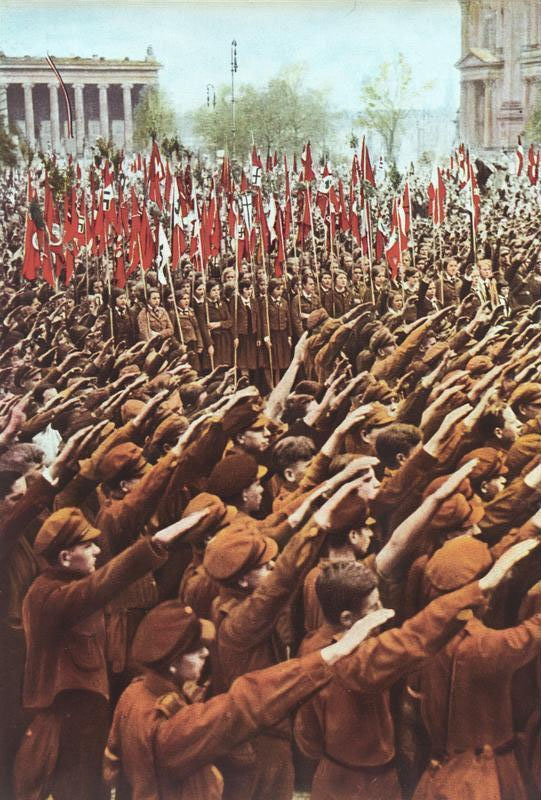
The Nazi salute, also known as the Hitler salute, or the Sieg Heil salute, is a gesture that was used as a greeting in Nazi Germany. The salute is performed by raising and extending the right arm forward at an upward angle with a straightened hand, fingers together, and palm facing downward. The salute is usually accompanied by a cry of "Heil Hitler!" ('Hail Hitler!'), "Heil, mein Führer!" ('Hail, my leader!'), or "Sieg Heil!" ('Hail victory!').
Inspired by the Fascist salute used by members of the Italian National Fascist Party, the Nazi salute was officially adopted by the Nazi Party in 1926, although it had been used within the party as early as 1921 to signal obedience to the party's leader, Adolf Hitler, and to glorify the German nation (and later the German war effort). The salute was mandatory for civilians but mostly optional for military personnel, who retained a traditional military salute until the failed assassination attempt on Hitler on 20 July 1944.
Use of this salute is illegal in modern-day Germany (Strafgesetzbuch section 86a), Austria, and Slovakia. The use of any Nazi phrases associated with the salute is also forbidden. In Italy, it is a criminal offence only if used with the intent to "reinstate the defunct National Fascist Party", or to exalt or promote its ideology or members. In Canada and most of Europe (including the Czech Republic, France, the Netherlands, Sweden, Switzerland, the United Kingdom, Ukraine, and Russia), displaying the salute is not in itself a criminal offence, but constitutes hate speech if used for propagating the Nazi ideology. In Australia, publicly performing the salute is illegal unless for a religious, academic, educational, artistic, literary, or scientific purpose.
The salute was executed by extending the right arm stiff to an upward 45° angle and then straightening the hand so that it is parallel to the arm. Usually, an utterance of "Sieg Heil", "Heil Hitler!", or "Heil!" accompanied the gesture. If one saw an acquaintance at a distance, it was enough to simply raise the right hand. If one encountered a superior, one would also say "Heil Hitler". If physical disability prevented raising the right arm, it was acceptable to raise the left.
Hitler gave a right-armed salute with variations. He used the typical stiff-armed salute when reviewing his troops or when facing crowds, but sometimes held at more of a right angle. To return a salute, he raised his arm with the elbow bent back and his palm facing up.
The spoken greeting "Heil" became popular in the pan-German movement around 1900. It was used by the followers of Georg Ritter von Schönerer, head of the Austrian Alldeutsche Partei ('Pan-German Party') who considered himself leader of the Austrian Germans, and who was described by Carl E. Schorske as "The strongest and most thoroughly consistent anti-Semite that Austria produced" before the coming of Hitler. Hitler took both the "Heil" greeting – which was popularly used in his "hometown" of Linz when he was a boy – and the title of "Führer" for the head of the Nazi Party from Schönerer, whom he admired.
The extended arm saluting gesture was alleged to be based on an ancient Roman custom, but no known Roman work of art depicts it, nor does any extant Roman text describe it. Historians have instead determined that the gesture originated from Jacques-Louis David's 1784 painting Oath of the Horatii, which displayed a raised arm salutatory gesture in an ancient Roman setting. The gesture and its identification with ancient Rome was advanced in other French neoclassic art.
In 1892, Francis Bellamy introduced the United States Pledge of Allegiance to the country and its national flag, which was to be accompanied by a visually similar salute. Following the introduction of the Nazi salute, the salute was replaced in 1942 by a hand-over-the-heart gesture to be used by civilians during the Pledge of Allegiance and the national anthem. A raised arm gesture was then used in the 1899 American stage production of Ben-Hur, and its 1907 film adaptation. The gesture was further elaborated upon in several early Italian films. Of special note was the 1914 silent film Cabiria, whose screenplay had contributions from the Italian ultra-nationalist Gabriele d'Annunzio, arguably a forerunner of Italian Fascism. In 1919, when he led the occupation of Fiume, d'Annunzio used the style of salute depicted in the film as a neo-Imperialist ritual and the Italian Fascist Party quickly adopted it.
Hub AI
Nazi salute AI simulator
(@Nazi salute_simulator)
Nazi salute
The Nazi salute, also known as the Hitler salute, or the Sieg Heil salute, is a gesture that was used as a greeting in Nazi Germany. The salute is performed by raising and extending the right arm forward at an upward angle with a straightened hand, fingers together, and palm facing downward. The salute is usually accompanied by a cry of "Heil Hitler!" ('Hail Hitler!'), "Heil, mein Führer!" ('Hail, my leader!'), or "Sieg Heil!" ('Hail victory!').
Inspired by the Fascist salute used by members of the Italian National Fascist Party, the Nazi salute was officially adopted by the Nazi Party in 1926, although it had been used within the party as early as 1921 to signal obedience to the party's leader, Adolf Hitler, and to glorify the German nation (and later the German war effort). The salute was mandatory for civilians but mostly optional for military personnel, who retained a traditional military salute until the failed assassination attempt on Hitler on 20 July 1944.
Use of this salute is illegal in modern-day Germany (Strafgesetzbuch section 86a), Austria, and Slovakia. The use of any Nazi phrases associated with the salute is also forbidden. In Italy, it is a criminal offence only if used with the intent to "reinstate the defunct National Fascist Party", or to exalt or promote its ideology or members. In Canada and most of Europe (including the Czech Republic, France, the Netherlands, Sweden, Switzerland, the United Kingdom, Ukraine, and Russia), displaying the salute is not in itself a criminal offence, but constitutes hate speech if used for propagating the Nazi ideology. In Australia, publicly performing the salute is illegal unless for a religious, academic, educational, artistic, literary, or scientific purpose.
The salute was executed by extending the right arm stiff to an upward 45° angle and then straightening the hand so that it is parallel to the arm. Usually, an utterance of "Sieg Heil", "Heil Hitler!", or "Heil!" accompanied the gesture. If one saw an acquaintance at a distance, it was enough to simply raise the right hand. If one encountered a superior, one would also say "Heil Hitler". If physical disability prevented raising the right arm, it was acceptable to raise the left.
Hitler gave a right-armed salute with variations. He used the typical stiff-armed salute when reviewing his troops or when facing crowds, but sometimes held at more of a right angle. To return a salute, he raised his arm with the elbow bent back and his palm facing up.
The spoken greeting "Heil" became popular in the pan-German movement around 1900. It was used by the followers of Georg Ritter von Schönerer, head of the Austrian Alldeutsche Partei ('Pan-German Party') who considered himself leader of the Austrian Germans, and who was described by Carl E. Schorske as "The strongest and most thoroughly consistent anti-Semite that Austria produced" before the coming of Hitler. Hitler took both the "Heil" greeting – which was popularly used in his "hometown" of Linz when he was a boy – and the title of "Führer" for the head of the Nazi Party from Schönerer, whom he admired.
The extended arm saluting gesture was alleged to be based on an ancient Roman custom, but no known Roman work of art depicts it, nor does any extant Roman text describe it. Historians have instead determined that the gesture originated from Jacques-Louis David's 1784 painting Oath of the Horatii, which displayed a raised arm salutatory gesture in an ancient Roman setting. The gesture and its identification with ancient Rome was advanced in other French neoclassic art.
In 1892, Francis Bellamy introduced the United States Pledge of Allegiance to the country and its national flag, which was to be accompanied by a visually similar salute. Following the introduction of the Nazi salute, the salute was replaced in 1942 by a hand-over-the-heart gesture to be used by civilians during the Pledge of Allegiance and the national anthem. A raised arm gesture was then used in the 1899 American stage production of Ben-Hur, and its 1907 film adaptation. The gesture was further elaborated upon in several early Italian films. Of special note was the 1914 silent film Cabiria, whose screenplay had contributions from the Italian ultra-nationalist Gabriele d'Annunzio, arguably a forerunner of Italian Fascism. In 1919, when he led the occupation of Fiume, d'Annunzio used the style of salute depicted in the film as a neo-Imperialist ritual and the Italian Fascist Party quickly adopted it.
Recent media