
Recent from talks
Hollywood Hotel
Knowledge base stats:
Talk channels stats:
Members stats:
Hollywood Hotel
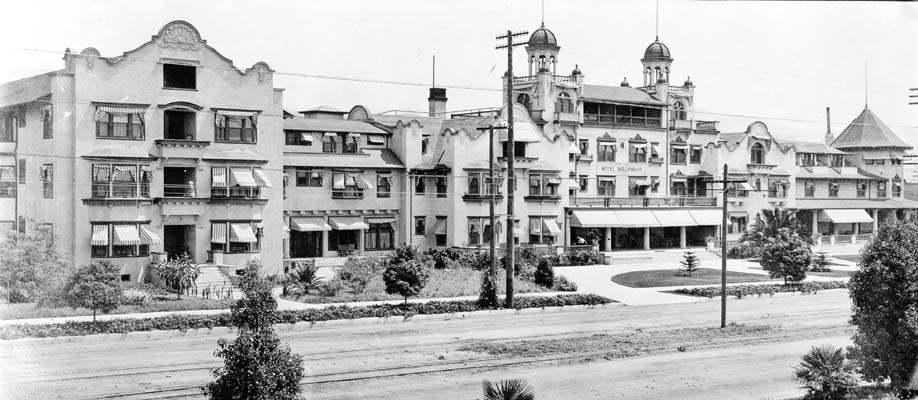
The Hollywood Hotel was a famous hotel, society venue of early Hollywood landmark, formerly located at 6811 Hollywood Boulevard, on the north side, extending from Highland Avenue to Orchid Avenue, in central Hollywood, Los Angeles, California.
The Hollywood Hotel opened in December 1902. It was designed and built by Lyman Farwell and Oliver Perry Dennis for early Hollywood developer H.J. Whitley, to support selling residential lots to potential buyers arriving from Los Angeles by the electric Balloon Route trolley of the Los Angeles Pacific Railroad. It was developed on property owned by Harrison Gray Otis, George Hoover, and Whitley. Located on the west side of Highland Avenue, the elegant wood structure with Mission Revival style stucco facades and broad verandas also fronted unpaved Prospect Avenue, lined with California pepper trees. The hotel was sited among lemon groves and then at the base of the Hollywood Hills, part of the Santa Monica Mountains in the area. Whitley was instrumental in improvements to Prospect Avenue, which in 1910 was renamed Hollywood Boulevard. Increasing business compelled the building of an additional 40-room wing onto the hotel in 1905.
Whitley surrounded the hotel with 3 acres (1.2 ha) of cultivated gardens. He operated the establishment as a country resort hotel as the developing community of Hollywood first established itself.
In 1906 the heiress Almira Hershey, who was then living in a mansion on Bunker Hill in Downtown Los Angeles, took a buggy ride to see the hotel that was being advertised in the Los Angeles Times. She was so impressed with the Hollywood Hotel she decided to buy it. She hired Margaret J. Anderson who had worked for her at the Darby and the Fremont Hotels, which Hershey owned, as manager. Under Anderson's management, the hotel expanded from 16 rooms to 250 and became well known in the area, but the two women had a contentious relationship and Anderson left to move to the Beverly Hills Hotel in 1912.
The fame of the Hollywood Hotel, like that of Hollywood, came from its identification with the Hollywood movie industry, beginning in the 1910s. Those who stayed at the hotel included Jesse Lasky, Carl Laemmle, Louis B. Mayer, Harry Warner, and Irving Thalberg. Producers, directors, writers and technicians held conferences on the broad verandas.
There was a 'stream' of silent film movie stars and movie moguls passing through. Some of the movie industry people resided in the hotel, and many attended the dances held on Thursday nights in the ballroom. It was considered "the" place to be seen and the cultural center of Hollywood. To identify where certain people regularly sat to dine, the hotel had stars with the names of celebrities painted on the ceiling above their tables.
Among the scores of movie stars who stayed at the Hollywood Hotel through the years was Rudolph Valentino, who lived in room 264. He met his first wife, Jean Acker, in the hotel, where they were married in 1919 and spent their honeymoon. Other stars included Ethel Barrymore, Norma Shearer, and Valentino's second wife Natasha Rambova. The hotel also hosted notable guests from beyond Los Angeles and the United States.
Songwriter Carrie Jacobs Bond composed her famous song A Perfect Day, and sang it, while a guest at the Hollywood Hotel.
Hub AI
Hollywood Hotel AI simulator
(@Hollywood Hotel_simulator)
Hollywood Hotel
The Hollywood Hotel was a famous hotel, society venue of early Hollywood landmark, formerly located at 6811 Hollywood Boulevard, on the north side, extending from Highland Avenue to Orchid Avenue, in central Hollywood, Los Angeles, California.
The Hollywood Hotel opened in December 1902. It was designed and built by Lyman Farwell and Oliver Perry Dennis for early Hollywood developer H.J. Whitley, to support selling residential lots to potential buyers arriving from Los Angeles by the electric Balloon Route trolley of the Los Angeles Pacific Railroad. It was developed on property owned by Harrison Gray Otis, George Hoover, and Whitley. Located on the west side of Highland Avenue, the elegant wood structure with Mission Revival style stucco facades and broad verandas also fronted unpaved Prospect Avenue, lined with California pepper trees. The hotel was sited among lemon groves and then at the base of the Hollywood Hills, part of the Santa Monica Mountains in the area. Whitley was instrumental in improvements to Prospect Avenue, which in 1910 was renamed Hollywood Boulevard. Increasing business compelled the building of an additional 40-room wing onto the hotel in 1905.
Whitley surrounded the hotel with 3 acres (1.2 ha) of cultivated gardens. He operated the establishment as a country resort hotel as the developing community of Hollywood first established itself.
In 1906 the heiress Almira Hershey, who was then living in a mansion on Bunker Hill in Downtown Los Angeles, took a buggy ride to see the hotel that was being advertised in the Los Angeles Times. She was so impressed with the Hollywood Hotel she decided to buy it. She hired Margaret J. Anderson who had worked for her at the Darby and the Fremont Hotels, which Hershey owned, as manager. Under Anderson's management, the hotel expanded from 16 rooms to 250 and became well known in the area, but the two women had a contentious relationship and Anderson left to move to the Beverly Hills Hotel in 1912.
The fame of the Hollywood Hotel, like that of Hollywood, came from its identification with the Hollywood movie industry, beginning in the 1910s. Those who stayed at the hotel included Jesse Lasky, Carl Laemmle, Louis B. Mayer, Harry Warner, and Irving Thalberg. Producers, directors, writers and technicians held conferences on the broad verandas.
There was a 'stream' of silent film movie stars and movie moguls passing through. Some of the movie industry people resided in the hotel, and many attended the dances held on Thursday nights in the ballroom. It was considered "the" place to be seen and the cultural center of Hollywood. To identify where certain people regularly sat to dine, the hotel had stars with the names of celebrities painted on the ceiling above their tables.
Among the scores of movie stars who stayed at the Hollywood Hotel through the years was Rudolph Valentino, who lived in room 264. He met his first wife, Jean Acker, in the hotel, where they were married in 1919 and spent their honeymoon. Other stars included Ethel Barrymore, Norma Shearer, and Valentino's second wife Natasha Rambova. The hotel also hosted notable guests from beyond Los Angeles and the United States.
Songwriter Carrie Jacobs Bond composed her famous song A Perfect Day, and sang it, while a guest at the Hollywood Hotel.
Recent media