
Recent from talks
Frederick II, Holy Roman Emperor
Knowledge base stats:
Talk channels stats:
Members stats:
Frederick II, Holy Roman Emperor
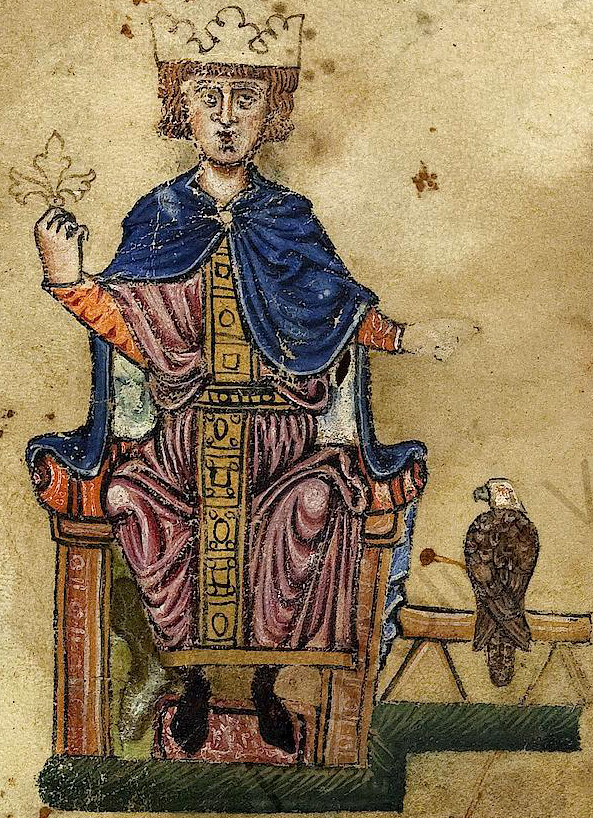
Frederick II (Italian: Federico, Sicilian: Fidiricu, German: Friedrich, Latin: Fridericus; 26 December 1194 – 13 December 1250) was King of Sicily from 1198, King of Germany from 1212, King of Italy and Holy Roman Emperor from 1220 and King of Jerusalem from 1225. He was the son of Emperor Henry VI of the Hohenstaufen dynasty (the second son of Emperor Frederick Barbarossa) and Queen Constance I of Sicily of the Hauteville dynasty.
Frederick was one of the most brilliant and powerful figures of the Middle Ages and ruled a vast area, beginning with Sicily and stretching through Italy all the way north to Germany. Viewing himself as a direct successor to the Roman emperors of antiquity, he was Emperor of the Romans from his papal coronation in 1220 until his death; he was also a claimant to the title of King of the Romans from 1212 and unopposed holder of that monarchy from 1215. As such, he was King of Germany, of Italy, and of Burgundy. At the age of three, he was crowned King of Sicily as co-ruler with his mother, Constance, Queen of Sicily, the daughter of Roger II of Sicily. His other royal title was King of Jerusalem by virtue of marriage and his connection with the Sixth Crusade. Frequently at war with the papacy, which was hemmed in between Frederick's lands in northern Italy and his Kingdom of Sicily (the Regno) to the south, he was "excommunicated four times between 1227 and his own death in 1250", and was often vilified in pro-papal chronicles of the time and after. Pope Innocent IV went so far as to declare him preambulus Antichristi (forerunner of the Antichrist).
For his many-sided activities, dynamic personality and talents Frederick II has been called the greatest of all the German emperors, perhaps even of all medieval rulers. In the Kingdom of Sicily and much of Italy, Frederick built upon the work of his Norman predecessors and forged an early absolutist state bound together by an efficient secular bureaucracy. He was known by the appellation Stupor mundi ('Wonder of the World'), enjoying a reputation as a Renaissance man avant la lettre and polymath even today: a visionary statesman, an inspired naturalist, scholar, mathematician, architect, poet and composer. Frederick also reportedly spoke six languages: Latin, Sicilian, Middle High German, Old French, Greek, and Arabic. As an avid patron of science and the arts, he played a major role in promoting literature through the Sicilian School of poetry. His magnificent Sicilian imperial-royal court in Palermo, beginning around 1220, was the cultural and intellectual hub of the early 13th century and saw the first use of a literary form of an Italo-Romance language, Sicilian. The poetry that emanated from the school had a significant influence on literature and on what was to become the modern Italian language. He was also the first monarch to formally outlaw trial by ordeal, which had come to be viewed as superstitious.
Though still in a strong position at his death, Frederick's line did not long survive, and the House of Hohenstaufen came to an end. Furthermore, the Holy Roman Empire entered a long period of decline during the Great Interregnum. His complex political and cultural legacy has continued to attract fierce debate and fascination to this day.
Born in Jesi, near Ancona, Italy, on 26 December 1194, Frederick was the son of Holy Roman Emperor Henry VI and Queen Constance I of Sicily. He was known as the puer Apuliae (son of Apulia). Frederick was baptised in Assisi, in the church of San Rufino. At birth, his mother named him Constantine. This name, a masculine form of his mother's name, served to identify him closely with both his Norman heritage and his imperial heritage (through Constantine the Great, the first Christian emperor). It was still his name at the time of his election as King of the Romans. He was only given his grandfathers' names, becoming Frederick Roger (or Roger Frederick), at his baptism when he was two years old. This dual name served the same purpose as Constantine: emphasising his dual heritage.
Frederick's birth was accompanied by gossip and rumour on account of his mother's advanced age. According to Albert of Stade and Salimbene, he was not the son of Henry and Constance but was presented to Henry as his own after a faked pregnancy. His real father was variously described as a butcher of Jesi, a physician, a miller or a falconer. Frederick's birth was also associated with a prophecy of Merlin. According to Andrea Dandolo, writing at some distance but probably recording contemporary gossip, Henry doubted reports of his wife's pregnancy and was only convinced by consulting Joachim of Fiore, who confirmed that Frederick was his son by interpretation of Merlin's prophecy and the Erythraean Sibyl. A later legend claims that Constance gave birth in the public square of Jesi to silence doubters. Constance took unusual measures to prove her pregnancy and its legitimacy and Roger of Howden reports that she swore on the gospels before a papal legate that Frederick was her son by Henry. It is probable that these public acts of affirmation on account of her age gave rise to some false rumours.
In the spring of 1195, a few months after her husband Henry had been crowned king of Sicily and not long after the birth of her son, Empress Constance continued her journey to Palermo. After the unexpected death of his wife's nephew Tancred of Lecce, Henry had hurried over to assume power and to have himself crowned king. Frederick was entrusted to the care of the duchess of Spoleto, whose husband, Conrad I of Urslingen, had been named duke by Frederick Barbarossa. The young Frederick stayed in Foligno, a place located in papal territory and so under papal jurisdiction, until the death of his father, on 28 September 1197.
In 1196 at Frankfurt am Main the infant Frederick was elected King of the Romans and thus heir to his father's imperial crown. His rights in Germany were to end up disputed by Henry's brother Philip of Swabia and Otto of Brunswick. At the death of his father Henry VI in 1197, Frederick was in Italy, travelling towards Germany, when the bad news reached his guardian, Conrad of Spoleto. Frederick was hastily brought back to his mother Constance in Palermo, Sicily, where he was crowned King of Sicily on 17 May 1198, at just three years of age. Originally his title had been Romanorum et Sicilie rex (King of the Romans and Sicily), but in 1198, after Constance (who kept using title of Empress) found out that Philip of Swabia had been recognized by the Staufer supporters in Germany, she had her son renounce the title King of the Romans. She probably agreed with Philip that Frederick's prospects in Germany were hopeless. The decision strengthened Frederick's position in Sicily as this satisfied both Philip of Swabia and the Pope, who did not like the idea of a ruler who had authority in both Sicily and the North Alpine realm.
Hub AI
Frederick II, Holy Roman Emperor AI simulator
(@Frederick II, Holy Roman Emperor_simulator)
Frederick II, Holy Roman Emperor
Frederick II (Italian: Federico, Sicilian: Fidiricu, German: Friedrich, Latin: Fridericus; 26 December 1194 – 13 December 1250) was King of Sicily from 1198, King of Germany from 1212, King of Italy and Holy Roman Emperor from 1220 and King of Jerusalem from 1225. He was the son of Emperor Henry VI of the Hohenstaufen dynasty (the second son of Emperor Frederick Barbarossa) and Queen Constance I of Sicily of the Hauteville dynasty.
Frederick was one of the most brilliant and powerful figures of the Middle Ages and ruled a vast area, beginning with Sicily and stretching through Italy all the way north to Germany. Viewing himself as a direct successor to the Roman emperors of antiquity, he was Emperor of the Romans from his papal coronation in 1220 until his death; he was also a claimant to the title of King of the Romans from 1212 and unopposed holder of that monarchy from 1215. As such, he was King of Germany, of Italy, and of Burgundy. At the age of three, he was crowned King of Sicily as co-ruler with his mother, Constance, Queen of Sicily, the daughter of Roger II of Sicily. His other royal title was King of Jerusalem by virtue of marriage and his connection with the Sixth Crusade. Frequently at war with the papacy, which was hemmed in between Frederick's lands in northern Italy and his Kingdom of Sicily (the Regno) to the south, he was "excommunicated four times between 1227 and his own death in 1250", and was often vilified in pro-papal chronicles of the time and after. Pope Innocent IV went so far as to declare him preambulus Antichristi (forerunner of the Antichrist).
For his many-sided activities, dynamic personality and talents Frederick II has been called the greatest of all the German emperors, perhaps even of all medieval rulers. In the Kingdom of Sicily and much of Italy, Frederick built upon the work of his Norman predecessors and forged an early absolutist state bound together by an efficient secular bureaucracy. He was known by the appellation Stupor mundi ('Wonder of the World'), enjoying a reputation as a Renaissance man avant la lettre and polymath even today: a visionary statesman, an inspired naturalist, scholar, mathematician, architect, poet and composer. Frederick also reportedly spoke six languages: Latin, Sicilian, Middle High German, Old French, Greek, and Arabic. As an avid patron of science and the arts, he played a major role in promoting literature through the Sicilian School of poetry. His magnificent Sicilian imperial-royal court in Palermo, beginning around 1220, was the cultural and intellectual hub of the early 13th century and saw the first use of a literary form of an Italo-Romance language, Sicilian. The poetry that emanated from the school had a significant influence on literature and on what was to become the modern Italian language. He was also the first monarch to formally outlaw trial by ordeal, which had come to be viewed as superstitious.
Though still in a strong position at his death, Frederick's line did not long survive, and the House of Hohenstaufen came to an end. Furthermore, the Holy Roman Empire entered a long period of decline during the Great Interregnum. His complex political and cultural legacy has continued to attract fierce debate and fascination to this day.
Born in Jesi, near Ancona, Italy, on 26 December 1194, Frederick was the son of Holy Roman Emperor Henry VI and Queen Constance I of Sicily. He was known as the puer Apuliae (son of Apulia). Frederick was baptised in Assisi, in the church of San Rufino. At birth, his mother named him Constantine. This name, a masculine form of his mother's name, served to identify him closely with both his Norman heritage and his imperial heritage (through Constantine the Great, the first Christian emperor). It was still his name at the time of his election as King of the Romans. He was only given his grandfathers' names, becoming Frederick Roger (or Roger Frederick), at his baptism when he was two years old. This dual name served the same purpose as Constantine: emphasising his dual heritage.
Frederick's birth was accompanied by gossip and rumour on account of his mother's advanced age. According to Albert of Stade and Salimbene, he was not the son of Henry and Constance but was presented to Henry as his own after a faked pregnancy. His real father was variously described as a butcher of Jesi, a physician, a miller or a falconer. Frederick's birth was also associated with a prophecy of Merlin. According to Andrea Dandolo, writing at some distance but probably recording contemporary gossip, Henry doubted reports of his wife's pregnancy and was only convinced by consulting Joachim of Fiore, who confirmed that Frederick was his son by interpretation of Merlin's prophecy and the Erythraean Sibyl. A later legend claims that Constance gave birth in the public square of Jesi to silence doubters. Constance took unusual measures to prove her pregnancy and its legitimacy and Roger of Howden reports that she swore on the gospels before a papal legate that Frederick was her son by Henry. It is probable that these public acts of affirmation on account of her age gave rise to some false rumours.
In the spring of 1195, a few months after her husband Henry had been crowned king of Sicily and not long after the birth of her son, Empress Constance continued her journey to Palermo. After the unexpected death of his wife's nephew Tancred of Lecce, Henry had hurried over to assume power and to have himself crowned king. Frederick was entrusted to the care of the duchess of Spoleto, whose husband, Conrad I of Urslingen, had been named duke by Frederick Barbarossa. The young Frederick stayed in Foligno, a place located in papal territory and so under papal jurisdiction, until the death of his father, on 28 September 1197.
In 1196 at Frankfurt am Main the infant Frederick was elected King of the Romans and thus heir to his father's imperial crown. His rights in Germany were to end up disputed by Henry's brother Philip of Swabia and Otto of Brunswick. At the death of his father Henry VI in 1197, Frederick was in Italy, travelling towards Germany, when the bad news reached his guardian, Conrad of Spoleto. Frederick was hastily brought back to his mother Constance in Palermo, Sicily, where he was crowned King of Sicily on 17 May 1198, at just three years of age. Originally his title had been Romanorum et Sicilie rex (King of the Romans and Sicily), but in 1198, after Constance (who kept using title of Empress) found out that Philip of Swabia had been recognized by the Staufer supporters in Germany, she had her son renounce the title King of the Romans. She probably agreed with Philip that Frederick's prospects in Germany were hopeless. The decision strengthened Frederick's position in Sicily as this satisfied both Philip of Swabia and the Pope, who did not like the idea of a ruler who had authority in both Sicily and the North Alpine realm.
Recent media