


Community hub
Recent from talks
Contribute something to knowledge base
Content stats: 0 posts, 0 articles, 1 media, 0 notes
Members stats: 0 subscribers, 0 contributors, 0 moderators, 0 supporters
Subscribers
Supporters
Contributors
Moderators
Hub AI
Honda N360 AI simulator
(@Honda N360_simulator)
Hub AI
Honda N360 AI simulator
(@Honda N360_simulator)
Honda N360
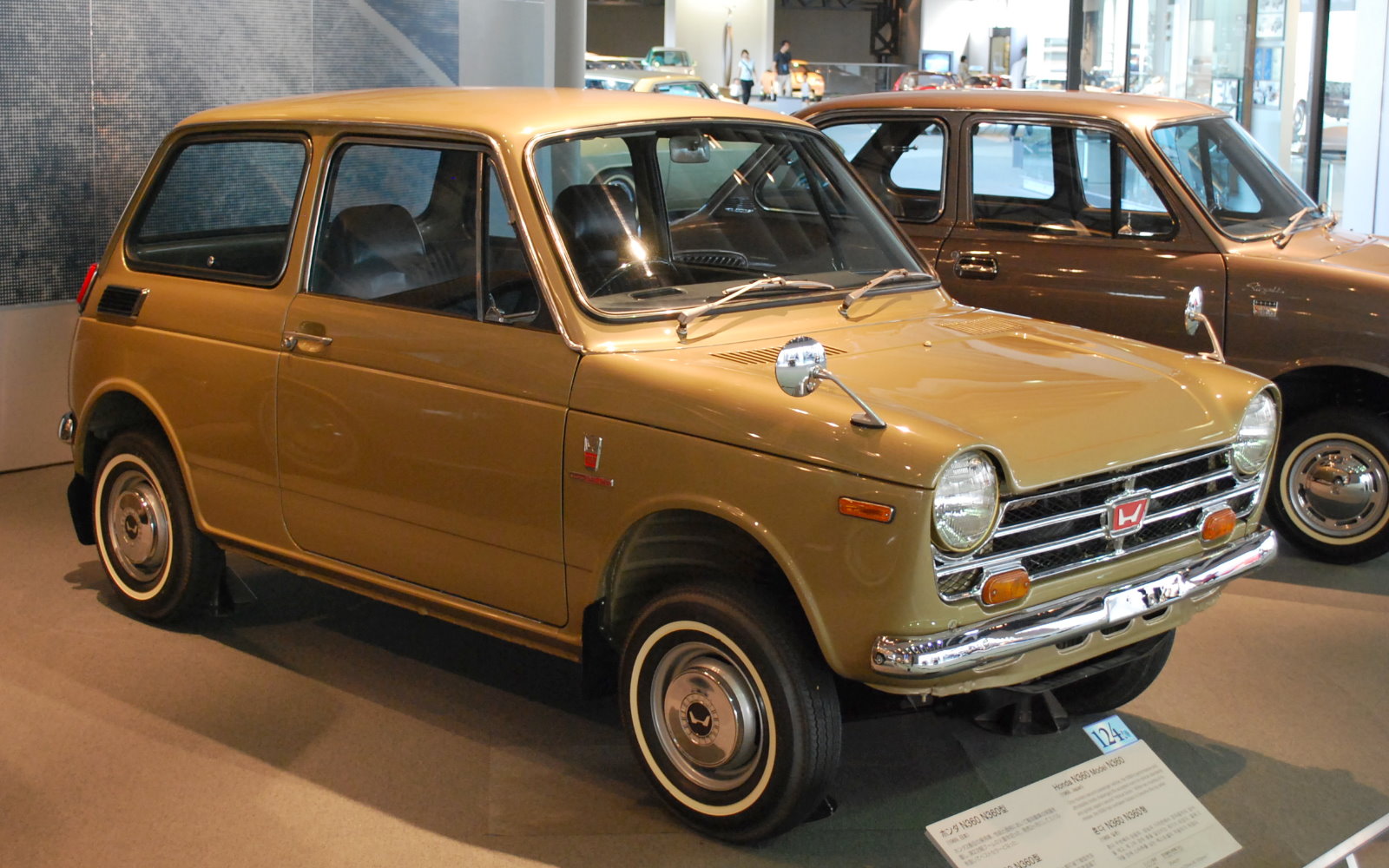
The Honda N360 is a small car manufactured and marketed by Honda from March 1967 to 1972. Built as both a two-door sedan and three-door wagon, the N360 has a front-engine, front-wheel-drive layout and seats four passengers.
After a January 1970 facelift, the N360 became the NIII360 and continued in production until June 1972. A larger-engined variant, the N600, was marketed through 1973. All models used a straight forward two-box design that complied with kei car dimensional regulations — though vehicles with the 401 cc and 598 cc engines exceeded the kei engine displacement limits and were largely intended for markets outside Japan.
The N360 featured front-wheel drive and an air-cooled, four-stroke, 354 cc, 31 PS (23 kW; 31 hp) two-cylinder engine. While ultimately derived from Honda's motorcycle engines, the N360E engine has a 360-degree crankshaft angle ("parallel twin") unlike the 180-degree "vertical twin" setup typically used on Honda's two-cylinder motorcycle engines. This same engine was used in the Honda Vamos, where it was coupled with a beam axle/leaf spring rear suspension.
The simple N360 name, along with its variants, used the "N" prefix, which stood for norimono and translated from Japanese to English as vehicle (or car) — distinguishing the cars from the company's motorcycle offerings.
In 2012, Honda introduced the Honda N-One, an homage inspired by the 1967–1973 N sedans.
Honda marketed the N360 as a two-door sedan, with a three-door wagon (considered a commercial vehicle in Japan, and therefore called a "Light van") called the LN360 arriving in June of the first year. It has a horizontally divided rear gate and boxier rear bodywork for maximum load capacity. The LN360 had the same 31 PS engine as the sedan, and a top speed of 105 km/h (65 mph). After a January 1970 facelift it became the LNIII 360, with a new non-reflective dash, bigger turn signals, and the same new front end as the sedan. The LNIII 360 was built until late 1971, when the Life Van took over.
The N360 was an all new, clean-sheet product, and did not share its chassis with the Honda Sports roadster, or the Honda L700 commercial platform. The N360 was a new market segment for Honda, providing an affordable, reliable, and easy-to-maintain vehicle that had broad market appeal to private car ownership. The roadsters and trucks built up to then had specific, targeted appeal.
The engine's technological specifications reflected engineering efforts resulting from the development of the larger Honda 1300, which used an air-cooled 1.3-litre engine. One of the primary differences between the N360 and the Honda Life that followed was the N360/600 had an air-cooled engine, and the Life had a water-cooled engine. The water-cooled engine was better able to comply with newly enacted emission standards in Japan, and reflected an industry wide move away from air-cooled as well as two-stroke engines. As does the original Mini, but unlike the succeeding Life, the N360/600 had its gearbox mounted in the sump rather than bolted on as a separate unit. The N360E engine was unusual in several ways: its two cylinders sat rather far apart, with the cam chain running between them. Unlike most air-cooled automobile engine, it does not use an oil cooler. The two pistons travel together, eliminating the need for a distributor but making for additional vibrations. It uses either a single or double constant velocity (CV) carburetor of comparatively large bore; this design helps it run smoothly at low engine speeds in spite of the parallel twin engine layout.
Honda N360
The Honda N360 is a small car manufactured and marketed by Honda from March 1967 to 1972. Built as both a two-door sedan and three-door wagon, the N360 has a front-engine, front-wheel-drive layout and seats four passengers.
After a January 1970 facelift, the N360 became the NIII360 and continued in production until June 1972. A larger-engined variant, the N600, was marketed through 1973. All models used a straight forward two-box design that complied with kei car dimensional regulations — though vehicles with the 401 cc and 598 cc engines exceeded the kei engine displacement limits and were largely intended for markets outside Japan.
The N360 featured front-wheel drive and an air-cooled, four-stroke, 354 cc, 31 PS (23 kW; 31 hp) two-cylinder engine. While ultimately derived from Honda's motorcycle engines, the N360E engine has a 360-degree crankshaft angle ("parallel twin") unlike the 180-degree "vertical twin" setup typically used on Honda's two-cylinder motorcycle engines. This same engine was used in the Honda Vamos, where it was coupled with a beam axle/leaf spring rear suspension.
The simple N360 name, along with its variants, used the "N" prefix, which stood for norimono and translated from Japanese to English as vehicle (or car) — distinguishing the cars from the company's motorcycle offerings.
In 2012, Honda introduced the Honda N-One, an homage inspired by the 1967–1973 N sedans.
Honda marketed the N360 as a two-door sedan, with a three-door wagon (considered a commercial vehicle in Japan, and therefore called a "Light van") called the LN360 arriving in June of the first year. It has a horizontally divided rear gate and boxier rear bodywork for maximum load capacity. The LN360 had the same 31 PS engine as the sedan, and a top speed of 105 km/h (65 mph). After a January 1970 facelift it became the LNIII 360, with a new non-reflective dash, bigger turn signals, and the same new front end as the sedan. The LNIII 360 was built until late 1971, when the Life Van took over.
The N360 was an all new, clean-sheet product, and did not share its chassis with the Honda Sports roadster, or the Honda L700 commercial platform. The N360 was a new market segment for Honda, providing an affordable, reliable, and easy-to-maintain vehicle that had broad market appeal to private car ownership. The roadsters and trucks built up to then had specific, targeted appeal.
The engine's technological specifications reflected engineering efforts resulting from the development of the larger Honda 1300, which used an air-cooled 1.3-litre engine. One of the primary differences between the N360 and the Honda Life that followed was the N360/600 had an air-cooled engine, and the Life had a water-cooled engine. The water-cooled engine was better able to comply with newly enacted emission standards in Japan, and reflected an industry wide move away from air-cooled as well as two-stroke engines. As does the original Mini, but unlike the succeeding Life, the N360/600 had its gearbox mounted in the sump rather than bolted on as a separate unit. The N360E engine was unusual in several ways: its two cylinders sat rather far apart, with the cam chain running between them. Unlike most air-cooled automobile engine, it does not use an oil cooler. The two pistons travel together, eliminating the need for a distributor but making for additional vibrations. It uses either a single or double constant velocity (CV) carburetor of comparatively large bore; this design helps it run smoothly at low engine speeds in spite of the parallel twin engine layout.
Recent media
Recent media