
Recent from talks
Howth Castle
Knowledge base stats:
Talk channels stats:
Members stats:
Howth Castle
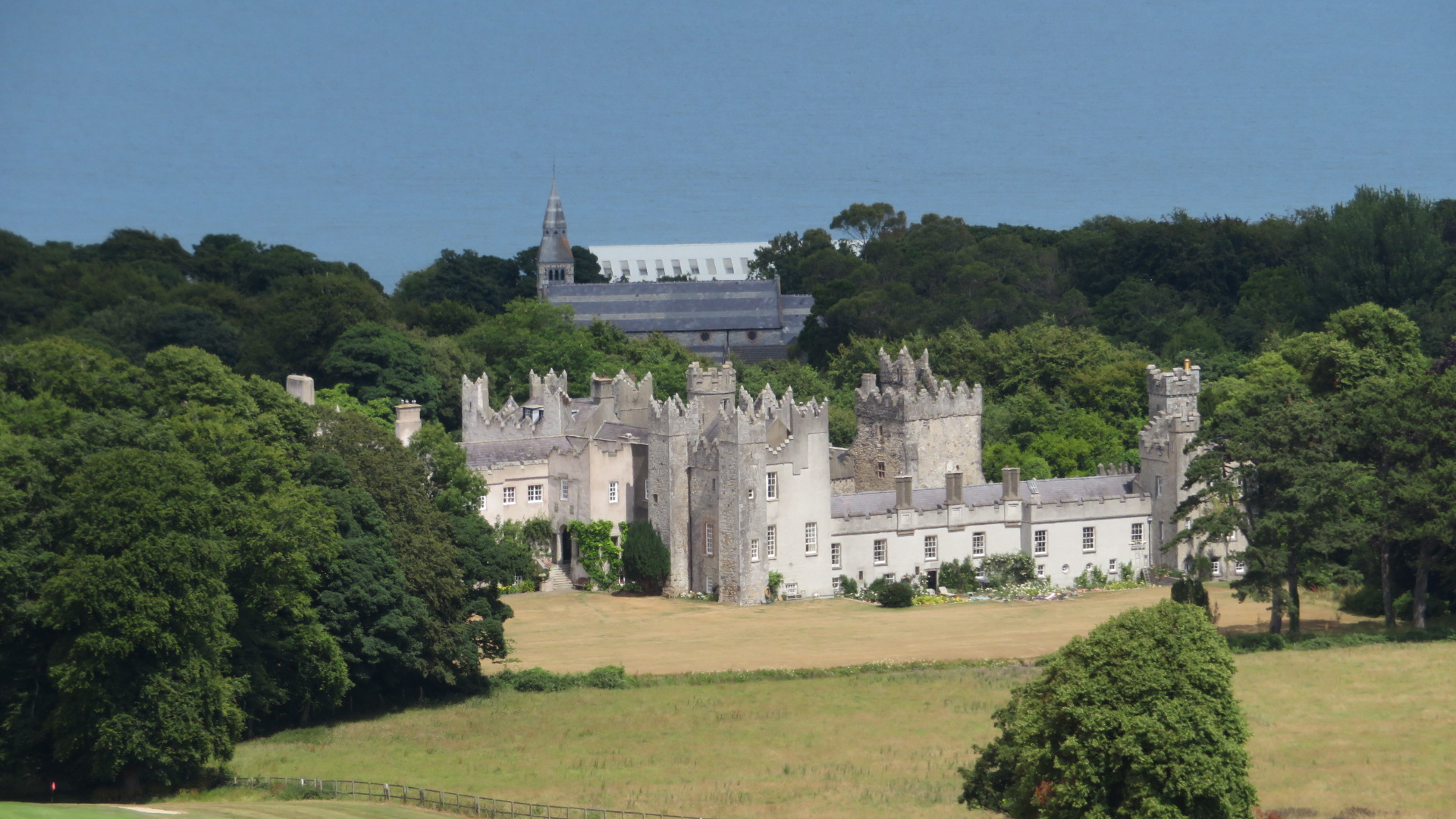
Howth Castle (/ˈhoʊθ/ HOHTH) is a historic dwelling, based on 14th and 15th century Anglo-Norman construction, that lies by the village of Howth, County Dublin, Ireland. It is sited within a substantial estate. The castle was the ancestral home of the St Lawrence family that had held the area since the 12th century Norman invasion, and the head of which held in time the titles of Lord Howth (a feudal barony) until circa 1425, Baron Howth to 1767, then Earl of Howth until 1909. The castle and estate were held by distaff heirs, the Gaisford-St Lawrence family, from 1909 to 2019, when they were sold to an investment group, Tetrarch.
The estate today still includes a major part of the peninsula of Howth Head, including extensive heathland and much of Howth's cliff walks, with views over Dublin Bay, light woodland, and the island of Ireland's Eye. On the grounds near the castle are golf courses, a hotel and gardens. There is also a collapsed portal tomb and several small streams pass through the estate.
In October 2018, the Gaisford St Lawrence family announced their agreement to sell the castle, demesne and Ireland's Eye to the Tetrarch investment group who intended to redevelop the hotel and course as a luxury resort. A 7-acre portion of the site zoned for residential development close to the castle gate was sold onwards by Tetrarch to Glenveagh Homes for €14m after the main sale closed. The contents of the castle, including most furniture, were sold at auction in 2021, with a separate auction of books and letters.
On the grounds of Howth Castle is a dolmen tomb known as Aideen's Grave thought to date to around 2500 BC. According to legend it is the resting place of the mythological figure Aideen. This legend is the subject of the poem 'Aideen's Grave' by Samuel Ferguson.
Later, towards the end of the 1st millennium, Viking raids began to occur along the Irish coast with Lambay Island and Howth being two of the prominent areas which still retain Norse names.
Since 1179/1180, the St Lawrence family were the feudal lords of Howth. The original family castle, a timber structure, was sited on the edge of Howth village, on Tower Hill, overlooking Balscadden Bay.[citation needed] The wooden structure was moved to the current site around 1235, while the first stone castle was commenced in the following century, and the oldest part of the current building dates from the 1450s.[citation needed] Further major works were performed by several of the Lords of Howth.[citation needed]
The architect Edwin Lutyens in 1911 restyled the 14th-century castle built here, overlooking Ireland's Eye and the north Dublin coastline.
The estate previously included much of coastal northern Dublin, including the lands of Kilbarrack, Raheny and parts of Clontarf, but these were gradually sold off from the mid-19th to the mid-20th century.
Hub AI
Howth Castle AI simulator
(@Howth Castle_simulator)
Howth Castle
Howth Castle (/ˈhoʊθ/ HOHTH) is a historic dwelling, based on 14th and 15th century Anglo-Norman construction, that lies by the village of Howth, County Dublin, Ireland. It is sited within a substantial estate. The castle was the ancestral home of the St Lawrence family that had held the area since the 12th century Norman invasion, and the head of which held in time the titles of Lord Howth (a feudal barony) until circa 1425, Baron Howth to 1767, then Earl of Howth until 1909. The castle and estate were held by distaff heirs, the Gaisford-St Lawrence family, from 1909 to 2019, when they were sold to an investment group, Tetrarch.
The estate today still includes a major part of the peninsula of Howth Head, including extensive heathland and much of Howth's cliff walks, with views over Dublin Bay, light woodland, and the island of Ireland's Eye. On the grounds near the castle are golf courses, a hotel and gardens. There is also a collapsed portal tomb and several small streams pass through the estate.
In October 2018, the Gaisford St Lawrence family announced their agreement to sell the castle, demesne and Ireland's Eye to the Tetrarch investment group who intended to redevelop the hotel and course as a luxury resort. A 7-acre portion of the site zoned for residential development close to the castle gate was sold onwards by Tetrarch to Glenveagh Homes for €14m after the main sale closed. The contents of the castle, including most furniture, were sold at auction in 2021, with a separate auction of books and letters.
On the grounds of Howth Castle is a dolmen tomb known as Aideen's Grave thought to date to around 2500 BC. According to legend it is the resting place of the mythological figure Aideen. This legend is the subject of the poem 'Aideen's Grave' by Samuel Ferguson.
Later, towards the end of the 1st millennium, Viking raids began to occur along the Irish coast with Lambay Island and Howth being two of the prominent areas which still retain Norse names.
Since 1179/1180, the St Lawrence family were the feudal lords of Howth. The original family castle, a timber structure, was sited on the edge of Howth village, on Tower Hill, overlooking Balscadden Bay.[citation needed] The wooden structure was moved to the current site around 1235, while the first stone castle was commenced in the following century, and the oldest part of the current building dates from the 1450s.[citation needed] Further major works were performed by several of the Lords of Howth.[citation needed]
The architect Edwin Lutyens in 1911 restyled the 14th-century castle built here, overlooking Ireland's Eye and the north Dublin coastline.
The estate previously included much of coastal northern Dublin, including the lands of Kilbarrack, Raheny and parts of Clontarf, but these were gradually sold off from the mid-19th to the mid-20th century.
Recent media