Hubbry Logo
Hubert SumlinHubert SumlinMain
Open search
Hubert Sumlin
Community hub
Hubert Sumlin
logo
8 pages, 0 posts
0 subscribers
Be the first to start a discussion here.
Hubert Sumlin
Hubert Sumlin
from Wikipedia

Key Information

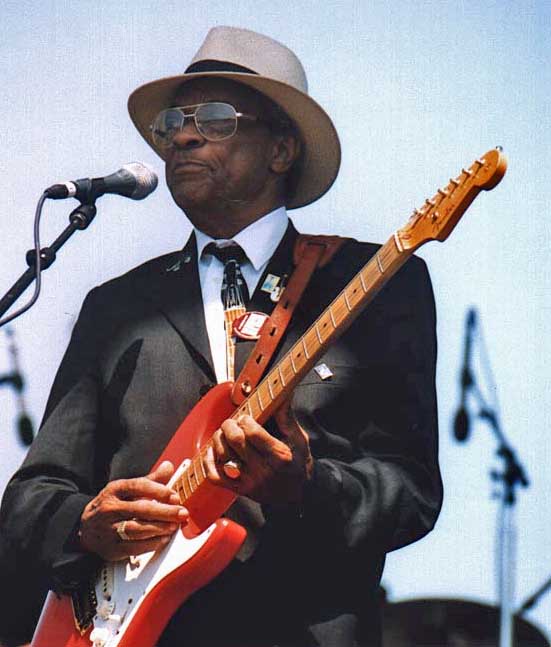
Hubert Charles Sumlin (November 16, 1931 – December 4, 2011) was a Chicago blues guitarist and singer,[1] best known for his "wrenched, shattering bursts of notes, sudden cliff-hanger silences and daring rhythmic suspensions" as a member of Howlin' Wolf's band.[2] He was ranked number 43 in Rolling Stone's "100 Greatest Guitarists of All Time".[3]

Biography

[edit]

Sumlin was born in Greenwood, Mississippi, and raised in Hughes, Arkansas.[4] He got his first guitar when he was eight years old.[5] As a boy, he met Howlin' Wolf by sneaking into a performance.

Wolf relocated from Memphis to Chicago in 1953, but his longtime guitarist Willie Johnson chose not to join him. In Chicago, Wolf hired the guitarist Jody Williams, but in 1954 he invited Sumlin to move to Chicago to play second guitar in his band.[6] Williams left the band in 1955, leaving Sumlin as the primary guitarist, a position he held almost continuously (except for a brief spell playing with Muddy Waters around 1956) for the remainder of Wolf's career.[6] According to Sumlin, Howlin' Wolf sent him to a classical guitar instructor at the Chicago Conservatory of Music to learn keyboards and scales.[7] Sumlin played on the album Howlin' Wolf (called the "rocking chair album", with reference to its cover illustration), which was named the third greatest guitar album of all time by Mojo magazine in 2004.[8][9]

Sumlin performing in France, December 17, 1975, five days before recording My Guitar and Me

Upon Wolf's death in 1976, Sumlin continued playing with several other members of Wolf's band, as the Wolf Gang, until about 1980.[6] He also recorded under his own name, beginning with a session from a tour of Europe with Wolf in 1964.[6] His last solo album was About Them Shoes, released in 2004 by Tone-Cool Records. He underwent lung removal surgery the same year, but he continued performing until just before his death. His final recording, just days before his death, was tracks for an album by Stephen Dale Petit, Cracking The Code (333 Records).

Hubert Sumlin playing guitar at the Ann Arbor Blues Festival, 1970, Ann Arbor, Michigan
Hubert Sumlin at the 1970 Ann Arbor Blues Festival

Sumlin was inducted into the Blues Foundation Hall of Fame in 2008.[10] He was nominated for four Grammy Awards: in 1999 for the album Tribute to Howlin' Wolf, with Henry Gray, Calvin Jones, Sam Lay, and Colin Linden; in 2000 for Legends, with Pinetop Perkins; in 2006, for his solo project About Them Shoes (which features performances by Keith Richards, Eric Clapton, Levon Helm, David Johansen and James Cotton) and in 2010 for his contribution to Kenny Wayne Shepherd's Live! in Chicago. He won multiple Blues Music Awards. He was a judge for the fifth annual Independent Music Awards, given to support the careers of independent artists.[11]

Sumlin lived in Totowa, New Jersey for 10 years before his death.[12] He died of heart failure on December 4, 2011, at the age of 80, in a hospital in Wayne, New Jersey.[13][14] He was survived by his wife, son, and three daughters.[15] Mick Jagger and Keith Richards paid Sumlin's funeral expenses.[16]

Partial discography

[edit]
Albums[17]
Year Title Label Number Notes
1964 American Folk Blues Amiga 850 043 Germany
1969 Hubert's "American" Blues! Scout Sc-4
1974 Kings of Chicago Blues, Vol. 2 Disques Vogue LDM 30175 France, recorded 1971
1976 Groove Black & Blue 33.511 France, recorded 1975
1980 Gamblin' Woman L + R 42.008 Germany, recorded 1980
1987 Hubert Sumlin's Blues Party Black Top BT-1036 US
1989 Heart & Soul Blind Pig BP-3389 US
1990 Healing Feeling Black Top BT-1053 US
1991 Blues Guitar Boss JSP 239 UK, recorded 1990 in London
1994 Made in Argentina 1993 Blues Special 9501 Argentina, recorded 1993 in Buenos Aires with Emilio Villanueva and the Kansas City Boys
1994 I'm the Back Door Man Blues Special 9506 Argentina, recorded 1993 in Buenos Aires
1994 My Guitar and Me Evidence Music ECD-26045 Paris, recorded on Dec 22, 1975 at Barclay Studio
1996 Blues Classics Bellaphon 82007 Germany, recorded 1964 in East Berlin
1998 I Know You APO 2004 US
1998 Wake Up Call Blues Planet 1116 US
1999 Pinetop Perkins & Hubert Sumlin: Legends Telarc 83446 US
2003 Do the Don't Intuition 34252 Germany; Elliott Sharp's Terraplane, with Hubert Sumlin
2005 About Them Shoes Tone-Cool/Artemis Records 51609 US, also Rykodisc RCD 17307 in the UK
2010 Midnight Memphis Sun NorthernBlues Music NMB0058 JW-Jones release with special guests Hubert Sumlin and Charlie Musselwhite
2012 Sky Road Songs Yellowbird 7724-2 Germany; Elliott Sharp's Terraplane, with special guest Hubert Sumlin (recorded in 2011)
Videos
Year Title Label Number Notes
2005 The Blues Guitar of Hubert Sumlin Homespun Tapes SUMGT21 US, VHS & DVD

References

[edit]
[edit]
Revisions and contributorsEdit on WikipediaRead on Wikipedia
from Grokipedia
Hubert Sumlin (November 16, 1931 – December 4, 2011) was an American guitarist renowned for his innovative and angular guitar style, particularly as the longtime lead guitarist for from 1955 until Wolf's death in 1976. Born in , and raised in Hughes, , Sumlin received his first guitar at age six and initially aspired to play before immersing himself in the tradition after encountering local musicians like as a teenager. He moved to in 1954 at Wolf's invitation, quickly becoming a core member of the band and contributing slashing, percussive solos with wide to iconic tracks such as "" (1956), "" (1960), "" (1960), and "Killing Floor" (1964). Sumlin's distinctive sound—characterized by jagged riffs, distortion techniques, and rhythmic interplay with Wolf's howling vocals—profoundly influenced generations of guitarists, including , , , and , who covered several Wolf songs featuring his playing. Beyond his sideman role, he recorded over a dozen solo albums starting with recordings made during his 1964 European tour and culminating in Treblemaker (2007), with notable later works like About Them Shoes (2004) featuring guest appearances by Clapton, , and others. He briefly played with in the early 1950s and maintained an active performing career into his later years despite health challenges, including cancer and heart issues. Sumlin's contributions to blues were recognized with four Grammy nominations (1998, 1999, 2005, and 2011), induction into the Blues Foundation Hall of Fame in 2008, and a ranking among Rolling Stone's 100 Greatest Guitarists of All Time. He died of heart failure in Wayne, New Jersey, at age 80, leaving a legacy as a pivotal figure in shaping the electric blues sound that bridged Delta roots and rock 'n' roll.

Early life

Childhood and family background

Hubert Sumlin was born on November 16, 1931, in , into a family as one of thirteen children. His parents, John Sumlin and Claudia James, worked the land in the rural Delta region, where economic hardships were commonplace for African American families during the era. Sumlin's early years were marked by the challenges of life, including his mother's employment at a local to supplement the family's income. Sumlin's family relocated from Greenwood to Hughes, , during his early childhood, immersing him in a rural environment steeped in the traditions of the , where fields and close-knit family gatherings shaped daily life. In Hughes, Sumlin received his first guitar at age six from his mother, who purchased it with a week's wages from her job, an act that introduced him to music amid the sounds of local juke joints and familial music-making by siblings like his brother, who played a one-string instrument. Sumlin's formal education was limited, as he attended school briefly in but prioritized music from a young age, eventually leaving high school to focus on his emerging interests. This early dedication reflected the broader economic pressures of the time, which later influenced his migration to for greater prospects.

Musical education and early influences

Sumlin began his musical journey as a self-taught , initially aspiring to play jazz and drawing inspiration from figures such as and . He honed his skills by ear, incorporating elements into church performances where he initially played. As a teenager, after encountering local musicians like , he immersed himself in the tradition, influenced by pioneers such as Charlie Patton, , and . This foundational period in and laid the groundwork for his intuitive grasp of phrasing and rhythm. In his teenage years, Sumlin gained practical experience through early gigs in , performing alongside harmonica player in local settings around Hughes. These informal performances often featured covers of standards, blending the genre's with the regional sounds he encountered, which helped solidify his commitment to the music before his relocation northward.

Career

Association with

Hubert Sumlin arrived in in 1954 to join Howlin' Wolf's band after Wolf, who had relocated from Memphis the previous year, sought a new lead guitarist when longtime player Willie Johnson declined to move north. Sumlin's self-taught guitar prowess from his youth in allowed him to quickly integrate into the professional scene. He first encountered Wolf's powerful stage presence during a performance in Hughes, , in the early , which inspired him to pursue the opportunity when Wolf extended the invitation. From 1954 until Wolf's death in 1976, Sumlin served as the primary guitarist in Wolf's band, providing the sharp, unpredictable riffs that defined many of their sessions. His contributions energized hits such as "" (1956), where his terse solos complemented Wolf's howling vocals; "" (1960), featuring his rhythmic interplay with the rhythm section; "Shake for Me" (1962) and "Hidden Charms" (1962), both showcasing his dynamic lead lines; and "Killing Floor" (1964), on which his innovative phrasing added tension to the track's raw energy. These recordings, produced at Chess Studios, helped establish Wolf's sound as a cornerstone of electric during the 1950s and 1960s. Sumlin's role extended to Wolf's live performances, where he adapted to the bandleader's demanding and volatile , including multiple firings followed by rehiring that underscored their father-son-like bond amid frequent tensions. He supported Wolf on European tours, notably the American Folk Blues Festival, introducing their intense stage dynamics to international audiences and influencing the revival. A brief interruption occurred in 1956 when Sumlin temporarily joined rival ' band for six months before returning to Wolf, reaffirming his central place in the group.

Solo recordings and collaborations

Sumlin's first solo recording efforts date back to , marking his initial foray into independent work beyond his primary role with . These early sessions laid the groundwork for his later output, though full-length solo albums emerged more prominently in the following decades. In the 1980s, Sumlin released Hubert Sumlin's Blues Party in 1987 on Black Top Records, a collection showcasing his raw guitar style on originals and covers. He followed with Healing Feeling in 1990, also on Black Top, featuring contributions from guitarist and vocalists James "Thunderbird" Davis and Darrell Nulisch, blending with ensemble interplay. Another notable release, I Know You in 1998 on APO Records, highlighted Sumlin's singing and guitar work on a mix of standards and originals. The 2000s saw Sumlin's solo career peak with About Them Shoes in 2004, produced by Rob Fraboni on Tone-Cool Records, which included guest appearances by Keith Richards on guitar and bass, Eric Clapton on guitar and vocals, Levon Helm on drums, and David Johansen on vocals. This album drew heavily from Muddy Waters' repertoire, emphasizing Sumlin's interpretive depth. Beyond solo projects, Sumlin collaborated with several blues luminaries outside his Wolf tenure. In the 1950s, he briefly joined Muddy Waters' band in 1956, contributing guitar to live and recording sessions before returning to Wolf. He also played on tracks with Jimmy Reed, including sessions in the early 1960s that captured his stinging leads in ensemble settings. Later collaborations included Legends (1998) with pianist Pinetop Perkins on Telarc Blues, and appearances with Rolling Stones members like Richards on his own records. Following Howlin' Wolf's death in 1976, Sumlin led the Wolf Gang band with other former members through the late 1970s and into 1980, performing live across the U.S. and to preserve Wolf's sound. He maintained an active touring schedule into the , including festival appearances and international gigs that often featured his solo material alongside standards.

Musical style

Guitar techniques and innovations

Hubert Sumlin's guitar playing was characterized by "wrenched, shattering bursts of notes, sudden cliff-hanger silences, and daring rhythmic suspensions," which created a sense of unpredictability and tension in his solos. This style featured angular riffs and abrupt pauses, as exemplified in the solo for "Killing Floor," where his phrasing interjected sharp, fragmented lines between vocal phrases to heighten the song's dramatic intensity. Sumlin innovated in the realm by embracing feedback and , often achieved by cranking his to push the limits of his Fender guitars, such as the Stratocaster, contributing to the raw, amplified shift from to the sound. He employed a thumb-picking technique without a pick, using his fingers for a lighter touch that produced sustained, expressive tones with natural and slides, allowing for greater dynamic control and emotional depth in his lines. A key aspect of Sumlin's approach was his emphasis on space and rhythmic interplay with the vocalist, avoiding incessant fills to instead punctuate songs with selective, vocal-like responses that complemented performers like . His adaptation of single-note runs and wide bends delivered raw, emotive expression, setting his jagged phrasing apart from the smoother, more fluid styles of contemporaries like . These elements drew roots from earlier influences like , whose raw Delta tone informed Sumlin's aggressive electric adaptations.

Personal influences and development

Hubert Sumlin's early musical influences were rooted in the raw intensity of pioneers such as , whose aggressive rhythms and vocal ferocity shaped Sumlin's foundational approach to the genre. He also drew sophistication from Lonnie Johnson's fluid single-note lines and melodic phrasing, which encouraged a more nuanced guitar vocabulary beyond pure Delta grit. These acoustic traditions evolved as Sumlin transitioned to in , incorporating the urbane swing and amplified tone of , whose sophisticated chord-melody work added polish to his style. Similarly, ' electrified sound influenced Sumlin's adoption of bolder, band-oriented dynamics during his formative years. A pivotal aspect of Sumlin's development came through formal music training arranged by , who enrolled him for six months at the Chicago Conservatory of Music under a instructor. This instruction focused on mastering the fretboard, scales, and note reading, allowing Sumlin to integrate structured and classical phrasing into his framework. The training enhanced his scale usage, enabling more precise bends and melodic runs that blended academic precision with instinctive blues expression. During his two-decade tenure with starting in 1954, Sumlin refined his style by emphasizing band cohesion and vocal accompaniment over individual flash. Wolf's taught him to time fills economically, using bent notes and sparse lines to underscore the singer's powerful growl in tracks like "" and "Killing Floor," fostering a mature, supportive role that defined his playing by the . This period transformed Sumlin from a raw talent into a disciplined player, prioritizing dynamics that elevated the group's raw energy. In his solo endeavors during the 1970s, Sumlin's style evolved further by absorbing rock-infused elements from the revival, evident in recordings like the 1975 album My Guitar and Me, where amplified leads and rhythmic drive reflected cross-pollination with artists such as . This phase allowed him to expand beyond traditional structures, incorporating bolder distortions and ensemble interplay honed from earlier sessions with British musicians.

Later years and legacy

Health challenges and death

In the 2000s, Hubert Sumlin resided in , where he lived for the last decade of his life, sharing his home with his wife, Evelyn, his son , and three daughters, , Berdelle, and Louise. This period marked a time of relative stability for Sumlin following earlier personal losses, including the death of his previous wife, Willie "Bea" Reed, in 1999. Despite his advancing age, Sumlin maintained an active presence in the music community from his base. Sumlin's health began to decline significantly in the early 2000s due to a lung cancer diagnosis in 2002, which necessitated the surgical removal of one lung in 2004. He also contended with ongoing heart problems, including congestive heart failure, which worsened over time and required him to use an oxygen tank during performances. In late 2011, these issues culminated in hospitalization, where he continued to perform sporadically until shortly before his passing, demonstrating remarkable resilience. Sumlin died on December 4, 2011, at a hospital in , at the age of 80, from complications of . His funeral services, held publicly on December 11 and 12 in Totowa, were attended by prominent musicians and admirers, including tributes that celebrated his enduring spirit and contributions to the genre. and of covered his expenses, underscoring his profound influence on .

Awards, honors, and cultural impact

Sumlin was inducted into the by the Blues Foundation in 2008, recognizing his innovative guitar contributions to 's classic recordings such as "Killing Floor" and "Shake for Me." He received multiple Music Awards, including the Traditional Blues Male Artist award in 2008. Sumlin earned four Grammy nominations for Best Traditional Blues Album or equivalent categories: in 1999 for A Tribute to Howlin' Wolf (with , Calvin Jones, , and ), in 2000 for Legends (with ), in 2005 for About Them Shoes, and in 2011 for (with the Band). Despite these accolades, he never won a Grammy during his lifetime. In 2011, ranked Sumlin number 43 on its list of the 100 Greatest Guitarists of All Time, praising his sharp, unpredictable style that influenced generations of players. His contributions to were further honored with a marker on the in , unveiled in 2008, which highlights his early life and role in shaping through his work with . Sumlin's cultural impact extends beyond into , where his jagged riffs on recordings inspired guitarists like (who covered "Killing Floor"), , , and , bridging raw with rock's electric energy. His innovative phrasing and tonal aggression on tracks like "" and "" became foundational for rock interpretations, cementing his legacy as a pivotal figure in the evolution of guitar-based music.

Discography

Solo albums

Sumlin's solo albums span decades, highlighting his growth from energetic Chicago blues to more contemplative and collaborative works, often featuring his jagged guitar lines as the centerpiece. His first solo recordings date back to 1964, though full-length albums began appearing in the late 1980s. Hubert Sumlin's Blues Party (1987, Black Top Records) consists of raw blues sessions recorded with a band of experienced musicians, emphasizing Sumlin's aggressive guitar tone and improvisational flair in straightforward, high-energy tracks like "Hidden Charms" and "A Soul That's Been Abused." Heart & Soul (1989, Blind Pig Records) represents a collaborative effort with and Little Mike and the Tornadoes, delivering a mature sound through ten tracks where Sumlin handles guitar alongside Cotton's harmonica, blending originals with covers in a classic style. Healing Feeling (1990, Black Top Records) offers introspective explorations across eleven songs, with Sumlin's emotive guitar supported by guests including guitarist and vocalist Darrell Nulisch, creating a reflective mood centered on personal struggle and resilience. Blues Guitar Boss (1991, JSP Records) showcases Sumlin's command of the instrument in a set of original compositions and standards, recorded in London with a backing band that highlights his rhythmic and melodic innovations. Legends (1998, Telarc Records), a collaboration with pianist Pinetop Perkins, mixes traditional blues covers and originals with guests including harmonica player Annie Raines and guitarist Doug Wainoris, allowing Sumlin to explore duo dynamics and expanded arrangements. I Know You (1998, Telarc Records) features Sumlin leading a session with Chicago blues veterans, delivering potent guitar-driven tracks that pay homage to his roots. About Them Shoes (2004, Tone-Cool Records) is a Grammy-nominated production boasting a star-studded lineup of guests such as , , , and , where Sumlin delivers gritty vocals and searing guitar on Muddy Waters-inspired tunes, culminating in a celebratory blues summit. Treblemaker (2007, Dreyfus Records) marks a late-career highlight with Sumlin's vibrant playing on a mix of covers and originals, supported by a tight ensemble and produced to capture his enduring energy.

Key contributions to other artists

Hubert Sumlin's most prominent contributions as a session guitarist came during his long tenure with Howlin' Wolf, where he provided lead guitar on numerous Chess Records classics from the mid-1950s onward. On the 1956 single "Smokestack Lightning," Sumlin's raw, piercing riffs helped define the track's hypnotic intensity, marking an early showcase of his innovative style within Wolf's ensemble. Similarly, his jagged, angular playing elevated "Spoonful" from 1960, a Willie Dixon-penned blues staple that became a cornerstone of Chicago electric blues. Sumlin's contributions extended to "The Red Rooster" in 1961, where his sparse yet explosive solos captured the song's brooding menace, influencing later covers by artists like the Rolling Stones. Beyond , Sumlin made brief but notable appearances on recordings in the mid-1950s (including 1956 singles like "Forty Days and Forty Nights") and (such as the 1967 The Super Super Blues Band), bridging the rival blues giants' circles during periods of cross-pollination in Chicago's scene. He also lent his guitar to several albums across the 1950s and on , such as the compilation You Don't Have to Go, where his rhythm and lead work supported Reed's laid-back shuffle on tracks like "I Ain't Got You." Sumlin's sessions with harmonica player included the 1989 Heart & Soul, on which he delivered gritty leads alongside Cotton's wailing harp on covers like "" and originals such as "Sitting on Top of the World." Following Howlin' Wolf's death in 1976, Sumlin continued performing and recording with the Wolf Gang, a collective featuring former bandmates like saxophonist Eddie Shaw, through the late 1970s until around 1980; notable efforts include the 1977 album Have Blues, Will Travel, where Sumlin's guitar anchored tracks like "Blues Men of Yesterday." His influence persisted posthumously, inspiring the Rolling Stones' 2016 blues covers album Blue & Lonesome, which drew heavily from Wolf-era material featuring Sumlin's iconic riffs, as Keith Richards cited the guitarist's "snarling and snapping" style as a direct touchstone. In 1998, Sumlin participated in the all-star tribute album A Tribute to Howlin' Wolf, contributing vocals and guitar on "Killing Floor" alongside Henry Gray, Calvin Jones, Sam Lay, and Colin Linden; the project earned a Grammy nomination for Best Contemporary Blues Album in 1999.

References

Add your contribution
Related Hubs
User Avatar
No comments yet.