Hubbry Logo
Delta bluesDelta bluesMain
Open search
Delta blues
Community hub
Delta blues
logo
8 pages, 0 posts
0 subscribers
Be the first to start a discussion here.
Delta blues
Delta blues
from Wikipedia
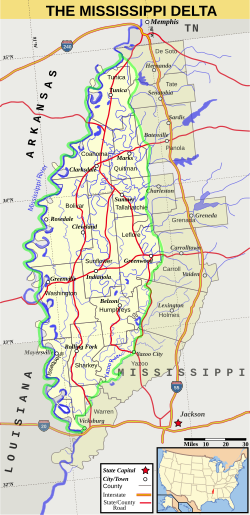
The Mississippi Delta (not to be confused with the Mississippi River Delta in Louisiana)

Delta blues is one of the earliest-known styles of blues. It originated in the Mississippi Delta and is regarded as a regional variant of country blues. Guitar and harmonica are its dominant instruments; slide guitar is a hallmark of the style. Vocal styles in Delta blues range from introspective and soulful to passionate and fiery.

Origin

[edit]

Although Delta blues certainly existed in some form or another at the turn of the twentieth century, it was first recorded in the late 1920s, when record companies realized the potential African-American market for "race records". The major labels produced the earliest recordings, consisting mostly of one person singing and playing an instrument. Live performances, however, more commonly involved a group of musicians. Record company talent scouts made some of the early recordings on field trips to the South, and some performers were invited to travel to northern cities to record. Current research suggests that Freddie Spruell is the first Delta blues artist to have been recorded; his "Milk Cow Blues" was recorded in Chicago in June 1926.[1] According to Dixon and Godrich (1981), Tommy Johnson and Ishmon Bracey were recorded by Victor on that company's second field trip to Memphis, in 1928. Robert Wilkins was first recorded by Victor in Memphis in 1928, and Big Joe Williams and Garfield Akers by Brunswick/Vocalion, also in Memphis, in 1929.

Charley Patton recorded for Paramount in Grafton, in June 1929 and May 1930. He also traveled to New York City for recording sessions in January and February 1934.

Son House first recorded in Grafton, Wisconsin, in 1930 for Paramount Records.[2]

Robert Johnson recorded his only sessions, in San Antonio in 1936 and in Dallas in 1937, for ARC. Many other artists were recorded during this period.

Subsequently, the early Delta blues (as well as other genres) were extensively recorded by John Lomax and his son Alan Lomax, who crisscrossed the southern U.S. recording music played and sung by ordinary people, helping establish the canon of genres known today as American folk music. Their recordings, numbering in the thousands, now reside in the Smithsonian Institution. According to Dixon and Godrich (1981) and Leadbitter and Slaven (1968), Alan Lomax and the Library of Congress researchers did not record any Delta bluesmen or blueswomen prior to 1941, when he recorded Son House and Willie Brown near Lake Cormorant, Mississippi, and Muddy Waters at Stovall, Mississippi. However, among others, John and Alan Lomax recorded Lead Belly in 1933,[3] and Bukka White in 1939.[4]

Female performers

[edit]

In big-city blues, female singers such as Ma Rainey, Bessie Smith, and Mamie Smith dominated the recordings of the 1920s.[5] Although very few women were recorded playing Delta blues and other rural or folk-style blues, many performers did not get professionally recorded.

Geeshie Wiley was a blues singer and guitar player who recorded six songs for Paramount Records that were issued on three records in April 1930. According to the blues historian Don Kent, Wiley "may well have been the rural South's greatest female blues singer and musician".[6]

Memphis Minnie was a blues guitarist, vocalist, and songwriter whose recording career lasted for more than three decades. She recorded approximately 200 songs, some of the best known being "Bumble Bee", "Nothing in Rambling", and "Me and My Chauffeur Blues".

Bertha Lee was a blues singer, active in the 1920s and 1930s. She recorded with and was the common-law wife of, Charley Patton.[7]

Rosa Lee Hill, daughter of Sid Hemphill, learned guitar from her father and by the time she was ten, was playing at dances with him.[8] Several of her songs, such as "Rolled and Tumbled", were recorded by Alan Lomax between 1959 and 1960.[9] In the late 1960s, Jo Ann Kelly (UK) started her recording career.[10] In the 1970s, Bonnie Raitt and Phoebe Snow performed blues.[11]

Bonnie Raitt, Susan Tedeschi and Rory Block are contemporary female blues artists, who were influenced by Delta blues and learned from some of the most notable of the original artists still living. Sue Foley and Shannon Curfman also performed blues music.

Influence

[edit]

Many Delta blues artists, such as Big Joe Williams, moved to Detroit and Chicago, creating a pop-influenced city blues style. This was displaced by the new Chicago blues sound in the early 1950s, pioneered by Delta bluesmen Muddy Waters, Howlin' Wolf, and Little Walter, that was harking back to a Delta-influenced sound, but with amplified instruments.

Delta blues was also an inspiration for the creation of British skiffle music, from which eventually came the British invasion bands, while simultaneously influencing British blues that led to the birth of early hard rock and heavy metal.

See also

[edit]

References

[edit]

Bibliography

[edit]
[edit]
Revisions and contributorsEdit on WikipediaRead on Wikipedia
from Grokipedia
Delta blues is a pioneering style of American blues music that emerged in the rural region during the late 19th and early 20th centuries, characterized by its raw, emotive solo performances featuring —often played with a slide or bottleneck technique—and intense, improvisational vocals that convey personal hardship, love, and resilience. Rooted in African American traditions such as work songs, field hollers, , and rhythmic chants from and levee camps, the genre blended these elements with European folk influences to create a distinctive sound marked by the AAB lyrical structure, pentatonic scales, blue notes, and polyrhythms. The style developed amid the socio-economic challenges of the post-Civil War , including , , racial oppression, and like floods, which inspired lyrics reflecting the struggles of African American communities in the fertile but unforgiving Delta landscape. By the 1890s, it had taken shape in juke joints and informal gatherings, with the first commercial recordings appearing in the 1920s, capturing a golden age of that peaked creatively through the 1930s. Pioneering artists like (1887–1934), often called the "Father of the Delta Blues" for his virtuosic guitar work and gritty vocals, laid the foundation, influencing figures such as (1902–1988), whose bottleneck slide playing exemplified the style's intensity, and (c. 1911–1938), renowned for haunting songs like "" that blended myth and raw emotion. As musicians migrated northward during the Great Migration, Delta blues evolved into electrified forms, notably , through artists like (1913–1983), who amplified the raw Delta sound with bands featuring harmonica, drums, and horns, profoundly shaping , , and global . Today, the genre's legacy endures through preservation efforts, such as the and commemorative sites, honoring its role as a foundational expression of African American cultural resilience and creativity.

History

Origins

Delta blues emerged in the early from the musical traditions of African American sharecroppers and laborers in the rural , particularly drawing on work songs, field hollers, and that had sustained communities since the late . These forms originated in the grueling labor of and levee camps, where call-and-response patterns and improvised vocalizations allowed workers to coordinate tasks and express hardship, laying the rhythmic and emotional foundation for the ' distinctive structure. Field hollers, with their unbound, melismatic cries, contributed the ' signature "blue notes" and tonal bends, while infused a sense of resilience and communal storytelling. The genre's roots extended further into post-Civil War African American folk traditions, including ring shouts and secular songs that blended sacred and profane elements in the late . Ring shouts, derived from West and Central African circular dances adapted into during , preserved polyrhythmic clapping, stamping, and antiphonal singing that echoed in blues improvisation and intensity. Secular songs, often performed at social gatherings after , incorporated everyday narratives of , migration, and toil, evolving from rural folk traditions and ballads into more personal expressions by the 1890s. These traditions provided Delta blues with its raw, emotive delivery, bridging spiritual fervor and worldly lament. Geographically centered in the fertile but flood-prone —a vast alluvial plain between Memphis and Vicksburg—Delta blues developed amid isolation and poverty, where African American communities formed tight-knit networks around . Early performances occurred informally at juke joints (small roadside establishments offering music and ), weekend picnics, fish fries, and house parties, serving as vital social outlets for sharecroppers after long workweeks. These venues, often lit by lanterns and powered by homemade instruments, fostered a raw acoustic style adapted to the Delta's humid nights and communal rhythms. By the , itinerant musicians in the Delta began blending these rural folk elements into proto-blues forms, traveling between plantations and towns to perform for tips or goods, thus disseminating and refining the style before its wider documentation. These wandering players, often self-taught on homemade guitars or harmonicas, fused local hollers with emerging chord progressions, creating the intense, solo-oriented sound that defined Delta blues as a precursor to broader electric and urban variants.

Early Recordings and Development

The commercialization of Delta blues began with the first known recording of the style, Freddie Spruell's "Milk Cow Blues," cut in on June 25, 1926, and released by . This track, backed with "Muddy Water Blues" recorded later that year, marked the entry of rural guitar traditions into the commercial "race records" market targeted at African American audiences. In the late 1920s, major labels such as Paramount, Victor, and Brunswick intensified their involvement in recording Delta blues during the peak of the race records era, conducting sessions in key Southern and Midwestern cities including Memphis, , and . Paramount, based in , scouted talent through agents like H.C. Speir and recorded pivotal Delta artists at its Grafton studio, releasing sides in its 12000/13000 race series starting in 1922 and peaking with rural guitarists by 1929. Victor's V-38500 race series captured Southern field trips featuring Delta-influenced performers, while Brunswick's 7000 series, bolstered by its 1924 acquisition of Vocalion, documented both urban and rural blues in studios. These efforts, driven by the growing African American consumer base, brought performers like into the studio for commercial releases. Field recordings by folklorists John and , commencing in 1933 under the auspices of the Library of Congress's Archive of American Folk-Song, preserved uncommercialized Delta blues traditions among rural and incarcerated Southern musicians. Their expeditions, using portable recorders, captured work songs, ballads, and blues from prisoners like Huddie Ledbetter () at Louisiana's Penitentiary in 1933, and later extended to the in 1941 and 1942, documenting figures such as and in rural communities and on plantations. The Great Depression severely curtailed Delta blues recordings by the early 1930s, with label sales plummeting from 104 million units in 1927 to 10 million in 1930, leading to the closure of studios like Paramount's in 1932. By the 1940s, widespread urban migration during and after shifted Delta musicians northward, fostering stylistic hybridization as rural sounds blended with electrified urban blues in cities like .

Musical Characteristics

Instrumentation and Techniques

The Delta blues tradition is characterized by the predominant use of the as its central instrument, often played solo or in sparse duo arrangements to evoke a raw, intimate sound reflective of the Delta's rural settings. Pioneers like and employed fingerpicking combined with slide techniques, using everyday objects such as glass bottlenecks, metal slides, pocket knives, or even razor blades pressed against the strings to produce dissonant, wailing tones that mimicked human cries and heightened emotional intensity. This bottleneck or knife-edge slide method, sliding along the neck without , created a fluid, vocal-like melody line that intertwined closely with the singer's delivery, distinguishing Delta blues from more structured regional styles. The harmonica served as an occasional secondary instrument in Delta blues, providing rhythmic chugs or melodic interjections to support the guitar in solo or duo performances, rather than dominating the ensemble. Players like Tommy Johnson integrated it sparingly for call-and-response effects or to fill gaps, using cross-harp positioning on diatonic models to draw out bent notes that echoed the guitar's raw timbre, though full bands with dedicated harmonica leads were rare in the Delta context. To compensate for the absence of drum kits or larger bands, Delta blues musicians incorporated percussive elements through foot stomping on wooden floors or tapping and slapping the guitar body, generating a propulsive that simulated a bass-drum and snare accents. , for instance, frequently used palm slaps against the guitar's soundboard during intense passages, adding a visceral, makeshift percussion layer that amplified the music's urgent, energy in juke joints. Guitarists often employed alternate open tunings, such as open G (D-G-D-G-B-D) or open D (D-A-D-F#-A-D), to simplify slide playing and enable resonant chord voicings without barring every fret, facilitating the genre's characteristic droning bass lines and fluid glissandos. These tunings, popularized by figures like , allowed for easier execution of fingerpicking patterns alongside slides, producing a full, booming tone on inexpensive steel-string acoustics despite the lack of amplification.

Style and Structure

Delta blues distinguishes itself through a looser adherence to conventional structures, often diverging from the rigid 12-bar framework prevalent in later styles. Instead, it frequently employs an AAB lyrical pattern, where the first line is repeated before resolving into a contrasting third line, allowing for improvised variations that enhance its spontaneous, expressive quality. This freer form accommodates irregular phrase lengths, such as extended or truncated bars (e.g., 13 or 16 bars), reflecting the improvisational nature of performances rooted in oral traditions. Harmonically, Delta blues emphasizes emotional depth through the use of minor keys alongside the standard I-IV-V progressions, incorporating blue notes—particularly the flattened third and seventh—which introduce microtonal inflections and tension. These elements, combined with dissonant chords and dominant seventh substitutions, create a raw intensity that evokes melancholy and urgency, setting it apart from more resolved harmonic schemes in other blues variants. Vocal delivery in Delta blues spans a spectrum from guttural shouts and anguished moans to more subdued, introspective croons, drawing from field hollers and work songs with techniques like note bending and sliding for emotive effect. Even in solo settings, performers maintain a call-and-response dynamic, where the voice interacts with the guitar—often via slide techniques—to mimic interplay and heighten the music's conversational feel. The genre's typically unfolds in slow to mid-tempos, fostering a hypnotic groove punctuated by that accentuates off-beats and generates propulsion. This rhythmic complexity traces back to African polyrhythmic influences, manifesting in cross-rhythms and subtle percussive elements like string snapping on guitar, which contribute to the style's driving yet erratic energy.

Lyrics and Themes

Delta blues lyrics frequently centered on poignant themes that captured the hardships of African American life in the rural , including , , , wandering, and elements such as hoodoo practices, crossroads deals, and encounters with the . emerged as a dominant motif, reflecting economic exploitation, drudgery, and post-emancipation struggles for survival. portrayed emotional betrayal, abandonment, and longing, often intertwined with themes of personal loss and relational despair. appeared in expressions of mortality, , and , underscoring existential anguish. Wandering symbolized mobility, escape, and the search for or better prospects, contrasting confinement with the of travel. elements drew from folk beliefs, incorporating omens, spirits, and mystical forces as explanations for misfortune or as sources of power in daily life. The poetic style of Delta blues employed repetitive, metaphorical language within an AAB structure, where the initial line (A) was restated for emphasis before a rhyming concluding line (B) provided resolution or contrast, fostering a rhythmic call-and-response quality. This form, rooted in oral expression, allowed for hyperbolic and autobiographical narratives that conveyed complex emotions through vivid , irony, and indirection, making the accessible yet symbolically rich. Metaphors often transformed personal woes into universal symbols, such as blues as an overpowering force or journeys as metaphors for life's uncertainties. Delta blues drew heavily from oral traditions, weaving biblical allusions, work chants, and into secular narratives to blend sacred and profane worlds. Biblical references, inherited from , offered inverted lessons on divine intervention or judgment, reframed to address earthly injustices like racial . Work chants from field hollers influenced the call-and-response patterns, embedding communal labor experiences into lyrics that mocked authority or invoked resilience. elements, including figures and West African-derived superstitions, enriched themes of resistance and , transforming myths into tools for navigating secular challenges. Thematically, Delta blues evolved from relative optimism in the early 1920s, with migration songs celebrating northern opportunities and individual agency during the Great Migration, to profound despair in the amid the Great Depression's economic collapse, floods, and deepened racial inequities. This shift mirrored broader societal changes, moving from hopeful narratives of escape and mobility to urgent expressions of survival, dislocation, and unrelenting hardship.

Notable Performers

Pioneering Male Artists

, born in 1891 in , and died in 1934, is widely regarded as the "Father of the Delta Blues" for his pioneering role in shaping the genre's raw, energetic style during the 1920s and early 1930s. Moving to the as a child, Patton developed a loud, percussive guitar technique and a booming voice that defined his dynamic live performances, often involving acrobatic movements and crowd engagement in juke joints. His first recording session in 1929 for Paramount Records produced "Pony Blues," a seminal track that showcased his rhythmic and became a cornerstone of Delta blues repertoire, influencing subsequent generations of musicians. Eddie James "Son" House Jr., born around 1902 near Lyon, Mississippi, and died in 1988, emerged as a key figure in Delta blues through his intense, trance-like performances blending raw with passionate, gospel-inflected vocals. Recording for Paramount in 1930, House captured the genre's emotional depth in tracks that emphasized personal turmoil and spiritual conflict, reflecting his own divided life between preaching and the . His style, marked by repetitive rhythms and open tunings, profoundly shaped the Delta sound, though he largely retired after the 1940s until his rediscovery in 1964, which revived interest in his foundational contributions. Robert Johnson, born in 1911 near , and died in 1938, stands as a mythic cornerstone of Delta blues, known for his 29 recordings made in 1936 and 1937 that fused intricate fingerpicking guitar with haunting, poetic lyrics exploring themes of love, travel, and supernatural dread. Tracks like "," recorded in in November 1936, exemplify his sophisticated technique and evocative storytelling, drawing from influences such as and while elevating the genre's emotional complexity. Johnson's brief career and legends of a crossroads pact with the devil amplified his aura, cementing his status as a transformative voice in the 1930s Delta tradition. Other pivotal male artists included Nehemiah Curtis "Skip" James, who recorded in 1931 for Paramount with his signature high-pitched and eerie, minor-key guitar in "Devil Got My Woman," a stark expression of heartbreak that highlighted a more haunting variant of Delta blues. Similarly, Booker T. Washington "Bukka" White, born in 1906 in , contributed a narrative-driven approach in his 1937 recordings, including "Parchman Farm Blues," which drew from his experiences in the Mississippi penitentiary and added vivid, elements to the genre's percussive slide style. These figures, active primarily in the and , collectively established the male-dominated foundations of Delta blues through their innovative techniques and regional performances.

Female Artists

Women in Delta blues have often been underrepresented in historical narratives, despite their vital contributions to the genre's raw emotional depth and guitar-driven intensity during its formative years in the early . These artists navigated a landscape dominated by male performers, bringing unique perspectives through their lyrics and musicianship that highlighted themes of resilience and personal struggle. One of the most prolific figures was , born Lizzie Douglas on June 3, 1897, in the region near Walls, where she grew up in Tunica and DeSoto counties. A masterful guitarist and singer, she began performing as a teenager alongside local musicians like Willie Brown and moved to Memphis in the 1910s, adopting her stage name from the city's vibrant scene. Minnie recorded over 200 sides starting in 1929, initially in a raw Delta style characterized by her aggressive and spirited vocals; notable early works include the 1929 hit "Bumble Bee," a duet with her husband , and "," which captured the flood's devastation with haunting urgency. By the 1930s, after relocating to , she transitioned toward an electrified urban blues sound while retaining Delta roots, influencing generations through her showmanship and technical prowess, such as defeating male competitors like in guitar battles. Geeshie Wiley, born Lillie Mae Wiley around 1908, remains one of the most enigmatic Delta blues artists, known primarily for her sparse but profoundly influential recordings made in 1930. Accompanied by fellow guitarist Elvie Thomas on several tracks, Wiley's six Paramount sides feature haunting work and minor-key melodies that evoke and field hollers, blending pre- lament with sophisticated fingerpicking. Her signature "Last Kind Words Blues" (1930) stands out for its eerie, doom-laden tone and innovative bass rhythms, often described as a masterpiece of rural that signified fate and sacrifice through veiled, signifying lyrics. Little is documented about Wiley's life beyond these sessions in ; research in 2014 revealed possible marriage to Thornton Wiley and later residences in and into the late 1950s, though details remain uncertain and no confirmed death record exists. Elvie Thomas, born L.V. Thomas in 1891 in but active in circles, complemented Wiley in their duo, contributing floating, melodic guitar lines on tracks like "Motherless Child Blues" (1930), which drew from work songs and emphasized emotional isolation. Their partnership represented a rare "feminizing force" in the male-centric Delta tradition, with surviving records—only a handful of which exist—highlighting their technical and thematic innovation. Other notable contributors include Bertha Lee, born in 1902 in the , who emerged as a powerful vocalist in the late and early , recording a dozen sides that showcased her dynamic, gospel-inflected delivery rooted in Delta expressiveness. Active until Patton's death in 1934, she brought a woman's viewpoint to themes of hardship and relationships in her performances around Lula and . Rosa Lee Hill, born September 25, 1910, in Como, Mississippi, grew up in a musical family as the daughter of fiddler Sid Hemphill and learned guitar by age ten, playing for both Black and white audiences in the hill country near the Delta. Her style echoed North Mississippi's raw, percussive blues; she was captured in field recordings by in 1959, performing songs like "Rolled and Tumbled" with driving rhythms and autobiographical lyrics that preserved family traditions from the onward. Female Delta blues artists faced profound gender barriers in the and , including exclusion from male-dominated juke joints where performances often turned rowdy and unsafe for women, limiting their live opportunities in the Delta's rural social hubs. The recording industry, controlled by labels targeting male artists, further marginalized them, with women like overcoming through exceptional skill but still receiving less promotion than peers; by the late , visibility for rural blueswomen declined amid economic hardship and shifting tastes toward urban styles. These obstacles underscored their resilience, paving brief influences on later female interpreters who drew from Delta roots in eras.

Later Interpreters and Revivers

, born McKinley Morganfield on April 4, 1913, near , grew up in the heart of the Delta on the Stovall plantation near Clarksdale, where he immersed himself in the raw acoustic style of local bluesmen like and . As a self-taught guitarist and harmonica player, he performed at house parties in the Delta region during the 1930s and early 1940s, capturing the essence of rural blues through techniques. His earliest recordings, made in 1941 by folklorist for the , documented this acoustic Delta sound on tracks like "I Be's Troubled" and "Country Blues," which later influenced his electrified hit "Rollin' Stone" in 1950. Relocating to in 1943 amid the Great Migration, Waters amplified the Delta style with electric guitar starting in 1944, pioneering through releases such as "I Can't Be Satisfied" (1948), thereby transforming rural traditions into an urban powerhouse. Howlin' Wolf, born Chester Arthur Burnett around June 10, 1910, near , honed his ferocious vocals, harmonica, and guitar under the mentorship of Delta legend while working on Dockery's plantation as a teenager. Influenced by Patton's intense performances and incorporating elements of yodeling from , Wolf developed a signature howling style rooted in Delta expressiveness during the 1920s and 1930s. After military service and establishing a radio presence in , in the late 1940s, he moved to in 1954, where he collaborated with producers like and guitarist to electrify his Delta heritage. Tracks like "Moanin' at Midnight" and "How Many More Years" (1951) and "" (1956) exemplified this bridge to urban blues, with their primal energy influencing subsequent rock acts. The 1960s folk revival played a pivotal role in rediscovering Delta blues, most notably through the 1964 Newport Folk Festival, where Son House (Eddie James House Jr., 1902–1988) performed alongside rediscovered contemporaries like Skip James and Mississippi John Hurt in the festival's Blues Workshop. House, a core Delta figure known for his trance-like slide guitar and passionate delivery on songs like "Death Letter," had largely faded from prominence after the 1930s but was sought out by young enthusiasts, leading to his electrifying Newport set that July. This event, organized by festival founder George Wein, not only revived House's career but also exposed original Delta artists to a youthful audience, fueling the British blues explosion among bands like the Rolling Stones and Cream who drew directly from these roots. In more recent decades, artists like Rory Block and Keb' Mo' have actively preserved acoustic Delta traditions through dedicated tributes and original compositions. Rory Block, a Grammy-nominated and vocalist, has earned acclaim as a foremost authority on pre-war , releasing tribute albums such as Blues Walkin' Like a Man: A Tribute to (2008) and Shake 'Em On Down: A Tribute to (2011), where she meticulously recreates slide techniques and raw Delta narratives. Her work, including interpretations of 's repertoire praised by his family, emphasizes faithful transmission of the genre's emotional depth and fingerpicking styles. Similarly, Keb' Mo' (Kevin Moore, born 1951), whose self-titled 1994 debut evoked the sparse intensity of Delta pioneers like and , has sustained acoustic traditions in a contemporary context, blending them with folk and roots elements on albums like Slow Down (1998). Recognized with multiple Music Awards, including Acoustic Artist of the Year in 2025, Keb' Mo' serves as a modern steward, ensuring Delta blues' haunting lyricism and guitar work remain vital.

Cultural and Social Context

The Mississippi Delta Environment

The , encompassing the northwestern region of Mississippi between the to the west and the to the east, is an formed by centuries of river sediment deposition, creating some of the most fertile soils in the United States ideal for cultivation. This flat, expansive , roughly 200 miles long and up to 70 miles wide, supported vast plantations that dominated the landscape and rural economy from the antebellum period onward, shaping the daily rhythms of agricultural life in the region. However, the area's fertility came at the cost of vulnerability to frequent flooding from the , which both enriched the soil and threatened livelihoods through destructive overflows. Born in the flat, humid rural cotton fields of the Mississippi Delta, the genre's raw slide guitar and mournful lyrics reflect the harsh agricultural life and vast, oppressive openness of the landscape. Social life in the Delta revolved around informal communal venues that served as vital outlets for expression and entertainment amid the rigors of plantation work. Juke joints—makeshift rural shacks often equipped with a bar, dance floor, and minimal furnishings—emerged as primary spaces for live music performances, where musicians played for tips and crowds gathered to dance and socialize late into the night. Saturday night fish fries, held outdoors or in community spaces following the week's labor, featured grilled fish, communal meals, and impromptu music sessions that fostered and musical exchange among locals. camps, temporary settlements along the riverbanks housing workers repairing or building flood barriers, also doubled as performance sites, with blues artists entertaining laborers during off-hours in these isolated work environments. The agricultural labor cycles of planting, chopping, and harvesting dictated much of daily existence in the Delta, leaving workers exhausted during the week but freeing weekends for community gatherings that preserved oral traditions and music. The region's profound rural isolation, far from urban centers like Memphis or New Orleans, reinforced tight-knit communities where music and at these events provided emotional release and cultural continuity. These patterns of communal interaction, tied to the land's demands, helped cultivate the raw, personal style of Delta blues as a reflection of shared experiences. The 1927 Great Flood, one of the most devastating natural disasters in U.S. history, exacerbated the Delta's environmental precariousness when levees broke, inundating over 16 million acres and displacing more than 640,000 people, many from rural communities. This catastrophe scattered families, destroyed homes and crops, and inspired numerous songs that captured the terror of rising waters, loss, and forced migration, embedding themes of resilience and hardship into the genre's repertoire. The flood's aftermath highlighted the floodplain's dual role as a bountiful yet perilous cradle for Delta culture.

Racial and Economic Influences

The , enacted in the post-Reconstruction South, enforced strict and disenfranchisement of , creating a system of legal and social oppression that profoundly shaped the lived experiences of Delta blues musicians. These laws, combined with the system, trapped many Black families in cycles of debt peonage, where tenant farmers were bound to plantations through perpetual indebtedness to white landowners, limiting economic mobility and fostering widespread poverty in the region. Pioneering Delta blues artists like emerged from these sharecropping communities, such as Dockery Farms, where the exploitative labor conditions directly informed the raw emotional intensity of their music. Economic pressures intensified these racial constraints, particularly through the boll weevil infestation that ravaged cotton crops starting in the early 1900s, devastating the Delta's primary agricultural economy and inspiring songs like Patton's "Mississippi Boweavil Blues" as laments for lost livelihoods. The Great Depression from 1929 to 1939 further exacerbated these hardships by collapsing cotton prices and increasing unemployment among sharecroppers, while the rise of mechanized farming in the 1930s displaced manual laborers, prompting widespread migration within the South to seek work. This economic turmoil not only strained family units but also fueled the itinerant lifestyle of many blues performers, who traveled between plantations and juke joints to earn meager wages. Delta blues served as a vital outlet for resistance against the era's pervasive racial and exploitation, allowing musicians to voice frustrations with , systemic , and in coded or direct lyrics that defied without immediate reprisal. like "Stagger Lee" portrayed folk heroes who resisted oppression, reflecting a broader tradition where blues articulated despair over social inequities while fostering communal in segregated spaces. These thematic reflections on often intertwined personal hardship with broader societal critiques, as seen in narratives of economic and racial terror. Gender dynamics within the Delta blues scene were heavily influenced by intersecting patriarchal and racial norms, which restricted women's public performance opportunities compared to men, confining many to domestic roles or informal settings amid Jim Crow-era expectations of Black female subservience. While a few women like broke through with bold recordings, they faced harsher scrutiny and punishment for defying stereotypes—such as expressing sexual agency—exacerbated by racial biases that labeled outspoken as unrespectable. Patriarchal structures in both white and Black communities limited women's access to professional circuits, reinforcing their marginalization in a dominated by male narratives of mobility and rebellion.

Legacy and Influence

Evolution into Other Blues Styles

The Great Migration, spanning from the 1910s to the 1940s, saw hundreds of thousands of , including Delta blues musicians, relocate from rural to northern industrial cities like in search of better economic opportunities and to escape racial violence. This mass movement fundamentally altered Delta blues, as artists adapted their solitary styles to urban environments by incorporating electric amplification to compete with louder city noise and larger audiences in clubs. Pioneers such as , who arrived in in 1943, began electrifying their raw, emotive Delta sound, blending it with the amplified guitars that had emerged in . By the late 1940s, this adaptation evolved into , a more robust ensemble style characterized by electric guitars, harmonicas, drums, and bass, which amplified the gritty intensity of Delta roots into a band-oriented format suitable for urban nightlife. and were central to this shift; Waters' recordings with in the early 1950s, such as those featuring full band arrangements, popularized the electric sound, while Wolf's powerful vocals and harmonica work brought Delta ferocity to Chicago stages. This ensemble approach, solidifying by the 1950s, transformed the intimate, solo Delta tradition into a collective, amplified genre that dominated post-war blues scenes. Delta blues also influenced other regional styles through parallel migration patterns, as musicians carried southern traditions northward and westward. These evolutions maintained Delta's emotional core while adapting to local contexts, such as mills and camps. A pivotal transitional recording was ' "I Can't Be Satisfied," released in 1948 on Aristocrat Records, which retained Delta rawness in its but introduced electric polish and urban production, signaling the bridge to . This track exemplified how Delta artists like Waters, originally mentored by figures such as , reshaped their heritage for northern audiences.

Impact on Broader Music Genres

Delta blues exerted a profound influence on the of the 1960s, where British rock bands rediscovered and adapted its raw, emotive style, fusing it with electric rock to create blues-rock. Groups such as and Led frequently covered Delta blues pioneers like , with the Stones incorporating Johnson's "" on their 1969 album , and Led Zeppelin drawing from Johnson's "" in their 1969 sessions, amplifying the genre's haunting guitar riffs and lyrical intensity for a global rock audience. This Delta foundation permeated broader rock music, particularly through slide guitar techniques and emotional depth that shaped artists like Eric Clapton and the Yardbirds. Clapton, inspired by Johnson's intricate fingerpicking and slide work, emulated these elements in his playing with the Yardbirds and later Cream, as seen in their 1966 cover of Skip James's Delta blues standard "I'm So Glad" on the album Fresh Cream, which highlighted the genre's raw power in a psychedelic rock context. The Yardbirds' experimentation with distorted slide guitar further bridged Delta blues to hard rock, influencing the genre's evolution. Even heavy metal traced roots to Delta blues' dark intensity; Black Sabbath drew from the eerie, dissonant tones of Delta artists like Skip James, whose "Devil Got My Woman" echoed in Sabbath's brooding riffs and occult themes on their 1970 debut album. In the folk revival of the , Delta blues inspired a renewed interest in acoustic roots music, with artists like integrating its narrative style and highway imagery into folk-rock. Dylan's 1965 album , named after the iconic Delta route, blended Johnson's mythic storytelling with electric folk arrangements, as in "Highway 61 Revisited," helping popularize Delta blues among white folk audiences and bridging rural blues traditions with urban protest songs. also absorbed Delta blues' improvisational spirit and rhythmic drive, though figures like , rooted in Delta traditions, extended its influence into jazz-blues hybrids; Hooker's boogie-infused tracks like "Boom Boom" (1962) incorporated swing and call-and-response patterns, influencing musicians through shared performance circuits in post-war and beyond. The global legacy of Delta blues endures through cultural institutions and events that preserve and export its traditions. The Mississippi Delta Blues & Heritage Festival, held annually in Greenville since 1978, showcases Delta artists and draws international visitors, fostering cross-cultural appreciation of the genre's origins and evolution. While not formally recognized by as intangible heritage, Delta blues' worldwide dissemination via recordings and revivals has cemented its role in shaping diverse musical expressions from African rhythms to contemporary global fusions.

References

Add your contribution
Related Hubs
User Avatar
No comments yet.