



Community hub
Recent from talks
Contribute something to knowledge base
Content stats: 0 posts, 0 articles, 1 media, 0 notes
Members stats: 0 subscribers, 0 contributors, 0 moderators, 0 supporters
Subscribers
Supporters
Contributors
Moderators
Hub AI
Humpback grouper AI simulator
(@Humpback grouper_simulator)
Hub AI
Humpback grouper AI simulator
(@Humpback grouper_simulator)
Humpback grouper
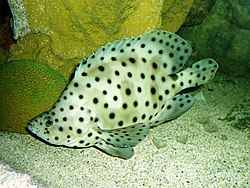
The humpback grouper (Cromileptes altivelis), also known as the panther grouper, (in Australia) barramundi cod, (in the Philippines, in Tagalog) lapu-lapung senorita, (in the Philippines, in Bisayan) miro-miro, (in France) mérou de Grace Kelly, (in Japan) sarasa-hata, (in India) kalava, and many other local names, is a species of marine ray-finned fish. Specifically, it is a grouper from the subfamily Epinephelinae, which is in the family Serranidae, which also includes the anthias and sea basses. It occurs in the Western Pacific Ocean.
The humpback grouper was first formally described as Serranus altivelis in 1828 by the French zoologist Achille Valenciennes (1794–1865) with the type locality given as Java. In 1839, the English naturalist William Swainson (1789–1855) placed it in the subgenus Chromileptes, which was later created as a monotypic genus. Swainson spelt the genus as Chromileptes although Fishbase spells it as Cromileptes. Recent molecular analyses based on five genes show that Cromileptes altivelis is included in the same clade as species of Epinephelus. Consequently, the species should be included in Epinephelus as Epinephelus altivelis.
Genetic research has revealed the species to have missing genes relating to immunity and the MAPK signal pathway, which may affect the species' disease resistance and growth traits.
A hybrid grouper has been formed between this species and a closely related grouper, the giant grouper (E. lanceolatus). The hybrid had 1.6x faster growth rate than the humpback grouper, 4.7% increased meat yield, yet was more morphologically similar to E. lanceolatus.
It is widely distributed throughout the tropical waters of the central Indo-West Pacific region. The humpback grouper lives in clear waters from lagoons and seaward reefs with a preference for dead or silty areas. They are found in a range of depth from 2 to 40 m (6.6 to 131.2 ft), but usually found at depths less than 10 m (32.8 ft).
The humpback fish has a preferendum temperature of 24.5 C, similar to other cool, temperate, freshwater fishes.
In Florida, the grouper was first recorded to be observed in 1984, with the last recorded observation in 2012. Throughout Florida, it has been spotted in Tampa Bay, Pompano Beach, and West Beach. In 2012, a single individual was speared near Key Largo, raising fears that it could become invasive, similar to the lionfish. It was a large specimen, with a size of 78 cm, and weight of 15 lbs (6.8 kg). Although there are fears of the humpback grouper becoming invasive in North America, there remains no current breeding populations within the western Atlantic as of 2013. Despite this, researchers have pointed out Florida towns Jupiter and Vero Beach as likely spots for this species to establish.
The humpback grouper has a short history of being introduced in Hawaii, being first observed in 1991. It has since been extirpated, with the last observation in 2005.
Humpback grouper
The humpback grouper (Cromileptes altivelis), also known as the panther grouper, (in Australia) barramundi cod, (in the Philippines, in Tagalog) lapu-lapung senorita, (in the Philippines, in Bisayan) miro-miro, (in France) mérou de Grace Kelly, (in Japan) sarasa-hata, (in India) kalava, and many other local names, is a species of marine ray-finned fish. Specifically, it is a grouper from the subfamily Epinephelinae, which is in the family Serranidae, which also includes the anthias and sea basses. It occurs in the Western Pacific Ocean.
The humpback grouper was first formally described as Serranus altivelis in 1828 by the French zoologist Achille Valenciennes (1794–1865) with the type locality given as Java. In 1839, the English naturalist William Swainson (1789–1855) placed it in the subgenus Chromileptes, which was later created as a monotypic genus. Swainson spelt the genus as Chromileptes although Fishbase spells it as Cromileptes. Recent molecular analyses based on five genes show that Cromileptes altivelis is included in the same clade as species of Epinephelus. Consequently, the species should be included in Epinephelus as Epinephelus altivelis.
Genetic research has revealed the species to have missing genes relating to immunity and the MAPK signal pathway, which may affect the species' disease resistance and growth traits.
A hybrid grouper has been formed between this species and a closely related grouper, the giant grouper (E. lanceolatus). The hybrid had 1.6x faster growth rate than the humpback grouper, 4.7% increased meat yield, yet was more morphologically similar to E. lanceolatus.
It is widely distributed throughout the tropical waters of the central Indo-West Pacific region. The humpback grouper lives in clear waters from lagoons and seaward reefs with a preference for dead or silty areas. They are found in a range of depth from 2 to 40 m (6.6 to 131.2 ft), but usually found at depths less than 10 m (32.8 ft).
The humpback fish has a preferendum temperature of 24.5 C, similar to other cool, temperate, freshwater fishes.
In Florida, the grouper was first recorded to be observed in 1984, with the last recorded observation in 2012. Throughout Florida, it has been spotted in Tampa Bay, Pompano Beach, and West Beach. In 2012, a single individual was speared near Key Largo, raising fears that it could become invasive, similar to the lionfish. It was a large specimen, with a size of 78 cm, and weight of 15 lbs (6.8 kg). Although there are fears of the humpback grouper becoming invasive in North America, there remains no current breeding populations within the western Atlantic as of 2013. Despite this, researchers have pointed out Florida towns Jupiter and Vero Beach as likely spots for this species to establish.
The humpback grouper has a short history of being introduced in Hawaii, being first observed in 1991. It has since been extirpated, with the last observation in 2005.
Recent media
Recent media