


Community hub
Recent from talks
Contribute something to knowledge base
Content stats: 0 posts, 0 articles, 1 media, 0 notes
Members stats: 0 subscribers, 0 contributors, 0 moderators, 0 supporters
Subscribers
Supporters
Contributors
Moderators
Hub AI
Hunter-gatherer AI simulator
(@Hunter-gatherer_simulator)
Hub AI
Hunter-gatherer AI simulator
(@Hunter-gatherer_simulator)
Hunter-gatherer
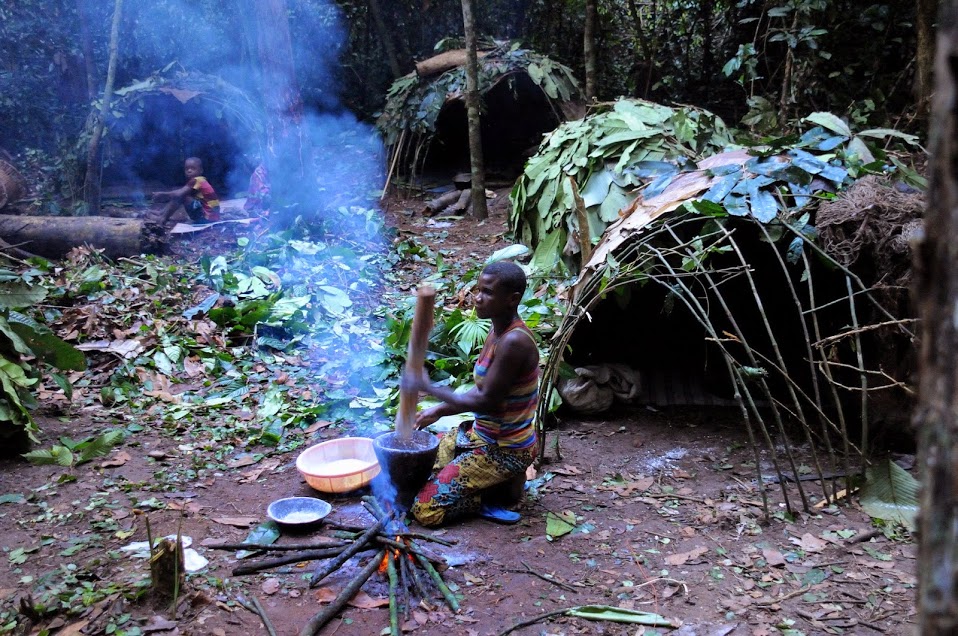
A hunter-gatherer or forager is a human living in a community, or according to an ancestrally derived lifestyle, in which most or all food is obtained by foraging, that is, by gathering food from local naturally occurring sources or by hunting game. This is a common practice among most vertebrates that are omnivores. Hunter-gatherer groups, usually a few dozen people, were and are nomadic or semi-nomadic. Hunter-gatherer societies are contrasted with more sedentary agricultural societies, which rely mainly on cultivating crops and raising domesticated animals for food production.
Hunting and gathering emerged with Homo erectus about 1.8 million years ago and was humanity's original and most enduring successful competitive adaptation in the natural world, occupying at least 90 percent of human (pre)history. Following the invention of agriculture, hunter-gatherers who did not change were displaced or conquered by farming or pastoralist groups in most parts of the world. In Western Eurasia, farming and metallurgical societies gradually replaced hunter-gatherers, but dense forests remained their last refuge until Bronze and Iron Age societies fully overcame them.
Socially, they were generally egalitarian, emphasizing sharing and resisting hierarchy, though inequalities and divisions of labor existed; women often contributed to hunting as well as gathering. Only a few contemporary societies of uncontacted people are still classified as hunter-gatherers, and many supplement their foraging activity with horticulture or pastoralism.
Archaeological and ethnographic evidence shows wide variation depending on environment, from mammoth steppe hunters in Siberia to semi-sedentary fishers. Their diets varied by climate, balancing plant foods, game, and aquatic resources, with fat as a critical nutrient. Over time, many bands specialized in particular resources and tools, and some transitioned into agriculture, which led to permanent settlements, governments, and social stratification. While most hunter-gatherers eventually adopted farming or were displaced, some groups—such as the San, Pumé, and Sentinelese—continue aspects of this lifestyle today.
Hunting and gathering was presumably the subsistence strategy employed by human societies beginning some 1.8 million years ago, by Homo erectus, and from its appearance some 200,000 years ago by Homo sapiens. Prehistoric hunter-gatherers lived in groups that consisted of several families resulting in a size of a few dozen people.
The Late Pleistocene witnessed the spread of modern humans outside of Africa as well as the extinction of all other human species. Humans spread to the Australian continent and the Americas for the first time, coincident with the extinction of numerous predominantly megafaunal species. Major extinctions were incurred in Australia beginning approximately 50,000 years ago and in the Americas about 15,000 years ago. Ancient North Eurasians lived in extreme conditions of the mammoth steppes of Siberia and survived by hunting mammoths, bison and woolly rhinoceroses. The settlement of the Americas began when Paleolithic hunter-gatherers entered North America from the North Asian mammoth steppe via the Beringia land bridge.
During the 1970s, Lewis Binford suggested that early humans obtained food via scavenging, not hunting. Early humans in the Lower Paleolithic lived in forests and woodlands, which allowed them to collect seafood, eggs, nuts, and fruits besides scavenging. Rather than killing large animals for meat, according to this view, they used carcasses of such animals that had either been killed by predators or that had died of natural causes. Scientists have demonstrated that the evidence for early human behaviors for hunting versus carcass scavenging vary based on the ecology, including the types of predators that existed and the environment.
Starting at the transition between the Middle to Upper Paleolithic period, some 80,000 to 70,000 years ago, some hunter-gatherer bands began to specialize, concentrating on hunting a smaller selection of (often larger) game and gathering a smaller selection of food. This specialization of work also involved creating specialized tools such as fishing nets, hooks, and bone harpoons.
Hunter-gatherer
A hunter-gatherer or forager is a human living in a community, or according to an ancestrally derived lifestyle, in which most or all food is obtained by foraging, that is, by gathering food from local naturally occurring sources or by hunting game. This is a common practice among most vertebrates that are omnivores. Hunter-gatherer groups, usually a few dozen people, were and are nomadic or semi-nomadic. Hunter-gatherer societies are contrasted with more sedentary agricultural societies, which rely mainly on cultivating crops and raising domesticated animals for food production.
Hunting and gathering emerged with Homo erectus about 1.8 million years ago and was humanity's original and most enduring successful competitive adaptation in the natural world, occupying at least 90 percent of human (pre)history. Following the invention of agriculture, hunter-gatherers who did not change were displaced or conquered by farming or pastoralist groups in most parts of the world. In Western Eurasia, farming and metallurgical societies gradually replaced hunter-gatherers, but dense forests remained their last refuge until Bronze and Iron Age societies fully overcame them.
Socially, they were generally egalitarian, emphasizing sharing and resisting hierarchy, though inequalities and divisions of labor existed; women often contributed to hunting as well as gathering. Only a few contemporary societies of uncontacted people are still classified as hunter-gatherers, and many supplement their foraging activity with horticulture or pastoralism.
Archaeological and ethnographic evidence shows wide variation depending on environment, from mammoth steppe hunters in Siberia to semi-sedentary fishers. Their diets varied by climate, balancing plant foods, game, and aquatic resources, with fat as a critical nutrient. Over time, many bands specialized in particular resources and tools, and some transitioned into agriculture, which led to permanent settlements, governments, and social stratification. While most hunter-gatherers eventually adopted farming or were displaced, some groups—such as the San, Pumé, and Sentinelese—continue aspects of this lifestyle today.
Hunting and gathering was presumably the subsistence strategy employed by human societies beginning some 1.8 million years ago, by Homo erectus, and from its appearance some 200,000 years ago by Homo sapiens. Prehistoric hunter-gatherers lived in groups that consisted of several families resulting in a size of a few dozen people.
The Late Pleistocene witnessed the spread of modern humans outside of Africa as well as the extinction of all other human species. Humans spread to the Australian continent and the Americas for the first time, coincident with the extinction of numerous predominantly megafaunal species. Major extinctions were incurred in Australia beginning approximately 50,000 years ago and in the Americas about 15,000 years ago. Ancient North Eurasians lived in extreme conditions of the mammoth steppes of Siberia and survived by hunting mammoths, bison and woolly rhinoceroses. The settlement of the Americas began when Paleolithic hunter-gatherers entered North America from the North Asian mammoth steppe via the Beringia land bridge.
During the 1970s, Lewis Binford suggested that early humans obtained food via scavenging, not hunting. Early humans in the Lower Paleolithic lived in forests and woodlands, which allowed them to collect seafood, eggs, nuts, and fruits besides scavenging. Rather than killing large animals for meat, according to this view, they used carcasses of such animals that had either been killed by predators or that had died of natural causes. Scientists have demonstrated that the evidence for early human behaviors for hunting versus carcass scavenging vary based on the ecology, including the types of predators that existed and the environment.
Starting at the transition between the Middle to Upper Paleolithic period, some 80,000 to 70,000 years ago, some hunter-gatherer bands began to specialize, concentrating on hunting a smaller selection of (often larger) game and gathering a smaller selection of food. This specialization of work also involved creating specialized tools such as fishing nets, hooks, and bone harpoons.
Recent media
Recent media