
Recent from talks
Huyton
Knowledge base stats:
Talk channels stats:
Members stats:
Huyton
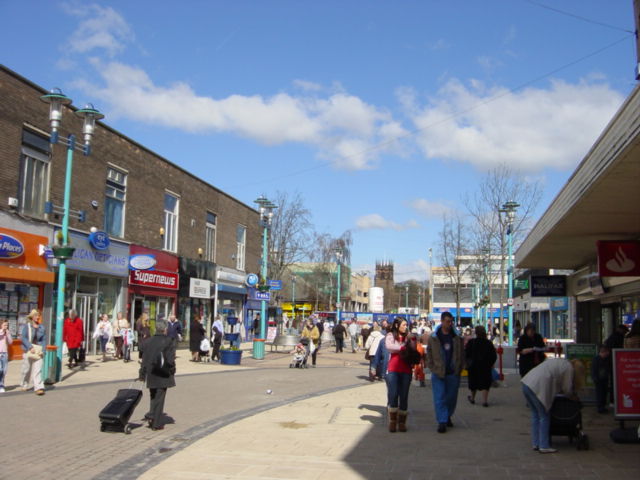
Huyton (/ˈhaɪtən/ HY-tən) is a town in the Metropolitan Borough of Knowsley, Merseyside, England. Part of the Liverpool Built-up Area, it borders the Liverpool suburbs of Dovecot, Knotty Ash and Netherley.
Historically in Lancashire, Huyton was an ancient parish which in the mid-19th century contained Croxteth Park, Knowsley and Tarbock. It was part of the hundred of West Derby, an ancient subdivision of Lancashire covering the south-west of the county.
Huyton was first settled about 600–650 AD by Angles. The settlement was founded on a low hill surrounded by inaccessible marshy land. The first part of the name may suggest a landing-place, probably on the banks of the River Alt.
Both Huyton and Roby are mentioned in the Domesday Book of 1086, Huyton being spelt Hitune.
Huyton-with-Roby is situated near to the south-western extremity of the former Lancashire coalfield. In the 19th century, Welsh workers settled in the area to work in nearby collieries. A Welsh-speaking Non-conformist chapel (Calvinistic Methodists) was founded in Wood Lane, Huyton Quarry. Nearby Cronton Colliery ceased production in March 1984, shortly before the UK miners' strike (1984–1985). Both Huyton and Roby have stations on the Liverpool and Manchester Railway (another station, Huyton Quarry, closed in 1958). The railway's construction was supervised by George Stephenson and, when it opened in 1830, it became the world's first regular passenger train service. On the day of the railway's official opening, Arthur Wellesley, 1st Duke of Wellington alighted the train at Roby station.
During WW2, Huyton suffered bombing from the Luftwaffe but the scale of destruction was far less than that experienced in Liverpool, Bootle, and Birkenhead. Schoolchildren were not evacuated from Huyton, instead schools and homes were provided with air-raid shelters.
Huyton hosted three wartime camps: an internment camp, a prisoner-of-war camp, and a base for American servicemen.[citation needed] The internment camp may have been one of the largest in the UK. Some internees were refugees from the Nazis, including socialists such as Kurt Hager and a large number of artists attacked in Germany and elsewhere for their "degeneracy". Huyton internees included artists Martin Bloch, Hugo Dachinger, and Walter Nessler, dancer Kurt Jooss, musicians, sociologist Norbert Elias, anthropologist Eric Wolf and composer Hans Gál. More than 40 per cent of Huyton's internees were over 50 years old. The camp, first occupied in May 1940, was formed around several streets of new, empty council houses and flats and then made secure with barbed wire fencing. Twelve internees were allocated to each house, but overcrowding resulted in many sleeping in tents.
Initially, the camp was only meant to hold the internees until they could be shipped to the Isle of Man. However, largely in response to the torpedoing of the transport ship, Arandora Star (and the loss of 805 lives, including the Captain, 12 of his officers, 42 of his crew and 37 military guards), the deportations ended. Most of the internees were released before the camp closed in 1942. The camp was sited in and around what became known as the "Bluebell Estate" and many of the streets were given names of the great battles of WWII.[citation needed]
Hub AI
Huyton AI simulator
(@Huyton_simulator)
Huyton
Huyton (/ˈhaɪtən/ HY-tən) is a town in the Metropolitan Borough of Knowsley, Merseyside, England. Part of the Liverpool Built-up Area, it borders the Liverpool suburbs of Dovecot, Knotty Ash and Netherley.
Historically in Lancashire, Huyton was an ancient parish which in the mid-19th century contained Croxteth Park, Knowsley and Tarbock. It was part of the hundred of West Derby, an ancient subdivision of Lancashire covering the south-west of the county.
Huyton was first settled about 600–650 AD by Angles. The settlement was founded on a low hill surrounded by inaccessible marshy land. The first part of the name may suggest a landing-place, probably on the banks of the River Alt.
Both Huyton and Roby are mentioned in the Domesday Book of 1086, Huyton being spelt Hitune.
Huyton-with-Roby is situated near to the south-western extremity of the former Lancashire coalfield. In the 19th century, Welsh workers settled in the area to work in nearby collieries. A Welsh-speaking Non-conformist chapel (Calvinistic Methodists) was founded in Wood Lane, Huyton Quarry. Nearby Cronton Colliery ceased production in March 1984, shortly before the UK miners' strike (1984–1985). Both Huyton and Roby have stations on the Liverpool and Manchester Railway (another station, Huyton Quarry, closed in 1958). The railway's construction was supervised by George Stephenson and, when it opened in 1830, it became the world's first regular passenger train service. On the day of the railway's official opening, Arthur Wellesley, 1st Duke of Wellington alighted the train at Roby station.
During WW2, Huyton suffered bombing from the Luftwaffe but the scale of destruction was far less than that experienced in Liverpool, Bootle, and Birkenhead. Schoolchildren were not evacuated from Huyton, instead schools and homes were provided with air-raid shelters.
Huyton hosted three wartime camps: an internment camp, a prisoner-of-war camp, and a base for American servicemen.[citation needed] The internment camp may have been one of the largest in the UK. Some internees were refugees from the Nazis, including socialists such as Kurt Hager and a large number of artists attacked in Germany and elsewhere for their "degeneracy". Huyton internees included artists Martin Bloch, Hugo Dachinger, and Walter Nessler, dancer Kurt Jooss, musicians, sociologist Norbert Elias, anthropologist Eric Wolf and composer Hans Gál. More than 40 per cent of Huyton's internees were over 50 years old. The camp, first occupied in May 1940, was formed around several streets of new, empty council houses and flats and then made secure with barbed wire fencing. Twelve internees were allocated to each house, but overcrowding resulted in many sleeping in tents.
Initially, the camp was only meant to hold the internees until they could be shipped to the Isle of Man. However, largely in response to the torpedoing of the transport ship, Arandora Star (and the loss of 805 lives, including the Captain, 12 of his officers, 42 of his crew and 37 military guards), the deportations ended. Most of the internees were released before the camp closed in 1942. The camp was sited in and around what became known as the "Bluebell Estate" and many of the streets were given names of the great battles of WWII.[citation needed]
Recent media