Hubbry Logo
BearBearMain
BearBearMain
Open search
Bear
community hub

Bear

#Wikipedia

#Grokipedia

Hub updates

Hub contents (all pages)

Talk channels
chitchatchitchat
Bear
Community hub
Bear
logo
8 pages, 0 posts
0 subscribers
2326471

Community hub

Bear

logo
0 subscribers
8 pages, 0 posts
Recent from talks
All channels
​
Be the first to start a discussion here.
Contribute something
Welcome to the community hub built to collect knowledge and have discussions related to Bear.
family of mammals

From Wikipedia

family of mammals

Media

Notes
0

  • Respect all members: no insults, harassment, or hate speech.
  • Be tolerant of different viewpoints, cultures, and beliefs. If you do not agree with others, just create separate note, article or collection.
  • Clearly distinguish between personal opinion and fact.
  • Verify facts before posting, especially when writing about history, science, or statistics.
  • Promotional content must be published on the “Related Services and Products” page—no more than one paragraph per service. You can also create subpages under the “Related Services and Products” page and publish longer promotional text there.
  • Do not post materials that infringe on copyright without permission.
  • Always credit sources when sharing information, quotes, or media.
  • Be respectful of the work of others when making changes.
  • Discuss major edits instead of removing others' contributions without reason.
  • If you notice rule-breaking, notify community about it in talks.
  • Do not share personal data of others without their consent.
  • Nothing was collected or created yet.

    Bear
    Bear
    Bear
    View on Wikipedia
    from Wikipedia
    Family of carnivoran mammals

    Bears
    Temporal range: 38–0 Ma
    PreꞒ
    Ꞓ
    O
    S
    D
    C
    P
    T
    J
    K
    Pg
    N
    Late Eocene – Recent
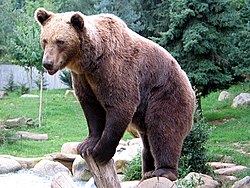
    Brown bear (Ursus arctos)
    Scientific classification Edit this classification
    Kingdom: Animalia
    Phylum: Chordata
    Class: Mammalia
    Order: Carnivora
    Suborder: Caniformia
    Superfamily: Ursoidea
    Family: Ursidae
    G. Fischer de Waldheim, 1817
    Type genus
    Ursus
    Linnaeus, 1758
    Subfamilies
    • †Hemicyoninae
    • †Ursavinae
    • Ailuropodinae (pandas)
    • Tremarctinae (short-faced bears)
    • Ursinae (all other bear species)

    Bears are carnivoran mammals of the family Ursidae (/ˈɜːrsɪdiː, -daɪ/). They are classified as caniforms, or doglike carnivorans. Although only eight species of bears are extant, they are widespread, appearing in a wide variety of habitats throughout most of the Northern Hemisphere and partially in the Southern Hemisphere. Bears are found on the continents of North America, South America, and Eurasia. Common characteristics of modern bears include large bodies with stocky legs, long snouts, small rounded ears, shaggy hair, plantigrade paws with five nonretractile claws, and short tails.

    While the polar bear is mostly carnivorous, and the giant panda is mostly herbivorous, the remaining six species are omnivorous with varying diets. With the exception of courting individuals and mothers with their young, bears are typically solitary animals. They may be diurnal or nocturnal and have an excellent sense of smell. Despite their heavy build and awkward gait, they are adept runners, climbers, and swimmers. Bears use shelters, such as caves and logs, as their dens; most species occupy their dens during the winter for a long period of hibernation, up to 100 days.

    Bears have been hunted since prehistoric times for their meat and fur; they have also been used for bear-baiting and other forms of entertainment, such as being made to dance. With their powerful physical presence, they play a prominent role in the arts, mythology, and other cultural aspects of various human societies. In modern times, bears have come under pressure through encroachment on their habitats and illegal trade in bear parts, including the Asian bile bear market. The IUCN lists six bear species as vulnerable or endangered, and even least concern species, such as the brown bear, are at risk of extirpation in certain countries. The poaching and international trade of these most threatened populations are prohibited, but still ongoing.

    Etymology

    [edit]

    The English word "bear" comes from Old English bera and belongs to a family of names for the bear in Germanic languages, such as Swedish björn, also used as a first name. This form is conventionally said to be related to a Proto-Indo-European word for "brown", so that "bear" would mean "the brown one".[1][2] However, Ringe notes that while this etymology is semantically plausible, a word meaning "brown" of this form cannot be found in Proto-Indo-European. He suggests instead that "bear" is from the Proto-Indo-European word *ǵʰwḗr- ~ *ǵʰwér "wild animal".[3] This terminology for the animal originated as a taboo avoidance term: proto-Germanic tribes replaced their original word for bear—arkto—with this euphemistic expression out of fear that speaking the animal's true name might cause it to appear.[4][5] According to author Ralph Keyes, this is the oldest known euphemism.[6]

    Bear taxon names such as Arctoidea and Helarctos come from the ancient Greek ἄρκτος (arktos), meaning bear,[7] as do the names "arctic" and "antarctic", via the name of the constellation Ursa Major, the "Great Bear", prominent in the northern sky.[8]

    Bear taxon names such as Ursidae and Ursus come from Latin Ursus/Ursa, he-bear/she-bear.[8] The female first name "Ursula", originally derived from a Christian saint's name, means "little she-bear" (diminutive of Latin ursa). In Switzerland, the male first name "Urs" is especially popular, while the name of the canton and city of Bern is by legend derived from Bär, German for bear. The Germanic name Bernard (including Bernhardt and similar forms) means "bear-brave", "bear-hardy", or "bold bear".[9][10] The Old English name Beowulf is a kenning, "bee-wolf", for bear, in turn meaning a brave warrior.[11]

    Taxonomy

    [edit]
    Further information: List of ursids

    The family Ursidae is one of nine families in the suborder Caniformia, or "doglike" carnivorans, within the order Carnivora. Bears' closest living relatives are the pinnipeds, canids, and musteloids.[12] (Some scholars formerly argued that bears are directly derived from canids and should not be classified as a separate family.)[13] Modern bears comprise eight species in three subfamilies: Ailuropodinae (monotypic with the giant panda), Tremarctinae (monotypic with the spectacled bear), and Ursinae (containing six species divided into one to three genera, depending on the authority). Nuclear chromosome analysis show that the karyotype of the six ursine bears is nearly identical, each having 74 chromosomes (see Ursid hybrid), whereas the giant panda has 42 chromosomes and the spectacled bear 52. These smaller numbers can be explained by the fusing of some chromosomes, and the banding patterns on these match those of the ursine species, but differ from those of procyonids, which supports the inclusion of these two species in Ursidae rather than in Procyonidae, where they had been placed by some earlier authorities.[14]

    Evolution

    [edit]
    Plithocyon armagnacensis skull, a member of the extinct subfamily Hemicyoninae from the Miocene

    The earliest members of Ursidae belong to the extinct subfamily Amphicynodontinae, including Parictis (late Eocene to early middle Miocene, 38–18 Mya) and the slightly younger Allocyon (early Oligocene, 34–30 Mya), both from North America. These animals looked very different from today's bears, being small and raccoon-like in overall appearance, with diets perhaps more similar to that of a badger. Parictis does not appear in Eurasia and Africa until the Miocene.[15] It is unclear whether late-Eocene ursids were also present in Eurasia, although faunal exchange across the Bering land bridge may have been possible during a major sea level low stand as early as the late Eocene (about 37 Mya) and continuing into the early Oligocene.[16] European genera morphologically very similar to Allocyon, and to the much younger American Kolponomos (about 18 Mya),[17] are known from the Oligocene, including Amphicticeps and Amphicynodon.[16] There has been various morphological evidence linking amphicynodontines with pinnipeds, as both groups were semi-aquatic, otter-like mammals.[18][19][20] In addition to the support of the pinniped–amphicynodontine clade, other morphological and some molecular evidence supports bears being the closest living relatives to pinnipeds.[21][22][23][19][24][20]

    Life restoration of Arctotherium bonariense

    The raccoon-sized, dog-like Cephalogale is the oldest-known member of the subfamily Hemicyoninae, which first appeared during the middle Oligocene in Eurasia about 30 Mya.[16] The subfamily includes the younger genera Phoberocyon (20–15 Mya), and Plithocyon (15–7 Mya). A Cephalogale-like species gave rise to the genus Ursavus during the early Oligocene (30–28 Mya); this genus proliferated into many species in Asia and is ancestral to all living bears. Species of Ursavus subsequently entered North America, together with Amphicynodon and Cephalogale, during the early Miocene (21–18 Mya). Members of the living lineages of bears diverged from Ursavus between 15 and 20 Mya,[25][26] likely via the species Ursavus elmensis. Based on genetic and morphological data, the Ailuropodinae (pandas) were the first to diverge from other living bears about 19 Mya, although no fossils of this group have been found before about 11 Mya.[27][28]

    The New World short-faced bears (Tremarctinae) differentiated from Ursinae following a dispersal event into North America during the mid-Miocene (about 13 Mya).[27] They invaded South America (≈2.5 or 1.2 Ma) following formation of the Isthmus of Panama.[29] Their earliest fossil representative is Plionarctos in North America (c. 10–2 Ma). This genus is probably the direct ancestor to the North American short-faced bears (genus Arctodus), the South American short-faced bears (Arctotherium), and the spectacled bears, Tremarctos, represented by both an extinct North American species (T. floridanus), and the lone surviving representative of the Tremarctinae, the South American spectacled bear (T. ornatus).[16]

    Fossil of the cave bear (Ursus spelaeus), a relative of the brown bear and polar bear from the Pleistocene epoch in Europe

    The subfamily Ursinae experienced a dramatic proliferation of taxa about 5.3–4.5 Mya, coincident with major environmental changes; the first members of the genus Ursus appeared around this time. The sloth bear is a modern survivor of one of the earliest lineages to diverge during this radiation event (5.3 Mya); it took on its peculiar morphology, related to its diet of termites and ants, no later than by the early Pleistocene. By 3–4 Mya, the species Ursus minimus appears in the fossil record of Europe; apart from its size, it was nearly identical to today's Asian black bear. It is likely ancestral to all bears within Ursinae, perhaps aside from the sloth bear. Two lineages evolved from U. minimus: the black bears (including the sun bear, the Asian black bear, and the American black bear); and the brown bears (which includes the polar bear). Modern brown bears evolved from U. minimus via Ursus etruscus, which itself is ancestral to the extinct Pleistocene cave bear.[27] Species of Ursinae have migrated repeatedly into North America from Eurasia as early as 4 Mya during the early Pliocene.[30][31] The polar bear is the most recently evolved species and descended from a population of brown bears that became isolated in northern latitudes by glaciation 400,000 years ago.[32]

    Phylogeny

    [edit]

    The relationship of the bear family with other carnivorans is shown in the following phylogenetic tree, which is based on the molecular phylogenetic analysis of six genes in Flynn (2005)[33] with the musteloids updated following the multigene analysis of Law et al. (2018).[34]

    Carnivora

    Feliformia Ocelot

    Caniformia

    Canidae African golden wolf

    Arctoidea

    Ursidae Brown bear

    Pinnipedia Common seal

    Musteloidea

    Mephitidae Striped skunk

    Ailuridae Red panda

    Procyonidae Common raccoon

    Mustelidae Steppe polecat

    Note that although they are called "bears" in some languages, red pandas and raccoons and their close relatives are not bears, but rather musteloids.[33]

    There are two phylogenetic hypotheses on the relationships among extant and fossil bear species. One is all species of bears are classified in seven subfamilies as adopted here and related articles: Amphicynodontinae, Hemicyoninae, Ursavinae, Agriotheriinae, Ailuropodinae, Tremarctinae, and Ursinae.[13][35][36][37] Below is a cladogram of the subfamilies of bears after McLellan and Reiner (1992)[13] and Qiu et al.. (2014):[37][clarification needed]

    Ursidae

    †Amphicynodontinae

    †Hemicyoninae

    †Ursavinae

    †Agriotheriinae

    Ailuropodinae

    Tremarctinae

    Ursinae

    The second alternative phylogenetic hypothesis was implemented by McKenna et al. (1997) to classify all the bear species into the superfamily Ursoidea, with Hemicyoninae and Agriotheriinae being classified in the family "Hemicyonidae".[38] Amphicynodontinae under this classification were classified as stem-pinnipeds in the superfamily Phocoidea.[38] In the McKenna and Bell classification, both bears and pinnipeds are in a parvorder of carnivoran mammals known as Ursida, along with the extinct bear dogs of the family Amphicyonidae.[38] Below is the cladogram based on McKenna and Bell (1997) classification:[38][clarification needed]

    Ursida

    †Amphicyonidae

    Phocoidea

    †Amphicynodontidae

    Pinnipedia Common seal

    Ursoidea
    †Hemicyonidae

    †Hemicyoninae

    †Agriotheriinae

    Ursidae

    †Ursavinae

    Ailuropodinae

    Tremarctinae

    Ursinae


    A possible phylogeny based on complete mitochondrial DNA sequences from Yu et al. (2007).[39]
    Ursidae

    Giant panda (Ailuropoda melanoleuca)

    Spectacled bear (Tremarctos ornatus)

    Ursinae

    Sloth bear (Melursus ursinus)

    Sun bear (Helarctos malayanus)

    Asian black bear (Ursus thibetanus)

    American black bear (Ursus americanus)

    Polar bear (Ursus maritimus)

    Brown bear (Ursus arctos)

    The polar bear and the brown bear form a close grouping, while the relationships of the other species are not very well resolved.[14]
    A more recent phylogeny based on the genetic study of Kumar et al. (2017).[40]
    Ursidae

    Giant panda (Ailuropoda melanoleuca)

    Spectacled bear (Tremarctos ornatus)

    Ursinae

    Sloth bear (Melursus ursinus)

    Sun bear (Helarctos malayanus)

    Asian black bear (Ursus thibetanus)

    American black bear (Ursus americanus)

    Polar bear (Ursus maritimus)

    Brown bear (Ursus arctos)

    The study concludes that Ursine bears originated around five million years ago and show extensive hybridization of species in their lineage.[40]


    Physical characteristics

    [edit]

    Size

    [edit]
    Polar bear (left) and sun bear, the largest and smallest species respectively, on average

    The bear family includes the most massive extant terrestrial members of the order Carnivora.[a] The polar bear is considered to be the largest extant species,[42] with adult males weighing 350–700 kg (770–1,540 lb) and measuring 2.4–3 m (7 ft 10 in – 9 ft 10 in) in total length.[43] The smallest species is the sun bear, which ranges 25–65 kg (55–143 lb) in weight and 100–140 cm (39–55 in) in length.[44] Prehistoric North and South American short-faced bears were the largest species known to have lived. The latter estimated to have weighed 1,600 kg (3,500 lb) and stood 3.4 m (11 ft) tall.[45][46] Body weight varies throughout the year in bears of temperate and arctic climates, as they build up fat reserves in the summer and autumn and lose weight during the winter.[47]

    Morphology

    [edit]
    Unlike most other carnivorans, bears have plantigrade feet. Drawing by Richard Owen, 1866.

    Bears are generally bulky and robust animals with short tails. They are sexually dimorphic with regard to size, with males typically being larger.[48][49] Larger species tend to show increased levels of sexual dimorphism in comparison to smaller species.[49] Relying as they do on strength rather than speed, bears have relatively short limbs with thick bones to support their bulk. The shoulder blades and the pelvis are correspondingly massive. The limbs are much straighter than those of the big cats as there is no need for them to flex in the same way due to the differences in their gait. The strong forelimbs are used to catch prey, excavate dens, dig out burrowing animals, turn over rocks and logs to locate prey, and club large creatures.[47]

    Despite being quadrupeds, bears can stand and sit as humans do, as demonstrated by this American black bear.

    Unlike most other land carnivorans, bears are plantigrade. They distribute their weight toward the hind feet, which makes them look lumbering when they walk. They are capable of bursts of speed but soon tire, and as a result mostly rely on ambush rather than the chase. Bears can stand on their hind feet and sit up straight with remarkable balance. Their front paws are flexible enough to grasp fruit and leaves. Bears' non-retractable claws are used for digging, climbing, tearing, and catching prey. The claws on the front feet are larger than those on the back and may be a hindrance when climbing trees; black bears are the most arboreal of the bears, and have the shortest claws. Pandas are unique in having a bony extension on the wrist of the front feet which acts as a thumb, and is used for gripping bamboo shoots as the animals feed.[47]

    Most mammals have agouti hair, with each individual hair shaft having bands of color corresponding to two different types of melanin pigment. Bears however have a single type of melanin and the hairs have a single color throughout their length, apart from the tip which is sometimes a different shade. The coat consists of long guard hairs, which form a protective shaggy covering, and short dense hairs which form an insulating layer trapping air close to the skin. The shaggy coat helps maintain body heat during winter hibernation and is shed in the spring leaving a shorter summer coat. Polar bears have hollow, translucent guard hairs which gain heat from the sun and conduct it to the dark-colored skin below. They have a thick layer of blubber for extra insulation, and the soles of their feet have a dense pad of fur.[47] While bears tend to be uniform in color, some species may have markings on the chest or face and the giant panda has a bold black-and-white pelage.[50]

    Bears have small rounded ears so as to minimize heat loss, but neither their hearing nor sight are particularly acute. Unlike many other carnivorans they have color vision, perhaps to help them distinguish ripe nuts and fruits. They are unique among carnivorans in not having touch-sensitive whiskers on the muzzle; however, they have an excellent sense of smell, better than that of the dog, or possibly any other mammal. They use smell for signalling to each other (either to warn off rivals or detect mates) and for finding food. Smell is the principal sense used by bears to locate most of their food, and they have excellent memories which helps them to relocate places where they have found food before.[47]

    Brown bear skull

    The skulls of bears are massive, providing anchorage for the powerful masseter and temporal jaw muscles. The canine teeth are large but mostly used for display, and the molar teeth flat and crushing. Unlike most other members of the Carnivora, bears have relatively undeveloped carnassial teeth, and their teeth are adapted for a diet that includes a significant amount of vegetable matter.[47] Considerable variation occurs in dental formula even within a given species. This may indicate bears are still in the process of evolving from a mainly meat-eating diet to a predominantly herbivorous one. Polar bears appear to have secondarily re-evolved carnassial-like cheek teeth, as their diets have switched back towards carnivory.[51] Sloth bears lack lower central incisors and use their protrusible lips for sucking up the termites on which they feed.[47] The general dental formula for living bears is: 3.1.2–4.23.1.2–4.3.[47] The structure of the larynx of bears appears to be the most basal of the caniforms.[52] They possess air pouches connected to the pharynx which may amplify their vocalizations.[53]

    Bears have a fairly simple digestive system typical for carnivorans, with a single stomach, short undifferentiated intestines and no cecum.[54][55] Even the herbivorous giant panda still has the digestive system of a carnivore, as well as carnivore-specific genes. Its ability to digest cellulose is ascribed to the microbes in its gut.[56] Bears must spend much of their time feeding in order to gain enough nutrition from foliage. The panda, in particular, spends 12–15 hours a day feeding.[57]

    Distribution and habitat

    [edit]
    The spectacled bear is the only species found in South America.[58]
    Further information: List of carnivorans by population

    Extant bears are found in sixty countries primarily in the Northern Hemisphere and are concentrated in Asia, North America, and Europe. An exception is the spectacled bear; native to South America, it inhabits the Andean region.[58] The sun bear's range extends below the equator in Southeast Asia.[59] The Atlas bear, a subspecies of the brown bear was distributed in North Africa from Morocco to Libya, but it became extinct around the 1870s.[60]

    The most widespread species is the brown bear, which occurs from Western Europe eastwards through Asia to the western areas of North America. The American black bear is restricted to North America, and the polar bear is restricted to the Arctic Ocean. All the remaining species of bear are Asian.[58] They occur in a range of habitats which include tropical lowland rainforest, both coniferous and broadleaf forests, prairies, steppes, montane grassland, alpine scree slopes, Arctic tundra and in the case of the polar bear, ice floes.[58][61] Bears may dig their dens in hillsides or use caves, hollow logs and dense vegetation for shelter.[61]

    Behavior and ecology

    [edit]
    American black bear tracks at Superior National Forest, Minnesota, U.S.

    Brown and American black bears are generally diurnal, meaning that they are active for the most part during the day, though they may forage substantially by night.[62] Other species may be nocturnal, active at night, though female sloth bears with cubs may feed more at daytime to avoid competition from conspecifics and nocturnal predators.[63] Bears are overwhelmingly solitary and are considered to be the most asocial of all the Carnivora. The only times bears are encountered in groups are mothers with young or occasional seasonal bounties of rich food (such as salmon runs).[64][65] Fights between males can occur and older individuals may have extensive scarring, which suggests that maintaining dominance can be intense.[66] With their acute sense of smell, bears can locate carcasses from several kilometres away. They use olfaction to locate other foods, encounter mates, avoid rivals and recognize their cubs.[47]

    Feeding

    [edit]
    Giant panda feeding on bamboo at Smithsonian National Zoological Park, Washington, D. C. This species is almost entirely herbivorous.

    Most bears are opportunistic omnivores and consume more plant than animal matter, and appear to have evolved from an ancestor which was a low-protein macronutrient omnivore.[67] They eat anything from leaves, roots, and berries to insects, carrion, fresh meat, and fish, and have digestive systems and teeth adapted to such a diet.[58] At the extremes are the almost entirely herbivorous giant panda and the mostly carnivorous polar bear. However, all bears feed on any food source that becomes seasonally available.[57] For example, Asiatic black bears in Taiwan consume large numbers of acorns when these are most common, and switch to ungulates at other times of the year.[68]

    When foraging for plants, bears choose to eat them at the stage when they are at their most nutritious and digestible, typically avoiding older grasses, sedges and leaves.[55][57] Hence, in more northern temperate areas, browsing and grazing is more common early in spring and later becomes more restricted.[69] Knowing when plants are ripe for eating is a learned behavior.[57] Berries may be foraged in bushes or at the tops of trees, and bears try to maximize the number of berries consumed versus foliage.[69] In autumn, some bear species forage large amounts of naturally fermented fruits, which affects their behavior.[70] Smaller bears climb trees to obtain mast (edible reproductive parts, such as acorns).[71] Such masts can be very important to the diets of these species, and mast failures may result in long-range movements by bears looking for alternative food sources.[72] Brown bears, with their powerful digging abilities, commonly eat roots.[69] The panda's diet is over 99% bamboo,[73] of 30 different species. Its strong jaws are adapted for crushing the tough stems of these plants, though they prefer to eat the more nutritious leaves.[74][75] Bromeliads can make up to 50% of the diet of the spectacled bear, which also has strong jaws to bite them open.[76]

    Polar bear feeding on a seal on an ice floe north of Svalbard, Norway. It is the most carnivorous species.

    The sloth bear is not as specialized as polar bears and the panda, has lost several front teeth usually seen in bears, and developed a long, suctioning tongue to feed on the ants, termites, and other burrowing insects. At certain times of the year, these insects can make up 90% of their diets.[77] Some individuals become addicted to sweets in garbage inside towns where tourism-related waste is generated throughout the year.[78] Some species may raid the nests of wasps and bees for the honey and immature insects, in spite of stinging from the adults.[79] Sun bears use their long tongues to lick up both insects and honey.[80] Fish are an important source of food for some species, and brown bears in particular gather in large numbers at salmon runs. Typically, a bear plunges into the water and seizes a fish with its jaws or front paws. The preferred parts to eat are the brain and eggs. Small burrowing mammals like rodents may be dug out and eaten.[81][69]

    The brown bear and both species of black bears sometimes take large ungulates, such as deer and bovids, mostly the young and weak.[68][82][81] These animals may be taken by a short rush and ambush, though hiding young may be sniffed out and pounced on.[69][83] The polar bear mainly preys on seals, stalking them from the ice or breaking into their dens. They primarily eat the highly digestible blubber.[84][81] Large mammalian prey is typically killed with raw strength, including bites and paw swipes, and bears do not display the specialized killing methods of felids and canids.[85] Predatory behavior in bears is typically taught to the young by the mother.[81]

    Bears are prolific scavengers and kleptoparasites, stealing food caches from rodents, and carcasses from other predators.[55][86] For hibernating species, weight gain is important as it provides nourishment during winter dormancy. A brown bear can eat 41 kg (90 lb) of food and gain 2–3 kg (4.4–6.6 lb) of fat a day prior to entering its den.[87]

    Communication

    [edit]
    Captive Asian black bears during an aggressive encounter

    Bears produce a number of vocal and non-vocal sounds. Tongue-clicking, grunting or chuffing may be made in cordial situations, such as between mothers and cubs or courting couples, while moaning, huffing, snorting or blowing air is made when an individual is stressed. Barking is produced during times of alarm, excitement or to give away the animal's position. Warning sounds include jaw-clicking and lip-popping, while teeth-chatters, bellows, growls, roars and pulsing sounds are made in aggressive encounters. Cubs may squeal, bawl, bleat or scream when in distress and make motor-like humming when comfortable or nursing.[52][88][89][90][91][92]

    Sloth bear rubbing against a tree at Nagarhole Tiger Reserve, India

    Bears sometimes communicate with visual displays such as standing upright, which exaggerates the individual's size. The chest markings of some species may add to this intimidating display. Staring is an aggressive act and the facial markings of spectacled bears and giant pandas may help draw attention to the eyes during agonistic encounters.[50] Individuals may approach each other by stiff-legged walking with the head lowered. Dominance between bears is asserted by making a frontal orientation, showing the canine teeth, muzzle twisting and neck stretching. A subordinate may respond with a lateral orientation, by turning away and dropping the head and by sitting or lying down.[65][93]

    Bears also communicate with their scent by urinating on[94] or rubbing against trees and other objects.[95] This is usually accompanied by clawing and biting the object. Bark may be spread around to draw attention to the marking post.[96] Pandas establish territories by marking objects with urine and a waxy substance from their anal glands.[97] Polar bears leave behind their scent in their tracks which allow individuals to keep track of one another in the vast Arctic wilderness.[98]

    Reproduction and development

    [edit]
    "Bear cub" redirects here. For the 2004 film, see Bear Cub.
    American black bears mating at the North American Bear Center

    The mating system of bears has variously been described as a form of polygyny, promiscuity and serial monogamy.[99][100][101] During the breeding season, males take notice of females in their vicinity and females become more tolerant of males. A male bear may visit a female continuously over a period of several days or weeks, depending on the species, to test her reproductive state. During this time period, males try to prevent rivals from interacting with their mate. Courtship may be brief, although in some Asian species, courting pairs may engage in wrestling, hugging, mock fighting and vocalizing. Ovulation is induced by mating, which can last up to 30 minutes depending on the species.[100]

    Polar bear mother nursing her cub

    Gestation typically lasts six to nine months, including delayed implantation, and litter size numbers up to four cubs.[102] Giant pandas may give birth to twins but they can only suckle one young and the other is left to die.[103] In northern living species, birth takes place during winter dormancy. Cubs are born blind and helpless with at most a thin layer of hair, relying on their mother for warmth. The milk of the female bear is rich in fat and antibodies and cubs may suckle for up to a year after they are born. By two to three months, cubs can follow their mother outside the den. They usually follow her on foot, but sloth bear cubs may ride on their mother's back.[102][61] Male bears play no role in raising young. Infanticide, where an adult male kills the cubs of another, has been recorded in polar bears, brown bears and American black bears but not in other species.[104] Males kill young to bring the female into estrus.[105] Cubs may flee and the mother defends them even at the cost of her life.[106][107][108]

    In some species, offspring may become independent around the next spring, though some may stay until the female successfully mates again. Bears reach sexual maturity shortly after they disperse; at around three to six years depending on the species. Male Alaskan brown bears and polar bears may continue to grow until they are 11 years old.[102] Lifespan may also vary between species. The brown bear can live an average of 25 years.[109]

    Hibernation

    [edit]
    Main article: Hibernation

    Bears of northern regions, including the American black bear and the grizzly bear, hibernate in the winter.[110][111] During hibernation, the bear's metabolism slows down, its body temperature decreases slightly, and its heart rate slows from a normal value of 55 to just 9 beats per minute.[112] In order for their heart rate to slow down to this level during hibernation, a protein found in striated muscle, like the heart, called myosin must enter a super-relaxed state. In the super-relaxed state, the consumption of ATP is kept very low, allowing the bear to make it through the winter without losing all of its energy due to the basic functions such as pumping blood through the body.[113] Bears normally do not wake during their hibernation, and can go the entire period without eating, drinking, urinating, or defecating.[47] A fecal plug is formed in the colon, and is expelled when the bear wakes in the spring.[114] If they have stored enough body fat, their muscles remain in good condition, and their protein maintenance requirements are met from recycling waste urea.[47] While larger bears have a larger supply of body fat to keep them alive through hibernation, researchers found that smaller bears were able to hibernate longer than their larger counterparts due to them being able to sustain a lower body temperature, which translates to less energy being spent on keeping their bodies warm.[115] Female bears give birth during the hibernation period, and are roused when doing so.[111]

    Mortality

    [edit]
    Hunters with shot bear, Sweden, early 20th century. This photograph is in the Nordic Museum.

    Bears do not have many predators. The most important are humans, and as they started cultivating crops, they increasingly came in conflict with the bears that raided them. Since the invention of firearms, people have been able to kill bears with greater ease.[116] Felids like the tiger may also prey on bears,[117][118] particularly cubs, which may also be threatened by canids.[14][101]

    Bears are parasitized by eighty species of parasites, including single-celled protozoans and gastro-intestinal worms, and nematodes and flukes in their heart, liver, lungs and bloodstream. Externally, they have ticks, fleas and lice. A study of American black bears found seventeen species of endoparasite including the protozoan Sarcocystis, the parasitic worm Diphyllobothrium mansonoides, and the nematodes Dirofilaria immitis, Capillaria aerophila, Physaloptera sp., Strongyloides sp. and others. Of these, D. mansonoides and adult C. aerophila were causing pathological symptoms.[119] By contrast, polar bears have few parasites; many parasitic species need a secondary, usually terrestrial, host, and the polar bear's life style is such that few alternative hosts exist in their environment. The protozoan Toxoplasma gondii has been found in polar bears, and the nematode Trichinella nativa can cause a serious infection and decline in older polar bears.[120] Bears in North America are sometimes infected by a Morbillivirus similar to the canine distemper virus.[121] They are susceptible to infectious canine hepatitis (CAV-1), with free-living black bears dying rapidly of encephalitis and hepatitis.[122]

    Relationship with humans

    [edit]

    Conservation

    [edit]
    Main article: Bear conservation
    Giant pandas at the Sichuan Giant Panda Sanctuaries
    A barrel trap in Grand Teton National Park, Wyoming, used to relocate bears away from where they might attack humans.

    In modern times, bears have come under pressure through encroachment on their habitats[123] and illegal trade in bear parts, including the Asian bile bear market, though hunting is now banned, largely replaced by farming.[124] The IUCN lists six bear species as vulnerable;[125] even the two least concern species, the brown bear and the American black bear,[125] are at risk of extirpation in certain areas. In general, these two species inhabit remote areas with little interaction with humans, and the main non-natural causes of mortality are hunting, trapping, road-kill and depredation.[126]

    Laws have been passed in many areas of the world to protect bears from habitat destruction. Public perception of bears is often positive, as people identify with bears due to their omnivorous diets, their ability to stand on two legs, and their symbolic importance.[127] Support for bear protection is widespread, at least in more affluent societies.[128] The giant panda has become a worldwide symbol of conservation. The Sichuan Giant Panda Sanctuaries, which are home to around 30% of the wild panda population, gained a UNESCO World Heritage Site designation in 2006.[129] Where bears raid crops or attack livestock, they may come into conflict with humans.[130][131] In poorer rural regions, attitudes may be more shaped by the dangers posed by bears, and the economic costs they cause to farmers and ranchers.[130]

    Attacks

    [edit]
    Main article: Bear attack
    Bear warning sign in Alberta, Canada

    Several bear species are dangerous to humans, especially in areas where they have become used to people; elsewhere, they generally avoid humans. Injuries caused by bears are rare, but are widely reported.[132] Bears may attack humans in response to being startled, in defense of young or food, or even for predatory reasons.[133]

    Entertainment, hunting, food and folk medicine

    [edit]

    Bears in captivity have for centuries been used for entertainment. They have been trained to dance,[134] and were kept for baiting in Europe from at least the 16th century. There were five bear-baiting gardens in Southwark, London, at that time; archaeological remains of three of these have survived.[135] Across Europe, nomadic Romani bear handlers called Ursari lived by busking with their bears from the 12th century.[136]

    Bears have been hunted for sport, food, and folk medicine. Their meat is dark and stringy, like a tough cut of beef. In Cantonese cuisine, bear paws are considered a delicacy. Bear meat should be cooked thoroughly, as it can be infected with the parasite Trichinella spiralis.[137][138]

    The peoples of eastern Asia use bears' body parts and secretions (notably their gallbladders and bile) as part of traditional Chinese medicine. More than 12,000 bears are thought to be kept on farms in China, Vietnam, and South Korea for the production of bile. Trade in bear products is prohibited under CITES, but bear bile has been detected in shampoos, wine and herbal medicines sold in Canada, the United States and Australia.[139]

    • The Dancing Bear by William Frederick Witherington, 1822
      The Dancing Bear by William Frederick Witherington, 1822
    • A nomadic ursar, a Romani bear-busker. Drawing by Theodor Aman, 1888
      A nomadic ursar, a Romani bear-busker. Drawing by Theodor Aman, 1888

    Cultural depictions

    [edit]
    Main article: Cultural depictions of bears
    See also: Bear in heraldry

    Bears have been popular subjects in art, literature, folklore and mythology. The image of the mother bear was prevalent throughout societies in North America and Eurasia, based on the female's devotion and protection of her cubs.[140] In many Native American cultures, the bear is a symbol of rebirth because of its hibernation and re-emergence.[141] A widespread belief among cultures of North America and northern Asia associated bears with shaman; this may be based on the solitary nature of both. Bears have thus been thought to predict the future and shaman were believed to have been capable of transforming into bears.[142]

    There is evidence of prehistoric bear worship, though this is disputed by archaeologists.[143] It is possible that bear worship existed in early Chinese and Ainu cultures.[144] The prehistoric Finns,[145] Siberian peoples[146] and more recently Koreans considered the bear as the spirit of their forefathers.[147] Artio (Dea Artio in the Gallo-Roman religion) was a Celtic bear goddess. Evidence of her worship has notably been found at Bern, itself named for the bear. Her name is derived from the Celtic word for "bear", artos.[148] In ancient Greece, the archaic cult of Artemis in bear form survived into Classical times at Brauron, where young Athenian girls passed an initiation rite as arktoi "she bears".[149]

    The constellations of Ursa Major and Ursa Minor, the great and little bears, are named for their supposed resemblance to bears, from the time of Ptolemy.[b][8] The nearby star Arcturus means "guardian of the bear", as if it were watching the two constellations.[151] Ursa Major has been associated with a bear for as much as 13,000 years since Paleolithic times, in the widespread Cosmic Hunt myths. These are found on both sides of the Bering land bridge, which was lost to the sea some 11,000 years ago.[152]

    Bears are popular in children's stories, including Winnie the Pooh,[153] Paddington Bear,[154] Gentle Ben[155] and "The Brown Bear of Norway".[156] An early version of "Goldilocks and the Three Bears",[157] was published as "The Three Bears" in 1837 by Robert Southey, many times retold, and illustrated in 1918 by Arthur Rackham.[158] The Hanna-Barbera character Yogi Bear has appeared in numerous comic books, animated television shows and films.[159][160] The Care Bears began as greeting cards in 1982, and were featured as toys, on clothing and in film.[161] Around the world, many children—and some adults—have teddy bears, stuffed toys in the form of bears, named after the American statesman Theodore Roosevelt when in 1902 he had refused to shoot an American black bear tied to a tree.[162]

    Bears, like other animals, may symbolize nations. The Russian Bear has been a common national personification for Russia from the 16th century onward.[163] Smokey Bear has become a part of American culture since his introduction in 1944, with his message "Only you can prevent forest fires".[164]

    • "The Three Bears", Arthur Rackham's illustration to English Fairy Tales, by Flora Annie Steel, 1918
      "The Three Bears", Arthur Rackham's illustration to English Fairy Tales, by Flora Annie Steel, 1918
    • The constellation of Ursa Major as depicted in Urania's Mirror, c. 1825
      The constellation of Ursa Major as depicted in Urania's Mirror, c. 1825

    Organizations

    [edit]
    Juvenile pandas at the Chengdu Research Base of Giant Panda Breeding

    The International Association for Bear Research & Management, also known as the International Bear Association, and the Bear Specialist Group of the Species Survival Commission, a part of the International Union for Conservation of Nature focus on the natural history, management, and conservation of bears. Bear Trust International works for wild bears and other wildlife through four core program initiatives, namely Conservation Education, Wild Bear Research, Wild Bear Management, and Habitat Conservation.[165]

    Specialty organizations for each of the eight species of bears worldwide include:

    • Vital Ground, for the brown bear[166]
    • Moon Bears, for the Asiatic black bear[167]
    • Black Bear Conservation Coalition, for the North American black bear[168]
    • Polar Bears International, for the polar bear[169]
    • Bornean Sun Bear Conservation Centre, for the sun bear[170]
    • Wildlife SOS, for the sloth bear[171]
    • Andean Bear Conservation Project, for the Andean bear[172]
    • Chengdu Research Base of Giant Panda Breeding, for the giant panda[173]

    See also

    [edit]
    • iconAnimals portal
    • List of fictional bears
    • List of individual bears

    Notes

    [edit]
    1. ^ Treating pinnipeds[41] as marine mammals.
    2. ^ Ptolemy named the constellations in Greek: Ἄρκτος μεγάλη (Arktos Megale) and Ἄρκτος μικρά (Arktos Mikra), the great and little bears.[150]

    References

    [edit]

    Citations

    [edit]
    1. ^ Mallory, J. P.; Adams, Douglas Q. (2006). The Oxford Iintroduction to Proto Indo European and the Proto Indo European World. New York: Oxford University Press. p. 333. ISBN 978-1-4294-7104-6. OCLC 139999117.
    2. ^ Fortson, Benjamin W. (2011). Indo-European Language and Culture: An Introduction (2nd ed.). Hoboken: John Wiley & Sons. p. 31. ISBN 978-1-4443-5968-8. OCLC 778339290.
    3. ^ Ringe, Don (2017). From Proto-Indo-European to Proto-Germanic. A Linguistic History of English. Vol. 1 (2nd ed.). Oxford: Oxford University Press. p. 128. ISBN 978-0-19-251118-8.
    4. ^ "bear (n.)". Online Etymology Dictionary. Archived from the original on 2017-02-02. Retrieved 22 January 2017.
    5. ^ Postma, Laura. "The word for "bear"". University of Pittsburgh Slovak Studies Program. Archived from the original on 2017-11-22. Retrieved 21 March 2018.
    6. ^ Silver, Alexandra (10 January 2011). "Hooking Up and Using the John: Why Do We Use So Many Euphemisms?". Time. Archived from the original on 6 April 2019. Retrieved 4 April 2019.
    7. ^ Liddell, Henry George; Scott, Robert. "Arktos". A Greek-English Lexicon. Perseus Digital Library.
    8. ^ a b c "The Great Bear Constellation Ursa Major". Archived from the original on 30 November 2010. Retrieved 12 January 2017.
    9. ^ "Ursa Major – the Greater Bear". constellationsofwords.com. Archived from the original on 2015-03-14. Retrieved 11 March 2015.
    10. ^ "Bernhard Family History". ancestry.com. Archived from the original on 2015-04-02. Retrieved 11 March 2015.
    11. ^ Sweet, Henry (1884) Anglo-Saxon Reader in Prose and Verse. The Clarendon Press, p. 202.
    12. ^ Wesley-Hunt, G.D.; Flynn, J.J. (2005). "Phylogeny of the Carnivora: Basal relationships among the Carnivoramorphans, and assessment of the position of 'Miacoidea' relative to Carnivora". Journal of Systematic Palaeontology. 3 (1): 1–28. Bibcode:2005JSPal...3....1W. doi:10.1017/S1477201904001518. ISSN 1477-2019. S2CID 86755875.
    13. ^ a b c McLellan, B.; Reiner, D.C. (1992). "A review of bear evolution". International Association for Bear Research and Management. 9 (1): 85–96. doi:10.2307/3872687. JSTOR 3872687. S2CID 91124592.
    14. ^ a b c Servheen, C.; Herrero, S.; Peyton, B. (1999). Bears: Status Survey and Conservation Action Plan (PDF). IUCN. pp. 26–30. ISBN 978-2-8317-0462-3. Archived (PDF) from the original on 2022-10-09.
    15. ^ Kemp, T.S. (2005). The Origin and Evolution of Mammals. Oxford University Press. p. 260. ISBN 978-0-19-850760-4.
    16. ^ a b c d Banyue, Wang; Zhanxiang, Qiu (2005). "Notes on Early Oligocene Ursids (Carnivora, Mammalia) from Saint Jacques, Nei Mongol, China" (PDF). Bulletin of the American Museum of Natural History. 279 (279): 116–124. doi:10.1206/0003-0090(2003)279<0116:C>2.0.CO;2. S2CID 26636569. Archived (PDF) from the original on 2009-03-26.
    17. ^ Tedford, R.H.; Barnes, L.G.; Ray, C.E. (1994). "The early Miocene littoral ursoid carnivoran Kolponomos: Systematics and mode of life" (PDF). Proceedings of the San Diego Society of Natural History. 29: 11–32. Archived from the original (PDF) on 22 September 2012.
    18. ^ Tedford, R.H.; Barnes, L.G.; Ray, C.E. (1994). "The early Miocene littoral ursoid carnivoran Kolponomos: Systematics and mode of life" (PDF). Proceedings of the San Diego Society of Natural History. 29: 11–32. Archived from the original (PDF) on 22 September 2012. Retrieved 24 July 2010.
    19. ^ a b Rybczynski, N.; Dawson, M.R.; Tedford, R.H. (2009). "A semi-aquatic Arctic mammalian carnivore from the Miocene epoch and origin of Pinnipedia". Nature. 458 (7241): 1021–1024. Bibcode:2009Natur.458.1021R. doi:10.1038/nature07985. PMID 19396145. S2CID 4371413.
    20. ^ a b Berta, A.; Morgan, C.; Boessenecker, R.W. (2018). "The Origin and Evolutionary Biology of Pinnipeds: Seals, Sea Lions, and Walruses". Annual Review of Earth and Planetary Sciences. 46: 203–228. Bibcode:2018AREPS..46..203B. doi:10.1146/annurev-earth-082517-010009. S2CID 135439365.
    21. ^ Hunt, R.M. Jr.; Barnes, L.G. (1994). "Basicranial evidence for ursid affinity of the oldest pinnipeds" (PDF). Proceedings of the San Diego Society of Natural History. 29: 57–67.
    22. ^ Lento, G.M.; Hickson, R.E.; Chambers, G.K.; Penny, D. (1995). "Use of spectral analysis to test hypotheses on the origin of pinnipeds". Molecular Biology and Evolution. 12 (1): 28–52. doi:10.1093/oxfordjournals.molbev.a040189. PMID 7877495.
    23. ^ Wang, X.; McKenna, M.C.; Dashzeveg, D. (2005). "Amphicticeps and Amphicynodon (Arctoidea, Carnivora) from Hsanda Gol Formation, central Mongolia and phylogeny of basal arctoids with comments on zoogeography". American Museum Novitates (3483): 1–58. doi:10.1206/0003-0082(2005)483[0001:AAAACF]2.0.CO;2. hdl:2246/5674. S2CID 59126616.
    24. ^ Higdon, J.W.; Bininda-Emonds, O.R.; Beck, R.M.; Ferguson, S.H. (2007). "Phylogeny and divergence of the pinnipeds (Carnivora: Mammalia) assessed using a multigene dataset". BMC Evolutionary Biology. 7 (1): 216. Bibcode:2007BMCEE...7..216H. doi:10.1186/1471-2148-7-216. PMC 2245807. PMID 17996107.
    25. ^ Waits, Lisette (1999). "Rapid radiation events in the family Ursidae indicated by likelihood phylogenetic estimation from multiple fragments of mtDNA" (PDF). Molecular Phylogenetics and Evolution. 13 (1): 82–92. Bibcode:1999MolPE..13...82W. doi:10.1006/mpev.1999.0637. PMID 10508542. Archived from the original (PDF) on 3 September 2015.
    26. ^ Pàges, Marie (2008). "Combined analysis of fourteen nuclear genes refines the Ursidae phylogeny". Molecular Phylogenetics and Evolution. 47 (1): 73–83. Bibcode:2008MolPE..47...73P. doi:10.1016/j.ympev.2007.10.019. PMID 18328735.
    27. ^ a b c Krause, J.; Unger, T.; Noçon, A.; Malaspinas, A.; Kolokotronis, S.; Stiller, M.; et al. (2008). "Mitochondrial genomes reveal an explosive radiation of extinct and extant bears near the Miocene-Pliocene boundary". BMC Evolutionary Biology. 8 (220): 220. Bibcode:2008BMCEE...8..220K. doi:10.1186/1471-2148-8-220. PMC 2518930. PMID 18662376.
    28. ^ Abella, Juan; Alba, David M.; Robles, Josep M.; et al. (2012). "Kretzoiarctos gen. nov., the Oldest Member of the Giant Panda Clade". PLOS ONE. 7 (11) e48985. Bibcode:2012PLoSO...748985A. doi:10.1371/journal.pone.0048985. PMC 3498366. PMID 23155439.
    29. ^ Soibelzon, L. H.; Tonni, E.P.; Bond, M. (2005). "The fossil record of South American short-faced bears (Ursidae, Tremarctinae)" (PDF). Journal of South American Earth Sciences. 20 (1–2): 105–113. Bibcode:2005JSAES..20..105S. doi:10.1016/j.jsames.2005.07.005. hdl:10915/5366.
    30. ^ Qiu Zhanxiang (2003). "Dispersals of Neogene Carnivorans between Asia and North America" (PDF). Bulletin of the American Museum of Natural History. 279 (279): 18–31. doi:10.1206/0003-0090(2003)279<0018:C>2.0.CO;2. S2CID 88183435. Archived (PDF) from the original on 26 March 2009.
    31. ^ Ward & Kynaston 1995, pp. 74–77
    32. ^ Liu, Shiping; Lorenzen, Eline D.; Fumagalli, Matteo; Li, Bo; Harris, Kelley; Xiong, Zijun; et al. (2014). "Population genomics reveal recent speciation and rapid evolutionary adaptation in Polar Bears". Cell. 157 (4): 785–794. doi:10.1016/j.cell.2014.03.054. PMC 4089990. PMID 24813606.
    33. ^ a b Flynn, J.J.; Finarelli, J.A.; Zehr, S.; Hsu, J.; Nedbal, M.A. (2005). "Molecular phylogeny of the Carnivora (Mammalia): Assessing the impact of increased sampling on resolving enigmatic relationships". Systematic Biology. 54 (2): 317–337. doi:10.1080/10635150590923326. PMID 16012099.
    34. ^ Law, Chris J.; Slater, Graham J.; Mehta, Rita S. (2018-01-01). "Lineage Diversity and Size Disparity in Musteloidea: Testing Patterns of Adaptive Radiation Using Molecular and Fossil-Based Methods". Systematic Biology. 67 (1): 127–144. doi:10.1093/sysbio/syx047. ISSN 1063-5157. PMID 28472434.
    35. ^ de Bonis, L. (2011). "A new species of Adelpharctos (Mammalia, Carnivora, Ursidae) from the late Oligocene of the "Phosphorites du Quercy" (France)". Estudios Geológicos. 67 (2): 179–186. doi:10.3989/egeol.40553.181.
    36. ^ Louis De Bonis (2013). "Ursidae (Mammalia, Carnivora) from the Late Oligocene of the "Phosphorites du Quercy" (France) and a reappraisal of the genus Cephalogale Geoffroy, 1862". Geodiversitas. 35 (4): 787–814. Bibcode:2013Geodv..35..787B. doi:10.5252/g2013n4a4. S2CID 131561629.
    37. ^ a b Qiu, Zhan-Xiang; et al. (2014). "A Late Miocene Ursavus skull from Guanghe, Gansu, China". Vertebrata PalAsiatica. 52 (3): 265–302.
    38. ^ a b c d McKenna, M.C.; Bell, S. (1997). Classification of nammals above the species level. New York: Columbia University Press. ISBN 978-0-231-52853-5.
    39. ^ Yu, Li; Li, Yi-Wei; Ryder, Oliver A.; Zhang, Ya-Ping (2007). "Analysis of complete mitochondrial genome sequences increases phylogenetic resolution of bears (Ursidae), a mammalian family that experienced rapid speciation". BMC Evolutionary Biology. 7 (198): 198. Bibcode:2007BMCEE...7..198Y. doi:10.1186/1471-2148-7-198. PMC 2151078. PMID 17956639.
    40. ^ a b Kumar, V.; Lammers, F.; Bidon, T.; Pfenninger, M.; Kolter, L.; Nilsson, M. A.; Janke, A. (2017). "The evolutionary history of bears is characterized by gene flow across species". Scientific Reports. 7 46487. Bibcode:2017NatSR...746487K. doi:10.1038/srep46487. PMC 5395953. PMID 28422140.
    41. ^ Illiger, J. K. W. (1811). Prodromus Systematis Mammalium et Avium (in Latin). Sumptibus C. Salfeld. pp. 138–39.
    42. ^ Ward & Kynaston 1995, p. 61
    43. ^ Hemstock, Annie (1999). The Polar Bear. Manakato, MN: Capstone Press. p. 4. ISBN 978-0-7368-0031-0.
    44. ^ Fitzgerald, C. S.; Krausman, P. S. (2002). "Helarctos malayanus". Mammalian Species (696): 1–5. doi:10.1644/1545-1410(2002)696<0001:HM>2.0.CO;2. S2CID 198969265.
    45. ^ Dell'Amore, C. (February 3, 2011), Biggest Bear Ever Found, National Geographic News, archived from the original on 2017-10-17
    46. ^ Soibelzon, L. H.; Schubert, B. W. (January 2011). "The Largest Known Bear, Arctotherium angustidens, from the Early Pleistocene Pampean Region of Argentina: With a Discussion of Size and Diet Trends in Bears". Journal of Paleontology. 85 (1): 69–75. doi:10.1666/10-037.1. hdl:11336/104215. S2CID 129585554. Archived from the original on 2011-03-10. Retrieved 2011-06-01.
    47. ^ a b c d e f g h i j k Anon (2010). Mammal Anatomy: An Illustrated Guide. Marshall Cavendish. pp. 104–123. ISBN 978-0-7614-7882-9.
    48. ^ Derocher, Andrew E.; Andersen, Magnus; Wiig, Øystein (2005). "Sexual dimorphism of polar bears". Journal of Mammalogy. 86 (5): 895–901. doi:10.1644/1545-1542(2005)86[895:SDOPB]2.0.CO;2.
    49. ^ a b Hunt, R. M. Jr. (1998). "Ursidae". In Janis, Christine M.; Scott, Kathleen M.; Jacobs, Louis L. (eds.). Evolution of Tertiary Mammals of North America, volume 1: Terrestrial carnivores, ungulates, and ungulatelike mammals. Cambridge, England: Cambridge University Press. pp. 174–195. ISBN 978-0-521-35519-3.
    50. ^ a b Ward & Kynaston 1995, pp. 124–125
    51. ^ Bunnell, Fred (1984). Macdonald, D. (ed.). The Encyclopedia of Mammals. Facts on File. p. 87. ISBN 978-0-87196-871-5.
    52. ^ a b Ward & Kynaston 1995, pp. 117–121
    53. ^ Weissengruber, G. E.; Forstenpointner, G.; Kübber-Heiss, A.; Riedelberger, K.; Schwammer, H.; Ganzberger, K. (2001). "Occurrence and structure of epipharyngeal pouches in bears (Ursidae)". Journal of Anatomy. 198 (3): 309–14. doi:10.1046/j.1469-7580.2001.19830309.x. PMC 1468220. PMID 11322723.
    54. ^ Schwartz, C. C.; Miller, S. D.; Haroldson, M. A. (2003-11-19). "Grizzly Bear". In Feldhamer, G.; Thompson, B.; Chapman, J. (eds.). Wild Mammals of North America; biology, management, and conservation. Johns Hopkins University Press. p. 562. ISBN 978-0-8018-7416-1.
    55. ^ a b c "Food Habits of Grizzly Bears and Black Bears in the Yellowstone Ecosystem". National Park Service. Archived from the original on 2017-01-28. Retrieved 18 January 2017.
    56. ^ Ruiqiang Li; Fan, Wei; Tian, Geng; Zhu, Hongmei; He, Lin; Cai, Jing; Huang, Quanfei; Cai, Qingle; Li, Bo; Bai, Yinqi; Zhang, Zhihe; Zhang, Yaping; Wang, Wen; Li, Jun; Wei, Fuwen; Li, Heng; Jian, Min; Li, Jianwen; Zhang, Zhaolei; Nielsen, Rasmus; Li, Dawei; Gu, Wanjun; Yang, Zhentao; Xuan, Zhaoling; Ryder, Oliver A.; Leung, Frederick Chi-Ching; Zhou, Yan; Cao, Jianjun; Sun, Xiao; et al. (2010). "The sequence and de novo assembly of the giant panda genome". Nature. 463 (21): 311–317. Bibcode:2010Natur.463..311L. doi:10.1038/nature08696. PMC 3951497. PMID 20010809.
    57. ^ a b c d Ward & Kynaston 1995, p. 83
    58. ^ a b c d e Servheen, C.; Herrero, S.; Peyton, B. (1999). Bears: Status Survey and Conservation Action Plan. IUCN. pp. 5–10. ISBN 978-2-8317-0462-3. They are opportunistic omnivores whose diet varies from plant foliage, roots, and fruits; insect adults, larvae, and eggs; animal matter from carrion; animal matter from predation; and fish. Their dentition and digestive system reflects this varied diet.
    59. ^ Ward & Kynaston 1995, p. 52
    60. ^ Hamdine, Watik; Thévenot, Michel; Michaux, Jacques (1998). "Histoire récente de l'ours brun au Maghreb". Comptes Rendus de l'Académie des Sciences (in French). 321 (7): 565–570. Bibcode:1998CRASG.321..565H. doi:10.1016/S0764-4469(98)80458-7. PMID 10877599.
    61. ^ a b c Nowak, R. M. (2005). Walker's Carnivores of the World. Johns Hopkins University Press. p. 114. ISBN 978-0-8018-8032-2.
    62. ^ Klinka, D. R.; Reimchen, T. E. (2002). "Nocturnal and diurnal foraging behaviour of brown bears ( Ursus arctos ) on a salmon stream in coastal British Columbia" (PDF). Canadian Journal of Zoology. 80 (8): 1317–1322. Bibcode:2002CaJZ...80.1317K. doi:10.1139/Z02-123. Archived (PDF) from the original on 2017-08-12. Retrieved 2017-01-07.
    63. ^ Ward & Kynaston 1995, p. 99
    64. ^ Sandell, M. (1989). "The mating tactics and spacing patterns of solitary carnivores". Carnivore behavior, ecology, and evolution. Springer. pp. 164–182. doi:10.1007/978-1-4613-0855-3_7. ISBN 978-1-4613-0855-3.
    65. ^ a b Stonorov, D.; Stokes, A. W. (1972). "Social behavior of the Alaska brown bear" (PDF). Bears: Their Biology and Management. 2: 232–242. doi:10.2307/3872587. JSTOR 3872587. Archived (PDF) from the original on 2013-07-22. Retrieved 2017-01-11.
    66. ^ Ward & Kynaston 1995, p. 130
    67. ^ Robbins, Charles T.; Christian, Amelia L.; Vineyard, Travis G.; Thompson, Debbie; Knott, Katrina K.; Tollefson, Troy N.; Fidgett, Andrea L.; Wickersham, Tryon A. (2022). "Ursids evolved early and continuously to be low-protein macronutrient omnivores". Scientific Reports. 12 (1): 15251. Bibcode:2022NatSR..1215251R. doi:10.1038/s41598-022-19742-z. PMC 9463165. PMID 36085304.
    68. ^ a b Hwang, Mei-Hsiu (2002). "Diets of Asiatic black bears in Taiwan, with Methodological and Geographical Comparisons" (PDF). Ursus. 13: 111–125. Archived (PDF) from the original on 2013-07-23. Retrieved 2012-12-22.
    69. ^ a b c d e Mattson, David. "Foraging Behavior of North American Bears" (PDF). Southwest Biological Science Center. Archived from the original (PDF) on 11 July 2007.
    70. ^ Rue, Leonard Lee (1981). Furbearing Animals of North America. Crown Publishers. p. 129. ISBN 978-0-517-53942-2.
    71. ^ Mattson, David J. (1998). "Diet and Morphology of Extant and Recently Extinct Northern Bears". Ursus. 10: 479–496. JSTOR 3873160.
    72. ^ Ryan, Christopher; Pack, James C.; Igo, William K.; Billings, Anthony (2007). "Influence of mast production on black bear non-hunting mortalities in West Virginia". Ursus. 18 (1): 46–53. doi:10.2192/1537-6176(2007)18[46:IOMPOB]2.0.CO;2. S2CID 59040812.
    73. ^ Lumpkin, Susan; Seidensticker, John (2007). Giant Pandas. Collins. p. 63. ISBN 978-0-06-120578-1.
    74. ^ Ward & Kynaston 1995, pp. 89–92
    75. ^ Dolberg, Frands (1 August 1992). "Progress in the utilization of urea-ammonia treated crop residues: biological and socio-economic aspects of animal production and application of the technology on small farms". University of Arhus. Archived from the original on 2011-07-07. Retrieved 10 August 2010.
    76. ^ Ward & Kynaston 1995, p. 87
    77. ^ Joshi, Anup; Garshelis, David L.; Smith, James L. D. (1997). "Seasonal and Habitat-Related Diets of Sloth Bears in Nepal". Journal of Mammalogy. 1978 (2): 584–597. doi:10.2307/1382910. JSTOR 1382910.
    78. ^ Prajapati, Utkarsh; Koli, Vijay K.; Sundar, K.S. Gopi (2021). "Vulnerable sloth bears are attracted to human food waste: a novel situation in Mount Abu town, India". Oryx. 55 (5): 699–707. doi:10.1017/S0030605320000216. S2CID 233677898.
    79. ^ "What do bears like to eat in a beehive?". North American Bear Center. Archived from the original on 2017-04-06. Retrieved 5 April 2017.
    80. ^ Ward & Kynaston 1995, p. 89
    81. ^ a b c d Ward & Kynaston 1995, pp. 93–98
    82. ^ Zager, Peter; Beecham, John (2006). "The role of American black bears and brown bears as predators on ungulates in North America". Ursus. 17 (2): 95–108. doi:10.2192/1537-6176(2006)17[95:TROABB]2.0.CO;2. S2CID 85857613.
    83. ^ "Animal Protein". North American bear Center. Archived from the original on 2017-03-23. Retrieved 22 March 2017.
    84. ^ Ward & Kynaston 1995, p. 92
    85. ^ Sacco, T; Van Valkenburgh, B (2004). "Ecomorphological indicators of feeding behaviour in the bears (Carnivora: Ursidae)". Journal of Zoology. 263 (1): 41–54. doi:10.1017/S0952836904004856.
    86. ^ COSEWIC. Canadian Wildlife Service (2002). "Assessment and Update Status Report on the Grizzly Bear (Ursus arctos)" (PDF). Environment Canada. Archived (PDF) from the original on 2022-10-09. Retrieved 8 April 2007.
    87. ^ Ward & Kynaston 1995, p. 104
    88. ^ Naughton, D. (2014). The Natural History of Canadian Mammals: Opossums and Carnivores. University of Toronto Press. pp. 218–219, 236, 251–252. ISBN 978-1-4426-4483-0.
    89. ^ "Vocalizations and Body Language". North American Bear Center. Archived from the original on 2016-12-23. Retrieved 7 January 2017.
    90. ^ Masterson, Linda (2016). Living With Bears Handbook: Expanded 2nd Edition. PixyJack Press. pp. 215–16. ISBN 978-1-936555-61-1.
    91. ^ Peters, G.; Owen, M.; Rogers, L. (2007). "Humming in bears: a peculiar sustained mammalian vocalization". Acta Theriologica. 52 (4): 379–389. doi:10.1007/BF03194236. S2CID 24886480. Archived (PDF) from the original on 2014-02-03. Retrieved 2017-09-08.
    92. ^ Laurie, A.; Seidensticker, J. (1977). "Behavioural ecology of the Sloth bear (Melursus ursinus)". Journal of Zoology. 182 (2): 187–204. doi:10.1111/j.1469-7998.1977.tb04155.x. Archived (PDF) from the original on 2017-03-27. Retrieved 2017-03-26.
    93. ^ Jordan, R. H. (1976). "Threat behavior of the black bear (Ursus americanus)". Bears: Their Biology and Management. 40: 57–63. doi:10.2307/3872754. JSTOR 3872754. S2CID 89660730.
    94. ^ Elbroch, Mark; Kresky, Michael; Evans, Jonah Wy (2012-02-11). Field Guide to Animal Tracks and Scat of California. University of California Press. ISBN 978-0-520-25378-0.
    95. ^ Clapham, M; Nevin, O. T.; Ramsey, A. D.; Rossell, F (2014). "Scent-marking investment and motor patterns are affected by the age and sex of wild brown bears". Animal Behaviour. 94: 107–116. doi:10.1016/j.anbehav.2014.05.017. S2CID 54371123.
    96. ^ Ward & Kynaston 1995, p. 122
    97. ^ Nie, Y.; Swaisgood, R. R.; Zhang, Z.; Hu, Y.; Ma, Y.; Wei, F. (2012). "Giant panda scent-marking strategies in the wild: role of season, sex and marking surface". Animal Behaviour. 84 (1): 39–44. doi:10.1016/j.anbehav.2012.03.026. S2CID 53256022.
    98. ^ Owen, M. A.; Swaisgood, R. R.; Slocomb, C.; Amstrup, S. C.; Durner, G. M.; Simac, K.; Pessier, A. P. (2014). "An experimental investigation of chemical communication in the polar bear". Journal of Zoology. 295 (1): 36–43. doi:10.1111/jzo.12181.
    99. ^ Eide, S.; Miller, S. "Brown Bear" (PDF). Alaska Department of Fish and Game. Archived (PDF) from the original on 2013-03-03. Retrieved 14 January 2016.
    100. ^ a b Ward & Kynaston 1995, pp. 138–141
    101. ^ a b Lariviere, S. (2001). "Ursus americanus" (PDF). Mammalian Species (647): 1–11. doi:10.1644/1545-1410(2001)647<0001:ua>2.0.co;2. S2CID 198968922. Archived from the original (PDF) on 2016-03-16.
    102. ^ a b c Ward & Kynaston 1995, pp. 144–148
    103. ^ "Panda Facts". Pandas International. Archived from the original on 24 September 2015. Retrieved 26 August 2015.
    104. ^ Ward & Kynaston 1995, p. 132
    105. ^ Bellemain, Eva; Swenson, Jon E.; Taberlet, Pierre (2006). "Mating Strategies in Relation to Sexually Selected Infanticide in a Non-Social Carnivore: The Brown Bear" (PDF). Ethology. 112 (3): 238–246. Bibcode:2006Ethol.112..238B. doi:10.1111/j.1439-0310.2006.01152.x. Archived (PDF) from the original on 2016-12-21. Retrieved 2017-05-02.
    106. ^ Bellemain, E.; Zedrosser, A.; Manel, S.; Waits, L. P.; Taberlet, P.; Swenson, J. E. (2005). "The dilemma of female mate selection in the brown bear, a species with sexually selected infanticide". Proceedings of the Royal Society of London B: Biological Sciences. 273 (1584): 283–291. doi:10.1098/rspb.2005.3331. PMC 1560043. PMID 16543170.
    107. ^ Swenson, J. E.; Dahle, B.; Sandegren, F. (2001). "Intraspecific predation in Scandinavian brown bears older than cubs-of-the-year". Ursus. 12: 81–91. JSTOR 3873233. Archived from the original on 2017-11-16. Retrieved 2017-01-14.
    108. ^ Mörner, T.; Eriksson, H.; Bröjer, C.; Nilsson, K.; Uhlhorn, H.; Ågren, E.; af Segerstad, C.H.; Jansson, D.S.; Gavier-Widén, D. (2005). "Diseases and mortality in free-ranging brown bear (Ursus arctos), gray wolf (Canis lupus), and wolverine (Gulo gulo) in Sweden". Journal of Wildlife Diseases. 41 (2): 298–303. doi:10.7589/0090-3558-41.2.298. PMID 16107663.
    109. ^ "Grizzly Bear". National Geographic.com. 10 September 2010. Archived from the original on 2017-04-21. Retrieved 29 April 2017.
    110. ^ Gerhard Heldmeier (2011). "Life on low flame in hibernation". Science. 331 (6019): 866–867. Bibcode:2011Sci...331..866H. doi:10.1126/science.1203192. PMID 21330523. S2CID 31514297.
    111. ^ a b Shimozuru, M.; et al. (2013). "Pregnancy during hibernation in Japanese black bears: effects on body temperature and blood biochemical profiles". Journal of Mammalogy. 94 (3): 618–627. doi:10.1644/12-MAMM-A-246.1. S2CID 86174817.
    112. ^ Tøien, Ø.; et al. (2011). "Hibernation in Black Bears: Independence of Metabolic Suppression from Body Temperature". Science. 331 (6019): 906–909. Bibcode:2011Sci...331..906T. doi:10.1126/science.1199435. PMID 21330544. S2CID 20829847.
    113. ^ Van der Pijl, Robbert J.; Ma, Weikang; Lewis, Christopher T. A.; Haar, Line; Buhl, Amalie; Farman, Gerrie P.; Rhodehamel, Marcus; Jani, Vivek P.; Nelson, O Lynne; Zhang, Chengxin; Granzier, Henk; Ochala, Julien (2025-02-01). "Increased cardiac myosin super-relaxation as an energy saving mechanism in hibernating grizzly bears". Molecular Metabolism. 92 102084. doi:10.1016/j.molmet.2024.102084. ISSN 2212-8778. PMC 11732570. PMID 39694092.
    114. ^ Biel, M; Gunther, K. "Denning and Hibernation Behavior". Yellowstone National Park. National Park Service. Archived from the original on 2016-11-18. Retrieved 18 November 2016.
    115. ^ Evans, Alina L.; Fuchs, Boris; Singh, Navinder J.; Thiel, Alexandra; Giroud, Sylvain; Blanc, Stephane; Laske, Timothy G.; Frobert, Ole; Friebe, Andrea; Swenson, Jon E.; Arnemo, Jon M. (2023-08-17). "Body mass is associated with hibernation length, body temperature, and heart rate in free-ranging brown bears". Frontiers in Zoology. 20 (1): 27. doi:10.1186/s12983-023-00501-3. ISSN 1742-9994. PMC 10433566. PMID 37587452.
    116. ^ McTaggart Cowan, I. (1972). "The Status and Conservation of Bears (Ursidae) of the World: 1970". Bears: Their Biology and Management. 2: 343–367. CiteSeerX 10.1.1.483.1402. doi:10.2307/3872596. JSTOR 3872596.
    117. ^ Seryodkin, Ivan (2006). The ecology, behavior, management and conservation status of brown bears in Sikhote-Alin (in Russian). Far Eastern National University, Vladivostok, Russia. pp. 1–252. Archived from the original on 2013-12-24.
    118. ^ Seryodkin; et al. (2003). "Denning ecology of brown bears and Asiatic black bears in the Russian Far East". Ursus. 14 (2): 159. Archived from the original on 2011-08-17. Retrieved 2014-10-05.
    119. ^ Crum, James M.; Nettles, Victor F.; Davidson, William R. (1978). "Studies on endoparasites of the black bear (Ursus americanus) in the southeastern United States". Journal of Wildlife Diseases. 14 (2): 178–186. doi:10.7589/0090-3558-14.2.178. PMID 418189.
    120. ^ Derocher, Andrew E. (2012). Polar Bears: A Complete Guide to Their Biology and Behavior. JHU Press. p. 212. ISBN 978-1-4214-0305-2.
    121. ^ Emergence and Control of Zoonotic Ortho- and Paramyxovirus Diseases. John Libbey Eurotext. 2001. p. 167. ISBN 978-2-7420-0392-1.
    122. ^ Williams, Elizabeth S.; Barker, Ian K. (2008). Infectious Diseases of Wild Mammals. John Wiley & Sons. p. 203. ISBN 978-0-470-34481-1.
    123. ^ "Brown Bear – Threats Grizzlies: Found in 2% of their former range". WWF. Archived from the original on 2016-12-21. Retrieved 16 January 2017.
    124. ^ Bacon, Heather (12 May 2008). "Implications of bear bile farming". Vet Times. Archived from the original on 2017-01-18. Retrieved 16 January 2017.
    125. ^ a b "The IUCN Red List of Threatened Species". IUCN Red List of Threatened Species. Archived from the original on 2024-04-04. Retrieved 2025-01-01.
    126. ^ Pelton, Michael R.; Coley, Alex B.; Eason, Thomas H.; Doan Martinez; Diana L.; Pederson, Joel A.; van Manen, Frank T.; Weaver, Keith M. (1999). Chapter 8. American Black Bear Conservation Action Plan. IUCN. pp. 144–156. ISBN 978-2-8317-0462-3.
    127. ^ Kellert, Stephen (1994). "Public Attitudes toward Bears and Their Conservation". Bears: Their Biology and Management. 9 (1): 43–50. doi:10.2307/3872683. JSTOR 3872683. S2CID 39632061.
    128. ^ Andersone, Žanete; Ozolinš, Jānis (2004). "Public perception of large carnivores in Latvia". Ursus. 15 (2): 181–187. doi:10.2192/1537-6176(2004)015<0181:PPOLCI>2.0.CO;2. S2CID 58919830.
    129. ^ "Pandas gain world heritage status". BBC News. 12 July 2006. Retrieved 2019-08-22.
    130. ^ a b Goldstein, Isaac; Paisley, Susanna; Wallace, Robert; Jorgenson, Jeffrey P.; Cuesta, Francisc; Castellanos, Armando (2006). "Andean bear–livestock conflicts: a review". Ursus. 17 (1): 8–15. doi:10.2192/1537-6176(2006)17[8:ABCAR]2.0.CO;2. S2CID 55185188.
    131. ^ Fredriksson, Gabriella (2005). "Human–sun bear conflicts in East Kalimantan, Indonesian Borneo". Ursus. 16 (1): 130–137. doi:10.2192/1537-6176(2005)016[0130:HBCIEK]2.0.CO;2. S2CID 26961091.
    132. ^ Clark, Douglas (2003). "Polar Bear–Human Interactions in Canadian National Parks, 1986–2000" (PDF). Ursus. 14 (1): 65–71. Archived (PDF) from the original on 2013-07-22. Retrieved 2012-12-22.
    133. ^ Than, K. (2013). "Maulings by Bears: What's Behind the Recent Attacks?". National Geographic.com. Archived from the original on 2017-01-28. Retrieved 16 January 2017.
    134. ^ Findeizen, Nikolai (2008). History of Music in Russia from Antiquity to 1800, Vol. 1: From Antiquity to the Beginning of the Eighteenth Century. Indiana University Press. p. 201. ISBN 978-0-253-02637-8.
    135. ^ "Elizabethan Playhouses and Bear Baiting Arenas Given Protection". Historic England. 26 September 2016. Archived from the original on 2017-01-04. Retrieved 4 January 2017.
    136. ^ Fraser, Angus M. (1995). The Gypsies. Blackwell. pp. 45–48, 226. ISBN 978-0-631-19605-1.
    137. ^ "Trichinellosis Associated with Bear Meat". Archived from the original on 30 September 2006. Retrieved 4 October 2006.
    138. ^ "Bear meat poisoning in Siberia". BBC News. 21 December 1997. Archived from the original on 2008-12-11. Retrieved 4 October 2006.
    139. ^ Black, Richard (11 June 2007). "BBC Test kit targets cruel bear trade". BBC News. Archived from the original on 15 January 2009. Retrieved 1 January 2010.
    140. ^ Ward & Kynaston 1995, pp. 12–13
    141. ^ Ward & Kynaston 1995, p. 17
    142. ^ Ward & Kynaston 1995, pp. 20–21
    143. ^ Wunn, Ina (2000). "Beginning of Religion". Numen. 47 (4): 417–452. doi:10.1163/156852700511612. S2CID 53595088.
    144. ^ Kindaichi, Kyōsuke; Yoshida, Minori (Winter 1949). "The Concepts behind the Ainu Bear Festival (Kumamatsuri)". Southwestern Journal of Anthropology. 5 (4): 345–350. doi:10.1086/soutjanth.5.4.3628594. JSTOR 3628594. S2CID 155380619.
    145. ^ Bonser, Wilfrid (1928). "The mythology of the Kalevala, with notes on bear-worship among the Finns". Folklore. 39 (4): 344–358. doi:10.1080/0015587x.1928.9716794. JSTOR 1255969.
    146. ^ Chaussonnet, Valerie (1995). Native Cultures of Alaska and Siberia. Washington, D.C.: Arctic Studies Center. p. 112. ISBN 978-1-56098-661-4.
    147. ^ Lee, Jung Young (1981). Korean Shamanistic Rituals. Mouton De Gruyter. pp. 14, 20. ISBN 978-90-279-3378-2.
    148. ^ Room, Adrian (2006). Placenames of the World: Origins and Meanings of the Names for 6,600 Countries, Cities, Territories, Natural Features, and Historic Sites. McFarland. p. 57. ISBN 978-0-7864-2248-7.
    149. ^ Burkert, Walter, Greek Religion, 1985:263.
    150. ^ Ridpath, Ian. "Ptolemy's Almagest First printed edition, 1515". Retrieved 13 January 2017.
    151. ^ Liddell, Henry George; Scott, Robert. "Ἀρκτοῦρος". A Greek-English Lexicon. Perseus. Archived from the original on 2017-03-07. Retrieved 23 January 2017.
    152. ^ Schaefer, Bradley E. (November 2006). "The Origin of the Greek Constellations: Was the Great Bear constellation named before hunter nomads first reached the Americas more than 13,000 years ago?". Scientific American, reviewed at Brown, Miland (30 October 2006). "The Origin of the Greek Constellations". World History Blog. Archived from the original on 2017-04-01. Retrieved 9 April 2017; Berezkin, Yuri (2005). "The cosmic hunt: variants of a Siberian – North-American myth". Folklore. 31: 79–100. doi:10.7592/FEJF2005.31.berezkin.
    153. ^ "Pooh celebrates his 80th birthday". BBC News. 24 December 2005. Archived from the original on 2006-04-25. Retrieved 23 January 2017.
    154. ^ "About". Paddington.com. Archived from the original on 17 August 2016. Retrieved 19 January 2017.
    155. ^ "Walt Morey, 84; Author of 'Gentle Ben'". Los Angeles Times. Associated Press. 14 January 1992. Archived from the original on 2016-10-23. Retrieved 6 April 2017.
    156. ^ Kennedy, Patrick, ed. (1866). "The Brown Bear of Norway". Legendary Fictions of the Irish Celts. Macmillan. pp. 57–67.
    157. ^ Elms, Alan C. (July–September 1977). ""The Three Bears": Four Interpretations". The Journal of American Folklore. 90 (357): 257–273. doi:10.2307/539519. JSTOR 539519.
    158. ^ Ashliman, D. L. (2004). Folk and Fairy Tales: A Handbook. Greenwood Publishing Group. pp. 114–115. ISBN 978-0-313-32810-7.
    159. ^ Mallory, Michael (1998). Hanna-Barbera Cartoons. Hugh Lauter Levin. p. 44. ISBN 978-0-88363-108-9.
    160. ^ Browne, Ray B.; Browne, Pat (2001). The Guide to United States Popular Culture. Popular Press. p. 944. ISBN 978-0-87972-821-2.
    161. ^ Holmes, Elizabeth (9 February 2007). "Care Bears Receive a (Gentle) Makeover". The Wall Street Journal. Archived from the original on 2018-01-18. Retrieved 27 January 2017.
    162. ^ Cannadine, David (1 February 2013). "A Point of View: The grownups with teddy bears". BBC. Archived from the original on 2017-04-25. Retrieved 21 January 2017.
    163. ^ "What the West thinks about Russia is not necessarily true". Telegraph. 23 April 2009. Archived from the original on 2015-12-06. Retrieved 3 January 2017.
    164. ^ "Forest Fire Prevention – Smokey Bear (1944–Present)". Ad Council. 1944-08-09. Archived from the original on 2010-12-02. Retrieved 2010-10-16.
    165. ^ "Vision and Mission". Bear Trust International. 2002–2012. Archived from the original on 2014-02-26. Retrieved 8 March 2014.
    166. ^ "Vital Ground". Archived from the original on 2019-01-20. Retrieved 2019-02-05.
    167. ^ "Moon Bears". Archived from the original on 2014-03-09. Retrieved 2014-03-09.
    168. ^ "Black Bear Conservation Coalition". Archived from the original on 2014-01-03. Retrieved 2014-03-09.
    169. ^ "Polar Bears International". Archived from the original on 2014-03-08. Retrieved 2014-03-09.
    170. ^ "Bornean Sun Bear Conservation Centre". Archived from the original on 2014-02-18.
    171. ^ "Wildlife SOS - Saving India's Wildlife". Wildlife SOS.
    172. ^ "Andean Bear Conservation Project". Archived from the original on 2014-02-18. Retrieved 2014-03-09.
    173. ^ "Chengdu Research Base of Giant Panda Breeding". Archived from the original on 2014-03-15. Retrieved 2014-03-09.

    General and cited references

    [edit]
    • Ward, Paul; Kynaston, Suzanne (1995). Wild Bears of the World. New York: Facts on File. ISBN 978-0-8160-3245-7. OCLC 443610490.

    Further reading

    [edit]
    • Brunner, Bernd (2007). Bears: A Brief History. Yale University Press. ISBN 978-0-300-12299-2.
    • Domico, Terry; Newman, Mark (1988). Bears of the World. Facts on File. ISBN 978-0-8160-1536-8.
    • Faulkner, William (1942). The Bear. Curley Publishing. ISBN 978-0-7927-0537-6.

    External links

    [edit]
    Look up bear in Wiktionary, the free dictionary.
    Wikiquote has quotations related to Bears.
    Wikimedia Commons has media related to Ursidae.
    • The Bears Project – Information, reports and images of European brown bears and other living species
    • The Bear Book and Curriculum Guide – a compilation of stories about all eight species of bears worldwide, including STEM lessons rooted in bear research, ecology, and conservation
    • v
    • t
    • e
    Extant Carnivora species
    • Kingdom: Animalia
    • Phylum: Chordata
    • Class: Mammalia
    • Infraclass: Eutheria
    • Superorder: Laurasiatheria
    Feliformia ("cat-like" carnivorans)
    Feliformia
    • African palm civet (Nandinia binotata)
    Feloidea
    Prionodon (Asiatic linsangs)
    • Banded linsang (P. linsang)
    • Spotted linsang (P. pardicolor)
    Felidae (cats)
    Pantherinae
    Neofelis
    • Sunda clouded leopard (N. diardi)
    • Clouded leopard (N. nebulosa)
    Panthera
    • Snow leopard (P. uncia)
    • Tiger (P. tigris)
    • Jaguar (P. onca)
    • Lion (P. leo)
    • Leopard (P. pardus)
    Felinae sensu stricto
    Bay cat
    lineage
    Pardofelis
    • Marbled cat (P. marmorata)
    Catopuma
    • Bay cat (C. badia)
    • Asian golden cat (C. temminckii)
    Caracal
    lineage
    • Serval (Leptailurus serval)
    Caracal
    • African golden cat (C. aurata)
    • Caracal (C. caracal)
    Leopardus
    • Pampas cat (L. colocola)
    • Geoffroy's cat (L. geoffroyi)
    • Kodkod (L. guigna)
    • Southern tiger cat (L. guttulus)
    • Andean mountain cat (L. jacobita)
    • Ocelot (L. pardalis)
    • Oncilla (L. tigrinus)
    • Margay (L. wiedii)
    Lynx
    • Canada lynx (L. canadensis)
    • Eurasian lynx (L. lynx)
    • Iberian lynx (L. pardinus)
    • Bobcat (L. rufus)
    Puma
    lineage
    Acinonyx
    • Cheetah (A. jubatus)
    • Jaguarundi (Herpailurus yagouaroundi)
    Puma
    • Cougar (P. concolor)
    Leopard cat
    lineage
    • Pallas's cat (Otocolobus manul)
    Prionailurus
    • Leopard cat (P. bengalensis)
    • Sunda leopard cat (P. javanensis)
    • Flat-headed cat (P. planiceps)
    • Rusty-spotted cat (P. rubiginosus)
    • Fishing cat (P. viverrinus)
    Felis
    • Chinese mountain cat (F. bieti)
    • Domestic cat (F. catus)
    • Jungle cat (F. chaus)
    • African wildcat (F. lybica)
    • Sand cat (F. margarita)
    • Black-footed cat (F. nigripes)
    • European wildcat (F. silvestris)
    Viverroidea
      • see below↓
    Viverroidea
    Viverridae
    Palm civets
    Hemigalinae
    • Owston's palm civet (Chrotogale owstoni)
    • Otter civet (Cynogale bennettii)
    • Hose's palm civet (Diplogale hosei)
    • Banded palm civet (Hemigalus derbyanus)
    Paradoxurinae
    • Binturong (Arctictis binturong)
    • Small-toothed palm civet (Arctogalidia trivirgata)
    • Sulawesi palm civet (Macrogalidia musschenbroekii)
    • Masked palm civet (Paguma larvata)
    Paradoxurus
    • Asian palm civet (P. hermaphroditus)
    • Brown palm civet (P. jerdoni)
    • Golden palm civet (P. zeylonensis)
    Viverrinae sensu lato
    Viverrinae
    sensu stricto
    • Small Indian civet (Viverricula indica)
    • African civet (Civettictis civetta)
    Viverra
    • Malabar large-spotted civet (V. civettina)
    • Large-spotted civet (V. megaspila)
    • Malayan civet (V. tangalunga)
    • Large Indian civet (V. zibetha)
    Genettinae
    Poiana
    (African linsangs)
    • Central African oyan (P. richardsonii)
    • West African oyan (P. leightoni)
    Genetta (genets)
    subgenus Genetta
    (paraphyletic)
    • Abyssinian genet (G. abyssinica)
    • Common genet (G. genetta)
    • South African small-spotted genet (G. felina)
    subgenus Eugenetta
    (paraphyletic)
    • Angolan genet (G. angolensis)
    • Cape genet (G. tigrina)
    subgenus Herpailuropoda
    (paraphyletic)
    • Bourlon's genet (G. bourloni)
    • Johnston's genet (G. johnstoni)
    • Hausa genet (G. thierryi)
    • Giant forest genet (G. victoriae)
    subgenus Pardogale
    (paraphyletic)
    • Pardine genet (G. pardina)
    • King genet (G. poensis)
    subgenus Prionailuropoda
    • Letaba genet (G. letabae)
    • Rusty-spotted genet (G. maculata)
    • Schouteden's genet (G. schoutedeni)
    subgenus Leptailuropoda
    (paraphyletic)
    • Crested servaline genet (G. cristata)
    • Servaline genet (G. servalina)
    subgenus Osbornictis
    • Aquatic genet (G. piscivora)
    Herpestoidea
      • see below↓
    Herpestoidea
    Hyaenidae
    (hyenas)
    Proteles
    • Aardwolf (P. cristata)
    Hyaeninae
    (bone-crushing hyenas)
    • Striped hyena (Hyaena hyaena)
    • Brown hyena (Parahyaena brunnea)
    Crocuta
    • Spotted hyena (C. crocuta)
    Herpestidae sensu lato
    Eupleridae
    (Malagasy
    carnivorans)
    Euplerinae
    (Malagasy civets)
    • Fossa (Cryptoprocta ferox)
    • Malagasy civet (Fossa fossana)
    Eupleres (falanoucs)
    • Eastern falanouc (E. goudotii)
    • Western falanouc (E. major)
    Galidiinae
    (vontsira)
    • Ring-tailed vontsira (Galidia elegans)
    Galidictis
    • Broad-striped Malagasy mongoose (G. fasciata)
    • Grandidier's mongoose (G. grandidieri)
    • Narrow-striped mongoose (Mungotictis decemlineata)
    Salanoia
    • Brown-tailed mongoose (S. concolor)
    • Durrell's vontsira (S. durrelli)
    Herpestidae sensu stricto (mongooses)
    Mungotinae
    Suricata
    • Meerkat (S. suricatta)
    • Liberian mongoose (Liberiictus kuhni)
    Mungos
    • Gambian mongoose (M. gambianus)
    • Banded mongoose (M. mungo)
    • Pousargues's mongoose (Dologale dybowskii)
    Helogale
    • Ethiopian dwarf mongoose (H. hirtula)
    • Common dwarf mongoose (H. parvula)
    Crossarchus
    (kusimanses)
    • Alexander's kusimanse (C. alexandri)
    • Angolan kusimanse (C. ansorgei)
    • Common kusimanse (C. obscurus)
    • Flat-headed kusimanse (C. platycephalus)
    Herpestinae
    • Marsh mongoose (Atilax paludinosus)
    • Long-nosed mongoose (Xenogale naso)
    Urva
    (Asian mongooses)
    • Small Indian mongoose (U. auropunctata)
    • Short-tailed mongoose (U. brachyura)
    • Indian grey mongoose (U. edwardsii)
    • Indian brown mongoose (U. fusca)
    • Javan mongoose (U. javanica)
    • Collared mongoose (U. semitorquata)
    • Ruddy mongoose (U. smithii)
    • Crab-eating mongoose (U. urva)
    • Stripe-necked mongoose (U. vitticolla)
    • White-tailed mongoose (Ichneumia albicauda)
    • Yellow mongoose (Cynictis penicillata)
    • Selous's mongoose (Paracynictis selousi)
    • Meller's mongoose (Rhynchogale melleri)
    Bdeogale
    • Bushy-tailed mongoose (B. crassicauda)
    • Jackson's mongoose (B. jacksoni)
    • Black-footed mongoose (B. nigripes)
    Herpestes
    (slender mongooses)
    • Angolan slender mongoose (H. flavescens)
    • Egyptian mongoose (H. ichneumon)
    • Somalian slender mongoose (H. ochracea)
    • Cape gray mongoose (H. pulverulenta)
    • Common slender mongoose (H. sanguinea)
    Caniformia ("dog-like" carnivorans)
    Canidae (dogs)
    Urocyon
    • Gray fox (U. cinereoargenteus)
    • Island fox (U. littoralis)
    Vulpini
    • Bat-eared fox (Otocyon megalotis)
    Nyctereutes
    (raccoon dogs)
    • Common raccoon dog (N. procyonoides)
    • Japanese raccoon dog (N. viverrinus)
    Vulpes
    (true foxes)
    • Bengal fox (V. bengalensis)
    • Blanford's fox (V. cana)
    • Cape fox (V. chama)
    • Corsac fox (V. corsac)
    • Tibetan fox (V. ferrilata)
    • Arctic fox (V. lagopus)
    • Kit fox (V. macrotis)
    • Pale fox (V. pallida)
    • Rüppell's fox (V. rueppelli)
    • Swift fox (V. velox)
    • Red fox (V. vulpes)
    • Fennec fox (V. zerda)
    Canini (true dogs)

    Cerdocyonina
    (zorro)
    • Maned wolf (Chrysocyon brachyurus)
    Speothos
    • Bush dog (S. venaticus)
    • Short-eared dog (Atelocynus microtis)
    • Crab-eating fox (Cerdocyon thous)
    Lycalopex
    (South American foxes)
    • Culpeo (L. culpaeus)
    • Darwin's fox (L. fulvipes)
    • South American gray fox (L. griseus)
    • Pampas fox (L. gymnocercus)
    • Sechuran fox (L. sechurae)
    • Hoary fox (L. vetulus)

    Canina
    (wolf-like canids)
    Lupulella
    • Side-striped jackal (L. adustus)
    • Black-backed jackal (L. mesomelas)
    Lycaon
    • African wild dog (L. pictus)
    • Dhole (Cuon alpinus)
    Canis
    • Golden jackal (C. aureus)
    • Domestic dog (C. familiaris)
    • Coyote (C. latrans)
    • African wolf (C. lupaster)
    • Wolf (C. lupus)
    • Eastern wolf (C. lycaon)
    • Red wolf (C. rufus)
    • Ethiopian wolf (C. simensis)
    Arctoidea
    Ursidae (bears)
    Ailuropoda
    • Giant panda (A. melanoleuca)
    Tremarctos
    • Spectacled bear (T. ornatus)
    Ursinae
    • Sloth bear (Melursus ursinus)
    • Sun bear (Helarctos malayanus)
    Ursus
    • American black bear (U. americanus)
    • Asian black bear (U. thibetanus)
    • Brown bear (U. arctos)
    • Polar bear (U. maritimus)
    Mustelida
    Pinnipedia (seals)
      • see below↓
    Musteloidea
      • see below↓
    Pinnipedia (seals)
    Odobenidae
    • Walrus (Odobenus rosmarus)
    Otariidae (eared seals)
    Callorhinus
    (northern fur seals)
    • Northern fur seal (C. ursinus)
    Otariinae
    (sea lions)
    • Steller sea lion (Eumetopias jubatus)
    Zalophus
    • California sea lion (Z. californianus)
    • Galápagos sea lion (Z. wollebaeki)
    • South American sea lion (Otaria flavescens)
    Neophoca
    • Australian sea lion (N. cinerea)
    • New Zealand sea lion (Phocarctos hookeri)
    Arctocephalus
    (southern fur seals)
    • South American fur seal (A. australis)
    • Australasian fur seal (A. forsteri)
    • Galápagos fur seal (A. galapagoensis)
    • Antarctic fur seal (A. gazella)
    • Juan Fernández fur seal (A. philippii)
    • Brown fur seal (A. pusillus)
    • Guadalupe fur seal (A. townsendi)
    • Subantarctic fur seal (A. tropicalis)
    Phocidae (earless seals or true seals)

    Phocinae
    ("northern seals")
    • Bearded seal (Erignathus barbatus)
    • Hooded seal (Cystophora cristata)
    Phocini
    • Harp seal (Pagophilus groenlandicus)
    • Ribbon seal (Histriophoca fasciata)
    • Grey seal (Halichoerus grypus)
    Phoca
    • Spotted seal (P. largha)
    • Harbor seal (P. vitulina)
    Pusa
    • Caspian seal (P. caspica)
    • Ringed seal (P. hispida)
    • Baikal seal (P. sibirica)

    Monachinae
    ("southern seals")
    Monachini
    (monk seals)
    • Mediterranean monk seal (Monachus monachus)
    Neomonachus
    • Hawaiian monk seal (N. schauinslandi)
    Mirounga
    (elephant seals)
    • Northern elephant seal (M. angustirostris)
    • Southern elephant seal (M. leonina)
    Lobodontini
    (Antarctic seals)
    • Leopard seal (Hydrurga leptonyx)
    • Weddell seal (Leptonychotes weddellii)
    • Crabeater seal (Lobodon carcinophagus)
    • Ross seal (Ommatophoca rossi)
    Musteloidea
    Ailuridae
    • Red panda (Ailurus fulgens)
    Mephitidae (skunks)
    Conepatus
    (hog-nosed skunks)
    • Molina's hog-nosed skunk (C. chinga)
    • Humboldt's hog-nosed skunk (C. humboldtii)
    • American hog-nosed skunk (C. leuconotus)
    • Striped hog-nosed skunk (C. semistriatus)
    Mephitis
    • Hooded skunk (M. macroura)
    • Striped skunk (M. mephitis)
    Mydaus
    (stink badgers)
    • Sunda stink badger (M. javanensis)
    • Palawan stink badger (M. marchei)
    Spilogale
    (spotted skunks)
    • Southern spotted skunk (S. angustifrons)
    • Western spotted skunk (S. gracilis)
    • Eastern spotted skunk (S. putorius)
    • Pygmy spotted skunk (S. pygmaea)
    Procyonidae
    • Kinkajou (Potos flavus)
    Bassariscus
    • Ringtail (B. astutus)
    • Cacomistle (B. sumichrasti)
    Procyon
    (raccoons)
    • Crab-eating raccoon (P. cancrivorus)
    • Raccoon (P. lotor)
    • Cozumel raccoon (P. pygmaeus)
    Bassaricyon
    (olingos)
    • Eastern lowland olingo (B. alleni)
    • Northern olingo (B. gabbii)
    • Western lowland olingo (B. medius)
    • Olinguito (B. neblina)
    Nasuina
    (coatis)
    Nasua
    • White-nosed coati (N. narica)
    • South American coati (N. nasua)
    Nasuella
    (mountain coatis)
    • Eastern mountain coati (N. meridensis)
    • Western mountain coati (N. olivacea)
    Mustelidae
      • see below↓
    Mustelidae
    Mustelidae
    • American badger (Taxidea taxus)
    Mellivora
    • Honey badger (M. capensis)
    Melinae
    Arctonyx
    (hog badgers)
    • Northern hog badger (A. albogularis)
    • Greater hog badger (A. collaris)
    • Sumatran hog badger (A. hoevenii)
    Meles
    (Eurasian badgers)
    • Japanese badger (M. anakuma)
    • Caucasian badger (M. canescens)
    • Asian badger (M. leucurus)
    • European badger (M. meles)
    Melogale
    (ferret-badgers)
    • Vietnam ferret-badger (M. cucphuongensis)
    • Bornean ferret badger (M. everetti)
    • Chinese ferret-badger (M. moschata)
    • Javan ferret-badger (M. orientalis)
    • Burmese ferret-badger (M. personata)
    • Formosan ferret-badger (M. subaurantiaca)
    Guloninae
    • Tayra (Eira barbara)
    Pekania
    • Fisher (P. pennanti)
    Gulo
    • Wolverine (G. gulo)
    Martes
    (martens)
    • American marten (M. americana)
    • Pacific marten (M. caurina)
    • Yellow-throated marten (M. flavigula)
    • Beech marten (M. foina)
    • Nilgiri marten (M. gwatkinsii)
    • European pine marten (M. martes)
    • Japanese marten (M. melampus)
    • Sable (M. zibellina)
    Ictonychinae
    Lyncodontini
    • Patagonian weasel (Lyncodon patagonicus)
    Galictis
    (grisons)
    • Lesser grison (G. cuja)
    • Greater grison (G. vittata)
    Ictonychini
    (African polecats)
    Vormela
    • Marbled polecat (V. peregusna)
    • African striped weasel (Poecilogale albinucha)
    Ictonyx
    • Saharan striped polecat (I. libycus)
    • Striped polecat (I. striatus)
    Lutrinae (otters)
    • Giant otter (Pteronura brasiliensis)
    Lontra
    • North American river otter (L. canadensis)
    • Marine otter (L. felina)
    • Neotropical otter (L. longicaudis)
    • Southern river otter (L. provocax)
    Enhydra
    • Sea otter (E. lutris)
    • Spotted-necked otter (Hydrictis maculicollis)
    Lutra
    • Eurasian otter (L. lutra)
    • Hairy-nosed otter (L. sumatrana)
    Lutrogale
    • Smooth-coated otter (L. perspicillata)
    Aonyx
    • African clawless otter (A. capensis)
    • Asian small-clawed otter (A. cinereus)
    • Congo clawless otter (A. congicus)
    Mustelinae
    Neogale
    (New World weasels)
    • Amazon weasel (N. africana)
    • Colombian weasel (N. felipei)
    • Long-tailed weasel (N. frenata)
    • American mink (N. vison)

    Mustela
    (weasels)
    subgenus Mustela
    (paraphyletic)
    • Sichuan weasel (M. aistoodonnivalis)
    • Mountain weasel (M. altaica)
    • Stoat/Beringian ermine (M. erminea)
    • Haida ermine (M. haidarum)
    • Yellow-bellied weasel (M. kathiah)
    • Least weasel (M. nivalis)
    • American ermine (M. richardsonii)
    subgenus Lutreola
    (paraphyletic)
    • Japanese weasel (M. itatsi)
    • European mink (M. lutreola)
    • Indonesian mountain weasel (M. lutreolina)
    • Malayan weasel (M. nudipes)
    • Siberian weasel (M. sibirica)
    • Back-striped weasel (M. strigidorsa)
    subgenus Putorius
    • Steppe polecat (M. eversmannii)
    • Ferret (M. furo)
    • Black-footed ferret (M. nigripes)
    • European polecat (M. putorius)
    • See also: Mink
    • Polecat
    Taxon identifiers
    Ursidae
    • Wikidata: Q11788
    • Wikispecies: Ursidae
    • ADW: Ursidae
    • BioLib: 1808
    • BOLD: 1408
    • CoL: HQQ
    • EoL: 7664
    • EPPO: 1URSUF
    • Fauna Europaea: 12635
    • Fauna Europaea (new): 9e3b44c5-bbfa-4884-930a-22039b1d7acd
    • GBIF: 9681
    • iNaturalist: 41636
    • IRMNG: 104793
    • ITIS: 180540
    • MSW: 14000939
    • NBN: NHMSYS0000377309
    • NCBI: 9632
    • Open Tree of Life: 297458
    • Paleobiology Database: 41301
    • Taxonomicon: 66517
    • WoRMS: 136977
    Authority control databases Edit this at Wikidata
    International
    • GND
    National
    • United States
    • France
    • BnF data
    • Czech Republic
    • Israel
    Other
    • NARA
    • Yale LUX
    Revisions and contributorsEdit on WikipediaRead on Wikipedia

    Bear

    View on Grokipedia
    from Grokipedia
    Bears are carnivoran mammals of the family Ursidae, characterized by robust bodies, long snouts, plantigrade paws with five non-retractable claws, small rounded ears, and short tails, with most species featuring shaggy, unicolored fur.[1][2] There are eight extant species, ranging in size from the diminutive sun bear (Helarctos malayanus), at about 1.2–1.5 meters long and 27–65 kg, to the massive polar bear (Ursus maritimus), reaching up to 3 meters and over 700 kg.[3][1] These animals inhabit diverse environments including forests, tundra, mountains, and coastal regions across North and South America, Europe, and Asia, though absent from Africa, Australia, and Antarctica.[2][4] Primarily omnivorous and opportunistic feeders, bears consume a varied diet of plants, insects, fish, and mammals, with extremes like the bamboo-specialized giant panda (Ailuropoda melanoleuca) and seal-hunting polar bear.[1][5] Many species enter a state of torpor or hibernation during winter to conserve energy after hyperphagia in preparation.[1] Bears originated evolutionarily from small carnivorans in the late Eocene to Oligocene, with the family Ursidae emerging in the Miocene around 23–5 million years ago, as evidenced by fossil records showing diversification into modern lineages.[6] As powerful apex or keystone species, bears play critical ecological roles in seed dispersal and population control of prey, though human expansion has led to habitat conflicts and varying conservation statuses, from vulnerable to least concern depending on the species.[3][7]

    Etymology and Nomenclature

    Origins of the Term "Bear"

    The English term "bear" for the animal derives from Old English bera, which traces back to Proto-Germanic \berô, a descriptive term meaning "the brown one," likely referring to the animal's typical fur coloration.[8][9] This nomenclature emerged as a circumlocution to avoid uttering the bear's original Proto-Indo-European name, reconstructed as \h₂ŕ̥tḱos (or variants like \rkto-), possibly signifying "destroyer" based on cognates such as Sanskrit ṛkṣa.[10][11] Linguistic evidence indicates that \h₂ŕ̥tḱos survived in some Indo-European branches, including Greek árktos (from which "arctic" derives) and Latin ursus, but was supplanted in others due to cultural taboos associating direct naming of powerful or dangerous predators with invocation or misfortune.[11][10] In Germanic languages, the shift to color-based descriptors like \berô occurred early, with cognates appearing in Old Norse bjǫrn ("brown") and modern German Bär.[8] Slavic languages, by contrast, adopted medvědъ ("honey-eater"), reflecting a parallel euphemistic strategy focused on the bear's foraging habits rather than appearance.[10] This pattern of replacement underscores a broader Indo-European phenomenon where the bear's "true" name was effaced through avoidance, leading to diverse folk etymologies across Eurasia; for instance, Latvian lācis may originally have meant "shaggy one."[10][9] The Germanic retention of a direct, descriptive term like "bear" thus represents one of the few preserved non-taboo alternatives, influencing English usage from at least the 8th century onward in texts such as the Anglo-Saxon Chronicle.[8]

    Scientific Naming and Common Names

    The family Ursidae, encompassing all bears, derives its binomial nomenclature from the Latin ursus, meaning "bear" or "she-bear" (ursa), a term rooted in Proto-Indo-European origins and adopted in Linnaean taxonomy for the genus Ursus.[11] This naming convention reflects classical linguistic influences, with Ursidae formally established to classify the group as carnivorans distinguished by traits such as plantigrade locomotion and non-retractile claws.[1] Extant bears comprise eight species across five genera, each assigned scientific binomials that often incorporate descriptive Latin or Greek elements denoting habitat, appearance, or behavior.[12] Common names for bear species typically emphasize physical characteristics, geographic distribution, or cultural associations rather than strict taxonomic precision, leading to regional variations; for instance, Ursus arctos is universally termed the brown bear but regionally called grizzly bear in coastal North America due to its grizzled, silver-tipped fur, or Kodiak bear for the largest subspecies on Kodiak Island.[13] Similarly, Ursus maritimus translates to "sea bear" in Latin, aligning with its common name polar bear, which highlights its Arctic marine adaptations, while Helarctos malayanus (sun bear) references a yellowish chest patch resembling a sun emblem observed in Southeast Asian populations.[14] These vernacular names predate modern taxonomy and stem from indigenous observations, such as the sloth bear (Melursus ursinus) named for its shaggy, sloth-like pelage and inverted mouth adapted for termite suction.[12] The following table enumerates the eight extant bear species, pairing scientific binomials with primary common names:
    GenusScientific NameCommon Name
    AiluropodaA. melanoleucaGiant panda
    HelarctosH. malayanusSun bear
    MelursusM. ursinusSloth bear
    TremarctosT. ornatusSpectacled bear
    UrsusU. americanusAmerican black bear
    UrsusU. arctosBrown bear
    UrsusU. maritimusPolar bear
    UrsusU. thibetanusAsiatic black bear
    This classification adheres to morphological and genetic criteria, with Ursus dominating due to shared Eurasian origins, though debates persist on subspecies boundaries influenced by hybridization potential.[1][15] Conservation listings under bodies like the IUCN often reference these names, underscoring their role in policy despite occasional mismatches with folk nomenclature.[14]

    Taxonomy and Phylogeny

    Classification into Species

    The family Ursidae encompasses eight extant species distributed across five genera, reflecting phylogenetic distinctions based on morphological, genetic, and behavioral traits.[1] These genera are Ailuropoda, Helarctos, Melursus, Tremarctos, and Ursus, with the latter comprising the majority of species.[16] Classification within Ursidae emphasizes adaptations such as dentition, cranial structure, and habitat specialization, supported by molecular analyses confirming monophyly of the family within Carnivora.[7] The genus Ursus includes four species: the brown bear (Ursus arctos), polar bear (Ursus maritimus), American black bear (Ursus americanus), and Asiatic black bear (Ursus thibetanus).[17] Brown bears exhibit wide morphological variation across subspecies, ranging from coastal forms exceeding 600 kg to inland variants under 200 kg, while polar bears are specialized for marine environments with adaptations like elongated skulls for seal predation.[18] American and Asiatic black bears share arboreal traits and omnivorous diets but diverged genetically approximately 5-6 million years ago.[12] The monotypic genera each represent distinct evolutionary lineages: the giant panda (Ailuropoda melanoleuca) in Ailuropodinae, characterized by bamboo-specialized pseudothumbs and carnassial teeth reduced for herbivory; the sun bear (Helarctos malayanus), the smallest ursid at 20-65 kg with long tongues for accessing bee nests; the sloth bear (Melursus ursinus), noted for shaggy coats and specialized lips for termite consumption; and the spectacled bear (Tremarctos ornatus), the sole surviving short-faced bear with arboreal climbing adaptations in Andean cloud forests.[19] Genetic evidence, including mitochondrial DNA sequencing, upholds these separations, though hybridization occurs rarely between Ursus arctos and U. maritimus in overlapping zones, prompting debate on species boundaries without altering formal taxonomy.[7]

    Genetic Relationships and Hybridization

    The family Ursidae comprises eight extant species, whose phylogenetic relationships have been resolved through analyses of mitochondrial DNA sequences (including cytochrome b, 12S rRNA, and D-loop regions) and multiple nuclear genes. The giant panda (Ailuropoda melanoleuca) forms the most basal lineage, diverging approximately 19–24 million years ago from other ursids.[20] [21] The sloth bear (Melursus ursinus) and sun bear (Helarctos malayanus) represent successive early branches within the Ursinae subfamily, with the sloth bear typically sister to a clade including the sun bear and remaining ursines.[22] The spectacled bear (Tremarctos ornatus) constitutes the monotypic Tremarctinae subfamily, branching off after the panda but before the diversification of modern Ursinae, supported by both mitochondrial and nuclear datasets despite some locus-specific discrepancies due to incomplete lineage sorting.[23] [24] The four Ursus species—Asiatic black bear (Ursus thibetanus), American black bear (Ursus americanus), brown bear (Ursus arctos), and polar bear (Ursus maritimus)—form a derived clade, with the American black bear diverging first, followed by the Asiatic black bear as sister to the brown-polar lineage.[21] The polar and brown bears exhibit the closest relationship, having diverged around 400,000–600,000 years ago, though gene flow and incomplete lineage sorting across nuclear loci produce phylogenetic incongruence, with some trees recovering the polar bear as nested within brown bear diversity.[25] [24] This complexity reflects historical admixture, including ancient hybridization contributing to the modern polar bear matriline originating from brown bear ancestors in regions like Ireland during the Pleistocene.[26] Hybridization occurs among sympatric bear species, facilitated by ecological overlap and behavioral similarities, though it remains rare and often unidirectional (e.g., male brown bear with female polar bear). Between polar and brown (grizzly) bears, only eight hybrids have been genomically confirmed from over 1,000 samples across North American populations, tracing to a single female polar bear mating with multiple grizzly males in the Canadian Arctic around 2010–2015; these first-generation (F1) and backcrossed individuals demonstrate fertility but minimal gene flow into parental populations.[27] [28] Hybrids between brown and American black bears have been documented in Alaska and the Yukon, with morphological intermediates (e.g., intermediate claw length and fur patterns) verified via genetic testing, though such events are infrequent and typically involve captive or semi-isolated individuals.[25] Evidence of interspecific gene flow extends to the Asiatic black bear, whose modern form arose via hybridization between ancestral sun bear-like and unknown ursine lineages approximately 3–4 million years ago, underscoring hybridization's role in ursid evolution despite reproductive barriers like differing estrus timing.[29] Overall, while hybridization introduces adaptive alleles (e.g., brown bear genes enhancing polar bear terrestrial foraging), it does not significantly blur species boundaries in wild populations due to low frequency and geographic separation.[30] [31]

    Evolutionary History

    Fossil Record and Origins

    The family Ursidae first appeared in the fossil record during the late Eocene, approximately 38 million years ago, with primitive members of the subfamily Amphicynodontinae such as Parictis known from North American deposits.[32] These early bears were small, dog-like carnivorans, roughly the size of modern raccoons, characterized by carnassial teeth adapted for shearing meat rather than the grinding molars seen in later omnivorous forms.[33] The origins of Ursidae trace back to arctoid carnivorans within the superfamily Ursoidea, diverging from other caniform lineages including procyonids and pinnipeds, likely from small, arboreal ancestors that transitioned to terrestrial foraging.[34] Fossil evidence indicates limited diversification in the Oligocene, with genera like Amphicyon and Daphoenus representing transitional forms, though their exact placement within Ursidae remains debated due to fragmentary remains and morphological overlaps with related families.[33] By the early Miocene, around 20-25 million years ago, more definitive ursids emerged, including Cephalogale in Eurasia and Plionarctos in North America, marking the onset of greater morphological variety and geographic spread.[32] These forms exhibited initial adaptations toward omnivory, evidenced by dental wear patterns suggesting mixed diets of flesh and vegetation.[6] The subfamily Ursinae, encompassing modern bears, is first documented around 15-12.5 million years ago in North American fossils, such as an unnamed early ursine from late Middle Miocene strata, which display the earliest clear signs of plant-dominated omnivory through microwear analysis on molars.[6] Phylogenetic analyses of these fossils, combined with molecular data, support an Asian origin for many ursine lineages, with migrations into North America via Beringia facilitating radiations like the tremarctines in the Americas.[25] The fossil record, while extensive for Carnivora, suffers from gaps in early Eocene deposits, complicating precise divergence timings, but consistently points to a Holarctic cradle for bear evolution driven by climatic shifts favoring versatile feeders.[23]

    Adaptive Radiations and Extinctions

    The family Ursidae originated from dog-like ancestors during the late Oligocene to early Miocene, approximately 20-25 million years ago, with early forms such as Ursavus representing primitive bears in Eurasia. [33] This initial diversification laid the groundwork for subsequent adaptive radiations, driven by ecological opportunities including shifts in vegetation and prey availability during the Miocene.[35] A major adaptive radiation occurred around 5 million years ago at the Miocene-Pliocene boundary, marked by rapid speciation events that produced lineages in both the Old and New Worlds.[36] Mitochondrial genome analyses indicate this explosive diversification resolved into modern subfamilies, including ursines and tremarctines, with unresolved polytomies suggesting sequential bursts of evolution linked to environmental changes like cooling climates and habitat fragmentation.[37] Further radiations in the mid-Pliocene to Early Pleistocene expanded bear niches, with Ursus etruscus serving as a key ancestor for late Pleistocene ursine bears amid intensifying competition and Ice Age cycles.[38] [39] Numerous bear lineages faced extinction, particularly during the Pleistocene, reducing diversity from over 100 extinct species across various genera.[40] Short-faced bears of the Tremarctinae subfamily, such as Arctodus simus in North America and Arctotherium angustidens in South America—the largest terrestrial carnivorans known, reaching estimated shoulder heights of 1.8 meters and weights up to 1,600 kg—disappeared around 11,000 years ago.[41] The European cave bear (Ursus spelaeus) went extinct between 24,000 and 13,000 years ago, with fossil evidence from over 140,000 individuals indicating reliance on cave hibernation and vegetarian diets that may have contributed to vulnerability during climatic shifts.[42] Other extinct genera like Agriotherium, Indarctos, and Plithocyon from Miocene-Pliocene epochs highlight episodic die-offs tied to faunal turnovers, though gene flow via hybridization persisted among surviving populations into the Holocene.[43]

    Physical Characteristics

    Size and Weight Variations

    Bears exhibit pronounced variations in size and weight among the eight extant species, spanning from the diminutive sun bear to the massive polar bear, with further intraspecific differences arising from sexual dimorphism, subspecies, and regional ecology. Adult sun bears (Helarctos malayanus), the smallest species, weigh 27–65 kg for males and 27–50 kg for females, with body lengths of 1.2–1.5 m.[17] At the opposite extreme, polar bears (Ursus maritimus) are the largest, with males averaging 400–600 kg and reaching recorded maxima exceeding 700 kg, while females average 150–250 kg; males measure 2.4–3 m in total length and 1.3–1.6 m at the shoulder.[44] [17]
    SpeciesMale Weight Range (kg)Female Weight Range (kg)Typical Length (m)
    Sun bear27–6527–501.2–1.5
    Sloth bear80–14055–951.4–1.9
    Giant panda~100–125~80–100~1.5
    Spectacled bear100–20035–821.2–2.0
    Asiatic black bear110–20065–1001.2–1.9
    American black bear60–27040–1801.2–1.8
    Brown bear (inland)135–36080–2251.8–2.8
    Brown bear (coastal/Kodiak)300–650180–3602.1–3.0
    Polar bear400–700+150–3002.4–3.0
    Sexual dimorphism is a key driver of variation, with males typically 20–60% heavier than females across species due to competitive pressures for mating and territorial defense; for instance, male polar bears outweigh females by a factor of up to 2.5, while in American black bears (Ursus americanus), males average 130–270 kg compared to 40–180 kg for females.[44][17] Geographic and subspecific factors amplify differences, particularly in brown bears (Ursus arctos), where coastal populations like Kodiak bears attain 300–650 kg in males owing to salmon-rich diets, contrasting with inland grizzlies at 135–360 kg adapted to less productive environments.[44] Sloth bears (Melursus ursinus) and spectacled bears (Tremarctos ornatus) occupy intermediate ranges, with males at 80–200 kg, reflecting arboreal and insectivorous adaptations that limit bulk.[17]

    Anatomical Features and Adaptations

    Bears possess a robust skeletal structure with short, stocky limbs, heavy bones, and enlarged scapulae and pelves to support substantial body mass, enabling stability during foraging and locomotion.[45] Their plantigrade posture, marked by well-developed digits and heel contact with the ground, distributes weight effectively across varied terrains, from snow to forest floors, and facilitates energy-efficient walking at speeds up to 6 km/hr, with bursts of galloping exceeding 56 km/hr for short distances.[46] [47] Paws are broad and padded, with five non-retractable claws per foot; claw length and curvature differ by species and ecology, as grizzly bears exhibit 5-10 cm claws suited for digging roots and overturning logs, while black bears have shorter, sharper 3-5 cm claws optimized for climbing and gripping bark.[48] The skull is massive with a long snout housing a keen olfactory system, where the nasal cavity's large surface area supports detection of food odors from several kilometers away, far surpassing human capabilities by a factor of seven or more in brown bears.[49] Vision and hearing align closely with human acuity, relying less on these for primary sensory input compared to olfaction, which constructs detailed environmental maps for locating carrion, mates, or threats.[49] Dentition reflects omnivory: unspecialized incisors, prominent hooked canines up to several centimeters for seizing prey, reduced or absent carnassial teeth, and broad, flat molars for pulverizing vegetation and insects, with the arctoid cranial profile providing anchorage for powerful temporalis muscles via a sagittal crest more pronounced in males.[1] [45] Physiological adaptations for seasonal survival include hibernation in temperate species, where metabolic rate falls to 25-40% of basal levels, body temperature stabilizes at 30-36°C, and heart rate drops to 8-19 beats per minute from 40-50, conserving fat reserves without muscle atrophy or bone density loss through efficient urea recycling via gut bacteria.[50] [51] These traits, coupled with thick pelage and subcutaneous fat layers up to 11 cm in polar bears, insulate against hypothermia and support prolonged fasting periods exceeding 150 days.[52]

    Distribution and Habitats

    Global Geographic Ranges

    The family Ursidae comprises eight extant species distributed across the Northern Hemisphere and parts of South America, with no native populations in Africa, Australia, or Antarctica.[53] Ranges vary by species, influenced by habitat preferences and historical distributions, though many have contracted due to human activity.
    SpeciesGlobal Range
    Brown bear (Ursus arctos)Eurasia from Europe and the Middle East through Asia to the Russian Far East; North America including Alaska, western Canada, and scattered populations in the contiguous United States such as parts of Washington, Montana, Wyoming, and the Rocky Mountains.[54][55]
    Polar bear (Ursus maritimus)Circumpolar Arctic regions, including coastal areas of Alaska (United States), Canada (Manitoba, Newfoundland, Labrador, Nunavut, Northwest Territories, Quebec, Yukon), Greenland, Norway (Svalbard), and Russia.[56][57]
    American black bear (Ursus americanus)North America, from northern Alaska eastward across Canada to Labrador and Newfoundland, southward through the contiguous United States (absent in the Great Plains and arid Southwest) and into northern Mexico.[58][59]
    Asiatic black bear (Ursus thibetanus)Asia, from southeastern Iran through Pakistan, northern Afghanistan, the Himalayan foothills, Myanmar, southern China, Indochina, the Korean Peninsula, Japan, and the Russian Far East.[60][61]
    Sun bear (Helarctos malayanus)Southeast Asia, from the eastern Himalayas and southern China (Szechuan) southward through Myanmar, Thailand, Laos, Cambodia, Vietnam, Peninsular Malaysia, Borneo, and Sumatra; undocumented in large parts of northwestern Myanmar and eastern mainland Southeast Asia.[62][63]
    Sloth bear (Melursus ursinus)Indian subcontinent, including India (from the Western Ghats to Himalayan foothills), Sri Lanka, Nepal, Bhutan, and Bangladesh.[64][65]
    Giant panda (Ailuropoda melanoleuca)Southwestern China, restricted to montane forests in Sichuan, Shaanxi, and Gansu provinces.[66][67]
    Spectacled bear (Tremarctos ornatus)Andes of South America, from Venezuela through Colombia, Ecuador, Peru, Bolivia, and into northern Argentina.[68][69]
    These distributions reflect current verified occurrences, with brown and American black bears exhibiting the broadest continental spans in the Northern Hemisphere.[53] Overlaps occur in regions like Alaska and Siberia, where multiple species coexist, though interspecific competition limits sympatry.[54]

    Preferred Environments and Adaptations

    Bears of the family Ursidae occupy diverse environments, with species-specific preferences shaped by food availability, cover, and climate tolerance. Most extant species favor forested or wooded habitats that provide dense vegetation for concealment, denning sites, and seasonal food resources such as berries, nuts, and roots, though some have adapted to open tundra or montane ecosystems. Proximity to water sources is generally essential across taxa for drinking, foraging, and thermoregulation.[1] The American black bear (Ursus americanus) thrives in mixed deciduous-coniferous forests featuring thick understories and mast-producing trees like oaks, which supply acorns and hickory nuts critical for pre-hibernation fattening. These bears exhibit behavioral flexibility, utilizing suburban woodlots and low-density human developments as travel corridors and feeding grounds when natural forests fragment. Morphological adaptations include strong climbing abilities aided by curved claws and flexible ankles, enabling escape from predators and access to arboreal foods.[70][71][72] Brown bears (Ursus arctos), encompassing grizzly and Kodiak populations, prefer a broad spectrum of habitats from coastal rainforests and riparian zones to alpine meadows and tundra margins, often at elevations exceeding 5,000 meters in Eurasia. In Alaska's coastal regions, they exploit nutrient-rich salmon streams, growing larger due to high-protein diets, while inland variants dig for tubers and prey on ungulates. Key adaptations encompass a powerful humped shoulder musculature for excavating and flipping heavy objects, non-retractable claws up to 10 cm long for traction on steep terrain, and physiological capacity for extended hibernation lasting 5-7 months, during which heart rates drop to 8 beats per minute to conserve energy amid food scarcity.[73][74][75] Polar bears (Ursus maritimus) are obligate inhabitants of Arctic sea ice, relying on stable platforms for ambushing seals, their primary prey comprising over 90% of caloric intake. Specialized traits include a dense underfur and guard hairs trapping insulating air layers, subcutaneous blubber up to 11 cm thick for buoyancy and heat retention in subzero conditions, and elongated necks with black skin to absorb solar radiation efficiently. Enlarged, fur-covered paws serve dual purposes as efficient paddles for swimming distances up to 100 km and snowshoes distributing weight on thin ice, while acute olfactory senses detect seals beneath 1 meter of snow or ice.[76][77][78] Asiatic black bears (Ursus thibetanus) and sun bears (Helarctos malayanus) select montane and tropical forests, respectively, with adaptations like keen claws for stripping bark and honey extraction, and elongated tongues for accessing insects in tree hollows. Sloth bears (Melursus ursinus) in Indian subcontinent dry forests and grasslands feature gapless lips and extended snouts for vacuuming termites, tolerating arid conditions through seasonal fruit reliance. Spectacled bears (Tremarctos ornatus) navigate Andean cloud forests up to 4,200 meters, employing partially prehensile lips and robust jaws to consume bromeliads and fruits, with elongated limbs facilitating climbing in steep, vegetated slopes. Giant pandas (Ailurus fulgens wait, no, Ailuropoda melanoleuca) are confined to high-altitude bamboo thickets in China, possessing an enlarged wrist bone functioning as a pseudo-thumb for gripping stalks, though this specialization limits dietary breadth to over 99% bamboo.[79][80]

    Behavioral Ecology

    Diet, Foraging, and Trophic Roles

    Bears display a range of dietary strategies across species, predominantly omnivory with variations from hypercarnivory in polar bears to near-exclusive herbivory in giant pandas. Most species consume a mix of plant matter, invertebrates, and vertebrates, adapting seasonally to maximize energy intake; for instance, brown bears (Ursus arctos) derive up to 80% of their diet from vegetation such as berries, roots, and nuts, supplemented by fish, insects, and occasional large mammals.[81] American black bears (Ursus americanus) exhibit similar opportunism, shifting toward human-associated foods in altered landscapes while prioritizing natural forage like fruits and insects.[82] This flexibility enables bears to exploit macronutrient imbalances across habitats, tolerating variations in food quality and availability.[83] Polar bears (Ursus maritimus) represent a carnivorous outlier, relying primarily on marine mammals like ringed and bearded seals, which provide high-fat prey essential for their large body size and Arctic survival; they metabolize lipids efficiently, with diets historically comprising over 90% marine mammal tissue in some populations.[84] [85] Giant pandas (Ailuropoda melanoleuca), conversely, specialize in bamboo, consuming 26–84 pounds daily across 30–40 species, comprising 99% of intake despite retaining carnivore-like gut anatomy from omnivorous ancestors; this adaptation evolved post-Pliocene, limiting nutritional efficiency but suiting abundant, low-energy forage.[86] [87] Other species, such as sloth bears (Melursus ursinus), emphasize myrmecophagy (ants and termites), while sun bears (Helarctos malayanus) and Asiatic black bears (Ursus thibetanus) favor fruits and insects.[88] Foraging behaviors are opportunistic and technique-diverse, involving digging with claws for roots and invertebrates, climbing for fruits, and aquatic pursuits like salmon snagging by brown bears using powerful paws and jaws.[89] Brown bears, for example, selectively target high-energy patches such as berry fields (up to 70% of optimal intake) or ant colonies, balancing caloric efficiency against search costs in models of nutritional ecology.[90] Polar bears employ ambush hunting on sea ice, minimizing energy expenditure through opportunistic scavenging of carcasses, while pandas strip bamboo culms methodically, processing low-nutrient foliage via pseudothumb adaptations. Seasonal shifts occur, with spring reliance on emergent greens and fall hyperphagia on fats for hibernation in temperate species.[91] In trophic dynamics, bears function as mid-to-top predators, herbivores, and ecosystem engineers, influencing community structure through predation on ungulates, salmon, and invertebrates, which regulates prey populations and prevents overgrazing.[92] They facilitate nutrient cycling by transporting marine-derived nitrogen from salmon carcasses into riparian forests, boosting tree growth and invertebrate abundance.[93] As seed dispersers, brown bears pass viable seeds from fleshy fruits in scats, promoting plant diversity and regeneration across disturbed landscapes, with scat containing thousands of seeds per deposit.[94] [95] Polar bears occupy a fifth trophic level as apex marine predators, while omnivorous species like black bears exert top-down control on understory vegetation and indirectly support biodiversity via carrion provision.[84] These roles underscore bears' integration into food webs, though human encroachment can amplify supplemental feeding, altering natural trophic cascades.[96]

    Social Behaviors and Communication

    Bears of the Ursidae family are predominantly solitary, maintaining overlapping home ranges while minimizing direct interactions with conspecifics to reduce competition for food and mates, except during brief mating periods or when females accompany dependent cubs.[97][98] Females with cubs form the principal social units, with offspring remaining under maternal protection and guidance for 1.5 to 3 years, during which cubs learn foraging skills, predator avoidance, and territorial navigation through observation and limited play behaviors.[99][100] In species like the American black bear (Ursus americanus), evidence indicates matrilineal kinship influences spatial distribution and resource access, suggesting subtle hierarchical structures beyond strict solitude.[99] Mating interactions involve temporary male-female pairings lasting days to weeks, driven by female estrus signals, after which bears revert to independence; males may compete aggressively for access via dominance displays rather than sustained groups.[101] Aggregations occasionally occur at abundant food sources, such as salmon streams for brown bears (Ursus arctos), but these are opportunistic and often tense, with individuals tolerating proximity only when foraging efficiency outweighs conflict risks.[97] Communication in bears emphasizes olfactory signaling for long-distance information exchange, with individuals depositing scents from anal glands, urine, and saliva via tree rubbing, ground clawing, or pedal marking to advertise presence, sex, reproductive condition, and social status.[102][103] Brown bears, for instance, select elevated or conspicuous rub trees—often conifers with rough bark—for repeated marking, creating persistent chemical signatures that persist for months and elicit investigative responses from passing bears.[104][101] Adult males intensify marking to assert dominance, particularly during breeding seasons, while females increase it during estrus to attract mates.[105] Auditory signals include low-frequency vocalizations such as woofs, huffs, and growls for short-range warnings or threats, with cubs emitting high-pitched squalls to summon mothers during distress.[106] Visual cues involve postural adjustments—like standing bipedally, lowering the head, or paw swatting—to convey aggression, submission, or play intent, often combined with facial expressions such as lip curling or ear flattening.[106] Tactile interactions are rare outside familial contexts but include nuzzling or gentle cuffing in mother-cub dyads to reinforce bonds or correct behavior.[107] These multimodal signals enable coordination without prolonged association, aligning with the solitary lifestyle that minimizes energy expenditure on social maintenance.[99]

    Reproduction, Parental Care, and Life History

    Bears in the family Ursidae typically mate during late spring to early summer, with breeding seasons spanning mid-May to July in temperate species such as black bears (Ursus americanus) and brown bears (Ursus arctos), though timing shifts later northward and varies by species like polar bears (Ursus maritimus), which mate from March to May.[108][109][110] Males roam widely during this period, covering ranges of 10-15 miles in diameter and competing aggressively for access to receptive females, often through displays of dominance rather than prolonged pair bonds.[108] Females are generally monoestrous but some, like American black bears, exhibit induced ovulation and potential polyoestry if initial pairings fail.[111] Following mating, Ursidae species employ delayed implantation, where fertilized embryos remain as blastocysts in diapause for 4-5 months before attaching to the uterine wall, allowing females to assess nutritional status post-mating and synchronize births with favorable conditions like winter denning.[112][113] True gestation after implantation lasts 60-70 days, resulting in 1-4 cubs born in January or February within the maternal den; newborns are altricial, weighing 200-500 grams, blind, hairless, and dependent on milk rich in fats for rapid growth.[114][115] Litter size averages 2-3 but declines with maternal age or poor condition, and twinning or multiples enhance survival odds through sibling cooperation in foraging later.[116] Maternal care is uniparental, with sires providing no investment post-conception; females nurse cubs for 4-8 months, emerge from dens in spring, and teach foraging, predator avoidance, and territorial navigation over 1-3 years until family breakup, which coincides with the mother's next estrus.[73] Cubs of black bears typically separate after 16-18 months, while brown bear cubs may remain 2-4 years, extended in hunted populations where surviving mothers retain offspring longer for protection against infanticidal males.[117][118][119] Weaning occurs gradually as cubs consume solid food by 6 months, but full independence demands learned skills, with yearling mortality high (up to 50%) from starvation, predation, or male attacks on family groups.[120][121] Sexual maturity arrives at 3-5 years for females and 4-6 years for males across most species, though effective breeding often delays until 5-8 years due to dominance hierarchies and nutritional thresholds; females reproduce every 2-4 years thereafter, limited by lactation-induced anoestrus.[122][123] Lifespan in the wild averages 15-25 years, with black bears reaching 18 years on average and brown bears up to 30 in protected areas, though human-caused mortality truncates this; longevity correlates with body size, habitat stability, and avoidance of conflicts, exceeding 40 years in captivity.[124][125] Reproductive output peaks mid-life, with lifetime fitness tied to cub survival rates influenced by density-dependent factors like male infanticide.[126]

    Hibernation, Physiology, and Seasonal Strategies

    Bears exhibit a form of winter dormancy termed torpor or carnivoran lethargy, distinct from the deep hibernation of smaller mammals, as they maintain a relatively high body temperature (dropping only from approximately 37°C to 31–33°C) and can arouse rapidly in response to disturbances without significant energy expenditure.[127] [128] This adaptation allows bears in temperate and boreal regions to conserve energy during periods of food scarcity, typically lasting 3 to 7 months depending on latitude, with northern populations like Scandinavian brown bears (Ursus arctos) denning from October to April.[50] [129] During this phase, bears do not eat, drink, defecate, or urinate regularly, relying on stored fat for sustenance while recycling urea through gut bacteria to prevent kidney damage and muscle wasting.[130] Prior to denning, bears engage in hyperphagia, a pre-hibernation foraging strategy commencing in late summer or early fall, during which they consume up to 20,000–30,000 calories daily—equivalent to 10 times their normal intake—for 20–22 hours per day to amass fat reserves comprising 30–50% of body mass.[131] [132] This phase prioritizes high-calorie foods such as berries, nuts, fish, and mammals, enabling weight gains of 0.9–1.8 kg per day in species like American black bears (Ursus americanus), sufficient to offset 15–30% body mass loss over winter without skeletal muscle atrophy.[133] [50] Environmental cues like shortening photoperiods trigger den entry, while internal fat depletion signals emergence in spring, when bears resume foraging immediately despite emaciation to rebuild reserves.[134] Physiologically, hibernating bears reduce metabolic rate by up to 75%, heart rate from 55–84 beats per minute (bpm) in active states to 8–19 bpm, and oxygen consumption by about 50%, yet they sustain vital functions including periodic arousal and, in females, lactation for cubs born mid-winter (January–February for many Ursus species).[135] [136] [137] These changes prevent issues like blood clots or bone loss observed in human inactivity, with genetic studies revealing persistent circadian rhythms that regulate gene expression even in dens.[138] Den sites vary—ground nests, hollow trees for black bears, or snow caves for grizzlies—selected for insulation and protection, though not all bears den annually; tropical species like sun bears (Helarctos malayanus) and sloth bears (Melursus ursinus) forgo it due to year-round food availability.[128] Polar bears (Ursus maritimus) show partial hibernation, with pregnant females denning for 4–8 months to birth and nurse cubs, while males remain active.[128]

    Mortality Factors, Predation, and Population Regulation

    Mortality in bears primarily stems from anthropogenic sources, which account for 71% of adult grizzly bear deaths, including poaching (32%), agency removals for conflicts (17%), and other human-related incidents such as vehicle collisions and illegal killing.[139] In Eurasian brown bears, human interventions like shooting, poisoning, and traffic accidents dominate recorded mortalities, often exceeding natural causes.[140] Natural mortality, comprising about 12% in grizzlies, includes starvation, injuries from intraspecific conflicts, and disease, with cubs experiencing the highest rates at 40-50% in the first year due to abandonment, exposure, and accidents.[139][141][142] Predation on bears is rare given their status as apex predators, but adult males frequently engage in infanticide, killing cubs of other males to bring females into estrus, which contributes significantly to juvenile mortality across species like brown and black bears.[143][144] In regions of sympatry, Siberian tigers occasionally prey on female or weakened brown bears and cubs, though such events are infrequent and selective.[145] Wolves and cougars may target cubs or subadults, particularly in high-density predator guilds, but these interactions rarely affect healthy adults.[143][146] Bear populations are regulated through a combination of density-dependent mechanisms and extrinsic pressures, where intraspecific aggression, including lethal conflicts and forced dispersal, intensifies at higher densities to limit growth beyond habitat carrying capacity.[147] Cub survival, influenced by maternal age, habitat quality, and food availability, serves as a key intrinsic regulator, with natural mortality varying density-dependently in black bears.[148] In naturally regulated grizzly populations, female reproductive output and dependent young survival primarily drive dynamics, modulated by social structure rather than solely extrinsic factors like hunting.[149] Harvesting in managed populations can override intrinsic regulation, disproportionately affecting males and altering sex ratios, though female harvest limits help maintain stability.[150] High bear densities, as observed in areas like Katmai National Park, amplify mortality from aggression and resource competition, enforcing equilibrium without heavy reliance on predation.[151]

    Human Interactions

    Conservation Status, Policies, and Debates

    The conservation status of bear species varies, with the International Union for Conservation of Nature (IUCN) classifying the brown bear (Ursus arctos) as Least Concern globally due to stable or recovering populations in many regions, while the polar bear (Ursus maritimus) is listed as Vulnerable primarily owing to projected declines from Arctic sea ice reduction.[152][153] Other species, such as the sun bear (Helarctos malayanus), sloth bear (Melursus ursinus), Asiatic black bear (Ursus thibetanus), spectacled bear (Tremarctos ornatus), and giant panda (Ailuropoda melanoleuca), are categorized as Vulnerable, facing threats from habitat loss and poaching, whereas the American black bear (Ursus americanus) remains Least Concern with expanding ranges in North America.[152] These assessments reflect empirical data on population trends, but regional variations exist; for instance, certain brown bear subpopulations in Europe and Asia are still fragmented and monitored closely. Global policies emphasize habitat protection, regulated harvest, and international cooperation. The 1973 Agreement on the Conservation of Polar Bears, signed by Canada, Denmark (Greenland), Norway, Russia, and the United States, prohibits sport hunting except by Indigenous peoples using traditional methods and mandates ecosystem protection, contributing to population recovery from historical lows of approximately 5,000–19,000 individuals in the mid-20th century to an estimated 26,000 today.[154][155] Many bear species are protected under the Convention on International Trade in Endangered Species (CITES) Appendix I or II, restricting commercial trade in parts and derivatives to curb poaching for gallbladders and skins in Asia.[156] Nationally, policies include the U.S. Endangered Species Act listings for grizzly bears in the lower 48 states (threatened, with delisting proposals in Yellowstone as of 2017 based on population growth to over 700) and polar bears (threatened since 2008), alongside European Union directives under the Habitats Directive that designate protected areas and set sustainable hunting quotas for brown bears.[157] Debates center on balancing anthropogenic threats with management efficacy, particularly for polar bears where sea ice decline has halved subpopulations like Western Hudson Bay over four decades according to bioenergetic models, yet global trends show stability or increases in some areas due to prior hunting controls, challenging narratives of uniform catastrophe.[158][159] Critics of alarmist projections, drawing from Polar Bear Specialist Group data, argue that overhunting—not climate—was the primary historical driver, with current declines localized and mitigated by adaptive behaviors like onshore feeding, while proponents of stricter protections cite modeling forecasts of two-thirds population loss by 2050 absent emissions reductions.[160] For brown bears, controversies involve regulated hunting's role in population control to minimize human conflicts, as evidenced by stable densities in Scandinavia (e.g., Sweden's quota of 1,300 annually sustaining 3,300 individuals) versus opposition from anti-hunting groups favoring total reserves, which some ecologists contend could exacerbate habitat pressures without culling overabundant individuals.[161] These discussions underscore tensions between empirical recovery successes and precautionary approaches to emerging threats like fragmentation, with evidence favoring science-based harvest over blanket prohibitions for species not facing imminent extinction.[156]

    Conflicts, Attacks, and Risk Management

    Human-bear conflicts primarily arise from habitat overlap, where expanding human development encroaches on bear ranges, leading to encounters over food resources such as unsecured garbage, livestock, or crops. These conflicts manifest as property damage, livestock depredation, or attacks on humans, with the latter being rare relative to bear populations but increasing in frequency in areas of population recovery and tourism. In North America, where most documented data exists, black bears (Ursus americanus) number approximately 750,000 individuals and cause fewer than one human fatality per year on average, with 66 fatal attacks recorded since 1784. Brown bears (Ursus arctos), including grizzlies, have resulted in 82 fatal attacks in North America since 1784, with a global attack rate for the species averaging 39.6 incidents per year, of which 11.4 occur in North America.[162] [163] [164] Attacks are typically defensive, triggered by surprise encounters, protection of cubs, or habituation to human food sources, rather than predatory intent, though predatory attacks occur more frequently with food-conditioned or isolated individuals. For black bears, non-fatal injuries number fewer than a dozen annually across their range, while grizzly attacks in backcountry settings injure humans at a rate about 3.9 times higher than black bears. In Alaska from 1880 to 2015, 682 human-bear conflicts were documented, with brown bears involved in more severe incidents, often linked to the presence of cubs in 32% of cases. Globally, species like sloth bears (Melursus ursinus) in India and Asiatic black bears (Ursus thibetanus) in Asia report higher attack frequencies due to dense human populations and agricultural conflicts, but North American data highlight that unsecured attractants like garbage are the root cause in most cases.[165] [166] [167] Risk management emphasizes prevention through habitat modification and human behavior changes. Wildlife agencies recommend bear-resistant garbage containers, electric fencing around livestock and apiaries, and proper food storage in bear country to reduce attractants, which directly addresses the primary driver of habituation.[168] Public education programs, such as those in national parks, have decreased conflicts by promoting awareness of regulations and storage practices. For encounters, guidelines differentiate by species: make noise to avoid surprise, deploy bear spray (effective in deterring charges when used within 6-9 meters), and for defensive grizzly attacks, play dead by covering the neck and remaining still; for black bear or predatory attacks, fight back aggressively with available tools.[169] [170] In persistent conflict areas, agencies employ aversive conditioning—using non-lethal hazing with rubber bullets or noise—and relocation of problem bears, though efficacy varies as relocated individuals often return or cause issues elsewhere. Lethal control is reserved for bears posing imminent threats, such as repeated predatory attacks, balancing conservation with public safety; for instance, in Alaska, such measures follow documented patterns of escalation from property damage to human injury. These strategies, informed by empirical data on conflict triggers, have stabilized or reduced attack rates in managed regions despite growing human and bear populations.[167][165]

    Hunting, Harvesting, and Resource Utilization

    Regulated hunting of bears serves primarily as a tool for population control and conflict mitigation in regions with stable or expanding populations, such as North American black bears (Ursus americanus), where overabundance can lead to increased human-wildlife encounters and habitat strain. In the United States and Canada, wildlife agencies set annual quotas based on population surveys, age-sex ratios, and habitat carrying capacity, with seasons typically aligned to minimize impacts on reproduction; for instance, 85% of the 40 U.S. states hosting black bears employ regulated hunting to maintain densities within sustainable limits.[171] [172] This approach accounts for approximately 97% of bear mortality in managed areas, reducing reliance on lethal control of problem animals or vehicle collisions.[172] Harvest numbers vary by jurisdiction and year, reflecting adaptive management; in Wisconsin, the 2023 black bear harvest fell below the recent average of about 4,000 animals, amid stable populations estimated at 6,800–8,000 in neighboring Vermont as of 2024 data.[173] [174] Canadian provinces like Alberta track resident hunter harvests through mandatory surveys, with non-resident guided hunts contributing additional data for quota adjustments.[175] These regulated takes fund conservation via license fees and excise taxes, generating economic activity—such as millions in annual revenue for states like New York—while supporting habitat programs and research.[176] [177] Legal utilization of harvested bears emphasizes multiple resources: meat provides a lean protein source when properly processed to mitigate strong flavors from fat content, often braised or ground for sausages; hides yield rugs, taxidermy mounts, or leather after tanning.[178] [179] Bear fat, rendered into oil, has historical uses among Indigenous groups for cooking, preservation, and skin conditioning, while claws and teeth serve as trophies or jewelry.[180] In contrast, gallbladders and bile—prized in traditional Asian medicine for purported anti-inflammatory effects from ursodeoxycholic acid—drive illegal poaching, with U.S. black market prices exceeding $1,000 per organ, fueling a global trade that threatens all eight bear species despite farming alternatives in Asia.[181] [182] Enforcement challenges persist, as poachers exploit regulatory gaps, with operations like "Something Bruin" documenting sales of paws, meat, and galls.[183] Agencies counter this through possession bans and traceability requirements, prioritizing wild-sourced sustainability over unregulated demand.[184]

    Cultural, Symbolic, and Economic Significance

    In numerous indigenous cultures, bears symbolize strength, introspection, and renewal, often linked to their hibernation cycle as a metaphor for death and rebirth. Among many Native American tribes, bears are regarded as medicine beings embodying wisdom, healing, and leadership, serving as guardians and teachers in spiritual narratives.[185][186] In Celtic traditions, the bear evokes ancestral wisdom and protection, with dreaming of bears interpreted as receiving guidance from ancient spirits.[186] Similarly, in Sami folklore of northern Europe, bears function as archetypal messengers to the supernatural realm, central to rituals emphasizing reciprocity with nature.[187] European mythologies further associate bears with martial ferocity and divine favor; Norse berserkers drew on bear symbolism for battle rage, invoking qualities of unyielding power.[188] Across rural Eurasian traditions, bears represent seasonal cycles, forest guardianship, and motherhood, frequently appearing in folklore as kin to humans or ancestral souls.[189] These motifs persist in modern symbolism, such as the Ursa Major constellation, which ancient cultures tied to celestial bears guiding navigation and storytelling.[190] Economically, live bears drive substantial revenue via ecotourism, outperforming lethal uses in several regions. In British Columbia's Great Bear Rainforest, bear viewing generated visitor spending twelve times higher than trophy hunting over a nine-month period analyzed in 2014.[191][192] In southwest Alaska, bear tourism yielded $34.5 million in direct economic output in 2017, sustaining 680 jobs through guided viewing and related services.[193] Regulated hunting also contributes; in Ontario, recreational big-game pursuits, including bears, underpinned $1.5 billion in net economic activity as of 2014 data.[194] Polar bear hunts in Canada similarly fund Inuit communities, covering annual costs like food and utilities via high-value tags.[195] Bear derivatives in traditional Asian medicine, notably bile for purported treatments of inflammation and liver ailments, fuel a persistent market despite lacking empirical validation beyond anecdotal claims and with synthetic ursodeoxycholic acid available as a substitute.[196][197] This trade, encompassing farmed and poached sources, sustains demand in countries like Vietnam and China, where up to 15% of surveyed Cambodians reported using bear products by 2020, though it exacerbates population declines without corresponding health benefits substantiated by clinical trials.[198][199]

    References

    1. https://animaldiversity.org/accounts/Ursidae/
    2. https://veteriankey.com/ursidae/
    3. https://www.nationalgeographic.com/animals/mammals/facts/bears-grizzly-polar-panda
    4. https://www.aazk.org/wp-content/uploads/Suggested-Guidelines-for-Bear-Enrichment.pdf
    5. https://wms.org/magazine/magazine/1193/Of-the-Family-Ursidae/default.aspx
    6. https://pmc.ncbi.nlm.nih.gov/articles/PMC7303987/
    7. https://www.sciencedirect.com/topics/agricultural-and-biological-sciences/ursidae
    8. https://www.backpacker.com/survival/bears/ask-a-bear/ask-a-bear-where-does-the-word-bear-come-from/
    9. https://www.newsweek.com/turns-out-word-bear-isnt-real-one-everyones-favorite-picnic-basket-thief-1527864
    10. https://topicsofnote.wordpress.com/2021/03/02/the-words-we-cannot-say-on-the-origin-of-the-word-for-bear/
    11. https://www.charlierussellbears.com/LinguisticArchaeology.html
    12. https://byjus.com/biology/scientific-name-of-bear/
    13. https://wms.org/magazine/magazine/1193/Of-the-Family-Ursidae/Default.aspx
    14. https://untamedscience.com/family/ursidae/
    15. https://fws.gov/taxonomic-tree/32091
    16. https://www.nhc.ed.ac.uk/index.php?page=493.172.289
    17. https://bearwithus.org/8-bears-of-the-world/
    18. https://ielc.libguides.com/sdzg/factsheets/brownbear/taxonomy
    19. https://greatbear.org/bear-species/
    20. https://pubmed.ncbi.nlm.nih.gov/7697192/
    21. https://pubmed.ncbi.nlm.nih.gov/15223031/
    22. https://www.sciencedirect.com/science/article/abs/pii/S1055790307003648
    23. https://bmcecolevol.biomedcentral.com/articles/10.1186/1471-2148-7-198
    24. https://academic.oup.com/mbe/article/31/8/2004/2925840
    25. https://www.nature.com/articles/srep46487
    26. https://www.sciencedirect.com/science/article/pii/S0960982211006452
    27. https://polarbearsinternational.org/news-media/articles/hybridization-extremely-rare-between-grizzly-and-polar-bears-study-finds/
    28. https://journalhosting.ucalgary.ca/index.php/arctic/article/view/67681
    29. https://pmc.ncbi.nlm.nih.gov/articles/PMC9351369/
    30. https://www.nature.com/articles/s41437-025-00762-0
    31. https://onlinelibrary.wiley.com/doi/full/10.1002/wll2.12024
    32. http://bearallover.atspace.com/History.html
    33. https://www.researchgate.net/publication/239750226_A_Review_of_Bear_Evolution
    34. https://biodb.com/taxa/bears/
    35. https://news.wildlifesos.org/evolution-of-bears/
    36. https://pmc.ncbi.nlm.nih.gov/articles/PMC2518930/
    37. https://pubmed.ncbi.nlm.nih.gov/10508542/
    38. https://www.researchgate.net/profile/Stephen-Herrero/publication/274857345_Aspects_of_Evolution_and_Adaptation_in_American_Black_Bears_Ursus_americanus_Pallas_and_Brown_and_Grizzly_Bears_U_arctos_Linne_of_North_America/links/5660f2e708ae418a786694df/Aspects-of-Evolution-and-Adaptation-in-American-Black-Bears-Ursus-americanus-Pallas-and-Brown-and-Grizzly-Bears-U-arctos-Linne-of-North-America.pdf
    39. https://www.mdpi.com/1424-2818/16/4/223
    40. https://a-z-animals.com/blog/discover-5-extinct-types-of-bears/
    41. https://ielc.libguides.com/sdzg/factsheets/extinctshort-facedbear/taxonomy
    42. https://thewhiskerchronicles.com/2014/01/03/bear-evolution-101/
    43. https://www.sciencedirect.com/science/article/pii/S0960982221005406
    44. https://www.greenbelly.co/pages/types-of-bears
    45. https://www.researchgate.net/profile/Frank-Manen-2/publication/338410206_Bear_Morphology/links/5e1363e94585159aa4b4ec15/Bear-Morphology.pdf
    46. https://verso.uidaho.edu/view/pdfCoverPage?instCode=01ALLIANCE_UID&filePid=13308678480001851&download=true
    47. https://ielc.libguides.com/sdzg/factsheets/brownbear/behavior
    48. https://missoulabears.org/bear-identification/
    49. https://www.allgrizzly.org/senses
    50. https://www.sciencedirect.com/science/article/abs/pii/S1095643319303551
    51. https://news.wildlifesos.org/hibernation-an-essential-survival-method-for-bears/
    52. https://pmc.ncbi.nlm.nih.gov/articles/PMC5156896/
    53. https://www.globalbearconservation.org/Species
    54. https://ielc.libguides.com/sdzg/factsheets/brownbear/distribution
    55. https://nhpbs.org/natureworks/grizzly.htm
    56. https://animaldiversity.org/accounts/Ursus_maritimus/
    57. https://ielc.libguides.com/sdzg/factsheets/polarbear/distribution
    58. https://animaldiversity.org/accounts/Ursus_americanus/
    59. https://www.nwf.org/Educational-Resources/Wildlife-Guide/Mammals/Black-Bear
    60. https://www.bearbiology.org/the-eight-bear-species/ursus-thibetanus-asiatic-black-bear/
    61. https://animaldiversity.org/accounts/Ursus_thibetanus/
    62. https://animaldiversity.org/accounts/Helarctos_malayanus/
    63. https://www.bearbiology.org/the-eight-bear-species/helarctos-malayanus-sun-bear/
    64. https://www.bearbiology.org/the-eight-bear-species/melursus-ursinus-sloth-bear/
    65. https://www.worldlandtrust.org/species/mammals/sloth-bear/
    66. https://nationalzoo.si.edu/animals/giant-panda
    67. https://www.bearbiology.org/the-eight-bear-species/ailuropoda-melanoleuca-giant-panda/
    68. https://animaldiversity.org/accounts/Tremarctos_ornatus/
    69. https://wwf.panda.org/discover/our_focus/wildlife_practice/profiles/mammals/spectacled_bear
    70. https://www.esf.edu/aec/adks/mammals/black_bear.php
    71. https://extension.wvu.edu/natural-resources/wildlife/black-bears
    72. https://www.maine.gov/ifw/fish-wildlife/wildlife/species-information/mammals/bear.html
    73. https://animaldiversity.org/accounts/Ursus_arctos/
    74. https://www.adfg.alaska.gov/index.cfm?adfg=brownbear.main
    75. https://fieldguide.mt.gov/speciesdetail.aspx?elcode=amajb01020
    76. https://polarbearsinternational.org/polar-bears-changing-arctic/polar-bear-facts/adaptions-characteristics/
    77. https://www.nationalgeographic.com/animals/mammals/facts/polar-bear
    78. https://www.lpzoo.org/wp-content/uploads/2020/05/Polar-Bear-Adaptations.pdf
    79. https://kids.britannica.com/students/article/bear/273135
    80. https://www.bearbiology.org/the-eight-bear-species/ursus-americanus-american-black-bear/
    81. https://www.four-paws.org/campaigns-topics/topics/help-for-bears/brown-bear-food-feeding-behaviour
    82. https://www.sciencedirect.com/science/article/abs/pii/S0006320716301938
    83. https://pmc.ncbi.nlm.nih.gov/articles/PMC5817158/
    84. http://fatlab.biology.dal.ca/wp-content/uploads/2013/06/Thiemann_etal_EcolMonogr_2008.pdf
    85. https://polarbearagreement.org/polar-bear-biology/diet
    86. https://ielc.libguides.com/sdzg/factsheets/giantpanda/diet
    87. https://pmc.ncbi.nlm.nih.gov/articles/PMC7142162/
    88. https://bambubatu.com/pandas-and-bamboo-species-for-a-specialized-diet/
    89. https://wildgrizzlybear.com/Grizzly-Bear-Foraging.html
    90. https://esajournals.onlinelibrary.wiley.com/doi/10.1002/ecy.4228
    91. https://pmc.ncbi.nlm.nih.gov/articles/PMC3923008/
    92. https://www.nps.gov/articles/000/bearfoodweb.htm
    93. https://esajournals.onlinelibrary.wiley.com/doi/10.1002/ecs2.2297
    94. https://www.nature.com/articles/s41598-020-80440-9
    95. https://www.sciencedirect.com/science/article/pii/S0006320721004286
    96. https://www.authorea.com/users/930059/articles/1301390-can-omnivores-be-considered-keystone-species-bears-as-a-study-case
    97. https://www.pbs.org/wnet/nature/bears-of-the-last-frontier-brown-bear-fact-sheet/6522/
    98. https://www.pubs.ext.vt.edu/420/420-200/420-200.html
    99. https://pmc.ncbi.nlm.nih.gov/articles/PMC9291961/
    100. https://www.bioexpedition.com/bear-social-structure/
    101. https://www.adfg.alaska.gov/index.cfm?adfg=wildlifenews.view_article&articles_id=803
    102. https://pmc.ncbi.nlm.nih.gov/articles/PMC7849508/
    103. https://www.sciencedirect.com/science/article/pii/S0168159123002228
    104. https://pmc.ncbi.nlm.nih.gov/articles/PMC8189685/
    105. https://conservationscience.uvic.ca/2017/01/ever-wonder-how-grizzly-bears-communicate-postdoctoral-fellow-melanie-clapham-has-take-a-peak-at-her-work-on-grizzly-bear-social-behaviour/
    106. https://bearsmart.org/about-bears/communication
    107. https://researchdiscovery.drexel.edu/esploro/outputs/doctoral/Social-Behavior-of-the-American-Black/991014632668404721
    108. https://bear.org/bear-facts/courtship-and-mating/
    109. https://www.wildgrizzlybear.com/Grizzly-Bear-Mating-Season.html
    110. https://polarbearsinternational.org/news-media/articles/mating-season-for-polar-bears/
    111. https://pmc.ncbi.nlm.nih.gov/articles/PMC4732479/
    112. https://pmc.ncbi.nlm.nih.gov/articles/PMC4079694/
    113. https://www.semanticscholar.org/paper/Delayed-implantation-in-the-Ursidae%252C-with-reference-Wimsatt/ef666a28911baa5d9a812dd37bd046f977549b82
    114. https://bearwithus.org/understanding-bears/the-black-bear-mother-her-cubs/
    115. https://www.fourpawsusa.org/campaigns-topics/topics/help-for-bears/brown-bears-way-of-life
    116. http://www.bear-hunting.com/tactics?ID=7774B5B4-7FB4-4E03-8B8C-3FD0CF20CB53
    117. https://yellowstonebearworld.com/when-do-cubs-become-independent/
    118. https://news.ncsu.edu/2021/09/when-do-black-bears-have-cubs/
    119. https://www.nationalgeographic.com/animals/article/brown-bears-cubs-reproduction-spd
    120. https://www.brownbearproject.com/mating-and-reproduction
    121. https://www.wildgrizzlybear.com/Grizzly-Bear-Cub-Now-Dealing-with-Life-Alone-Jan-2024.html
    122. https://bearsmart.org/about-bears/reproduction
    123. https://ielc.libguides.com/sdzg/factsheets/brownbear/reproduction
    124. https://www.dnr.sc.gov/wildlife/species/bear.html
    125. https://www.biologicaldiversity.org/species/mammals/Kenai_brown_bear/natural_history.html
    126. https://besjournals.onlinelibrary.wiley.com/doi/10.1111/1365-2656.13371
    127. https://www.nps.gov/katm/blogs/hibernation-in-bears.htm
    128. https://www.nationalforests.org/blog/do-bears-really-hibernate
    129. https://bearwithus.org/understanding-bears/sleeping-away-the-winter/
    130. https://pmc.ncbi.nlm.nih.gov/articles/PMC5351099/
    131. https://bearwise.org/bears-fall-eat-a-thon-is-on-whats-on-the-menu-at-your-house/
    132. https://www.btfriends.org/when-you-have-to-eat-all-day-hyperphagia
    133. https://bigforkeagle.com/news/2025/sep/17/bears-in-hyperphagia-a-seasonal-strategy-for-winter-survival/
    134. https://frontiersinzoology.biomedcentral.com/articles/10.1186/s12983-016-0140-6
    135. https://www.nature.com/articles/s42003-019-0574-4
    136. https://www.sciencedaily.com/releases/2011/02/110207142625.htm
    137. https://pmc.ncbi.nlm.nih.gov/articles/PMC9810840/
    138. https://news.wsu.edu/press-release/2023/11/16/bear-genes-show-circadian-rhythms-even-during-hibernation/
    139. https://www.vitalground.org/life-on-the-brink-how-grizzly-bears-die/
    140. https://pmc.ncbi.nlm.nih.gov/articles/PMC7552303/
    141. https://www.brownbearproject.com/mortality
    142. https://bear.org/bear-facts/longevity-and-causes-of-death/
    143. https://a-z-animals.com/articles/who-hunts-the-hunter-animals-that-prey-on-bears/
    144. https://www.ck12.org/flexi/biology/mammal-structure-and-function/what-predator-eats-bears/
    145. https://www.reddit.com/r/whowouldwin/comments/o6cnw8/is_there_any_land_predator_that_could_kill_a_bear/
    146. https://whateats.com/what-eats-bears/
    147. https://knrc.org/Files/WA/McLelland_1994_Density_dependent_regulation_of_brown_bears.pdf
    148. https://www.bearstudy.org/images/stories/Publications/Role_of_Habitat_Quality_in_the_Natural_Regulation_of_Black_Bear_Populations.pdf
    149. https://wildlife.onlinelibrary.wiley.com/doi/am-pdf/10.1002/jwmg.21425
    150. https://www.nature.com/articles/s41598-020-65290-9
    151. https://www.adfg.alaska.gov/static/home/library/pdfs/wildlife/research_pdfs/population_dynamics_brown_bear_katmai_national_park.pdf
    152. https://www.iucnredlist.org/
    153. https://polarbearsinternational.org/polar-bears-changing-arctic/polar-bear-facts/status/
    154. https://polarbearagreement.org/polar-bear-biology/population-distribution-and-trends
    155. https://www.arcticwwf.org/newsroom/features/50-years-of-multilateral-polar-bear-conservation-whats-to-celebrate/
    156. https://conbio.onlinelibrary.wiley.com/doi/10.1111/cobi.70010
    157. https://www.fws.gov/page/polar-bear-5-year-status-review-FAQ
    158. https://polarbearsinternational.org/news-media/articles/new-study-quantifies-link-between-sea-ice-and-polar-bears/
    159. https://www.theguardian.com/environment/2023/aug/30/why-it-may-be-time-to-stop-using-the-polar-bear-as-a-symbol-of-the-climate-crisis
    160. https://iucn.org/sites/default/files/2025-04/2024-2025-iucn-ssc-polar-bear-sg-report_publication_r2.pdf
    161. https://www.bearbiology.org/
    162. https://bear.org/bear-facts/how-dangerous-are-black-bears/
    163. https://bearvault.com/bear-attack-statistics/
    164. https://www.nature.com/articles/s41598-019-44341-w
    165. https://pmc.ncbi.nlm.nih.gov/articles/PMC9956656/
    166. https://bioone.org/journals/ursus/volume-2024/issue-35e16/URSUS-D-24-00001/Grizzly-bear-and-American-black-bear-interactions-with-people-in/10.2192/URSUS-D-24-00001.full
    167. https://www.researchgate.net/publication/324990308_Human-bear_conflict_in_Alaska_1880-2015_Alaska_Human-Bear_Conflict
    168. https://www.fishwildlife.org/application/files/6116/1297/7054/Human-Black_Bear_Conflicts__A_Review_of_Common_Management_Practices.pdf
    169. https://www.nps.gov/subjects/bears/safety.htm
    170. https://fwp.mt.gov/conservation/wildlife-management/bear/be-bear-aware/bear-encounters
    171. https://myfwc.com/hunting/bear/
    172. https://www.nssf.org/articles/how-bear-hunting-helps-manage-healthy-wildlife-populations/
    173. https://antigotimes.com/stories/2023-bear-season-results-show-drop-in-total-harvest-hunter-success-rates%2C192551
    174. https://www.facebook.com/vtfishandwildlife/posts/weve-just-released-our-updated-bear-population-estimate-based-on-2024-data-our-m/1190493219781510/
    175. https://open.alberta.ca/publications/hunter-harvest-report-black-bear-estimated-resident-harvest-for-black-bear
    176. https://dec.ny.gov/things-to-do/hunting/deer-bear
    177. https://safariclubfoundation.org/rising-bear-populations-calls-for-hunting/
    178. https://www.fromfieldtotable.com/blog/mystery-of-bear-meat
    179. https://safariclub.org/making-the-most-of-your-bear-harvest/
    180. https://westernhunter.net/fitness-lifestyle/eat-bear-meat/
    181. https://www.nationalgeographic.com/animals/article/bear-bile-explained
    182. https://animalwellnessaction.org/bear-gall-bile-market-threatens-earths-eight-bear-species/
    183. https://www.fws.gov/testimony/operation-something-bruin
    184. https://novascotia.ca/natr/wildlife/sustainable/beargalls.asp
    185. https://www.facebook.com/groups/226443475450908/posts/1208382640590315/
    186. https://druidry.org/resources/the-bear
    187. https://www.laits.utexas.edu/sami/diehtu/siida/religion/bear.htm
    188. https://www.reddit.com/r/pagan/comments/1g6m7vb/any_deities_associated_with_bears/
    189. https://www.civilizedbears.com/bear-mythology-folklore-bears-native-american-celtic-german-culture/
    190. https://sweeticeandfiresunray.com/bears-and-maidens/
    191. https://www.responsibletravel.org/library/economic-impact-of-bear-viewing-and-bear-hunting-in-the-great-bear-rainforest-of-british-columbia/
    192. https://www.responsibletravel.org/wp-content/uploads/sites/213/2021/03/economic-impact-bear-viewing-bear-hunting-gbr-bc.pdf
    193. https://www.nathab.com/blog/potential-for-roaring-success-bear-tourism-boosts-local-economies-in-southwest-alaska
    194. https://www.facebook.com/groups/514689836791079/posts/1085907659669291/
    195. https://www.polarbearscanada.ca/en/polar-bears-canada/economic-importance
    196. https://www.worldanimalprotection.org.nz/our-work/wildlife-trade/traditional-medicine/
    197. https://pmc.ncbi.nlm.nih.gov/articles/PMC2630947/
    198. https://www.eurekalert.org/news-releases/635388
    199. https://besjournals.onlinelibrary.wiley.com/doi/abs/10.1002/pan3.10249
    Add your contribution
    Related Hubs
    Hubbry - a platform of hubs to organize world’s information and connect people.Community hub content is available under the Creative Commons Attribution-ShareAlike 4.0 License; Personal hub content is available under Personal Hub Content License. Additional terms may apply. By using this site, you agree to the Terms of Use and Privacy Policy.
    © 2026 Hubbry
    Privacy Policy
    Terms of Use
    Contact Hubbry
    Contribute something
    User Avatar
    No comments yet.