
Recent from talks
Hydroforming
Knowledge base stats:
Talk channels stats:
Members stats:
Hydroforming
Hydroforming is a means of shaping ductile metals such as aluminium, brass, low alloy steel, and stainless steel into lightweight, structurally stiff and strong pieces. One of the largest applications of cost-effective hydroforming is the automotive industry, which makes use of the complex shapes made possible by hydroforming to produce stronger, lighter, and more rigid unibody structures for vehicles. This technique is particularly popular with the high-end sports car industry and is also frequently employed in the shaping of aluminium tubes for bicycle frames.
Hydroforming is a specialized type of die forming that uses a high pressure hydraulic fluid to press room temperature working material into a die. To hydroform aluminium into a vehicle's frame rail, a hollow tube of aluminium is placed inside a negative mold that has the shape of the desired result. High pressure hydraulic pumps then inject fluid at very high pressure inside the aluminium tube which causes it to expand until it matches the mold. The hydroformed aluminium is then removed from the mold. Hydroforming allows complex shapes with concavities to be formed, which would be difficult or impossible with standard solid die stamping. Hydroformed parts can often be made with a higher stiffness-to-weight ratio and at a lower per unit cost than traditional stamped or stamped and welded parts. Virtually all metals capable of cold forming can be hydroformed, including aluminium, brass, carbon and stainless steel, copper, and high strength alloys.[clarification needed]
Electrohydraulic forming uses electrodes to vaporize the fluid explosively in an arc to deform the working material.
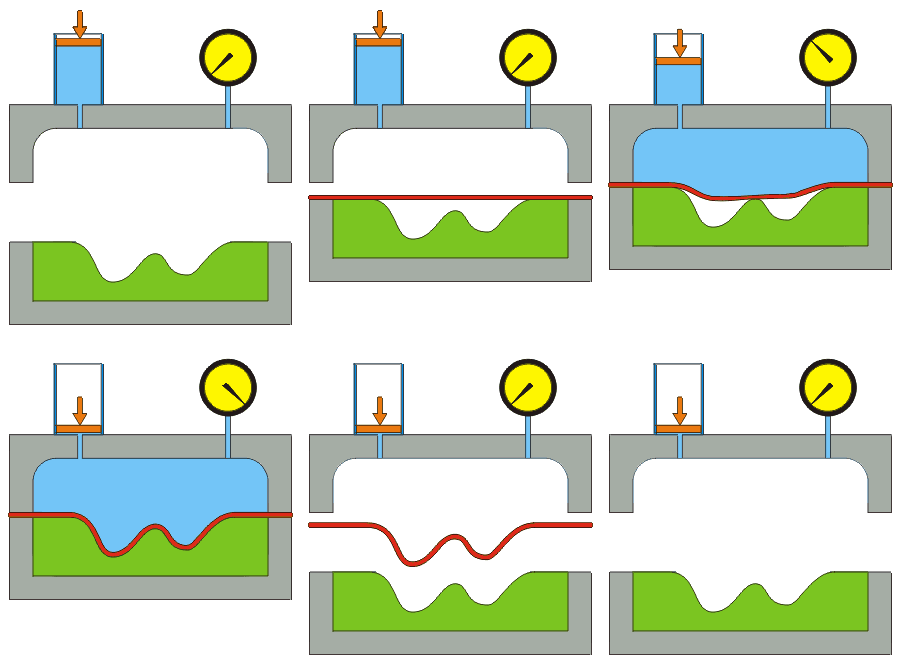
This process is based on the 1950s patent for hydramolding by Fred Leuthesser, Jr. and John Fox of the Schaible Company of Cincinnati, Ohio in the United States. It was originally used in producing kitchen spouts. This was done because in addition to the strengthening of the metal, hydromolding also produced less "grainy" parts, allowing for easier metal finishing. In sheet hydroforming there are bladder forming (where there is a bladder that contains the liquid; no liquid contacts the sheet) and hydroforming where the fluid contacts the sheet (no bladder). Bladder forming is sometimes called flexforming. Flexforming is mostly used for low volume productions, as in the aerospace field. Forming with the fluid in direct contact with the part can be done either with a male solid punch (this version is sometimes called hydro-mechanical deep drawing) or with a female solid die. In hydro-mechanical deep drawing, a work piece is placed on a draw ring (blank holder) over a male punch then a hydraulic chamber surrounds the work piece and a relatively low initial pressure seats the work piece against the punch. The punch then is raised into the hydraulic chamber and pressure is increased to as high as 100 MPa (15000 psi) which forms the part around the punch. Then the pressure is released and punch retracted, hydraulic chamber lifted, and the process is complete.
Among these techniques hydraulic bulge testing allows for an increased work hardening of sheet material by distinctive stretching operations and provides better shape accuracy for complex parts. Hence, by selecting proper material and the forming parameters for hydraulic sheet bulging study one can determine Forming Limit Curves (FLCs). [1]
Significance
In tube hydroforming there are two major practices: high pressure and low pressure. With the high pressure process the tube is fully enclosed in a die prior to pressurization of the tube. In low pressure the tube is slightly pressurized to a fixed volume during the closing of the die (this used to be called the Variform process). Historically, the process was patented in the '50s, but it was industrially spread in the 1970s for the production of large T-shaped joints for the oil and gas industry. Today it is mostly used in the automotive sector, where many industrial applications can be found. With the rise of the electric bicycle it is now a method of choice for e-bicycle manufacturers. Especially down tubes and top tubes are favorably made with hydroforming in order to fit the battery for the electric bicycle. Newest applications in the bicycle industry are now hydroformed handlebars to improve aero dynamics and ergonomics. In tube hydroforming pressure is applied to the inside of a tube that is held by dies with the desired cross sections and forms. When the dies are closed, the tube ends are sealed by axial punches and the tube is filled with hydraulic fluid. The internal pressure can go up to a few thousand bars and it causes the tube to calibrate against the dies. The fluid is injected into the tube through one of the two axial punches. Axial punches are movable and their action is required to provide axial compression and to feed material towards the center of the bulging tube. Transverse counterpunches may also be incorporated in the forming die in order to form protrusions with small diameter/length ratio. Transverse counter punches may also be used to punch holes in the work piece at the end of the forming process.
Designing the process has in the past been a challenging task, since initial analytical modeling is possible only for limited cases. Advances in FEA and FEM in recent years has enabled hydroform processes to be more widely engineered for varieties of parts and materials. Often FEM simulations must be performed in order to find a feasible process solution and to define the correct loading curves: pressure vs. time and axial feed vs. time. In the case of more complex tube hydroformed parts the tube must be pre-bent prior to loading into the hydroforming die. Bending is done sequentially along the length of the tube, with the tube being bent around bending discs (or dies) as the tube length is fed in. Bending can be done with or without mandrels. This additional complexity of process further increases the reliance on FEM for designing and evaluating manufacturing processes. The feasibility of a hydroforming process must take into consideration the initial tube material properties and its potential for variation, along with the bending process, hydraulic pressure throughout the forming process, in inclusion of axial feed or not, in order to predict metal formability.
Hub AI
Hydroforming AI simulator
(@Hydroforming_simulator)
Hydroforming
Hydroforming is a means of shaping ductile metals such as aluminium, brass, low alloy steel, and stainless steel into lightweight, structurally stiff and strong pieces. One of the largest applications of cost-effective hydroforming is the automotive industry, which makes use of the complex shapes made possible by hydroforming to produce stronger, lighter, and more rigid unibody structures for vehicles. This technique is particularly popular with the high-end sports car industry and is also frequently employed in the shaping of aluminium tubes for bicycle frames.
Hydroforming is a specialized type of die forming that uses a high pressure hydraulic fluid to press room temperature working material into a die. To hydroform aluminium into a vehicle's frame rail, a hollow tube of aluminium is placed inside a negative mold that has the shape of the desired result. High pressure hydraulic pumps then inject fluid at very high pressure inside the aluminium tube which causes it to expand until it matches the mold. The hydroformed aluminium is then removed from the mold. Hydroforming allows complex shapes with concavities to be formed, which would be difficult or impossible with standard solid die stamping. Hydroformed parts can often be made with a higher stiffness-to-weight ratio and at a lower per unit cost than traditional stamped or stamped and welded parts. Virtually all metals capable of cold forming can be hydroformed, including aluminium, brass, carbon and stainless steel, copper, and high strength alloys.[clarification needed]
Electrohydraulic forming uses electrodes to vaporize the fluid explosively in an arc to deform the working material.
This process is based on the 1950s patent for hydramolding by Fred Leuthesser, Jr. and John Fox of the Schaible Company of Cincinnati, Ohio in the United States. It was originally used in producing kitchen spouts. This was done because in addition to the strengthening of the metal, hydromolding also produced less "grainy" parts, allowing for easier metal finishing. In sheet hydroforming there are bladder forming (where there is a bladder that contains the liquid; no liquid contacts the sheet) and hydroforming where the fluid contacts the sheet (no bladder). Bladder forming is sometimes called flexforming. Flexforming is mostly used for low volume productions, as in the aerospace field. Forming with the fluid in direct contact with the part can be done either with a male solid punch (this version is sometimes called hydro-mechanical deep drawing) or with a female solid die. In hydro-mechanical deep drawing, a work piece is placed on a draw ring (blank holder) over a male punch then a hydraulic chamber surrounds the work piece and a relatively low initial pressure seats the work piece against the punch. The punch then is raised into the hydraulic chamber and pressure is increased to as high as 100 MPa (15000 psi) which forms the part around the punch. Then the pressure is released and punch retracted, hydraulic chamber lifted, and the process is complete.
Among these techniques hydraulic bulge testing allows for an increased work hardening of sheet material by distinctive stretching operations and provides better shape accuracy for complex parts. Hence, by selecting proper material and the forming parameters for hydraulic sheet bulging study one can determine Forming Limit Curves (FLCs). [1]
Significance
In tube hydroforming there are two major practices: high pressure and low pressure. With the high pressure process the tube is fully enclosed in a die prior to pressurization of the tube. In low pressure the tube is slightly pressurized to a fixed volume during the closing of the die (this used to be called the Variform process). Historically, the process was patented in the '50s, but it was industrially spread in the 1970s for the production of large T-shaped joints for the oil and gas industry. Today it is mostly used in the automotive sector, where many industrial applications can be found. With the rise of the electric bicycle it is now a method of choice for e-bicycle manufacturers. Especially down tubes and top tubes are favorably made with hydroforming in order to fit the battery for the electric bicycle. Newest applications in the bicycle industry are now hydroformed handlebars to improve aero dynamics and ergonomics. In tube hydroforming pressure is applied to the inside of a tube that is held by dies with the desired cross sections and forms. When the dies are closed, the tube ends are sealed by axial punches and the tube is filled with hydraulic fluid. The internal pressure can go up to a few thousand bars and it causes the tube to calibrate against the dies. The fluid is injected into the tube through one of the two axial punches. Axial punches are movable and their action is required to provide axial compression and to feed material towards the center of the bulging tube. Transverse counterpunches may also be incorporated in the forming die in order to form protrusions with small diameter/length ratio. Transverse counter punches may also be used to punch holes in the work piece at the end of the forming process.
Designing the process has in the past been a challenging task, since initial analytical modeling is possible only for limited cases. Advances in FEA and FEM in recent years has enabled hydroform processes to be more widely engineered for varieties of parts and materials. Often FEM simulations must be performed in order to find a feasible process solution and to define the correct loading curves: pressure vs. time and axial feed vs. time. In the case of more complex tube hydroformed parts the tube must be pre-bent prior to loading into the hydroforming die. Bending is done sequentially along the length of the tube, with the tube being bent around bending discs (or dies) as the tube length is fed in. Bending can be done with or without mandrels. This additional complexity of process further increases the reliance on FEM for designing and evaluating manufacturing processes. The feasibility of a hydroforming process must take into consideration the initial tube material properties and its potential for variation, along with the bending process, hydraulic pressure throughout the forming process, in inclusion of axial feed or not, in order to predict metal formability.
Recent media