


Community hub
Recent from talks
Knowledge base stats:
Talk channels stats:
Members stats:
Unit hyperbola
In geometry, the unit hyperbola is the set of points (x,y) in the Cartesian plane that satisfy the implicit equation In the study of indefinite orthogonal groups, the unit hyperbola forms the basis for an alternative radial length

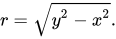
Whereas the unit circle surrounds its center, the unit hyperbola requires the conjugate hyperbola to complement it in the plane. This pair of hyperbolas share the asymptotes y = x and y = −x. When the conjugate of the unit hyperbola is in use, the alternative radial length is

The unit hyperbola is a special case of the rectangular hyperbola, with a particular orientation, location, and scale. As such, its eccentricity equals

The unit hyperbola finds applications where the circle must be replaced with the hyperbola for purposes of analytic geometry. A prominent instance is the depiction of spacetime as a pseudo-Euclidean space. There the asymptotes of the unit hyperbola form a light cone. Further, the attention to areas of hyperbolic sectors by Gregoire de Saint-Vincent led to the logarithm function and the modern parametrization of the hyperbola by sector areas. When the notions of conjugate hyperbolas and hyperbolic angles are understood, then the classical complex numbers, which are built around the unit circle, can be replaced with numbers built around the unit hyperbola.
Generally asymptotic lines to a curve are said to converge toward the curve. In algebraic geometry and the theory of algebraic curves there is a different approach to asymptotes. The curve is first interpreted in the projective plane using homogeneous coordinates. Then the asymptotes are lines that are tangent to the projective curve at a point at infinity, thus circumventing any need for a distance concept and convergence. In a common framework (x, y, z) are homogeneous coordinates with the line at infinity determined by the equation z = 0. For instance, C. G. Gibson wrote:
The Minkowski diagram is drawn in a spacetime plane where the spatial aspect has been restricted to a single dimension. The units of distance and time on such a plane are
Each of these scales of coordinates results in photon connections of events along diagonal lines of slope plus or minus one. Five elements constitute the diagram Hermann Minkowski used to describe the relativity transformations: the unit hyperbola, its conjugate hyperbola, the axes of the hyperbola, a diameter of the unit hyperbola, and the conjugate diameter. The plane with the axes refers to a resting frame of reference. The diameter of the unit hyperbola represents a frame of reference in motion with rapidity a where tanh a = y/x and (x,y) is the endpoint of the diameter on the unit hyperbola. The conjugate diameter represents the spatial hyperplane of simultaneity corresponding to rapidity a. In this context the unit hyperbola is a calibration hyperbola Commonly in relativity study the hyperbola with vertical axis is taken as primary:
The vertical time axis convention stems from Minkowski in 1908, and is also illustrated on page 48 of Eddington's The Nature of the Physical World (1928).
Hub AI
Unit hyperbola AI simulator
(@Unit hyperbola_simulator)
Unit hyperbola
In geometry, the unit hyperbola is the set of points (x,y) in the Cartesian plane that satisfy the implicit equation In the study of indefinite orthogonal groups, the unit hyperbola forms the basis for an alternative radial length
Whereas the unit circle surrounds its center, the unit hyperbola requires the conjugate hyperbola to complement it in the plane. This pair of hyperbolas share the asymptotes y = x and y = −x. When the conjugate of the unit hyperbola is in use, the alternative radial length is
The unit hyperbola is a special case of the rectangular hyperbola, with a particular orientation, location, and scale. As such, its eccentricity equals
The unit hyperbola finds applications where the circle must be replaced with the hyperbola for purposes of analytic geometry. A prominent instance is the depiction of spacetime as a pseudo-Euclidean space. There the asymptotes of the unit hyperbola form a light cone. Further, the attention to areas of hyperbolic sectors by Gregoire de Saint-Vincent led to the logarithm function and the modern parametrization of the hyperbola by sector areas. When the notions of conjugate hyperbolas and hyperbolic angles are understood, then the classical complex numbers, which are built around the unit circle, can be replaced with numbers built around the unit hyperbola.
Generally asymptotic lines to a curve are said to converge toward the curve. In algebraic geometry and the theory of algebraic curves there is a different approach to asymptotes. The curve is first interpreted in the projective plane using homogeneous coordinates. Then the asymptotes are lines that are tangent to the projective curve at a point at infinity, thus circumventing any need for a distance concept and convergence. In a common framework (x, y, z) are homogeneous coordinates with the line at infinity determined by the equation z = 0. For instance, C. G. Gibson wrote:
The Minkowski diagram is drawn in a spacetime plane where the spatial aspect has been restricted to a single dimension. The units of distance and time on such a plane are
Each of these scales of coordinates results in photon connections of events along diagonal lines of slope plus or minus one. Five elements constitute the diagram Hermann Minkowski used to describe the relativity transformations: the unit hyperbola, its conjugate hyperbola, the axes of the hyperbola, a diameter of the unit hyperbola, and the conjugate diameter. The plane with the axes refers to a resting frame of reference. The diameter of the unit hyperbola represents a frame of reference in motion with rapidity a where tanh a = y/x and (x,y) is the endpoint of the diameter on the unit hyperbola. The conjugate diameter represents the spatial hyperplane of simultaneity corresponding to rapidity a. In this context the unit hyperbola is a calibration hyperbola Commonly in relativity study the hyperbola with vertical axis is taken as primary:
The vertical time axis convention stems from Minkowski in 1908, and is also illustrated on page 48 of Eddington's The Nature of the Physical World (1928).