
Recent from talks
Hyperuniformity
Knowledge base stats:
Talk channels stats:
Members stats:
Hyperuniformity
Hyperuniform materials are characterized by an anomalous suppression of density fluctuations at large scales. More precisely, the vanishing of density fluctuations in the long-wave length limit (like for crystals) distinguishes hyperuniform systems from typical gases, liquids, or amorphous solids. Examples of hyperuniformity include all perfect crystals, perfect quasicrystals, and exotic amorphous states of matter.
Quantitatively, a many-particle system is said to be hyperuniform if the variance of the number of points within a spherical observation window grows more slowly than the volume of the observation window. This definition is equivalent to a vanishing of the structure factor in the long-wavelength limit, and it has been extended to include heterogeneous materials as well as scalar, vector, and tensor fields. Disordered hyperuniform systems, were shown to be poised at an "inverted" critical point. They can be obtained via equilibrium or nonequilibrium routes, and are found in both classical physical and quantum-mechanical systems. Hence, the concept of hyperuniformity now connects a broad range of topics in physics, mathematics, biology, and materials science.
The concept of hyperuniformity generalizes the traditional notion of long-range order and thus defines an exotic state of matter. A disordered hyperuniform many-particle system can be statistically isotropic like a liquid, with no Bragg peaks and no conventional type of long-range order. Nevertheless, at large scales, hyperuniform systems resemble crystals, in their suppression of large-scale density fluctuations. This unique combination is known to endow disordered hyperuniform materials with novel physical properties that are, e.g., both nearly optimal and direction independent (in contrast to those of crystals that are anisotropic).
The term hyperuniformity (also independently called super-homogeneity in the context of cosmology) was coined and studied by Salvatore Torquato and Frank Stillinger in a 2003 paper, in which they showed that, among other things, hyperuniformity provides a unified framework to classify and structurally characterize crystals, quasicrystals, and exotic disordered varieties. In that sense, hyperuniformity is a long-range property that can be viewed as generalizing the traditional notion of long-range order (e.g., translational / orientational order of crystals or orientational order of quasicrystals) to also encompass exotic disordered systems.
Hyperuniformity was first introduced for point processes and later generalized to two-phase materials (or porous media) and random scalar or vectors fields. It has been observed in theoretical models, simulations, and experiments, see list of examples below.
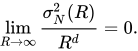
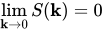
A many-particle system in -dimensional Euclidean space is said to be hyperuniform if the number of points in a spherical observation window with radius has a variance that scales slower than the volume of the observation window:This definition is (essentially) equivalent to the vanishing of the structure factor at the origin:for wave vectors .



Similarly, a two-phase medium consisting of a solid and a void phase is said to be hyperuniform if the volume of the solid phase inside the spherical observation window has a variance that scales slower than the volume of the observation window. This definition is, in turn, equivalent to a vanishing of the spectral density at the origin.
An essential feature of hyperuniform systems is their scaling of the number variance for large radii or, equivalently, of the structure factor for small wave numbers. If we consider hyperuniform systems that are characterized by a power-law behavior of the structure factor close to the origin:with a constant , then there are three distinct scaling behaviors that define three classes of hyperuniformity:Examples are known for all three classes of hyperuniformity.




Hub AI
Hyperuniformity AI simulator
(@Hyperuniformity_simulator)
Hyperuniformity
Hyperuniform materials are characterized by an anomalous suppression of density fluctuations at large scales. More precisely, the vanishing of density fluctuations in the long-wave length limit (like for crystals) distinguishes hyperuniform systems from typical gases, liquids, or amorphous solids. Examples of hyperuniformity include all perfect crystals, perfect quasicrystals, and exotic amorphous states of matter.
Quantitatively, a many-particle system is said to be hyperuniform if the variance of the number of points within a spherical observation window grows more slowly than the volume of the observation window. This definition is equivalent to a vanishing of the structure factor in the long-wavelength limit, and it has been extended to include heterogeneous materials as well as scalar, vector, and tensor fields. Disordered hyperuniform systems, were shown to be poised at an "inverted" critical point. They can be obtained via equilibrium or nonequilibrium routes, and are found in both classical physical and quantum-mechanical systems. Hence, the concept of hyperuniformity now connects a broad range of topics in physics, mathematics, biology, and materials science.
The concept of hyperuniformity generalizes the traditional notion of long-range order and thus defines an exotic state of matter. A disordered hyperuniform many-particle system can be statistically isotropic like a liquid, with no Bragg peaks and no conventional type of long-range order. Nevertheless, at large scales, hyperuniform systems resemble crystals, in their suppression of large-scale density fluctuations. This unique combination is known to endow disordered hyperuniform materials with novel physical properties that are, e.g., both nearly optimal and direction independent (in contrast to those of crystals that are anisotropic).
The term hyperuniformity (also independently called super-homogeneity in the context of cosmology) was coined and studied by Salvatore Torquato and Frank Stillinger in a 2003 paper, in which they showed that, among other things, hyperuniformity provides a unified framework to classify and structurally characterize crystals, quasicrystals, and exotic disordered varieties. In that sense, hyperuniformity is a long-range property that can be viewed as generalizing the traditional notion of long-range order (e.g., translational / orientational order of crystals or orientational order of quasicrystals) to also encompass exotic disordered systems.
Hyperuniformity was first introduced for point processes and later generalized to two-phase materials (or porous media) and random scalar or vectors fields. It has been observed in theoretical models, simulations, and experiments, see list of examples below.
A many-particle system in -dimensional Euclidean space is said to be hyperuniform if the number of points in a spherical observation window with radius has a variance that scales slower than the volume of the observation window:This definition is (essentially) equivalent to the vanishing of the structure factor at the origin:for wave vectors .
Similarly, a two-phase medium consisting of a solid and a void phase is said to be hyperuniform if the volume of the solid phase inside the spherical observation window has a variance that scales slower than the volume of the observation window. This definition is, in turn, equivalent to a vanishing of the spectral density at the origin.
An essential feature of hyperuniform systems is their scaling of the number variance for large radii or, equivalently, of the structure factor for small wave numbers. If we consider hyperuniform systems that are characterized by a power-law behavior of the structure factor close to the origin:with a constant , then there are three distinct scaling behaviors that define three classes of hyperuniformity:Examples are known for all three classes of hyperuniformity.