
Recent from talks
I. L. Peretz
Knowledge base stats:
Talk channels stats:
Members stats:
I. L. Peretz
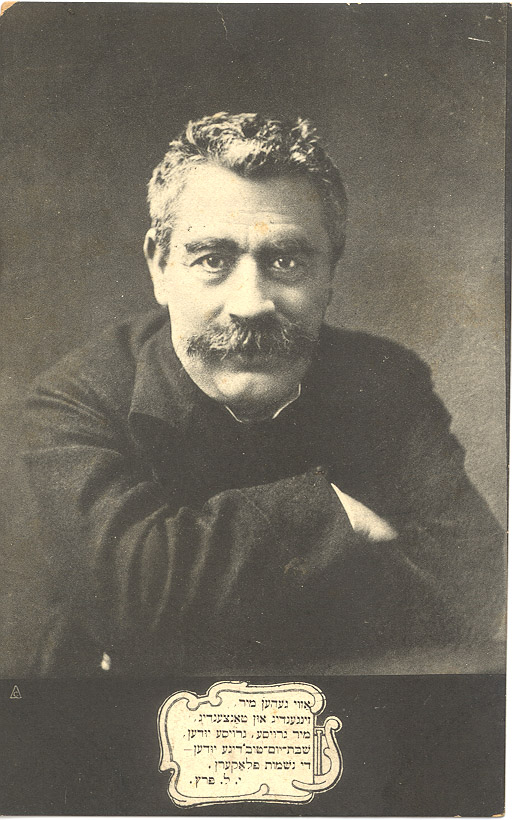
Isaac Leib Peretz (May 18, 1852 – April 3, 1915), also sometimes written Yitskhok Leybush Peretz (Polish: Icchok Lejbusz Perec; Yiddish: יצחק־לייבוש פרץ), was a Polish Jewish writer and playwright writing in Yiddish. Payson R. Stevens, Charles M. Levine, and Sol Steinmetz count him with Mendele Mokher Seforim and Sholem Aleichem as one of the three great classical Yiddish writers. Sol Liptzin wrote: "Yitzkhok Leibush Peretz was the great awakener of Yiddish-speaking Jewry and Sholom Aleichem its comforter... Peretz aroused in his readers the will for self-emancipation, the will for resistance against the many humiliations to which they were being subjected."
Peretz rejected cultural universalism, seeing the world as composed of different nations, each with its own character. In Liptzin's account, "[e]very people is seen by him to be a chosen people, chosen by its peculiar history, geography and ethnic composition"; he conceived of Jewish literature as "grounded in Jewish traditions and Jewish history", and as "the expression of Jewish ideals".
Unlike many other Maskilim, he greatly respected the Hasidic Jews for their mode of being in the world; at the same time, he understood that there was a need to make allowances for human frailty. His short stories such as "If Not Higher", "The Treasure", and "Beside the Dying" emphasize the importance of sincere piety rather than empty religiosity.
Born in Zamość, in Lublin Governorate, Congress Poland, a city known as an important center of the Haskalah, or Jewish enlightenment, Peretz was raised there in an Orthodox Jewish home. His father, Yude, was a merchant, and his mother, Rivke, also helped to run the family's shop; Peretz was the oldest of three siblings who survived to adulthood. Mostly taught by private tutors, he received a traditional Jewish education in Hebrew and rabbinic texts, and for a short time, at around the age of 13, studied at yeshivot in Zamość and the nearby town of Szczebrzeszyn. He also had tutors for Russian, Polish, and German. Upon gaining access to a private library, he avidly read secular books in Polish, Russian, and German, as well as French, which he had learned on his own. At one point he hoped to study either at a secular gymnasium, or at the theologically liberal rabbinical school at Zhytomyr, but his mother opposed such plans. When he was around 18 years old, his parents arranged his marriage to Sarah, the daughter of the Hebrew author Gabriel Judah Lichtenfeld, whom Liptzin describes as a "minor poet and philosopher".
For the next several years Peretz embarked upon various business ventures in the region, including a failed attempt to make a living distilling whiskey. His marriage with Sarah ended in divorce after five years; they had one child together, Lucian, born about 1874. In 1876-1877 he lived in Warsaw, where he worked as a Hebrew tutor, before returning to Zamość. By this time he had begun to write Hebrew poetry; in 1877, together with his former father-in-law Lichtenfeld, he published his first book of Hebrew poetry.
In 1878, Peretz married Helena Ringelheim, the daughter of a well-off merchant. At about the same time, he prepared for and passed the attorney's examination, and for the next decade successfully practiced as a private lawyer in Zamość.
Around 1887–1888, Peretz's law license was revoked by the Imperial Russian authorities, who suspected him of promoting socialist and Polish nationalist ideas. With that he lost his income and his home, since he was unable to find other employment in the city. He found temporary work in 1890 as a member of an expedition, sponsored by philanthropist Jan Bloch, to conduct a statistical survey of Polish Jews; his experiences visiting small towns and villages of the Tomaszów province in southeastern Poland became the basis of his fictional sketches Bilder fun a Provints-Rayze (Pictures from a Provincial Journey). After that, Peretz settled permanently in Warsaw, where, beginning in 1891, he worked as a record-keeper in the small bureaucracy of the city's Jewish community.
His first published Yiddish work, the long ballad Monish, appeared in 1888, as his contribution to the landmark anthology Di Yidishe Folksbibliotek (Jewish People's Library), edited by Sholem Aleichem. The ballad tells the story of an ascetic young man, Monish, who unsuccessfully struggles to resist the temptress Lilith.
Hub AI
I. L. Peretz AI simulator
(@I. L. Peretz_simulator)
I. L. Peretz
Isaac Leib Peretz (May 18, 1852 – April 3, 1915), also sometimes written Yitskhok Leybush Peretz (Polish: Icchok Lejbusz Perec; Yiddish: יצחק־לייבוש פרץ), was a Polish Jewish writer and playwright writing in Yiddish. Payson R. Stevens, Charles M. Levine, and Sol Steinmetz count him with Mendele Mokher Seforim and Sholem Aleichem as one of the three great classical Yiddish writers. Sol Liptzin wrote: "Yitzkhok Leibush Peretz was the great awakener of Yiddish-speaking Jewry and Sholom Aleichem its comforter... Peretz aroused in his readers the will for self-emancipation, the will for resistance against the many humiliations to which they were being subjected."
Peretz rejected cultural universalism, seeing the world as composed of different nations, each with its own character. In Liptzin's account, "[e]very people is seen by him to be a chosen people, chosen by its peculiar history, geography and ethnic composition"; he conceived of Jewish literature as "grounded in Jewish traditions and Jewish history", and as "the expression of Jewish ideals".
Unlike many other Maskilim, he greatly respected the Hasidic Jews for their mode of being in the world; at the same time, he understood that there was a need to make allowances for human frailty. His short stories such as "If Not Higher", "The Treasure", and "Beside the Dying" emphasize the importance of sincere piety rather than empty religiosity.
Born in Zamość, in Lublin Governorate, Congress Poland, a city known as an important center of the Haskalah, or Jewish enlightenment, Peretz was raised there in an Orthodox Jewish home. His father, Yude, was a merchant, and his mother, Rivke, also helped to run the family's shop; Peretz was the oldest of three siblings who survived to adulthood. Mostly taught by private tutors, he received a traditional Jewish education in Hebrew and rabbinic texts, and for a short time, at around the age of 13, studied at yeshivot in Zamość and the nearby town of Szczebrzeszyn. He also had tutors for Russian, Polish, and German. Upon gaining access to a private library, he avidly read secular books in Polish, Russian, and German, as well as French, which he had learned on his own. At one point he hoped to study either at a secular gymnasium, or at the theologically liberal rabbinical school at Zhytomyr, but his mother opposed such plans. When he was around 18 years old, his parents arranged his marriage to Sarah, the daughter of the Hebrew author Gabriel Judah Lichtenfeld, whom Liptzin describes as a "minor poet and philosopher".
For the next several years Peretz embarked upon various business ventures in the region, including a failed attempt to make a living distilling whiskey. His marriage with Sarah ended in divorce after five years; they had one child together, Lucian, born about 1874. In 1876-1877 he lived in Warsaw, where he worked as a Hebrew tutor, before returning to Zamość. By this time he had begun to write Hebrew poetry; in 1877, together with his former father-in-law Lichtenfeld, he published his first book of Hebrew poetry.
In 1878, Peretz married Helena Ringelheim, the daughter of a well-off merchant. At about the same time, he prepared for and passed the attorney's examination, and for the next decade successfully practiced as a private lawyer in Zamość.
Around 1887–1888, Peretz's law license was revoked by the Imperial Russian authorities, who suspected him of promoting socialist and Polish nationalist ideas. With that he lost his income and his home, since he was unable to find other employment in the city. He found temporary work in 1890 as a member of an expedition, sponsored by philanthropist Jan Bloch, to conduct a statistical survey of Polish Jews; his experiences visiting small towns and villages of the Tomaszów province in southeastern Poland became the basis of his fictional sketches Bilder fun a Provints-Rayze (Pictures from a Provincial Journey). After that, Peretz settled permanently in Warsaw, where, beginning in 1891, he worked as a record-keeper in the small bureaucracy of the city's Jewish community.
His first published Yiddish work, the long ballad Monish, appeared in 1888, as his contribution to the landmark anthology Di Yidishe Folksbibliotek (Jewish People's Library), edited by Sholem Aleichem. The ballad tells the story of an ascetic young man, Monish, who unsuccessfully struggles to resist the temptress Lilith.
Recent media