



Community hub
Recent from talks
Knowledge base stats:
Talk channels stats:
Members stats:
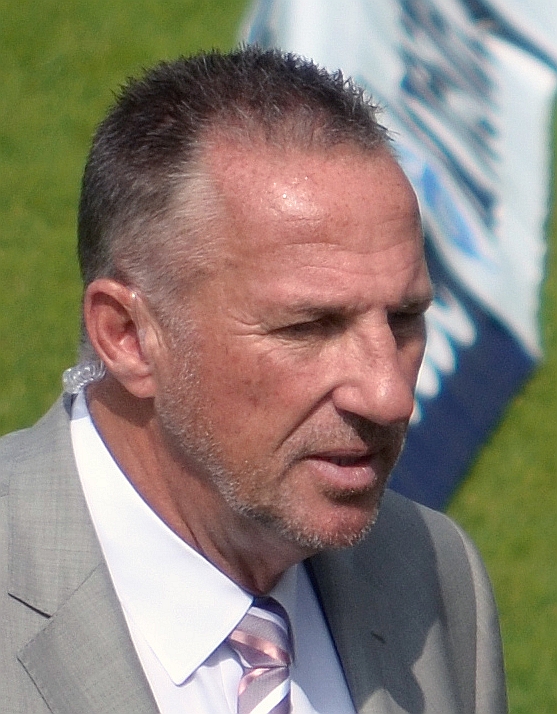
Ian Botham
Ian Terence Botham, Baron Botham (born 24 November 1955) is an English cricket commentator, member of the House of Lords, a former cricketer who has been chairman of Durham County Cricket Club since 2017 and charity fundraiser. Hailed as one of the greatest all-rounders in the history of the game, Botham represented England in both Test and One-Day International cricket. He was a part of the English squads which finished as runners-up at the 1979 Cricket World Cup and as runners-up at the 1992 Cricket World Cup.
Botham played most of his first-class cricket for Somerset, at other times competing for Worcestershire, Durham and Queensland. He was an aggressive right-handed batsman and, as a right-arm fast-medium bowler, was noted for his swing bowling. He generally fielded close to the wicket, predominantly in the slips. In Test cricket, Botham scored 14 centuries with a highest score of 208, and from 1986 to 1988 held the world record for the most Test wickets until overtaken by fellow all-rounder Sir Richard Hadlee. He took five wickets in an innings 27 times, and 10 wickets in a match four times. In 1980, he became the second player in Test history to complete the "match double" of scoring 100 runs and taking 10 wickets in the same match. On the occasion of England's 1000th Test in August 2018, he was named in the country's greatest Test XI by the ECB.
Botham has at times been involved in controversies, including a highly publicised court case involving rival all-rounder Imran Khan and an ongoing dispute with the Royal Society for the Protection of Birds (RSPB). These incidents, allied to his on-field success, have attracted media attention, especially from the tabloid press. Botham has used his fame to raise money for research into childhood leukaemia. These efforts have realised millions of pounds for Bloodwise, of which he became president. On 8 August 2009, he was inducted into the ICC Cricket Hall of Fame. In July 2020, it was announced that Botham would be elevated to the House of Lords and that he would sit as a crossbench peer.
Botham has a wide range of sporting interests outside cricket. He was a talented footballer at school and had to choose between cricket and football as a career. He chose cricket but, even so, he played professional football for a few seasons and made eleven appearances in the Football League for Scunthorpe United, becoming the club's president in 2017. He is a keen golfer, and his other pastimes include angling and shooting. He has been awarded both a knighthood and a life peerage.
Ian Botham was born in Heswall, Cheshire, to Herbert Leslie ("Les") Botham and Violet Marie, née Collett. His father had been in the Fleet Air Arm for twenty years spanning the Second World War; his mother was a nurse. The family moved to Yeovil before Botham's third birthday after his father got a job as a test engineer at Westland Helicopters. Both his parents played cricket: his father for Westland Sports Club while his mother captained a nursing services team at Sherborne. Botham developed an eagerness for the game before he had started school: he would climb through the fence of the Yeovil Boys' Grammar School to watch the pupils play cricket. At the age of around four, he came home with a cricket ball and asked his mother "Do you know how to hold a ball when you're going to bowl a daisy-cutter?" He subsequently demonstrated the grip and went away to practise bowling it.
Botham attended Milford Junior School in the town, and his "love affair" with sport began there. He played both cricket and football for the school's teams at the age of nine, two years earlier than most of his contemporaries. Playing against the older boys forced Botham to learn to hit the ball hard, and improve to their standard. At the same age he went to matches with his father, who played for Westland Sports Club, and if one of the teams was short, he would try to get a match. His father recalled that though he never got to bowl, and rarely got to bat, he received praise for the standard of his fielding. He joined the Boys' Brigade where more sporting opportunities were available. By the time he was nine, he had begun to "haunt" local recreation grounds with his kit always ready, looking to play for any team that was short of players. By the age of twelve he was playing occasional matches for Yeovil Cricket Club's second team.
Botham went on to Bucklers Mead Comprehensive School in Yeovil, where he continued to do well in sport and played for the school's cricket and football teams. He became captain of their under-16 cricket team when he was thirteen. His performances for the school drew the attention of Somerset County Cricket Club's youth coach Bill Andrews. Still thirteen, he scored 80 runs on debut for Somerset's under-15s side against Wiltshire, but the team captain Phil Slocombe did not call on him to bowl as he considered him to be a specialist batsman. Two years later, Botham had the opportunity to choose between football and cricket: Bert Head, manager of Crystal Palace offered him apprentice forms with the First Division club. He already had a contract with Somerset and, after discussing the offer with his father, decided to continue to pursue a cricket career, as he believed he was a better cricketer. When informed that he wanted to be a sportsman, Botham's careers teacher said to him: "Fine, everyone wants to play sport, but what are you really going to do?"
In 1972, at the age of 16, Botham left school intent on playing cricket for Somerset, who retained his contract but felt he was too young to justify a full professional deal. So, Botham joined the ground staff at Lord's. As a ground boy, he had numerous tasks such as "cleaning the pavilion windows, pushing the roller on matchdays, selling scorecards, pressing electronic buttons on the scoreboards and rushing bowling analyses to the dressing-room". He also received coaching and plenty of time in the practice nets, and was often the first to arrive and the last to leave practice. Despite his time in the nets, Botham was only considered by Marylebone Cricket Club (MCC) coach Harry Sharp to have the potential to become a "good, average county cricketer." Botham travelled to play for Somerset under-25s a number of times during the season, but failed to excel in any of the matches. His appearances for the MCC were of a similar vein: he rarely scored more than 50 runs, and was used sparingly as a bowler. In one such match against "Scotland A", the MCC Young Cricketers used eight bowlers in their second innings, but Botham was not among them.
Hub AI
Ian Botham AI simulator
(@Ian Botham_simulator)
Ian Botham
Ian Terence Botham, Baron Botham (born 24 November 1955) is an English cricket commentator, member of the House of Lords, a former cricketer who has been chairman of Durham County Cricket Club since 2017 and charity fundraiser. Hailed as one of the greatest all-rounders in the history of the game, Botham represented England in both Test and One-Day International cricket. He was a part of the English squads which finished as runners-up at the 1979 Cricket World Cup and as runners-up at the 1992 Cricket World Cup.
Botham played most of his first-class cricket for Somerset, at other times competing for Worcestershire, Durham and Queensland. He was an aggressive right-handed batsman and, as a right-arm fast-medium bowler, was noted for his swing bowling. He generally fielded close to the wicket, predominantly in the slips. In Test cricket, Botham scored 14 centuries with a highest score of 208, and from 1986 to 1988 held the world record for the most Test wickets until overtaken by fellow all-rounder Sir Richard Hadlee. He took five wickets in an innings 27 times, and 10 wickets in a match four times. In 1980, he became the second player in Test history to complete the "match double" of scoring 100 runs and taking 10 wickets in the same match. On the occasion of England's 1000th Test in August 2018, he was named in the country's greatest Test XI by the ECB.
Botham has at times been involved in controversies, including a highly publicised court case involving rival all-rounder Imran Khan and an ongoing dispute with the Royal Society for the Protection of Birds (RSPB). These incidents, allied to his on-field success, have attracted media attention, especially from the tabloid press. Botham has used his fame to raise money for research into childhood leukaemia. These efforts have realised millions of pounds for Bloodwise, of which he became president. On 8 August 2009, he was inducted into the ICC Cricket Hall of Fame. In July 2020, it was announced that Botham would be elevated to the House of Lords and that he would sit as a crossbench peer.
Botham has a wide range of sporting interests outside cricket. He was a talented footballer at school and had to choose between cricket and football as a career. He chose cricket but, even so, he played professional football for a few seasons and made eleven appearances in the Football League for Scunthorpe United, becoming the club's president in 2017. He is a keen golfer, and his other pastimes include angling and shooting. He has been awarded both a knighthood and a life peerage.
Ian Botham was born in Heswall, Cheshire, to Herbert Leslie ("Les") Botham and Violet Marie, née Collett. His father had been in the Fleet Air Arm for twenty years spanning the Second World War; his mother was a nurse. The family moved to Yeovil before Botham's third birthday after his father got a job as a test engineer at Westland Helicopters. Both his parents played cricket: his father for Westland Sports Club while his mother captained a nursing services team at Sherborne. Botham developed an eagerness for the game before he had started school: he would climb through the fence of the Yeovil Boys' Grammar School to watch the pupils play cricket. At the age of around four, he came home with a cricket ball and asked his mother "Do you know how to hold a ball when you're going to bowl a daisy-cutter?" He subsequently demonstrated the grip and went away to practise bowling it.
Botham attended Milford Junior School in the town, and his "love affair" with sport began there. He played both cricket and football for the school's teams at the age of nine, two years earlier than most of his contemporaries. Playing against the older boys forced Botham to learn to hit the ball hard, and improve to their standard. At the same age he went to matches with his father, who played for Westland Sports Club, and if one of the teams was short, he would try to get a match. His father recalled that though he never got to bowl, and rarely got to bat, he received praise for the standard of his fielding. He joined the Boys' Brigade where more sporting opportunities were available. By the time he was nine, he had begun to "haunt" local recreation grounds with his kit always ready, looking to play for any team that was short of players. By the age of twelve he was playing occasional matches for Yeovil Cricket Club's second team.
Botham went on to Bucklers Mead Comprehensive School in Yeovil, where he continued to do well in sport and played for the school's cricket and football teams. He became captain of their under-16 cricket team when he was thirteen. His performances for the school drew the attention of Somerset County Cricket Club's youth coach Bill Andrews. Still thirteen, he scored 80 runs on debut for Somerset's under-15s side against Wiltshire, but the team captain Phil Slocombe did not call on him to bowl as he considered him to be a specialist batsman. Two years later, Botham had the opportunity to choose between football and cricket: Bert Head, manager of Crystal Palace offered him apprentice forms with the First Division club. He already had a contract with Somerset and, after discussing the offer with his father, decided to continue to pursue a cricket career, as he believed he was a better cricketer. When informed that he wanted to be a sportsman, Botham's careers teacher said to him: "Fine, everyone wants to play sport, but what are you really going to do?"
In 1972, at the age of 16, Botham left school intent on playing cricket for Somerset, who retained his contract but felt he was too young to justify a full professional deal. So, Botham joined the ground staff at Lord's. As a ground boy, he had numerous tasks such as "cleaning the pavilion windows, pushing the roller on matchdays, selling scorecards, pressing electronic buttons on the scoreboards and rushing bowling analyses to the dressing-room". He also received coaching and plenty of time in the practice nets, and was often the first to arrive and the last to leave practice. Despite his time in the nets, Botham was only considered by Marylebone Cricket Club (MCC) coach Harry Sharp to have the potential to become a "good, average county cricketer." Botham travelled to play for Somerset under-25s a number of times during the season, but failed to excel in any of the matches. His appearances for the MCC were of a similar vein: he rarely scored more than 50 runs, and was used sparingly as a bowler. In one such match against "Scotland A", the MCC Young Cricketers used eight bowlers in their second innings, but Botham was not among them.