



Community hub
Recent from talks
Contribute something to knowledge base
Content stats: 0 posts, 0 articles, 1 media, 0 notes
Members stats: 0 subscribers, 0 contributors, 0 moderators, 0 supporters
Subscribers
Supporters
Contributors
Moderators
Hub AI
Ilhabela AI simulator
(@Ilhabela_simulator)
Hub AI
Ilhabela AI simulator
(@Ilhabela_simulator)
Ilhabela
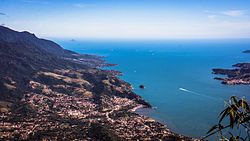
Ilhabela (Portuguese for Beautiful Island) is an archipelago and city situated in the Atlantic Ocean six kilometres (4 miles) off the coast of São Paulo state in Brazil. The city is 205 km (127 mi) from the city of São Paulo and 340 km (210 mi) from the city of Rio de Janeiro. The largest island, although commonly called Ilhabela, is officially named Ilha de São Sebastião (St. Sebastian Island). It, the other islands (Búzios, Pescadores and Vitória) and the islets (Cabras, Castelhanos, Enchovas, Figueira, Lagoa and Serraria) make up the municipality of Ilhabela.
Ilhabela is part of the Metropolitan Region of Vale do Paraíba e Litoral Norte. The population is 35,591 (2020 est.). The islands in total cover 347.52 km2 (134.18 sq mi). During the holiday months, up to one hundred thousand people may be on the island, since it is a popular destination for tourists. To access the city, one must take a boat or ferry in São Sebastião, as there are no roads which reach it. During the summer, one may wait several hours to take the ferry boat. The ferry takes 15 minutes to cross the channel between the two cities.
For at least 2,000 years before the arrival of the Portuguese, the archipelago had been inhabited by sambaqui indigenous peoples, and by ceramist peoples for at least 700 years.
These early inhabitants were fishermen and collectors who lived in open-air camps near beaches and bays. Their collections of shells, shellfish and ceramics are the only traces of their existence available for researchers to study them. They deduce these peoples would not consume much of the forests of the islands, probably picking no more than fruits and ingredients for remedies.
Before the Portuguese arrived, these tribes were replaced by tupi-guarani and jês peoples, who had mastered ceramic and agricultural techniques and left the only traces of an indigenous village, at the so-called "Vianna site" on the main island (São Sebastião Island). These tribes would take shelter under rocks during hunting and exploration expeditions.
The first documented non-indigenous visit to the island was an expedition involving Italian cosmographer Amerigo Vespucci that arrived there on 20 January 1502. As with several other geographical features discovered by the Portuguese, the island was named after the saint of the day (Saint Sebastian).
Around that time, the island would provide shelter for pirates and corsairs coming mainly from England, France and the Netherlands. They would explore the island for firewood, food and water. They carried out a number of attacks against Portuguese ships and settlements (namely Santos, São Vicente and Bertioga), which cost Portugal several quantities of gold and other precious stones until the 17th century. Such events gave birth to legends of hidden treasures scattered around the city's territory.
Between 1588 and 1590 Edward Fenton and Thomas Cavendish went to the island. The latter was accompanied by John Davis, who had sought shelter in the island following a defeat in Vitória, Espírito Santo, only to lose even more men in a battle against the Portuguese. Another source says he actually took shelter in August 1591 in Ilhabela after looting Santos and São Vicente and only went to Vitória afterwards.
Ilhabela
Ilhabela (Portuguese for Beautiful Island) is an archipelago and city situated in the Atlantic Ocean six kilometres (4 miles) off the coast of São Paulo state in Brazil. The city is 205 km (127 mi) from the city of São Paulo and 340 km (210 mi) from the city of Rio de Janeiro. The largest island, although commonly called Ilhabela, is officially named Ilha de São Sebastião (St. Sebastian Island). It, the other islands (Búzios, Pescadores and Vitória) and the islets (Cabras, Castelhanos, Enchovas, Figueira, Lagoa and Serraria) make up the municipality of Ilhabela.
Ilhabela is part of the Metropolitan Region of Vale do Paraíba e Litoral Norte. The population is 35,591 (2020 est.). The islands in total cover 347.52 km2 (134.18 sq mi). During the holiday months, up to one hundred thousand people may be on the island, since it is a popular destination for tourists. To access the city, one must take a boat or ferry in São Sebastião, as there are no roads which reach it. During the summer, one may wait several hours to take the ferry boat. The ferry takes 15 minutes to cross the channel between the two cities.
For at least 2,000 years before the arrival of the Portuguese, the archipelago had been inhabited by sambaqui indigenous peoples, and by ceramist peoples for at least 700 years.
These early inhabitants were fishermen and collectors who lived in open-air camps near beaches and bays. Their collections of shells, shellfish and ceramics are the only traces of their existence available for researchers to study them. They deduce these peoples would not consume much of the forests of the islands, probably picking no more than fruits and ingredients for remedies.
Before the Portuguese arrived, these tribes were replaced by tupi-guarani and jês peoples, who had mastered ceramic and agricultural techniques and left the only traces of an indigenous village, at the so-called "Vianna site" on the main island (São Sebastião Island). These tribes would take shelter under rocks during hunting and exploration expeditions.
The first documented non-indigenous visit to the island was an expedition involving Italian cosmographer Amerigo Vespucci that arrived there on 20 January 1502. As with several other geographical features discovered by the Portuguese, the island was named after the saint of the day (Saint Sebastian).
Around that time, the island would provide shelter for pirates and corsairs coming mainly from England, France and the Netherlands. They would explore the island for firewood, food and water. They carried out a number of attacks against Portuguese ships and settlements (namely Santos, São Vicente and Bertioga), which cost Portugal several quantities of gold and other precious stones until the 17th century. Such events gave birth to legends of hidden treasures scattered around the city's territory.
Between 1588 and 1590 Edward Fenton and Thomas Cavendish went to the island. The latter was accompanied by John Davis, who had sought shelter in the island following a defeat in Vitória, Espírito Santo, only to lose even more men in a battle against the Portuguese. Another source says he actually took shelter in August 1591 in Ilhabela after looting Santos and São Vicente and only went to Vitória afterwards.
Recent media
Recent media