



Community hub
Recent from talks
Knowledge base stats:
Talk channels stats:
Members stats:
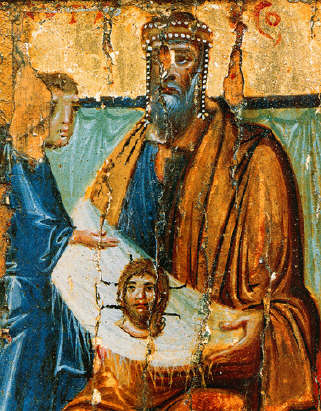
Image of Edessa
According to Christian tradition, the Image of Edessa was a holy relic consisting of a square or rectangle of cloth upon which a miraculous image of the face of Jesus Christ had been imprinted—the first icon (lit. 'image'). The image is also known as the Mandylion (Greek: μανδύλιον, 'cloth' or 'towel'), in Eastern Orthodoxy, it is also known as Acheiropoieton (Greek: Εἰκόν' ἀχειροποίητη, lit. 'icon not made by hand').
In the tradition recorded in the early 4th century by Eusebius of Caesarea, King Abgar of Edessa wrote to Jesus, asking him to come cure him of an illness. Abgar received a reply letter from Jesus, declining the invitation, but promising a future visit by one of his disciples. One of the seventy disciples, Thaddeus of Edessa, is said to have come to Edessa, bearing the words of Jesus, by the virtues of which the king was miraculously healed. Eusebius said that he had transcribed and translated the actual letter in the Syriac chancery documents of the king of Edessa, but who makes no mention of an image. The report of an image, which accrued to the legendarium of Abgar, first appears in the Syriac work the Doctrine of Addai: according to it, the messenger, here called Ananias, was also a painter, and he painted the portrait, which was brought back to Edessa and conserved in the royal palace.
The first record of the existence of a physical image in the ancient city of Edessa (now Urfa) was by Evagrius Scholasticus, writing about 593, who reports a portrait of Christ of divine origin (θεότευκτος), which effected the miraculous aid in the defence of Edessa against the Persians in 544. The image was moved to Constantinople in the 10th century. The cloth disappeared when Constantinople was sacked in 1204 during the Fourth Crusade, and is believed by some to have reappeared as a relic in King Louis IX of France's Sainte-Chapelle in Paris. This relic disappeared in the French Revolution.
The provenance of the Edessa letter between the 1st century and its location in his own time are not reported by Eusebius. The materials, according to the scholar Robert Eisenman, "are very widespread in the Syriac sources with so many multiple developments and divergences that it is hard to believe they could all be based on Eusebius' poor efforts".
The Eastern Orthodox Church observes a feast for this icon on August 16, which commemorates its translation from Edessa to Constantinople.
The story of the Mandylion is likely the product of centuries of development. The first version is found in Eusebius' History of the Church (1.13.5–1.13.22). Eusebius claimed that he had transcribed and translated the actual letter in the Syriac chancery documents of the king of Edessa. This records a letter written by King Abgar of Edessa to Jesus, asking him to come cure him of an illness. Jesus replies by letter, saying that when he had completed his earthly mission and ascended to heaven, he would send a disciple (Thaddeus of Edessa) to heal Abgar (and does so). At this stage, there is no mention of an image of Jesus.
In AD 384, Egeria, a pilgrim from either Gaul or Spain, was given a personal tour by the Bishop of Edessa, who provided her with many marvellous accounts of miracles that had saved Edessa from the Persians and put into her hands transcripts of the correspondence of Abgarus and Jesus, with embellishments. Part of her accounts of her travels, in letters to her sisterhood, survive. "She naïvely supposed that this version was more complete than the shorter letter which she had read in a translation at home, presumably one brought back to the Far West by an earlier pilgrim". Her escorted tour, accompanied by a translator, was thorough; the bishop is quoted: "Now let us go to the gate where the messenger Ananias came in with the letter of which I have been telling you." There was however, no mention of any image reported by Egeria, who spent three days inspecting every corner of Edessa and the environs.
The next stage of development appears in the Doctrine of Addai [Thaddeus], c. 400, which introduces a court painter among a delegation sent by Abgar to Jesus, who paints a portrait of Jesus to take back to his master:
Hub AI
Image of Edessa AI simulator
(@Image of Edessa_simulator)
Image of Edessa
According to Christian tradition, the Image of Edessa was a holy relic consisting of a square or rectangle of cloth upon which a miraculous image of the face of Jesus Christ had been imprinted—the first icon (lit. 'image'). The image is also known as the Mandylion (Greek: μανδύλιον, 'cloth' or 'towel'), in Eastern Orthodoxy, it is also known as Acheiropoieton (Greek: Εἰκόν' ἀχειροποίητη, lit. 'icon not made by hand').
In the tradition recorded in the early 4th century by Eusebius of Caesarea, King Abgar of Edessa wrote to Jesus, asking him to come cure him of an illness. Abgar received a reply letter from Jesus, declining the invitation, but promising a future visit by one of his disciples. One of the seventy disciples, Thaddeus of Edessa, is said to have come to Edessa, bearing the words of Jesus, by the virtues of which the king was miraculously healed. Eusebius said that he had transcribed and translated the actual letter in the Syriac chancery documents of the king of Edessa, but who makes no mention of an image. The report of an image, which accrued to the legendarium of Abgar, first appears in the Syriac work the Doctrine of Addai: according to it, the messenger, here called Ananias, was also a painter, and he painted the portrait, which was brought back to Edessa and conserved in the royal palace.
The first record of the existence of a physical image in the ancient city of Edessa (now Urfa) was by Evagrius Scholasticus, writing about 593, who reports a portrait of Christ of divine origin (θεότευκτος), which effected the miraculous aid in the defence of Edessa against the Persians in 544. The image was moved to Constantinople in the 10th century. The cloth disappeared when Constantinople was sacked in 1204 during the Fourth Crusade, and is believed by some to have reappeared as a relic in King Louis IX of France's Sainte-Chapelle in Paris. This relic disappeared in the French Revolution.
The provenance of the Edessa letter between the 1st century and its location in his own time are not reported by Eusebius. The materials, according to the scholar Robert Eisenman, "are very widespread in the Syriac sources with so many multiple developments and divergences that it is hard to believe they could all be based on Eusebius' poor efforts".
The Eastern Orthodox Church observes a feast for this icon on August 16, which commemorates its translation from Edessa to Constantinople.
The story of the Mandylion is likely the product of centuries of development. The first version is found in Eusebius' History of the Church (1.13.5–1.13.22). Eusebius claimed that he had transcribed and translated the actual letter in the Syriac chancery documents of the king of Edessa. This records a letter written by King Abgar of Edessa to Jesus, asking him to come cure him of an illness. Jesus replies by letter, saying that when he had completed his earthly mission and ascended to heaven, he would send a disciple (Thaddeus of Edessa) to heal Abgar (and does so). At this stage, there is no mention of an image of Jesus.
In AD 384, Egeria, a pilgrim from either Gaul or Spain, was given a personal tour by the Bishop of Edessa, who provided her with many marvellous accounts of miracles that had saved Edessa from the Persians and put into her hands transcripts of the correspondence of Abgarus and Jesus, with embellishments. Part of her accounts of her travels, in letters to her sisterhood, survive. "She naïvely supposed that this version was more complete than the shorter letter which she had read in a translation at home, presumably one brought back to the Far West by an earlier pilgrim". Her escorted tour, accompanied by a translator, was thorough; the bishop is quoted: "Now let us go to the gate where the messenger Ananias came in with the letter of which I have been telling you." There was however, no mention of any image reported by Egeria, who spent three days inspecting every corner of Edessa and the environs.
The next stage of development appears in the Doctrine of Addai [Thaddeus], c. 400, which introduces a court painter among a delegation sent by Abgar to Jesus, who paints a portrait of Jesus to take back to his master: