
Recent from talks
Sainte-Chapelle
Knowledge base stats:
Talk channels stats:
Members stats:
Sainte-Chapelle
The Sainte-Chapelle (French: [sɛ̃t ʃapɛl]; English: Holy Chapel) is a royal chapel in the Gothic style, within the medieval Palais de la Cité, the residence of the Kings of France until the 14th century, on the Île de la Cité in the River Seine in Paris, France.
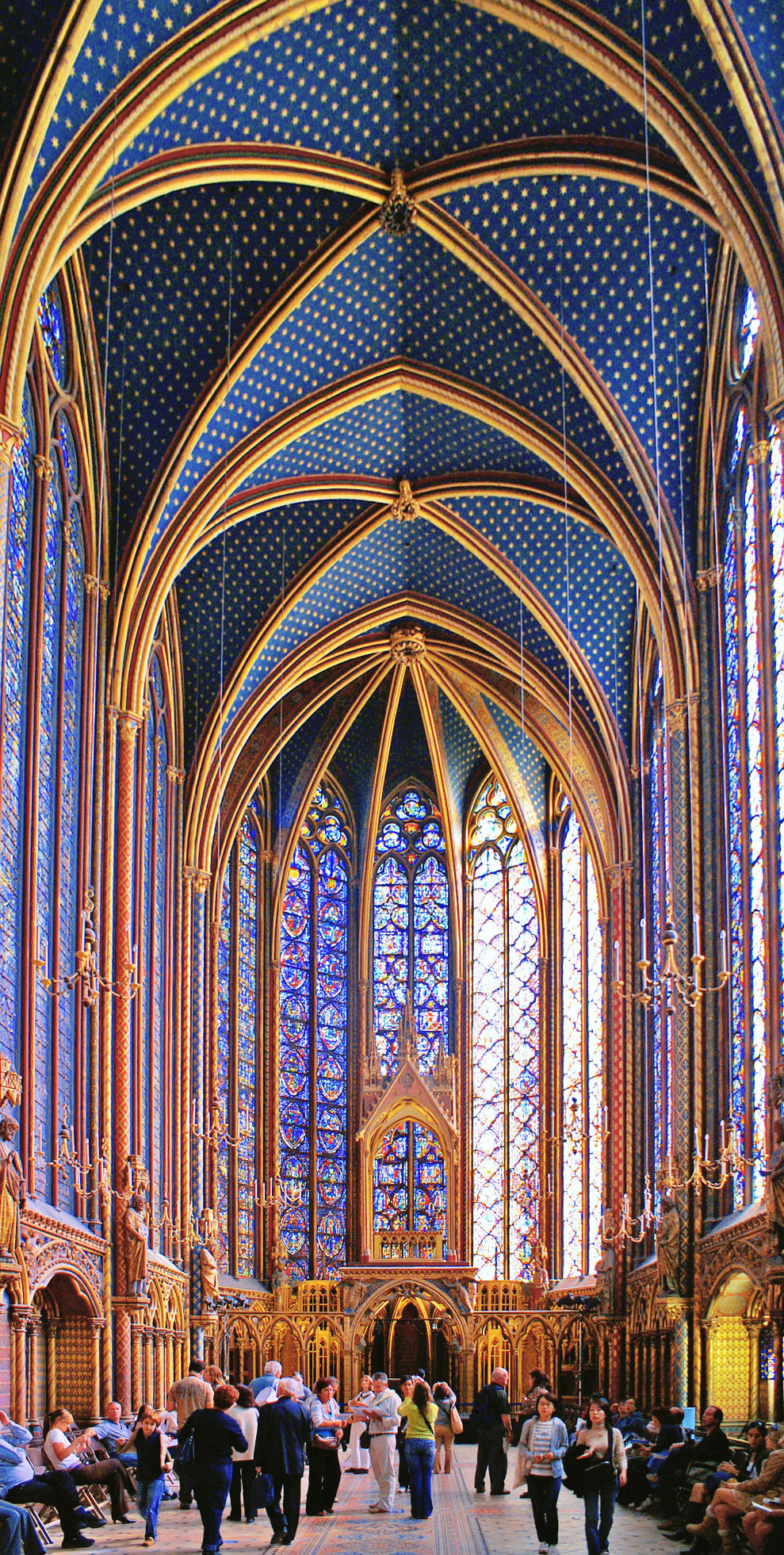
Construction began sometime after 1238 and the chapel was consecrated on 26 April 1248. The Sainte-Chapelle is considered among the highest achievements of the Rayonnant period of Gothic architecture. It was commissioned by King Louis IX of France to house his collection of Passion relics, including Christ's claimed Crown of Thorns – one of the most important relics in medieval Christendom. This was later held in the nearby Notre-Dame Cathedral until the 2019 fire, which it survived.
Along with the Conciergerie, Sainte-Chapelle is one of the earliest surviving buildings of the Capetian royal palace on the Île de la Cité. Although damaged during the French Revolution and restored in the 19th century, it has one of the most extensive 13th-century stained glass collections anywhere in the world.
The chapel is now operated as a museum by the Centre des monuments nationaux, along with the nearby Conciergerie, the other remaining vestige of the original palace.
Sainte-Chapelle was inspired by the earlier Carolingian royal chapels, notably the Palatine Chapel of Charlemagne at his palace in Aix-la-Chapelle (now Aachen). It was built in about 800 and served as the oratory of the Emperor. In 1238 Louis IX had already built one royal chapel, attached to the Château de Saint-Germain-en-Laye. This earlier chapel had only one level; its plan, on a much grander scale, was adapted for Sainte-Chapelle.
The two levels of the new chapel, equal in size, had entirely different purposes. The upper level, where the sacred relics were kept, was reserved exclusively for the royal family and their guests. The lower level was used by the courtiers, servants, and soldiers of the palace. It was a very large structure, 36 meters (118 ft) long, 17 meters (56 ft) wide, and 42.5 meters (139 ft) high, ranking in size with the new Gothic cathedrals in France.
In addition to serving as a place of worship, the Sainte-Chapelle played an important role in the political and cultural ambitions of King Louis and his successors. With the imperial throne at Constantinople occupied by a mere Count of Flanders and with the Holy Roman Empire in uneasy disarray, Louis' artistic and architectural patronage helped to position him as the central monarch of western Christendom, the Sainte-Chapelle fitting into a long tradition of prestigious palace chapels. Just as the Emperor could pass privately from his palace into the Hagia Sophia in Constantinople, so now Louis could pass directly from his palace into the Sainte-Chapelle. More importantly, the two-story palace chapel had obvious similarities to Charlemagne's palatine chapel at Aachen (built 782–805)—a parallel that Louis was keen to exploit in presenting himself as a worthy successor to the first Holy Roman Emperor. The presence of the fragment of the True Cross and crown of thorns gave enormous prestige to Louis IX. Pope Innocent IV proclaimed that it meant that Christ had symbolically crowned Louis with his own crown.
Sainte-Chapelle, in the courtyard of the royal palace on the Île de la Cité (now part of a later administrative complex known as La Conciergerie), was built to house Louis IX's collection of relics of Christ, which included the crown of thorns, the Image of Edessa, and some thirty other items. Louis purchased his Passion relics from Baldwin II, the Latin emperor at Constantinople, for the sum of 135,000 livres. This money was paid to the Venetians to whom the relics had been pawned.
Hub AI
Sainte-Chapelle AI simulator
(@Sainte-Chapelle_simulator)
Sainte-Chapelle
The Sainte-Chapelle (French: [sɛ̃t ʃapɛl]; English: Holy Chapel) is a royal chapel in the Gothic style, within the medieval Palais de la Cité, the residence of the Kings of France until the 14th century, on the Île de la Cité in the River Seine in Paris, France.
Construction began sometime after 1238 and the chapel was consecrated on 26 April 1248. The Sainte-Chapelle is considered among the highest achievements of the Rayonnant period of Gothic architecture. It was commissioned by King Louis IX of France to house his collection of Passion relics, including Christ's claimed Crown of Thorns – one of the most important relics in medieval Christendom. This was later held in the nearby Notre-Dame Cathedral until the 2019 fire, which it survived.
Along with the Conciergerie, Sainte-Chapelle is one of the earliest surviving buildings of the Capetian royal palace on the Île de la Cité. Although damaged during the French Revolution and restored in the 19th century, it has one of the most extensive 13th-century stained glass collections anywhere in the world.
The chapel is now operated as a museum by the Centre des monuments nationaux, along with the nearby Conciergerie, the other remaining vestige of the original palace.
Sainte-Chapelle was inspired by the earlier Carolingian royal chapels, notably the Palatine Chapel of Charlemagne at his palace in Aix-la-Chapelle (now Aachen). It was built in about 800 and served as the oratory of the Emperor. In 1238 Louis IX had already built one royal chapel, attached to the Château de Saint-Germain-en-Laye. This earlier chapel had only one level; its plan, on a much grander scale, was adapted for Sainte-Chapelle.
The two levels of the new chapel, equal in size, had entirely different purposes. The upper level, where the sacred relics were kept, was reserved exclusively for the royal family and their guests. The lower level was used by the courtiers, servants, and soldiers of the palace. It was a very large structure, 36 meters (118 ft) long, 17 meters (56 ft) wide, and 42.5 meters (139 ft) high, ranking in size with the new Gothic cathedrals in France.
In addition to serving as a place of worship, the Sainte-Chapelle played an important role in the political and cultural ambitions of King Louis and his successors. With the imperial throne at Constantinople occupied by a mere Count of Flanders and with the Holy Roman Empire in uneasy disarray, Louis' artistic and architectural patronage helped to position him as the central monarch of western Christendom, the Sainte-Chapelle fitting into a long tradition of prestigious palace chapels. Just as the Emperor could pass privately from his palace into the Hagia Sophia in Constantinople, so now Louis could pass directly from his palace into the Sainte-Chapelle. More importantly, the two-story palace chapel had obvious similarities to Charlemagne's palatine chapel at Aachen (built 782–805)—a parallel that Louis was keen to exploit in presenting himself as a worthy successor to the first Holy Roman Emperor. The presence of the fragment of the True Cross and crown of thorns gave enormous prestige to Louis IX. Pope Innocent IV proclaimed that it meant that Christ had symbolically crowned Louis with his own crown.
Sainte-Chapelle, in the courtyard of the royal palace on the Île de la Cité (now part of a later administrative complex known as La Conciergerie), was built to house Louis IX's collection of relics of Christ, which included the crown of thorns, the Image of Edessa, and some thirty other items. Louis purchased his Passion relics from Baldwin II, the Latin emperor at Constantinople, for the sum of 135,000 livres. This money was paid to the Venetians to whom the relics had been pawned.
Recent media