
Recent from talks
Imperial fora
Knowledge base stats:
Talk channels stats:
Members stats:
Imperial fora
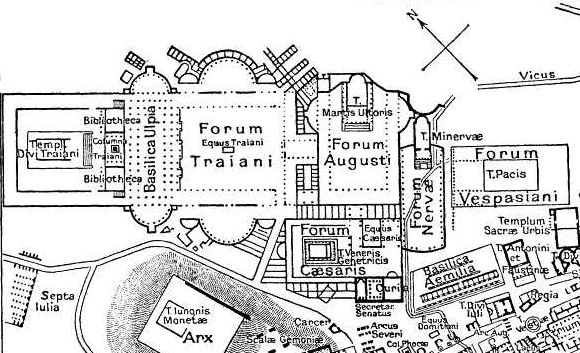
The Imperial Fora (Fori Imperiali in Italian) are a series of monumental fora (public squares), constructed in Rome over a period of one and a half centuries, between 46 BC and 113 AD. The fora were the center of the Roman Republic and of the Roman Empire.
The Imperial Fora, while not part of the Roman Forum, are located relatively close to each other. Julius Caesar was the first to build in this section of Rome and rearranged both the Forum and the Comitium, another forum type space designated for politics, to do so. These fora were the centres of politics, religion and economy in the ancient Roman Empire.
During the early 20th century, Mussolini restored the Imperial Fora as part of his campaign to evoke and emulate the past glories of Ancient Rome, but he also built the Via dei Fori Imperiali across the middle of the site. The modern street and its heavy traffic has proved a source of damage to the buildings because of vibration and pollution. There have been a number of proposals to remove the road, but none have taken effect.
Julius Caesar decided to construct a large forum bearing his name. This forum was inaugurated in 46 BC, although it was probably incomplete at this time and was finished later by Augustus.
The Forum of Caesar was constructed as an extension to the Roman Forum. The Forum was used as a replacement venue to the Roman Forum for public affairs as well as government; it was also designed as a celebration of Caesar's power. Caesar had placed, on the front of his forum, a temple devoted to Venus Genetrix, since Caesar's family (gens Julia) claimed to descend by Venus through Aeneas. A statue of Caesar himself riding Bucephalus, the celebrated horse of Alexander the Great, was placed in front of the temple, to symbolise absolute power.[citation needed] This centralised vision corresponded to the ideological function, following the propaganda of the Hellenistic sanctuaries; also the choice of the Forum site carried a meaning: the future dictator didn't want to be far from the central power, represented in the Curia, seat of the Senate. In fact, not long before Caesar's death, the Senate agreed to reconstruct the Curia on the site.
In the battle of Philippi in 42 BC, in which Augustus and Mark Antony worked together and avenged Caesar's death, defeating the forces of Brutus and Cassius, Augustus vowed to build the Temple of Mars Ultor ("Mars the Avenger"). The incomplete forum was inaugurated, after 40 years of construction, in 2 BC, adding the second monumental square, the Forum of Augustus.
This new complex lies at right angles to the Forum of Caesar. The temple consists of a very tall wall, and this still distinguishes itself from the popular neighbourhood of Suburra. This high wall served as a firebreak, protecting the Forum area from the frequent conflagrations from which Rome suffered. The rectangular square has long deep porticos with a surface that widens into large semicircular exedras.
Recently one more slightly smaller exedra was found south on the wall bordering the Forum of Trajan, meaning that for the sake of symmetry there must have been other exedra demolished to make room for the forum of Nerva, rising the number to four and not two exedras. This completely changed the layout for the south part of the Forum of Augustus, meaning that it is much more similar to the Forum of Trajan and a new theory for this southern part of the forum suggests that in fact there was a basilica between the two new exedras (like in the Forum of Trajan). This supports the numerous ancient authors that tell us the forum was used as a court of law.
Hub AI
Imperial fora AI simulator
(@Imperial fora_simulator)
Imperial fora
The Imperial Fora (Fori Imperiali in Italian) are a series of monumental fora (public squares), constructed in Rome over a period of one and a half centuries, between 46 BC and 113 AD. The fora were the center of the Roman Republic and of the Roman Empire.
The Imperial Fora, while not part of the Roman Forum, are located relatively close to each other. Julius Caesar was the first to build in this section of Rome and rearranged both the Forum and the Comitium, another forum type space designated for politics, to do so. These fora were the centres of politics, religion and economy in the ancient Roman Empire.
During the early 20th century, Mussolini restored the Imperial Fora as part of his campaign to evoke and emulate the past glories of Ancient Rome, but he also built the Via dei Fori Imperiali across the middle of the site. The modern street and its heavy traffic has proved a source of damage to the buildings because of vibration and pollution. There have been a number of proposals to remove the road, but none have taken effect.
Julius Caesar decided to construct a large forum bearing his name. This forum was inaugurated in 46 BC, although it was probably incomplete at this time and was finished later by Augustus.
The Forum of Caesar was constructed as an extension to the Roman Forum. The Forum was used as a replacement venue to the Roman Forum for public affairs as well as government; it was also designed as a celebration of Caesar's power. Caesar had placed, on the front of his forum, a temple devoted to Venus Genetrix, since Caesar's family (gens Julia) claimed to descend by Venus through Aeneas. A statue of Caesar himself riding Bucephalus, the celebrated horse of Alexander the Great, was placed in front of the temple, to symbolise absolute power.[citation needed] This centralised vision corresponded to the ideological function, following the propaganda of the Hellenistic sanctuaries; also the choice of the Forum site carried a meaning: the future dictator didn't want to be far from the central power, represented in the Curia, seat of the Senate. In fact, not long before Caesar's death, the Senate agreed to reconstruct the Curia on the site.
In the battle of Philippi in 42 BC, in which Augustus and Mark Antony worked together and avenged Caesar's death, defeating the forces of Brutus and Cassius, Augustus vowed to build the Temple of Mars Ultor ("Mars the Avenger"). The incomplete forum was inaugurated, after 40 years of construction, in 2 BC, adding the second monumental square, the Forum of Augustus.
This new complex lies at right angles to the Forum of Caesar. The temple consists of a very tall wall, and this still distinguishes itself from the popular neighbourhood of Suburra. This high wall served as a firebreak, protecting the Forum area from the frequent conflagrations from which Rome suffered. The rectangular square has long deep porticos with a surface that widens into large semicircular exedras.
Recently one more slightly smaller exedra was found south on the wall bordering the Forum of Trajan, meaning that for the sake of symmetry there must have been other exedra demolished to make room for the forum of Nerva, rising the number to four and not two exedras. This completely changed the layout for the south part of the Forum of Augustus, meaning that it is much more similar to the Forum of Trajan and a new theory for this southern part of the forum suggests that in fact there was a basilica between the two new exedras (like in the Forum of Trajan). This supports the numerous ancient authors that tell us the forum was used as a court of law.
Recent media