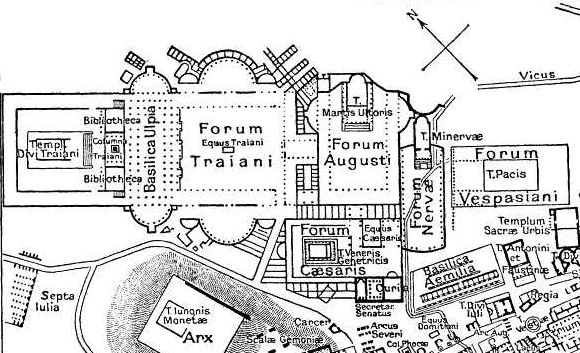

Imperial fora
View on WikipediaThe Imperial Fora (Fori Imperiali in Italian) are a series of monumental fora (public squares), constructed in Rome over a period of one and a half centuries, between 46 BC and 113 AD. The fora were the center of the Roman Republic and of the Roman Empire.
Key Information


The Imperial Fora, while not part of the Roman Forum, are located relatively close to each other. Julius Caesar was the first to build in this section of Rome and rearranged both the Forum and the Comitium, another forum type space designated for politics, to do so. These fora were the centres of politics, religion and economy in the ancient Roman Empire.
During the early 20th century, Mussolini restored the Imperial Fora as part of his campaign to evoke and emulate the past glories of Ancient Rome, but he also built the Via dei Fori Imperiali across the middle of the site. The modern street and its heavy traffic has proved a source of damage to the buildings because of vibration and pollution. There have been a number of proposals to remove the road, but none have taken effect.
Forum of Caesar
[edit]
Julius Caesar decided to construct a large forum bearing his name. This forum was inaugurated in 46 BC, although it was probably incomplete at this time and was finished later by Augustus.
The Forum of Caesar was constructed as an extension to the Roman Forum. The Forum was used as a replacement venue to the Roman Forum for public affairs as well as government; it was also designed as a celebration of Caesar's power. Caesar had placed, on the front of his forum, a temple devoted to Venus Genetrix, since Caesar's family (gens Julia) claimed to descend by Venus through Aeneas. A statue of Caesar himself riding Bucephalus, the celebrated horse of Alexander the Great, was placed in front of the temple, to symbolise absolute power.[citation needed] This centralised vision corresponded to the ideological function, following the propaganda of the Hellenistic sanctuaries; also the choice of the Forum site carried a meaning: the future dictator didn't want to be far from the central power, represented in the Curia, seat of the Senate. In fact, not long before Caesar's death, the Senate agreed to reconstruct the Curia on the site.
Forum of Augustus
[edit]_-_Laterale.jpg)
In the battle of Philippi in 42 BC, in which Augustus and Mark Antony worked together and avenged Caesar's death, defeating the forces of Brutus and Cassius, Augustus vowed to build the Temple of Mars Ultor ("Mars the Avenger"). The incomplete forum was inaugurated, after 40 years of construction, in 2 BC, adding the second monumental square, the Forum of Augustus.
This new complex lies at right angles to the Forum of Caesar. The temple consists of a very tall wall, and this still distinguishes itself from the popular neighbourhood of Suburra. This high wall served as a firebreak, protecting the Forum area from the frequent conflagrations from which Rome suffered. The rectangular square has long deep porticos with a surface that widens into large semicircular exedras.
Recently one more slightly smaller exedra was found south on the wall bordering the Forum of Trajan, meaning that for the sake of symmetry there must have been other exedra demolished to make room for the forum of Nerva, rising the number to four and not two exedras. This completely changed the layout for the south part of the Forum of Augustus, meaning that it is much more similar to the Forum of Trajan and a new theory for this southern part of the forum suggests that in fact there was a basilica between the two new exedras (like in the Forum of Trajan). This supports the numerous ancient authors that tell us the forum was used as a court of law.
The entire decoration of the Forum was tightly connected to the ideology of Augustus. According to myth, Rome herself was born from the god Mars through Romulus. This forum was occupied by . . .
Temple of Peace
[edit]_-_2021-08-25_-_1.jpg)
In 75 AD, the Temple of Peace, also known as the Forum of Vespasian, was built under Emperor Vespasian. Separated from the Forum of Augustus and the Forum of Caesar by the Argiletum, which connected the Roman Forum to the Subura, the temple faced the Velian Hill (in the direction of the Colosseum). The fact that this structure is not mentioned as having a civil function has prevented it from being classified as a true Forum. Therefore, the structure was simply identified as the Temple of Peace (Templum Pacis) until the late Empire.
The shape of the square was also different: the temple was constructed as a large apsidal hall that opened up like an exedra at the bottom of the portico. A row of columns distinguished the portico from the temple. The central area was not paved like other fora and served as a garden, with pools and pedestals for statues, so that it was similar to an open-air museum.
The monument was built to celebrate the conquest of Jerusalem. One of the chambers opened at the end of the porticos housed the Forma Urbis Romae, a marble map of ancient Rome, made in the Severan period (3rd century) by drawing on the marble slab that covered the wall. The wall is now part of the façade of the church of Santi Cosma e Damiano, where the holes used to mount the slabs of the map can still be seen. The Temple of Peace is also said to have housed the Menorah from Herod's Temple.[1]
Forum of Nerva, or the Transitional Forum
[edit].jpg)
Domitian decided to unify the previous complex and the free remaining irregular area, between the Temple of Peace and the Fora of Caesar and Augustus, and build another monumental forum which connected all of the other fora.
The limited space, partially occupied by one of the exedrae of the Forum of Augustus and by the via dell'Argileto, obliged Domitian to build the lateral porticos as simply decorations of the bounding walls of the forum. The temple, dedicated to Minerva as protector of the emperor, was built leaning on the exedra of the Forum of Augustus, so that the remaining space became a large monumental entrance (Porticus Absidatus) for all the fora.
Because of the death of Domitian, the forum was inaugurated by his successor, Nerva, who gave his own name to it. The Forum of Nerva is also known as Transitional Forum, because it worked as an access way, just like via dell'Argileto had done.
Forum of Trajan
[edit]
It is probable that Domitian's projects were more ambitious than the building of the small Forum of Nerva and probably under his reign they started to remove the small saddle that united the Capitoline Hill to the Quirinal Hill, thus blocking the Fora towards Campus Martius, near to modern Piazza Venezia.
The project was resumed by Trajan with the construction of Trajan's Forum between 112 and 113. The occasion was the conquest of Dacia, whose spoils paid for this celebration of the military conquests of Rome.
The preparation of the Forum required a lot of work. It was necessary to remove the hilly saddle, and to support the cut of Quirinal Hill through the building of Trajan's market. The Forum square was closed by the Basilica Ulpia, with Trajan's Column at its back. In front of the basilica, a monumental façade was the background of a large, equestrian sculpture of the Emperor. The last Forum was also the biggest and greatest.[2]
Museum
[edit]In 2007, a museum dedicated to the Imperial Fora was opened in the Trajan's Market, which once constituted the northern edge of the Forum of Trajan. The new museum, named "Museo dei Fori Imperiali" (English: Museum of Imperial Fora) by the means of sculptures, videos, architectural pieces, and scale models depicts the history of the four fora and the Temple of Peace.[3]
References
[edit]- ^ "News and Announcements | College of Agriculture and Life Sciences". Cals.cornell.edu. Retrieved 2013-08-31.
- ^ Tucci, Pier Luigi, ‘Nuove osservazioni sull’architettura del Templum Pacis’, in F. Coarelli (ed.), Divus Vespasianus. Il Bimillenario dei Flavi (Milan 2009), catalogue of the exhibition on the Flavian dynasty (Rome, March 2009 – January 2010) 158–167
- ^ Riccardo Bianchini. "Rome – The Museum of Imperial Fora". Inexhibit. Retrieved November 26, 2015.
External links
[edit]- James Grout: Imperial Fora, part of the Encyclopædia Romana
- Satellite image of the area of the Fora
- Rome, The Imperial Fora (2007 onwards) in: the "Fori Imperiali," of the: Sovrintendenza Capitolina ai Beni Culturali,' Roma (2007) [text only available in Italian.
- Lucentini, M. (31 December 2012). The Rome Guide: Step by Step through History's Greatest City. Interlink. ISBN 9781623710088.
 Media related to Forums of Rome at Wikimedia Commons
| Preceded by Roman Forum |
Landmarks of Rome Imperial fora |
Succeeded by Forum of Augustus |

Imperial fora
View on GrokipediaHistorical Context and Development
Origins in the Roman Republic
The Roman Forum, or Forum Romanum, originated as a low-lying marshy valley between the Capitoline, Palatine, and Velian Hills, transformed into a public space through drainage via the Cloaca Maxima sewer system around 600 BCE, enabling its use as an open-air marketplace and assembly ground during the early Republic.[4] By the fifth century BCE, key temples emerged, including the Temple of Saturn dedicated in 497 BCE to honor the deity associated with wealth and agriculture, and the Temple of Castor and Pollux in 484 BCE, commemorating the mythical twins' aid in the Battle of Lake Regillus.[4] During the middle Republic, from the third to second centuries BCE, the forum evolved into a complex of monumental architecture to accommodate expanding civic, judicial, and religious functions, with the introduction of basilicas as covered halls for legal proceedings and commerce. Notable additions included the Basilica Porcia, built by Marcus Porcius Cato in 184 BCE; the Basilica Aemilia, constructed in 179 BCE and later expanded; and the Basilica Opimia in 121 BCE, reflecting the increasing demands of Rome's growing bureaucracy and population.[4] These structures flanked the central square, interspersed with the Curia Hostilia for senatorial meetings and the Rostra for public oratory, underscoring the forum's role as the political nerve center where assemblies, trials, and triumphs occurred.[5] By the late Republic, around the first century BCE, the Roman Forum suffered severe overcrowding due to Rome's population surge—estimated at up to one million inhabitants—and intensified political, legal, and commercial activities amid territorial expansions and civil strife, rendering it inadequate for efficient governance and public gatherings.[2] This congestion prompted innovative spatial solutions from leading figures; Pompey the Great's theater and portico complex of 55 BCE exemplified private patronage of public works, but it was Julius Caesar who addressed the forum's core limitations by acquiring adjacent private land for 60 million sesterces starting in 54 BCE, initiating construction of the Forum Iulium to extend judicial and assembly capacities northward toward the Capitoline Hill.[2] Dedicated in September 46 BCE with the Temple of Venus Genetrix—Caesar's claimed divine ancestress—the new forum featured a rectangular piazza, colonnades, and shops, funded partly by Gallic spoils, marking the conceptual precursor to later imperial complexes by prioritizing monumental propaganda alongside practical relief.[1] Caesar's intervention, as pontifex maximus and dictator, thus bridged republican traditions of public building with autocratic ambition, setting a template for subsequent rulers to replicate in expanding Rome's monumental core.[2]Imperial Expansion and Motivations
The territorial expansion of the Roman Empire during the late Republic and early Principate era resulted in substantial population influxes to the capital, estimated to exceed one million inhabitants by the 1st century CE, alongside heightened administrative requirements for managing provincial affairs, taxation, and justice.[6] This growth overwhelmed the capacity of the existing Roman Forum, which had developed organically since the 7th century BCE, prompting emperors to construct supplementary complexes to decongest the area and provide dedicated spaces for law courts, markets, and public assemblies.[2] These Imperial Fora, built between 46 BCE and 112 CE, represented a deliberate urban extension northward from the traditional Forum, integrating new infrastructure while preserving symbolic continuity with republican traditions.[7] Primary motivations for these constructions included practical governance needs, as the original Forum's basilicas and porticos could no longer suffice for the empire's bureaucratic expansion, with activities like judicial hearings relocating to the new venues to enhance efficiency.[2] Emperors financed projects using spoils from conquests, such as the vast sums from Caesar's Gallic Wars or Trajan's Dacian campaigns (101–106 CE), which not only funded the works but also symbolized the economic benefits of imperial dominion.[2] Administrative relief was thus intertwined with displays of fiscal prowess derived from overseas expansion. Beyond functionality, the fora functioned as potent tools for political propaganda and dynastic legitimation, enabling rulers to eternalize their achievements through temples, statues, and narrative reliefs that linked personal victories to divine favor and Roman destiny.[7] For example, structures commemorated specific triumphs, like Vespasian's Templum Pacis housing artifacts from the sack of Jerusalem in 70 CE, reinforcing the emperor's role as bringer of peace (pax) following conquest.[2] Each successive forum aimed to surpass predecessors in scale and opulence, asserting the builder's superiority and stability amid the empire's growing complexities, while fostering collective identity among citizens via monumental art that glorified imperial expansion.[2][7]Chronological Sequence of Construction
The Imperial Fora were constructed sequentially from the mid-first century BC through the early second century AD, reflecting the expansion of imperial patronage in Roman urban planning. The initial forum, initiated by Julius Caesar, marked a departure from republican precedents by incorporating private land acquisition and monumental temple dedication to Venus Genetrix, with construction commencing around 54 BC after purchasing properties between the Forum Romanum and Subura. Intensive building occurred post-48 BC following the Battle of Pharsalus, culminating in its dedication on 26 September 46 BC amid Caesar's quadruple triumph, though some elements like the temple's cella were completed posthumously by Augustus.[8][9] Augustus began the Forum Augustum shortly after the Battle of Philippi in 42 BC, fulfilling a vow to Mars Ultor for vengeance against Caesar's assassins; work progressed intermittently amid civil wars and urban renewal, with the complex dedicated on 12 May 2 BC after decades of construction emphasizing equestrian statues and genealogical porticos.[10][11] A hiatus followed until the Flavian dynasty, when Vespasian initiated the Templum Pacis around 71 AD using spoils from the Jewish War, dedicating it in 75 AD as a repository for imperial treasures and a symbol of restored peace after the Year of the Four Emperors.[12][13] Domitian commenced the narrow Forum Transitorium (later Nerva's) before 85 AD to link prior fora across the Argiletum valley, but after his assassination, Nerva completed and dedicated it in 97 AD, incorporating the Temple of Minerva with reliefs emphasizing continuity.[14][15] Trajan's Forum, the final and largest, began construction between 105 and 107 AD under architect Apollodorus of Damascus, funded by Dacian spoils, and was inaugurated in 112 AD, featuring basilica, libraries, and the victory column, though minor additions continued into Hadrian's reign.[16][17]| Forum | Initiator(s) | Approximate Start | Dedication Date |
|---|---|---|---|
| Julius Caesar | Julius Caesar | c. 54 BC | 46 BC |
| Augustus | Augustus | c. 42 BC | 2 BC |
| Templum Pacis | Vespasian | c. 71 AD | 75 AD |
| Nerva (Transitorium) | Domitian/Nerva | Before 85 AD | 97 AD |
| Trajan | Trajan | 105–107 AD | 112 AD |