Hubbry Logo
search
logo

Ina Bauer (element)

logo
Community Hub0 Subscribers
Read side by side
from Wikipedia
Figure skating element
Kim Ye-lim performing an Ina Bauer at Skate Canada 2019
Element nameIna Bauer
Element typeMoves in the field
InventorIna Bauer

An Ina Bauer is a "moves in the field" element in figure skating in which a skater skates on two parallel blades. One foot is on a forward edge and the other leg is on a backwards and different parallel edge. The forward leg is bent slightly and the trailing leg is straight. If the leading leg is on the inside edge, the move is known as an inside ina bauer. If the skater is on the outside edge, it is known as an outside ina bauer. Many skaters bend backwards while performing this move, although this is not required. The most flexible skaters can bend over almost completely backwards. When performed this way, the move is called a layback Ina Bauer, after the layback position.[1]

The move is named after Ina Bauer, who invented it.[2]

Technique

[edit]
Ballet 4th position with flat shoes.

The Ina Bauer element is an extended fourth position in ballet in terms of where the feet are placed. However, the front leg is bent and the back leg is kept straight. It can be entered into through an inside-edge spread eagle, and, like the spread eagle, is commonly used as an entrance into jumps, adding to the difficulty level of the jump under Code of Points. It can be used as an entrance to any jump because the element can be performed on either edge. For example, after the skater exits the Ina Bauer position, a double Axel jump can be executed.

The Ina Bauer can be performed on the inside edge or the outside edge. The outside edge Ina Bauer is considered more difficult than an inside edge. The back position is not mandatory, although most skaters will at least bend a little. The most flexible skaters can bend their backs until their head is nearly upside down.

The Ina Bauer is a variation of the spread eagle. The skater's feet trace parallel lines, with one leg bent deeply at their knee while tracing a shallow or flat forward outside edge. Their body is bent backward "so the other leg is on a parallel line tracing a backward inside edge".[2]

The position can also be used in pairs and ice dancing by the lifting partner in ice dancing lifts.[3] In this case, the lifting partner does not bend backwards.

[edit]

In singles (inside edge)

[edit]

In singles (outside edge)

[edit]

In pairs skating

[edit]

In ice dancing

[edit]

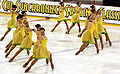
In synchronized skating

[edit]

In Japan

[edit]
Shizuka Arakawa performs her signature layback ina bauer.

Shizuka Arakawa of Japan is famous for her flexible take on the Ina Bauer, during which she bends her back backwards until her head is upside down. This move was highlighted in Arakawa's winning free skating program at the 2006 Winter Olympics, where she performed an outside edge Ina Bauer, then performed a three jump combination (triple salchow-double toe-double loop). Because of this publicity, the term "ina bauer" has been transliterated phonetically into the Japanese word イナバウアー and has taken on a new meaning. It is a "vogue" word that has come to mean anything having to do with bending over backwards, because the term was repeated so often that many people mistakenly thought that "ina bauer" referred to the back position,[4] not the skating involved (the back position is more exactly called the layback position, making the move combined with Arakawa's back position a "layback Ina Bauer"[1]). In Japan, it is also known as the "Arakawa way" or the "Arakawa type" (荒川のように), after Shizuka Arakawa.

The term has become so popular in Japan that Asahi Breweries has attempted to trademark it.[5] However, that attempt was blocked because it is a proper name and Bauer refused to give the rights.[5]

References

[edit]
[edit]
Revisions and contributorsEdit on WikipediaRead on Wikipedia
from Grokipedia
The Ina Bauer is a two-footed gliding element in figure skating in which the skater travels forward along parallel but separate tracings on the ice, with one skate on a forward inside or outside edge and the other on a matching backward edge, typically with the forward knee deeply bent and the trailing leg extended straight behind.[1][2] Named after the German figure skater Ina Bauer, who invented and popularized the position during her competitive career in the late 1950s, the move is often performed as a transitional element leading into jumps or spins, and it emphasizes balance, edge control, and expressive body positioning.[3] Born on January 31, 1941, in Krefeld, Germany, to a silk manufacturer father, Ina Bauer (later Szenes after marrying Hungarian skater István Szenes) rose to prominence in West German figure skating, winning three consecutive national titles from 1957 to 1959.[3] She achieved international recognition by placing fourth at the World Figure Skating Championships in both 1958 and 1959, showcasing her innovative style that earned her the nickname "Brigitte Bardot on ice" for her glamorous and athletic performances.[3] After retiring from competition in 1959, Bauer transitioned to professional skating with the Ice Follies tour and appeared in films such as Kauf dir einen bunten Luftballon (1961), while later coaching at her home club in Krefeld and establishing the Ina Bauer Cup junior competition in 1980.[3] She passed away on December 13, 2014, at age 73.[3] In modern figure skating under International Skating Union (ISU) rules, the Ina Bauer is defined as a two-footed movement, often used as a transitional element in programs rather than as a scored jump or spin, and it can be executed on inside or outside edges, with outside versions considered more challenging due to the required hip extension and stability.[1][4] The move has been notably featured in routines by skaters like Shizuka Arakawa, who incorporated a layback variation during her gold medal performance at the 2006 Winter Olympics in Turin.[3] Its enduring legacy lies in demonstrating the artistry and technical precision central to the sport, influencing choreography across singles, pairs, and ice dance disciplines.[2]

Overview and History

Definition

An Ina Bauer is a fundamental "moves in the field" element in figure skating, characterized by a two-footed glide in which the skater travels along the ice with one foot on a forward edge and the other on a corresponding backward edge (inside or outside), while the blades remain parallel but offset to create distinct tracings. This configuration produces a curved path, distinguishing it from linear glides, as the skater's body arches backward over the tracing for aesthetic extension and balance.[5] In executing the position, the skater leans the torso backward, extends the arms outward for stability, and stretches the free leg behind, with a slight bend at the knee of the forward skate to maintain flow and control. Unlike a spread eagle, where the skates align on the same tracing to form a straight or minimally curved line with toes pointed outward, the Ina Bauer's parallel blade setup emphasizes a more pronounced arc, enhancing its role in program transitions.[5] The element is named after German figure skater Ina Bauer, who invented and popularized it during her competitive career in the 1950s.[6] The International Skating Union (ISU) classifies the Ina Bauer as a connecting move or transition element under steps, turns, and movements, rather than a scored jump or spin, allowing it to link phrases in routines while demonstrating edge control and body positioning. This recognition underscores its utility in building program difficulty through sustained edge quality and ice coverage.

Etymology and Origin

The Ina Bauer element in figure skating is named after Ina Bauer, a German competitive skater who invented and popularized the move during her career in the 1950s.[3][7] Born on January 31, 1941, in Krefeld, West Germany, Ina Bauer rose to prominence as a singles skater renowned for her graceful and innovative edges and glides.[3] She secured three consecutive West German national titles from 1957 to 1959 and earned fourth-place finishes at the World Figure Skating Championships in both 1958 in Paris and 1959 in Colorado Springs.[3][7] After withdrawing from the 1960 European Championships in Garmisch-Partenkirchen, she retired from competition at her father's request.[8] The element originated as a variation of the inside spread eagle during the post-World War II evolution of figure skating, when skaters began experimenting with expressive gliding positions beyond traditional figures.[8] Bauer first demonstrated the move publicly around 1957, incorporating it into her programs to highlight her technical artistry and earning widespread attention at events like the European and World Championships.[3] It gained formal recognition within the International Skating Union framework in the 1960s, as compulsory figures waned in emphasis and free skating programs increasingly featured transitional elements like the Ina Bauer for fluidity and aesthetic appeal.[7] Early adoption centered in European competitions, where Bauer's performances showcased the move's elegance, before it spread globally and influenced the development of similar connecting maneuvers in international routines.[3]

Technique

Execution Mechanics

The Ina Bauer is typically entered from a forward glide, a mohawk turn, or a crossover sequence, where the skater pushes off the forward skate to transition into the parallel blade position. This initiation requires a deliberate hip rotation to place the back skate into alignment, often beginning with a bent-knee spread eagle on a curved path to build control.[9] In terms of blade placement, the forward skate is positioned on an inside or outside edge, with the backward skate on the complementary edge (outside for inside forward, inside for outside forward) to maintain parallelism, though the blades form a subtle V-shape as they trace distinct paths on the ice.[10][11] The offset between the skates, typically 10 to 24 inches, ensures the traces remain parallel without crossing, demanding precise edge control to avoid wobbling or deviation from the intended curve.[10] Body alignment is critical for stability and aesthetics, featuring a forward knee bent at approximately 90 degrees to deepen the edge, while the back leg remains extended straight for extension and balance. Hips must open fully to accommodate the parallel stance, with shoulders arched backward over the skating curve and weight distributed evenly across both skates to prevent tipping. This posture requires leaning into the curve, particularly for outside-edge variations, to sustain the glide without losing momentum.[9] The element is generally held for at least 3 seconds to demonstrate control and edge quality, particularly for the outside variation to earn scoring features, before exiting via a spread eagle pull-through or a directional turn to transition into subsequent elements. Common challenges include maintaining balance amid the arched position, which can lead to falls if the arch is excessive or weight shifts unevenly.[9][1] Executing the Ina Bauer demands strong core and leg strength to support the extended posture and edge pressure, making it a key skill in skating development, introduced at pre-juvenile levels in synchronized skating contexts. Training often progresses from off-ice stretches for hip flexibility to on-ice drills like lobe-switching to refine control and prevent injury from improper alignment.[9][12]

Edge Variations

The Ina Bauer element in figure skating features two primary edge variations: the inside edge and the outside edge, distinguished by the edges used on the forward and backward skates. In the inside edge Ina Bauer, the forward skate glides on an inside edge while the backward skate is on an outside edge, resulting in a tighter curve that facilitates a pronounced lean into the circle. This variation is generally easier for beginners due to its stability and is historically associated with compulsory figures practice, where precise edge control was emphasized.[9][11] The outside edge Ina Bauer, by contrast, employs an outside edge on the forward skate and an inside edge on the backward skate, creating a wider arc that demands greater balance and hip turnout to counteract inherent instability. This version requires enhanced control over the hips and core, making it more challenging overall, and is frequently incorporated into programs for dramatic entrances leading into jumps, leveraging its expansive path for visual impact.[13][9] Comparatively, the inside edge variation permits a deeper knee bend on the forward leg, enhancing flow and speed, whereas the outside edge necessitates a straighter posture to maintain alignment and prevent wobbling. Both variations are evaluated under International Skating Union (ISU) guidelines primarily through Grade of Execution (GOE) criteria in singles skating, which reward superior edge quality, control, and hold length—typically favoring sustained glides of at least 3 seconds without loss of form—though in solo ice dance it may receive levels with base value as an edge element.[10][1] Advanced modifications to the Ina Bauer include one-foot executions, where the skater briefly lifts the trailing foot while sustaining the position, or integrations with twizzles for added rotational complexity in transitions. However, ISU and national federation rules, such as those from Skate Canada, strictly define the Ina Bauer as a two-footed movement, limiting such variations to non-competitive or training contexts to preserve the element's core mechanics.[5][14]

Applications in Figure Skating

Singles Skating

In singles skating, the Ina Bauer primarily functions as a transitional element that connects jumps, spins, and other program components, enhancing overall flow and artistic elegance. It is commonly incorporated into footwork sequences and the required Choreographic Sequence in the free program, where it contributes to positive Grades of Execution (GOE) by demonstrating variety and creativity in movement. According to the International Skating Union (ISU) guidelines, the Choreographic Sequence must include at least two different skating movements such as Ina Bauers, spirals, or arabesques, allowing skaters to showcase the element's gliding quality while maintaining program momentum.[15] Historically, the Ina Bauer emerged in the 1950s as an innovative free skating move invented by German champion Ina Bauer, who featured it prominently in her routines during an era dominated by compulsory figures from the 1950s through the 1970s. Although not classified as a compulsory figure, which emphasized precise edge tracings like figure-eights and loops, the element gained traction in optional free skating to add stylistic transitions amid the technical focus on figures that accounted for up to 60% of scores.[3][16] Notable Olympic champions, such as Shizuka Arakawa, utilized inside edge Ina Bauers for seamless transitions in their programs, exemplified by her gold-medal-winning 2006 Torino free skate where the move highlighted her expressive style. In technical integration, the Ina Bauer is frequently paired with intricate footwork patterns to build speed or set up elements, with the inside edge variation favored for its efficiency in accelerating across the ice, while the outside edge offers greater visual drama when placed near the program's centerline for audience impact.[4] This dual-edged approach allows skaters to reference basic edge types briefly in execution, adapting the hold and body position to fit musical phrasing without disrupting rhythm. Under ISU judging criteria, the Ina Bauer's quality is evaluated based on edge depth and control, sustained speed without deceleration, and innovative integration into the program; deductions occur for instability such as wobbles, shallow edges, or abbreviated holds that fail to demonstrate full extension.[15] These factors directly influence GOE levels from -5 to +5, rewarding precise execution that elevates the program's artistic cohesion.

Pairs Skating

In pairs skating, the Ina Bauer is adapted for partnered execution, where both skaters often perform the move simultaneously in mirror or parallel formations to highlight their synchronization and unity on the ice. This coordinated gliding allows for dynamic visual effects, with one partner's backward edge occasionally providing support or momentum for the other's entry into subsequent elements like lifts.[17] The element integrates seamlessly into various program components, serving as a transitional move into complex maneuvers such as death spirals or throw jumps, where it forms part of the entry curve executed by one or both partners. Outside edge variations enhance dramatic effect during side-by-side glides, adding flair to transitional sequences between required elements. According to ISU technical rules, the Ina Bauer qualifies as a difficult takeoff variation in pair lifts when performed by the lifted skater immediately before full arm extension, contributing to higher levels of difficulty across lift groups if varied appropriately. It is also permitted as a non-lift connecting element in step sequences and choreographic sequences, provided it maintains continuous flow without interrupting the program's rhythm.[18][19] Historically, the Ina Bauer appeared in pairs routines during the 1990s as part of innovative transitional choreography, gaining prominence in programs that emphasized artistic expression alongside technical prowess. ISU regulations have consistently allowed its use as a connecting element outside of lifts, rewarding its inclusion when it enhances program difficulty without violating element classifications.[20] Executing the Ina Bauer in pairs presents unique challenges, including the need for precise timing and spatial awareness to prevent collisions between partners during synchronized glides. Judges award higher grades of execution (GOE) for flawless unison in body lines, speed matching, and edge control, while deductions apply for any loss of synchronization or imbalance in the formation.[17]

Ice Dancing

In ice dancing, the Ina Bauer is adapted for partnered execution, typically performed while in hold—such as foxtrot or waltz positions—to highlight rhythmic musical phrasing and synchronized movement between partners. The inside edge variation is especially suited for creating smooth, flowing curves that align with the interpretive demands of pattern dances, where precise edge work enhances the overall flow without disrupting the required pattern.[17] Within programs, the Ina Bauer frequently appears in free dance transitions leading into twizzles or lifts, providing an elegant gliding element that builds momentum and maintains speed without incorporating jumps, in keeping with International Skating Union (ISU) regulations for rhythm and free dances that prioritize non-jumping transitions. This placement allows skaters to demonstrate control and partnership while adhering to pattern dance elements in the rhythm dance phase. Notable examples include its use in routines by teams like Meryl Davis and Charlie White during the 2010s, where outside edge variations were incorporated to accentuate dramatic poses and enhance the artistic narrative of their programs. Such applications underscore the move's versatility in elevating the emotional and visual impact of free dances. The Ina Bauer in ice dancing is evaluated based on its synchronization with the music's timing, the quality of partner connection during the hold, and the depth and clarity of edge control, as outlined in ISU technical guidelines for skating skills and program components. It is restricted to non-lifting glides to comply with rules prohibiting unsupported lifts in certain program segments, ensuring it remains a grounded interpretive tool rather than an acrobatic feature. Skaters often incorporate an arched body posture to amplify its expressive lines, drawing from core execution mechanics.

Synchronized Skating

In synchronized skating, the Ina Bauer is executed by teams of 8 to 16 skaters in formations such as lines or blocks, where all participants glide on parallel blades simultaneously to produce unified curves and maintain precise spacing.[21] This team approach requires each skater to hold the position while preserving the overall shape, often using parallel inside edges to create circular or arc-like patterns that amplify the element's aesthetic flow.[21] The move plays a key role in routines as a transitional element, linking intersections, blocks, or other features while promoting visual symmetry and momentum across both the short program and free skate.[22] It contributes to the program's structure by facilitating smooth shifts between required elements, emphasizing collective precision over individual flair. Under International Skating Union (ISU) guidelines, the Ina Bauer is categorized as a basic free skating move (fms) within the discipline, which gained formal recognition through the inaugural ISU World Synchronized Skating Championships in 2000 amid the sport's expansion in the early 2000s.[23] Scoring focuses on unison among skaters, sustained speed, and the integrity of the formation, with technical panels evaluating these aspects via base value, levels of difficulty, and grade of execution (GOE) from -5 to +5.[23]

Cultural and Regional Significance

Usage in Japan

The Ina Bauer gained significant prominence in Japanese figure skating culture following Shizuka Arakawa's gold medal-winning performance at the 2006 Winter Olympics in Turin, where her layback variation of the move became a highlight of her free skate to Giacomo Puccini's Turandot.[24] This execution, featuring a dramatic backbend while gliding on parallel blades, captivated audiences and elevated the element's visibility in Japan, transforming it into a cultural phenomenon. The term "Ina Bauer" itself emerged as a buzzword of the year in 2006, frequently referenced by sports commentators to describe Arakawa's spectacular artistry and contributing to her status as the first Japanese woman to win Olympic gold in singles skating.[25] In Japan, the layback style is often specifically associated with Arakawa, sometimes referred to as the "Arakawa way" in media and fan discussions.[26] Building on this legacy, the Ina Bauer has been extensively incorporated into the programs of subsequent Japanese skaters, most notably two-time Olympic champion Yuzuru Hanyu, who adopted it as a signature transition element inspired by Arakawa's influence. Hanyu first prominently featured the move in his 2014 Sochi Olympic free skate to The Phantom of the Opera, using it to showcase fluidity and emotional depth amid his technical jumps.[27] He revisited it in his 2018 Pyeongchang Olympic free skate to "La Marseillaise" and "Hope & Legacy" by Yiruma, executing a precise Ina Bauer near the program's conclusion after hydroblading, which underscored his blend of power and elegance while securing his second consecutive gold medal.[28] In contemporary Japanese skating, the Ina Bauer remains a staple in exhibitions and professional ice shows, symbolizing grace and artistic expression beyond competitive routines. Arakawa continued performing it in post-retirement exhibitions, such as a 2006 Tokyo gala shortly after the Olympics, where it drew enthusiastic crowds.[29] Hanyu has integrated it into tours like Fantasy on Ice, notably transitioning from an Ina Bauer into a triple Axel during a 2017 finale in Kobe, highlighting its versatility in choreographed narratives.[30] Hanyu has continued to incorporate the Ina Bauer in his post-retirement ice shows, such as in "RE_PRAY" tours from 2023 onward, maintaining its prominence in Japanese performances as of 2025.[31] These appearances in events such as Fantasy on Ice reinforce the move's role as an emblem of refined beauty in Japan's vibrant ice show scene, where it often evokes the poise of classical and theatrical performances.

Global Recognition

The Ina Bauer has achieved widespread standardization within the International Skating Union (ISU), where it is incorporated into the technical requirements and scoring guidelines for competitive elements across disciplines. Since the adoption of the International Judging System (IJS) in 2004, the move serves as an entry feature or connecting element in pairs lifts, death spirals, and choreographic sequences, contributing to levels of difficulty and Grade of Execution (GOE) marks in events like the Olympics and World Championships.[20][32] In national testing structures, the Ina Bauer is a core component of moves-in-the-field curricula, evaluated for edge quality, control, and flow in progression from preliminary to senior levels. Organizations such as U.S. Figure Skating include it as a required or optional pattern in test standards, ensuring its integration into foundational training programs globally.[33] This recognition underscores its role in developing skaters' edge work and body positioning, with the move appearing in official test protocols since at least the late 20th century. The element's educational influence extends to international coaching resources, where it is detailed in manuals for technique and program design. Skate Canada's technical glossary defines the Ina Bauer as a two-footed edge movement, emphasizing its use in building flexibility and artistic expression, while U.S. Figure Skating's instructional materials feature it in basic skills progressions and advanced maneuvers.[2][34] Variations, such as those combining the Bauer with spins or extended poses, have inspired hybrid elements in competitive programs, enhancing transitions and highlighting skaters' innovation. As a hallmark of 20th-century figure skating evolution, the Ina Bauer symbolizes technical elegance and has been highlighted in ISU educational content, including official element explanation videos.[35] The element's adoption by elite international competitors further cements its legacy, often employed to elevate program components scores through seamless integration into choreography.

Visual Examples

Inside Edge in Singles

The inside edge Ina Bauer in singles skating is characterized by a tighter curve on the ice, with the skater's blades positioned parallel but offset by 10-24 inches, the back foot consistently on an inside edge and the front foot also on an inside edge to facilitate a closer embrace of the circular path. This configuration demands a pronounced knee bend in the leading leg, allowing the body to lean inward toward the curve for balance, while the trailing leg remains relatively straight to maintain propulsion and edge control. When executed gracefully, the move conveys elegance and stability, though improper form can result in visible tension or deviation from the intended arc.[10][9] A prominent example appears in Yuna Kim's 2010 Olympic free skate to "Gershwin's Rhapsody in Blue," where she employed an inside edge Ina Bauer as a transitional element into a jump combination, briefly sustaining the position to build momentum before a triple flip. This integration underscored her athletic command, adding subtle difficulty to the sequence without overshadowing the program's overall technical demands.[36] In video and photographic documentation, the inside edge Ina Bauer highlights an arched back and extended arms, which contribute to a fluid, expressive silhouette that amplifies the move's aesthetic flow and integration with the surrounding choreography.[9] Skaters often incorporate the inside edge Ina Bauer in lyrical portions of their programs, leveraging its curved intimacy to evoke emotion and demonstrate interpretive depth alongside technical poise.[35]

Outside Edge in Singles

The outside edge Ina Bauer in singles figure skating produces a wider tracing on the ice than a standard single-edge glide, as both skates travel in parallel paths while curving in a shallow arc. This variation demands straighter legs, with the trailing leg extended fully to maximize the line's length and visual impact, while the leading leg bends slightly to steer the front skate open. The skater's body leans dramatically into the turn for stability, often incorporating a pronounced backward arch to counter the inherent instability of the outside edge and maintain balance under speed.[9] A notable example appears in Evgenia Medvedeva's programs, where the outside edge Ina Bauer serves as a dynamic entry to spins, as seen in her 2018 Olympic free skate to Anna Karenina by Tchaikovsky, highlighting rapid acceleration and full-body extension for dramatic effect. This move underscores the skater's technical control, transitioning seamlessly from propulsion to rotation while preserving edge quality.[37][38] In media depictions, the outside edge Ina Bauer is frequently shown in slow-motion sequences within instructional videos to illustrate moments of potential instability—such as edge wobbles or hip misalignment—and the precise recovery adjustments needed, like shifting weight over the leading knee to recenter the body. These breakdowns emphasize the move's challenges, aiding learners in avoiding common errors like loss of ice contact.[39][9] Artistically, the outside edge Ina Bauer is favored in high-energy program segments of singles routines to demonstrate superior edge control and poise, often amplifying the music's intensity through its expansive glide and arched posture that conveys power and elegance.[9]

In Pairs Skating

In pairs skating, the Ina Bauer is often performed in a side-by-side formation, where both partners execute parallel glides on inside edges, creating mirrored arches that emphasize symmetry and unison. The skaters' bodies lean in coordination, with one leg extended forward and the other trailing behind, while their hands may connect lightly for balance and visual harmony, enhancing the element's elegance without restricting movement.[40] A notable example is the performance by American pair Tai Babilonia and Randy Gardner during their 1979 World Championships routine, where they transitioned into a synchronized Ina Bauer sequence that showcased their technical precision and artistic flair. In this visual, the duo glides in tandem, their blades tracing parallel curves across the ice, building momentum before flowing into subsequent lifts and spins, highlighting the move's role in transitional choreography. This sequence, captured in archival footage, remains a benchmark for paired execution of the element.[41][42] Key imagery from overhead angles in pairs Ina Bauers accentuates the synchronized leans of the partners, with their hips opened and torsos aligned to maintain blade parallelism, creating an illusion of a single, elongated arch spanning the rink. These perspectives reveal the subtle interplay of edges and body positions that sustain the glide, often under dynamic lighting that underscores the curve's fluidity. The dynamic elements of a paired Ina Bauer capture the buildup of speed as partners push off in unison, accelerating through the arch to generate momentum for connecting maneuvers, such as press lifts or death spirals, while preserving the element's inherent grace and partnership synergy.[43]

In Ice Dancing

In ice dancing, the Ina Bauer is executed in open or closed holds, allowing partners to traverse curved paths on the ice while synchronized to the musical phrasing, with one skater on a forward inside edge and the other on a matching backward inside edge along parallel tracings. This configuration underscores the discipline's emphasis on partnership and flow, as the move requires precise weight distribution and body alignment to sustain the glide without interruption.[44] Inside edge variations of the Ina Bauer are integral to pattern dances, where they facilitate the tracing of defined lobes and curves essential to the dance's structure. In the Tea-Time Foxtrot, for example, partners perform a smooth inside Ina Bauer, concluding with a subtle three-turn-like motion on the forward leg to seamlessly transition into the next step, enhancing the rhythmic continuity of the foxtrot pattern. From side-view perspectives, the Ina Bauer in ice dancing accentuates fluid partner proximity and edge control, with bodies often arching expressively to interpret the music's emotional nuances. This is exemplified in Tessa Virtue and Scott Moir's 2018 Olympic free dance to Moulin Rouge!, where Scott Moir's Ina Bauer transition into a spin highlights the move's interpretive arch and the duo's synchronized body lines, conveying deep emotional intimacy.[45] The element's expressive nature thus amplifies the partners' connection, transforming mechanical precision into a narrative of unity and passion.[44]

In Synchronized Skating

In synchronized skating, the Ina Bauer is executed by teams in coordinated formations, such as linear lines or circular blocks, where all skaters glide in unison on parallel blades with one foot on a forward edge and the other on a backward edge. This collective movement creates dynamic wave-like curves across the rink, enhancing the visual flow and demonstrating the discipline's emphasis on precise synchronization among 8 to 20 skaters. The move serves as a free skating element in routines, often contributing to the artistic impression and transitions between larger elements like circles or wheels.[19] Ina Bauers in synchronized skating are commonly used during intersection transitions to maintain uniform body positions and speed while formations weave across the ice. Overhead views of such performances reveal the parallel edges held by the skaters, forming striking uniform arches that underscore the scale of the element in a group context. The multiplicity of skaters in connected holds amplifies the precision required, with even minor deviations visible in the curved paths traced on the ice. Key shots from such routines highlight the geometric beauty of the Ina Bauer in team settings, including close-ups of the blades' parallel tracking and wide-angle captures of the formation's curvature, which evoke a sense of fluid motion across the entire team. These visuals emphasize how the element scales from individual technique to collective artistry, distinguishing synchronized skating's large-scale presentations.

References

User Avatar
No comments yet.