Hubbry Logo
Musical phrasingMusical phrasingMain
Open search
Musical phrasing
Community hub
Musical phrasing
logo
8 pages, 0 posts
0 subscribers
Be the first to start a discussion here.
Contribute something
Musical phrasing
Musical phrasing
from Wikipedia
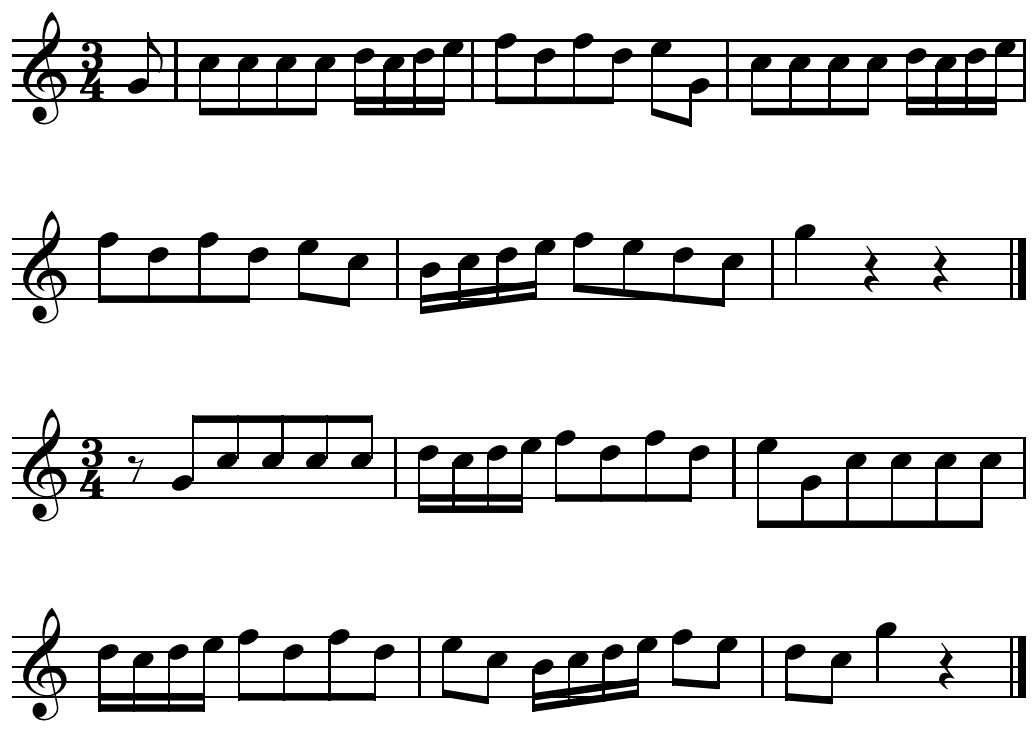
Bar-line shift's effect on metric accent: first two lines vs. second two lines[1] Play or play with percussion marking the measures.
Period (two five-bar phrases) in Haydn's Feldpartita. Play The second phrase is distinguished by an authentic cadence answering the half cadence at the end of the first phrase.[2] Note the use of slurs by the composer to indicate the intended phrasing.

Musical phrasing is the method by which a musician shapes a sequence of notes in a passage of music to allow expression, much like when speaking English a phrase may be written identically but may be spoken differently, and is named for the interpretation of small units of time known as phrases (half of a period). A musician accomplishes this by interpreting the music—from memory or sheet music—by altering tone, tempo, dynamics, articulation, inflection, and other characteristics. Phrasing can emphasise a concept in the music or a message in the lyrics, or it can digress from the composer's intention, aspects of which are commonly indicated in musical notation called phrase marks or phrase markings. For example, accelerating the tempo or prolonging a note may add tension.

A phrase is a substantial musical thought, which ends with a musical punctuation called a cadence. Phrases are created in music through an interaction of melody, harmony, and rhythm.[3]

Giuseppe Cambini—a composer, violinist, and music teacher of the Classical period—had this to say about bowed string instruments, specifically violin, phrasing:

The bow can express the affections of the soul: but besides there being no signs that indicate them, such signs, even were one to invent them, would become so numerous that the music, already too full of indications, would become a formless mass to the eyes, almost impossible to decipher. I should consider myself fortunate if I could only get a student to hear, through a small number of examples, the difference between bad and mediocre, mediocre and good, and good and excellent, in the diversity of expressions that one may give to the same passage.[4]

— "Nouvelle Méthode théorique et pratique pour le violon". Paris, Naderman (c. 1803)

Intuitive and analytical phrasing

[edit]

"There are two schools of thought on phrasing," says flutist Nancy Toff: "one more intuitive, the other more analytical. The intuitive school uses a verbal model, equating the function of phrasing with that of punctuation in language. Thus, said Chopin to a student, 'He who phrases incorrectly is like a man who does not understand the language he speaks.'"[5]

Problems linked with an analytical approach to phrasing occur particularly when the analytical approach is based only on the search for objective information, or (as is often the case) only concerned with the score:

The reliance on the score for information about temporal structures reflects a more profound analytical difficulty. Structural information gleaned from the score is visually apprehended and as such is predisposed to visualist models of structure. These models are premised on symmetry and balance and on a timeless notion of "objective" structure. [...] Temporal and aurally-apprehended structures are denied reality because they cannot be said to "exist" in the way that spatial and visually apprehended structures do. [...] Musical investigations exhibit the Western prejudice toward visualism in the dependence on visual symmetry and balance. Information about structure from listening experience is suspect because it is considered "subjective" and is opposed to "objective" information from the score.

— F. Joseph Smith[6]

According to Andranik Tangian,[7] analytical phrasing can be quite subjective, the only point is that it should follow a certain logic. For example, Webern’s Klangfarbenmelodie-styled orchestral arrangement of Ricercar from Bach’s Musical offering demonstrates Webern’s analytical phrasing of the theme, which is quite subjective on the one hand but, on the other hand, logically consistent:

The first note of the countersubject (C) is deliberately detached from the theme, as shown by the change from brass to strings. Previous notes are grouped as if they were suspensions with resolutions. It follows that the theme may be considered to end only at the B natural in bar 6, at the F natural in bar 7, or at D natural in bar 8; this in turn implies the theme is interpreted as modulating into the tonality of the dominant, and moreover that in accordance with the rules of polyphony it may end only with the B natural — the mediant — rather than with the 5th or the 7th (D natural or F natural). The notes which follow the B natural may therefore be considered as not attributed to the theme but as a codetta (quite unevident interpretation!). Thus Webern's interpretation implies two contrasting episodes distinguished within the theme: the first phrase (trombone) and the descending chromatic succession. The latter is itself segmental, this being articulated by changes of instrumentation and further subtleties such as the addition of a harp harmonic.


We conclude:

1. Interpretation is based on the understanding of musical form, being close to music analysis. This analysis is creative, subjective and even ambiguous, being close to composition. On the contrary, the unambiguous analysis, which reflexes evident facts only, is trivial and non-creative. Therefore, there are no "true" interpretation of a piece.

2. Interpretation presupposes finding a structure, which organizes notes into a meaningful composition. Different interpretations are associated with different structures. Structuralization is based on segmentation.

3. Interpretations in form of orchestral arrangements (instruments can be conditional) provide both the structure and indicate the way of execution. lt displays the interpretation of music in a more comprehensive way than precise performance instructions. At the same time it is better adapted for reading and editing. A trained piano player can 'implement' these interpretations in playing by appropriate means of execution.

— Andranik Tangian (1999) "Towards a generative theory of interpretation for performance modeling", Musicae Scientiae, 3(2), pp. 242-243

Departing from Webern’s example, Tangian proposes not only phrasing/interpretation notation but also a model of performance, where the segments are selected both intuitively and analytically and are shown by tempo envelopes, dynamics and specific instrumental techniques.

Elision or reinterpretation

[edit]

In the analysis of 18th- and 19th-century Western music, an elision, overlap, or rather reinterpretation (Umdeutung), is the perception, after the fact, of a (metrically weak) cadential chord at the end of one phrase as the (metrically strong) initial chord of the next phrase. Two phrases may overlap, making the beginning and ending of both happen at the same moment in time, or both phrases and hypermeasures may overlap, making the last bar in the first hypermeasure and the first in the second. Charles Burkhart uses overlap and reinterpretation to distinguish between the overlap of phrases and of both phrase and measure-group, respectively.[8][9]

See also

[edit]

References

[edit]

Further reading

[edit]
[edit]
Revisions and contributorsEdit on WikipediaRead on Wikipedia
from Grokipedia
Musical phrasing refers to the division of a melodic line into structural subunits known as , which segment a musical thought to convey and expression, typically ranging in duration between a single motif and a full period. A itself is defined as a musical unit that culminates in a terminal point, such as a , with lengths that can vary considerably depending on the style and . These boundaries are often delineated by acoustic cues including pauses, elongated notes, shifts in pitch, or resolutions like cadences, which help structure the flow of music. In performance, phrasing involves the deliberate shaping of these units to highlight their inherent rhythmic, tonal, and expressive elements, allowing musicians to imbue with and intent beyond the literal notes on the page. This practice emerged prominently in the nineteenth century as a core aspect of interpretation, where it was regarded as "the very of music," emphasizing the performer's role in mentally envisioning and articulating the music's inner structure rather than mechanical reproduction. Earlier, in the eighteenth century, phrasing drew analogies to linguistic , using rests and pauses to separate phrases and periods in a manner akin to commas and full stops in speech. From a perceptual standpoint, phrasing facilitates the cognitive of by organizing auditory streams into coherent segments, much like prosody divides into meaningful units. In the Classical era (1750–1800), phrases were typically periodic and balanced, often structured in multiples of four measures with antecedent-consequent pairings separated by rests to create and forward momentum. This hierarchical organization not only aids listeners in anticipating musical closure but also underpins expressive delivery across genres, from to popular forms, where phrases drive goal-directed motion toward conclusive points.

Fundamentals

Definition and Overview

Musical phrasing refers to the method by which performers group and shape sequences of notes into coherent units known as , employing variations in timing, volume, and articulation to express musical intent and structural logic. A functions as the smallest complete musical thought, typically concluding with a that provides a of resolution or punctuation, much like the end of a sentence. This process allows musicians to imbue the music with emotional depth and clarity, transforming a linear sequence of notes into expressive arcs that communicate the composer's vision. Analogous to linguistic structures, musical resemble sentences with distinct beginnings, developments, and conclusions: an or pickup initiates the phrase, a climax builds tension at its peak, and a signals closure. A prominent example is antecedent-consequent phrasing, where the antecedent phrase ends inconclusively—often with a half —posing a musical "question," while the consequent phrase resolves it through a more definitive perfect authentic , creating a balanced . This underscores how phrasing mirrors the prosody of speech, enhancing the music's narrative flow and interpretative nuance. At its core, phrasing involves organizing smaller motifs—recurring melodic or rhythmic ideas—into larger s, which in tonal music commonly span 4 to 8 bars to align with progressions and formal . These units provide the building blocks for larger sections, ensuring rhythmic and melodic coherence without rigid uniformity, as phrase lengths can vary to suit expressive needs. The notation of phrasing has evolved significantly, originating in Renaissance mensural notation, which specified through note shapes and mensuration signs but relied on implied cadences for structural grouping rather than explicit marks. By the , slurs and dedicated marks emerged as standard tools, curving over notes to indicate connections and broader boundaries, enabling composers like to convey precise interpretive guidance.

Importance in Performance

Musical phrasing plays a pivotal role in performance by enabling musicians to infuse personal interpretation into the score, transforming a mechanical rendering of notes into a living, experience that engages listeners emotionally and intellectually. Through subtle variations in dynamics, , and articulation, performers shape phrases to convey intent and character, much like in , thereby highlighting the music's inherent potential. This expressive freedom allows artists to adapt the composer's vision to their own artistic sensibility, fostering a deeper connection between performer and audience. In addition to its expressive function, phrasing enhances structural clarity, helping audiences perceive the underlying form of a piece, such as binary or ternary structures, by delineating boundaries through pauses, cadences, or shifts in intensity. These markers act as perceptual cues that segment the music into coherent units, facilitating comprehension of the overall architecture and progression, from motive to larger sections. Research in music demonstrates that such boundary indicators trigger neural responses akin to those in language processing, underscoring phrasing's role in guiding listener and . Phrasing also amplifies emotional impact by building tension and providing resolution, evoking moods through techniques like accelerating momentum in ascending lines to suggest urgency or relaxation in descending ones to imply repose. For instance, a crescendo toward a phrase's peak can heighten anticipation, while a ritardando at its close offers cathartic release, mirroring emotional arcs in human experience and intensifying the music's affective power. These elements allow performers to manipulate listener perceptions of stability and instability, drawing on principles of tension and release to sustain engagement. Pedagogically, phrasing serves as a foundational in conservatory training, bridging the gap between literal note-reading and profound artistic expression by encouraging students to internalize the "shape" of musical lines. Instructors often employ exercises such as vocalizing phrases to help instrumentalists embody natural contours and inflections, promoting fluency and intuition over rote execution. This approach, rooted in emulating vocal models, cultivates interpretive depth and is integrated into curricula to develop performers who can communicate nuanced intent effectively.

Historical Development

Origins in Early Music

In the medieval period, the foundations of musical phrasing emerged primarily through oral traditions in , where performers relied on textual prosody and natural breath points to shape melodic lines without the aid of explicit rhythmic notation. This unmeasured style emphasized the rhythmic flow of Latin speech, with phrases delineated by syntactic pauses, accents on tonic syllables, and cadential drops in pitch that mirrored sentence endings, ensuring that the music served the liturgical text's expressive needs. Such phrasing was inherently tied to orality, as chant was transmitted aurally in monastic settings, fostering a fluid, speech-like delivery that prioritized textual clarity over fixed meter. During the , these vocal principles extended to polyphonic music, where phrasing became implied through text underlay in motets and masses, guiding singers to group notes according to natural speech rhythms and syllabic emphasis. Composers and copyists often left underlay ambiguous in manuscripts, entrusting performers to align text with melodic contours for coherent phrasing, as seen in works by figures like , where multiple voices interwove to reflect prosodic patterns without notated slurs or breaths. This approach reinforced phrasing as a performative , rooted in the text's rhetorical structure rather than prescriptive notation. Early instrumental music around 1500–1600 drew parallels from these vocal traditions, with and tablatures suggesting phrasing through implied patterns of plucking and that echoed melodic groupings in accompanying songs or intabulations. Tablature notations, such as those in Italian lute books, directed fingerings that facilitated connections or articulated breaks akin to breath points, allowing performers to adapt vocal-style phrasing to solo or contexts. The transition to the era marked the emergence of more affective phrasing in and solo sonatas, exemplified by Claudio Monteverdi's innovative use of to contour melodic lines with emotional intensity. In works like (1607), Monteverdi fused text and music through prosodic rhythms and pictorial devices—such as descending lines for sorrow or ascending motifs for hope—shaping phrases to heighten dramatic expression and departing from the more restrained emphasis on textual fidelity. This development laid groundwork for phrasing as a vehicle for personal affect, influencing subsequent instrumental and vocal practices.

Evolution Across Eras

In the Baroque period (c. 1600–1750), musical phrasing evolved through the integration of and the doctrine of affections, enabling performers to improvise expressive lines over a harmonic foundation while evoking specific emotions. , a numerical shorthand for realizing chords above a bass line, allowed accompanists to shape phrasing dynamically through varied voicings and voice-leading, fostering improvisation that emphasized rhetorical flow and emotional contrast in ensemble music. The doctrine of affections, a theoretical framework positing that music could arouse particular passions via elements like intervals, keys, and , further guided phrasing to mimic oratorical structures, as seen in Johann Sebastian Bach's use of large intervals for joy in the Kreuzstab (BWV 56) and Antonio Vivaldi's key choices, such as for exuberance in The Four Seasons. During the Classical era (c. 1750–1820), phrasing shifted toward structural clarity and balance, prominently featuring antecedent-consequent pairs within to create logical, symmetrical musical discourse. The antecedent phrase typically ends with an inconclusive , such as a half , posing a musical "question," while the consequent resolves it with a conclusive perfect authentic , ensuring formal coherence in thematic development. Composers like and exemplified this in their sonatas; for instance, Haydn's in (Hob. XVI:9, III) employs an antecedent ending in an imperfect authentic followed by a consequent with a perfect authentic , reinforcing the era's emphasis on proportional phrasing. Similarly, Mozart's K. 331 (I) uses this structure to delineate clear thematic units, adapting Baroque expressivity into more architectonic forms. The Romantic era (c. 1820–1900) expanded phrasing toward greater subjectivity and vocal-like expressivity, incorporating techniques such as rubato and to heighten emotional intensity, often drawing from opera traditions. Rubato, involving tempo elasticity with a steady bass accompaniment, allowed performers to infuse phrases with improvisatory freedom, as in Fryderyk Chopin's nocturnes where the right hand varies rhythmically over a strict left-hand pulse to evoke lyrical sighs. , a gliding connection between notes, enhanced melodic flow and tenderness, mirroring 's sustained, ornamented lines, evident in Chopin's Andante spianato (Op. 22, 1835) with its smooth transitions and embellishments inspired by Vincenzo Bellini's arias. This vocal influence permeated Chopin's works, such as the Op. 15 No. 1 (1830–1833), where phrasing blends melody with selective ornamentation for intimate expression. In the 20th century and beyond, phrasing adapted to modernist fragmentation and minimalist repetition, departing from tonal rhetoric to explore non-traditional structures in and . Igor Stravinsky's works, like (1913), fragmented phrases into angular, asymmetrical units driven by rhythmic propulsion rather than melodic resolution, reflecting a modernist break from Classical balance. , as in Arnold Schoenberg's twelve-tone method, dissolved conventional phrasing into motivic cells without tonal hierarchy, prioritizing structural permutation over emotional arcs. Conversely, Steve Reich's emphasized repetitive phrasing through phase-shifting patterns, as in (1972), where overlapping pulses create evolving textures from simple motifs, adapting phrasing to hypnotic, process-oriented forms in non-tonal contexts.

Core Elements

Articulation and Dynamics

Articulation plays a crucial role in shaping musical phrases by defining how notes connect or detach, thereby influencing the expressive flow and contour of the line. articulation connects notes smoothly without interruption, creating a seamless, flowing phrase that emphasizes continuity and lyrical quality. In contrast, articulation detaches notes with brief separations, lending a crisp, punctuated character to phrases that can heighten rhythmic vitality or create contrast within a melodic arc. Accents, marked by symbols like >, emphasize specific notes to highlight phrase peaks, attention to structural high points and adding dramatic intensity. For instance, in Beethoven's piano sonatas, such as Opus 110, slur markings guide legato connections to delineate phrasing, ensuring interpretive clarity in performance. Dynamic variations further enhance phrase shaping by modulating volume to build emotional tension or provide resolution. A crescendo gradually increases intensity toward the end of a phrase, creating a sense of forward momentum and culmination. Conversely, a decrescendo diminishes volume for a gentle release, often signaling phrase closure and repose. Historically, favored terraced dynamics, with abrupt shifts between loud (forte) and soft () levels to delineate sections without gradual transitions. This evolved in the Romantic era toward more fluid, gradual dynamic changes, allowing for nuanced expressive swells that mirror emotional depth in phrasing. The interplay between articulation and dynamics is evident in techniques like , a semi-legato style that combines slight detachments with connected or to evoke a pulsing, breath-like quality. On string instruments, portato involves a single bow stroke with minimal pressure releases between notes, while on winds, it uses gentle retonguing on a continuous breath stream to maintain flow. Pairing portato with dynamic swells—subtle expansions and contractions—mimics natural human breath, enhancing the organic phrasing essential for expressive performance on these instruments. In notation, hairpins (< and >) emerged in the early 18th century, becoming common in the late 18th and standardized in the 19th for indicating gradual changes in dynamics (crescendos and decrescendos) and often agogics, providing guidance for expressive phrasing. Similarly, dashed slurs appeared in 19th-century editions to suggest phrasing boundaries distinct from strict legato, aiding interpreters in shaping broader melodic ideas without implying seamless connection.

Tempo and Rhythmic Nuances

Tempo and rhythmic nuances play a crucial role in shaping the organic flow of musical phrases, allowing performers to infuse timing variations that enhance expressivity without disrupting the overall . These elements involve deliberate adjustments to speed and that mirror natural speech patterns or emotional contours, creating a sense of breath and momentum within the music. Agogics refers to subtle fluctuations used to emphasize phrasing, such as slight accelerations or decelerations that highlight structural points. Performers often apply agogic accents by lengthening or ritardando at phrase ends to build tension or resolution, a technique particularly evident in Romantic compositions. For instance, in Robert Schumann's piano works, such as the , Op. 16, these variations underscore emotional depth, with slowing at cadences to mimic narrative pauses. Rubato, derived from the Italian for "robbed time," involves temporary deviations from the strict , typically expanding melodic lines while the maintains a steady . This practice, central to 19th-century performance, allows the soloist to convey passion and flexibility, as seen in Frédéric Chopin's nocturnes where the right hand's drifts rhythmically against a rhythmic left-hand . described rubato as a natural ebb and flow that preserves the bar's overall duration, rooted in Chopin's teaching methods. Rhythmic grouping techniques, such as and , alter the perceived length and accentuation of phrases by shifting metrical expectations. superimposes a 3:2 rhythmic ratio, grouping two bars of triple meter as three duple beats, which creates tension leading to cadences. In fugues, like those of J.S. Bach, often appears at phrase conclusions to propel contrapuntal lines forward, while displaces accents to off-beats, extending or compressing phrase boundaries for dramatic effect. Breath and pause markings, including fermatas and caesuras, delineate phrase divisions by introducing deliberate silences or extensions, particularly vital in vocal music to accommodate natural respiration. A fermata (𝄐) indicates holding a note or rest beyond its notated value, often at phrase ends to heighten anticipation, as in operatic arias where it allows singers to prepare for the next line. The caesura, a brief silent break typically marked by thin double bars (‖), functions similarly but without prolongation, signaling a rhetorical pause akin to a comma in text; in vocal settings, it reinforces textual phrasing and prosody.

Phrasing Techniques

Intuitive Approaches

Intuitive approaches to musical phrasing emphasize performers' instinctive reliance on auditory perception and cultural traditions, allowing musicians to shape musical lines through internalized patterns rather than explicit notation. In many folk traditions, such as old-time American fiddling, players learn phrase contours by imitating elders in communal settings, absorbing the natural ebb and flow of melodies through repeated listening and replication without written scores. This oral-aural process fosters a flexible, embodied understanding of phrasing, where performers adjust articulations and durations based on the tune's inherent rhythm and emotional arc, as observed in ethnographic studies of fiddle transmission. Emotional plays a central role in these methods, guiding performers to align phrasing with the music's perceived "natural" flow, often mirroring breath or . In singing, for instance, vocalists intuitively place breaths at cadences—points of harmonic resolution—to delineate phrases, ensuring sustained tone and expressive continuity without disrupting the line's momentum. This approach draws from the body's respiratory rhythms, enabling singers to convey sentiment through subtle expansions and contractions in duration and volume, as evidenced in analyses of classical vocal . In improvisational contexts, intuitive phrasing manifests as spontaneous shaping of unnotated material, rooted in personal expression and immediate creative impulses. Jazz improvisers, for example, craft phrases by varying timing and intensity on the fly, drawing from internalized stylistic norms to produce unique interpretations that reflect individual and . This real-time decision-making relies on an intuitive grasp of musical tension and , enabling performers to forge coherent lines amid uncertainty. Despite its strengths, intuitive phrasing carries limitations due to its inherent subjectivity, which can lead to variability in interpretations across performances or performers. Without standardized markers, the same piece may yield inconsistent phrase boundaries or emphases based on the musician's mood, experience, or cultural background, potentially undermining cohesion or historical . This variability highlights the approach's dependence on personal agency, contrasting with more systematic analytical techniques that seek greater uniformity.

Analytical Methods

Analytical methods for musical phrasing involve systematic score-study techniques that enable musicians and scholars to delineate phrase structures through deliberate examination of musical elements. Score markup is a foundational approach, where analysts annotate the score to identify phrase boundaries by tracking changes, such as cadences (e.g., half cadences ending on the dominant or authentic cadences resolving to the tonic), recurring motifs, and textural shifts like sudden dynamic contrasts or instrumental entries. For instance, in Brahms's symphonies, motivic development often blurs boundaries, with short motifs (e.g., the A-G♯-A dyad in the Second Symphony's first movement) linking phrases through rhythmic and registral variations, creating continuity across sections. This markup labels key harmonic functions—such as cadential dominants (D), tonic endings (Te), and strong predominants (PD)—to reveal how phrases build tension and resolve, facilitating precise interpretive decisions. Rhetorical analysis draws on doctrines to impose logical structure on phrases, treating music as an oratorical discourse. Concepts like exordium (an introductory section that engages the listener through gentle motifs or stability) and (a buildup of intensity via ascending lines or textural density) guide the identification of phrase arcs, ensuring emotional progression mirrors persuasive speech. In works by composers such as Bach or , analysts apply these to map narratio (narrative development of ideas) and peroratio (concluding summation), where phrase endings align with rhetorical culminations, often marked by emphatic cadences or figurative repetitions. This method, rooted in classical as outlined by , emphasizes how phrases "speak" through affective gestures, influencing modern analytical interpretations of earlier repertoires. Form-based phrasing aligns phrase construction with overarching architectural structures, such as the exposition in , where the first thematic area establishes the tonic, the transition modulates to the dominant, and the second area introduces contrasting material. Analysts examine how phrases delineate these sections through cadential progressions and motivic echoes, ensuring interpretations reflect the form's dramatic trajectory—e.g., rising tension in the transition mirroring the exposition's expository function. In Haydn or sonatas, this involves diagramming tonal areas (e.g., first tonal area in mm. 1-19) to highlight how phrase groupings support larger formal goals like key contrast and thematic . A key tool in these methods is the Schenkerian graph, which reduces surface details to reveal fundamental phrase lines through multi-level analysis. By layering foreground (embellished melodies and dissonances) to background (the Ursatz, or fundamental structure), graphs uncover the Urlinie—a linear descent (e.g., from scale degree 5 or 3 to 1) that defines phrase coherence and boundaries via prolonged . For example, in Mozart's K. 545, the graph simplifies motifs to stepwise motion, exposing how interruptions or elaborations shape phrasing across levels. This reductive technique, emphasizing voice-leading fluency and structural tones, aids in distinguishing essential phrase elements from ornamental ones, providing a hierarchical framework for tonal phrasing.

Applications in Genres

Classical and Orchestral Music

In classical and orchestral music, phrasing serves to unify the ensemble while highlighting the architectural balance inherent in Western traditions. Conductors exert significant influence over orchestral balance by shaping collective phrases through gestures that synchronize articulation, dynamics, and across sections. For instance, Leonard Bernstein's interpretations of Beethoven's symphonies underscored motivic phrasing, where short thematic units drive the music's forward momentum, creating a sense of inevitable progression as each note feels structurally essential. This approach, evident in his live recordings of the Fifth Symphony, emphasized the motif's transformative role, fostering cohesion in large-scale orchestral textures without sacrificing expressive freedom. Solo phrasing within orchestral contexts often contrasts with ensemble demands, allowing virtuosic expression to emerge amid collective support. Violinists like Jascha Heifetz utilized portamento—a gliding slide between notes—to infuse lyrical phrases in concertos with emotional depth, particularly in Romantic works such as Tchaikovsky's Violin Concerto. Heifetz's signature "Russian slide," applied selectively based on dynamics and tempo, enhanced the melodic line's singing quality while integrating seamlessly with the orchestra, as heard in his 1950s recordings where upward glissandi accentuated climactic moments. This technique, rooted in the Russian violin school, balanced individual flair against the need for orchestral dialogue, drawing briefly from core elements like articulation to maintain phrase contour. Historically informed performance practices have revitalized phrasing nuances from earlier eras, particularly in repertoire. In French suites, such as those by Bach influenced by French style, performers revive , rendering even note values unequally—typically lengthening the first and shortening the second—for a graceful, dance-like swing that infuses phrases with rhythmic vitality. Experimental studies of specialists, including harpsichordists and violinists, confirm that this inequality varies with and structure, applied more consistently in moderate speeds to evoke the era's expressive elegance without disrupting overall phrasing. Such practices, central to 20th- and 21st-century revivals, underscore phrasing's role in period authenticity. A representative example of balanced phrasing appears in Mozart's (K. 525), where Classical symmetry governs melodic construction. The third movement's features 8-bar themes divided into two balanced 4-bar phrases: the first often begins with an and detached notes leading to a half , while the second resolves with a perfect , creating periodic symmetry that propels the form. This structure, repeated in binary fashion (aabb), highlights Mozart's emphasis on proportional phrasing, with trills and slurs articulating phrase boundaries to achieve elegant orchestral interplay. In jazz, phrasing often incorporates swing rhythms characterized by anticipations and delays relative to the steady beat, creating a propulsive, laid-back feel that distinguishes the from stricter classical interpretations. These microtiming variations, measured in milliseconds, allow performers to warp phrase lengths for expressive tension and release, as seen in early recordings where off-beat placements evoke a sense of forward momentum. Blue notes—flattened pitches like the third, seventh, or fifth—further bend phrases with inflected slides and bends, adding emotional depth and vocal-like inflection to instrumental lines. exemplified this in his Hot Five recordings, where his phrasing mimicked and vocal bends, using delayed resolutions and anticipatory attacks to infuse swing with personal narrative, transitioning toward soloist-driven . In popular and rock styles, vocal phrasing emphasizes natural breaths, echoes, and melodic contours to enhance catchiness and emotional immediacy, often prioritizing listener relatability over rigid structure. For instance, ' melodies in songs like "Yesterday" employ phrasing that mimics conversational flow through rhythmic flexibility and alignment with lyrical stresses, building intimacy in verse-chorus forms. Rhythmic flexibility in and hip-hop extends phrasing through —soft, understated accents—and fills that subtly alter phrase boundaries, fostering groove and unpredictability. In drumming, on the snare fill interstices between main beats, creating layered textures that extend or compress phrases without disrupting the core pulse, as heard in James Brown's tracks where they add conversational nuance. Hip-hop beats build on this with fills that introduce micro-delays or anticipations, reshaping phrase lengths to sync with rap flows, evident in producers like J Dilla's use of swung hi-hats and ghosted snares for organic, humanized timing variations. Blues phrasing, rooted in African American work songs, relies on call-and-response patterns where a lead phrase prompts an echoing reply, establishing dialogic structure that influenced subsequent genres. This evolved through and , retaining call-response in vocal-instrumental exchanges, before manifesting in electronic music via sampled loops and manipulated echoes in and , where digital delays recreate the responsive interplay for dancefloor immersion.

Advanced Concepts

Elision and Reinterpretation

involves the overlapping of consecutive musical phrases such that the final measure of one phrase functions simultaneously as the initial measure of the next, effectively omitting an expected note or beat to compress the overall and promote continuity. This technique shortens the perceived of phrases while maintaining and melodic logic, often resulting in a sense of propulsion rather than discrete units. In , appears in works like Mozart's , K. 525, first movement, where the shared measure creates an unbroken line between antecedent and consequent phrases. In Richard Wagner's operas, manifests through the concept of "endless melody," where phrases bleed into one another without clear cadential closure, allowing leitmotifs—one short, recurring musical idea associated with a character, object, or emotion—to transition seamlessly into subsequent material. For instance, in the Prelude to , the end of one melodic phrase frequently overlaps with the start of another, compressing transitions and enhancing dramatic intensity via continuous motivic development. This approach avoids abrupt breaks, enabling leitmotifs to evolve and interconnect across extended scenes. Reinterpretation, a related technique, shifts the metrical or structural role of a note or chord, causing a listener to retroactively adjust their of boundaries and creating momentary ambiguity that resolves into new continuity. This often involves hypermetric reinterpretation, where an expected is delayed or advanced, altering the grouping of measures. In Beethoven's No. 21 in C major, Op. 53 ("Waldstein"), the closing theme of the first movement (mm. 75–82) exemplifies this through hypermetrical ambiguity: one interpretation aligns strong beats with odd-numbered measures to match the and , while another favors even-numbered measures based on harmonic rhythm, ultimately redefining the phrase's alignment for heightened expressive tension. Overlap effects further enhance these techniques by notating continuations across bar lines, such as beaming groups of that span measures to emphasize ic flow over metrical divisions. This notational choice, prevalent in Romantic-era piano music, visually and performatively reinforces seamless by de-emphasizing bar lines as interruptions. Collectively, and reinterpretation build musical momentum and introduce elements of surprise by subverting expectations of symmetrical, "square" —typically four- or eight-bar units—fostering a more organic, narrative-like progression that heightens emotional engagement. These methods, rooted in analytical phrase , allow performers to identify and execute boundary shifts for interpretive depth, as explored in studies of hypermeter and form.

Phrasing in Vocal and Ensemble Settings

In , phrasing is intimately tied to the text, requiring singers to shape melodic lines that reflect the natural , , and syllabic stress of . Techniques such as aspirate onsets—breathy attacks that add intimacy or vulnerability—and —smooth slides connecting notes—allow performers to convey nuanced sentiment, particularly in where vocal lines must support dramatic narrative. For instance, in Giacomo Puccini's arias, such as "" from , the soprano employs portamento to elongate phrases, mirroring the character's anticipatory longing and aligning musical arcs with the Italian libretto's poetic flow. These elements ensure that phrasing not only follows the score but enhances textual intelligibility and emotional depth, as Puccini designed phrases to accommodate the human breath for sustained expressivity. In ensemble settings, phrasing demands precise among performers to create a unified musical narrative, with chamber groups like string quartets negotiating collective breath and timing through auditory and visual cues. Performers continuously adjust onsets and durations to minimize asynchronies, fostering a shared interpretive pulse that binds individual lines into coherent phrases. In Joseph Haydn's string quartets, such as Op. 77 No. 1, ensembles achieve this "breathing together" by aligning bow strokes and phrasing gestures, where subtle leadership from the first violin guides the group's expressive swells and releases without disrupting the democratic interplay. This extends to physiological , as studies show expert quartets exhibit correlated cardiac and respiratory patterns during , enhancing phrase cohesion. Choral phrasing, often conductor-led, balances individual vocal lines within a collective architecture, particularly in large-scale works like masses where polyphonic textures require unified shaping. The conductor coordinates respiration, articulation, and dynamic contours to form overarching phrases, ensuring that , , , and bass sections interweave without overpowering one another. In Sebastian Bach's Mass in B Minor, conductors guide singers through extended choruses like the "Et incarnatus est," employing dynamic shading and breath alignment to sculpt arching lines that convey theological depth while maintaining sectional equilibrium. This approach highlights the conductor's role in interpreting phrasing as a communal breath, adjusting balances to emphasize contrapuntal independence within the ensemble's unified form. Modern extensions of phrasing in vocal ensembles appear in groups and traditions, where cultural idioms inform improvisational coordination. Contemporary ensembles, such as those drawing from pop and , adapt phrasing by layering vocal harmonies and rhythmic extensions to mimic textures, emphasizing clean onsets and blended sustains for seamless phrase transitions. In Indian raga-based vocal ensembles, performers engage in collective improvisation within or forms, using taans (rapid melodic runs) and sargams (note-name solfege) to shape phrases that evoke the raga's mood, with group members responding in call-and-response patterns to maintain structural unity. These practices underscore phrasing as a process, extending traditional vocal techniques into culturally specific, collaborative expressions.

References

Add your contribution
Related Hubs
Contribute something
User Avatar
No comments yet.