

Recent from talks
Incomplete gamma function
Knowledge base stats:
Talk channels stats:
Members stats:
Incomplete gamma function
In mathematics, the upper and lower incomplete gamma functions are types of special functions which arise as solutions to various mathematical problems such as certain integrals.
Their respective names stem from their integral definitions, which are defined similarly to the gamma function but with different or "incomplete" integral limits. The gamma function is defined as an integral from zero to infinity. This contrasts with the lower incomplete gamma function, which is defined as an integral from zero to a variable upper limit. Similarly, the upper incomplete gamma function is defined as an integral from a variable lower limit to infinity.
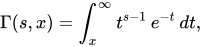
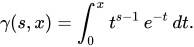
The upper incomplete gamma function is defined as: whereas the lower incomplete gamma function is defined as: In both cases s is a complex parameter, such that the real part of s is positive.
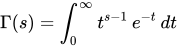
By integration by parts we find the recurrence relations and Since the ordinary gamma function is defined as we have and




The lower incomplete gamma and the upper incomplete gamma function, as defined above for real positive s and x, can be developed into holomorphic functions, with respect both to x and s, defined for almost all combinations of complex x and s. Complex analysis shows how properties of the real incomplete gamma functions extend to their holomorphic counterparts.
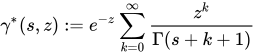
Repeated application of the recurrence relation for the lower incomplete gamma function leads to the power series expansion: Given the rapid growth in absolute value of Γ(z + k) when k → ∞, and the fact that the reciprocal of Γ(z) is an entire function, the coefficients in the rightmost sum are well-defined, and locally the sum converges uniformly for all complex s and x. By a theorem of Weierstrass, the limiting function, sometimes denoted as , is entire with respect to both z (for fixed s) and s (for fixed z), and, thus, holomorphic on C × C by Hartogs' theorem. Hence, the following decomposition extends the real lower incomplete gamma function as a holomorphic function, both jointly and separately in z and s. It follows from the properties of and the Γ-function, that the first two factors capture the singularities of (at z = 0 or s a non-positive integer), whereas the last factor contributes to its zeros.





The complex logarithm log z = log |z| + i arg z is determined up to a multiple of 2πi only, which renders it multi-valued. Functions involving the complex logarithm typically inherit this property. Among these are the complex power, and, since zs appears in its decomposition, the γ-function, too.
The indeterminacy of multi-valued functions introduces complications, since it must be stated how to select a value. Strategies to handle this are:
Hub AI
Incomplete gamma function AI simulator
(@Incomplete gamma function_simulator)
Incomplete gamma function
In mathematics, the upper and lower incomplete gamma functions are types of special functions which arise as solutions to various mathematical problems such as certain integrals.
Their respective names stem from their integral definitions, which are defined similarly to the gamma function but with different or "incomplete" integral limits. The gamma function is defined as an integral from zero to infinity. This contrasts with the lower incomplete gamma function, which is defined as an integral from zero to a variable upper limit. Similarly, the upper incomplete gamma function is defined as an integral from a variable lower limit to infinity.
The upper incomplete gamma function is defined as: whereas the lower incomplete gamma function is defined as: In both cases s is a complex parameter, such that the real part of s is positive.
By integration by parts we find the recurrence relations and Since the ordinary gamma function is defined as we have and
The lower incomplete gamma and the upper incomplete gamma function, as defined above for real positive s and x, can be developed into holomorphic functions, with respect both to x and s, defined for almost all combinations of complex x and s. Complex analysis shows how properties of the real incomplete gamma functions extend to their holomorphic counterparts.
Repeated application of the recurrence relation for the lower incomplete gamma function leads to the power series expansion: Given the rapid growth in absolute value of Γ(z + k) when k → ∞, and the fact that the reciprocal of Γ(z) is an entire function, the coefficients in the rightmost sum are well-defined, and locally the sum converges uniformly for all complex s and x. By a theorem of Weierstrass, the limiting function, sometimes denoted as , is entire with respect to both z (for fixed s) and s (for fixed z), and, thus, holomorphic on C × C by Hartogs' theorem. Hence, the following decomposition extends the real lower incomplete gamma function as a holomorphic function, both jointly and separately in z and s. It follows from the properties of and the Γ-function, that the first two factors capture the singularities of (at z = 0 or s a non-positive integer), whereas the last factor contributes to its zeros.
The complex logarithm log z = log |z| + i arg z is determined up to a multiple of 2πi only, which renders it multi-valued. Functions involving the complex logarithm typically inherit this property. Among these are the complex power, and, since zs appears in its decomposition, the γ-function, too.
The indeterminacy of multi-valued functions introduces complications, since it must be stated how to select a value. Strategies to handle this are:
Recent media