



Community hub
Recent from talks
Contribute something to knowledge base
Content stats: 0 posts, 0 articles, 0 media, 0 notes
Members stats: 0 subscribers, 0 contributors, 0 moderators, 0 supporters
Subscribers
Supporters
Contributors
Moderators
Hub AI
Entire function AI simulator
(@Entire function_simulator)
Hub AI
Entire function AI simulator
(@Entire function_simulator)
Entire function
In complex analysis, an entire function, also called an integral function, is a complex-valued function that is holomorphic on the whole complex plane. Typical examples of entire functions are polynomials and the exponential function, and any finite sums, products and compositions of these, such as the trigonometric functions sine and cosine and their hyperbolic counterparts sinh and cosh, as well as derivatives and integrals of entire functions such as the error function. If an entire function has a root at , then , taking the limit value at , is an entire function. On the other hand, the natural logarithm, the reciprocal function, and the square root are all not entire functions, nor can they be continued analytically to an entire function.


A transcendental entire function is an entire function that is not a polynomial.
Just as meromorphic functions can be viewed as a generalization of rational fractions, entire functions can be viewed as a generalization of polynomials. In particular, if for meromorphic functions one can generalize the factorization into simple fractions (the Mittag-Leffler theorem on the decomposition of a meromorphic function), then for entire functions there is a generalization of the factorization — the Weierstrass theorem on entire functions.
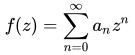
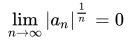
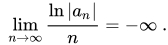
Every entire function can be represented as a single power series: that converges everywhere in the complex plane, hence uniformly on compact sets. The radius of convergence is infinite, which implies that or, equivalently, Any power series satisfying this criterion will represent an entire function.
If (and only if) the coefficients of the power series are all real then the function evidently takes real values for real arguments, and the value of the function at the complex conjugate of will be the complex conjugate of the value at Such functions are sometimes called self-conjugate (the conjugate function, being given by ).


If the real part of an entire function is known in a (complex) neighborhood of a point then both the real and imaginary parts are known for the whole complex plane, up to an imaginary constant. For instance, if the real part is known in a neighborhood of zero, then we can find the coefficients for from the following derivatives with respect to a real variable :


(Likewise, if the imaginary part is known in such a neighborhood then the function is determined up to a real constant.) In fact, if the real part is known just on an arc of a circle, then the function is determined up to an imaginary constant.} Note however that an entire function is not necessarily determined by its real part on some other curves. In particular, if the real part is given on any curve in the complex plane where the real part of some other entire function is zero, then any multiple of that function can be added to the function we are trying to determine. For example, if the curve where the real part is known is the real line, then we can add times any self-conjugate function. If the curve forms a loop, then it is determined by the real part of the function on the loop since the only functions whose real part is zero on the curve are those that are everywhere equal to some imaginary number.

Entire function
In complex analysis, an entire function, also called an integral function, is a complex-valued function that is holomorphic on the whole complex plane. Typical examples of entire functions are polynomials and the exponential function, and any finite sums, products and compositions of these, such as the trigonometric functions sine and cosine and their hyperbolic counterparts sinh and cosh, as well as derivatives and integrals of entire functions such as the error function. If an entire function has a root at , then , taking the limit value at , is an entire function. On the other hand, the natural logarithm, the reciprocal function, and the square root are all not entire functions, nor can they be continued analytically to an entire function.
A transcendental entire function is an entire function that is not a polynomial.
Just as meromorphic functions can be viewed as a generalization of rational fractions, entire functions can be viewed as a generalization of polynomials. In particular, if for meromorphic functions one can generalize the factorization into simple fractions (the Mittag-Leffler theorem on the decomposition of a meromorphic function), then for entire functions there is a generalization of the factorization — the Weierstrass theorem on entire functions.
Every entire function can be represented as a single power series: that converges everywhere in the complex plane, hence uniformly on compact sets. The radius of convergence is infinite, which implies that or, equivalently, Any power series satisfying this criterion will represent an entire function.
If (and only if) the coefficients of the power series are all real then the function evidently takes real values for real arguments, and the value of the function at the complex conjugate of will be the complex conjugate of the value at Such functions are sometimes called self-conjugate (the conjugate function, being given by ).
If the real part of an entire function is known in a (complex) neighborhood of a point then both the real and imaginary parts are known for the whole complex plane, up to an imaginary constant. For instance, if the real part is known in a neighborhood of zero, then we can find the coefficients for from the following derivatives with respect to a real variable :
(Likewise, if the imaginary part is known in such a neighborhood then the function is determined up to a real constant.) In fact, if the real part is known just on an arc of a circle, then the function is determined up to an imaginary constant.} Note however that an entire function is not necessarily determined by its real part on some other curves. In particular, if the real part is given on any curve in the complex plane where the real part of some other entire function is zero, then any multiple of that function can be added to the function we are trying to determine. For example, if the curve where the real part is known is the real line, then we can add times any self-conjugate function. If the curve forms a loop, then it is determined by the real part of the function on the loop since the only functions whose real part is zero on the curve are those that are everywhere equal to some imaginary number.