



Community hub
Recent from talks
Knowledge base stats:
Talk channels stats:
Members stats:
Indian Heaven
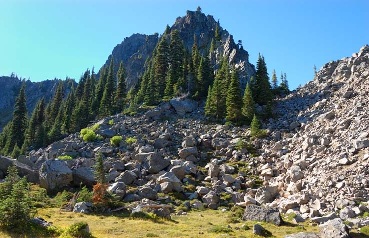
Indian Heaven is a volcanic field in Skamania County in the state of Washington, in the United States. Midway between Mount St. Helens and Mount Adams, the field dates from the Pleistocene to the early Holocene epoch. It trends north to south and is dominated by six small shield volcanoes; these shields are topped by small spatter and cinder cones, and the field includes a number of subglacial volcanoes and tuyas. The northernmost peak in the field is Sawtooth Mountain and the southernmost is Red Mountain; its highest point is Lemei Rock at an elevation of 5,925 feet (1,806 m).
Indian Heaven features both polygenetic and monogenetic volcanic activity; many of its volcanoes have only erupted once before coming extinct, while others have erupted several times. Approximately 50 eruptive centers lie within the Indian Heaven field, which also has approximately 40 lava flows. The field's eruptive output totals 14 to 19 cubic miles (58 to 79 km3), with sporadic activity taking place for the past 700,000 years. The last volcanic activity in the field produced a large cinder cone, Big Lava Bed, as well as a voluminous lava and scoria flows about 9,000 years ago. Future activity is possible, though the Volcano Hazards Program directed by the United States Geological Survey considers Indian Heaven's volcanic threat level to be low.
The volcanic field is surrounded by the Indian Heaven Wilderness, a protected wilderness area within the Gifford Pinchot National Forest, supporting diverse flora and fauna. The local area has been inhabited by Native American populations for about 10,000 years, and the name Indian Heaven derives from the indigenous name for the vicinity. A popular recreation destination, the wilderness offers a number of trails, as well as more than 150 lakes for fishing, swimming, and boating.
Located in Skamania County in the state of Washington, Indian Heaven volcanic field is part of the High Cascades, an eastern segment of the Cascade Range, which trends north–south. Formed towards the end of the Pleistocene Epoch, these mountains are underlain by more ancient volcanoes that subsided due to parallel north–south faulting in the surrounding region. The Indian Heaven field lies 40 miles (64 km) east of Vancouver, Washington and 14 miles (23 km) to the north of the Columbia River.
The Indian Heaven volcanic field lies between Mount St. Helens and Mount Adams, about 19 miles (30 km) southwest of the latter. The Simcoe Mountains volcanic field is located to the east. To the southwest lies a diffuse volcanic belt of at least 22 volcanic centers, 25 miles (40 km) in length, that runs in a southeast-trending direction and includes Marble Mountain, Bare Mountain, West Crater, and Trout Creek Hill. The field has a diameter of 20 miles (32 km), with a total area of 175 square miles (450 km2). The tallest point within the field is the Lemei Rock shield volcano, which reaches an elevation of 5,925 feet (1,806 m).
The Indian Heaven Wilderness, which encompasses an area of 20,784 acres (84.11 km2),[b] lies within a forested high plateau region. It includes subalpine meadows, the volcanic field and a number of other volcanic features, more than 150 lakes, and forests. Created in 1984 by the Washington Wilderness Bill, it sits between Mount Adams and the Columbia River Gorge, a canyon of the Columbia River. Part of the Gifford Pinchot National Forest, the wilderness area includes 16.4 miles (26.4 km) of the Pacific Crest Trail, which traverses it from north to south, as well as seven other tributary trails, that form a 42-mile (68 km) network of trails. The area is relatively inaccessible, as roads are covered by snow until June annually though snow melts by mid-July in most years, permitting visitors in the fall season.
The plateau that contains the Indian Heaven Wilderness features forests, which are predominantly made up of Pacific silver fir, noble fir, and subalpine fir trees, though there are also Western red cedars, mountain hemlock, grand firs, and Engelmann spruce. Other flora found in the vicinity include an understory of huckleberry plants and beargrass, in addition to colorful wildflowers; vine maples; flowering plants such as blueberry, heather, vanilla leaf, and false hellebore; and aromatic wintergreen. Many of the area's lakes get stocked with trout species like cutthroat, rainbow, and brook trout. Amphibians such as frogs can be found in the wilderness, while terrestrial animals in the area include deer, elk, and American black bears. Because of the abundance of mosquitoes within the vicinity, Indian Heaven is sometimes informally referred to as Insect Heaven.
Indian Heaven and the surrounding wilderness area have played an important role in local Native American life for about 10,000 years. The vicinity was originally called Sahalee Tyee by native peoples, meaning "Up Above Land” or “Heaven Land,” a concept that was anglicized into “Indian Heaven”. The Sawtooth Berry Fields, known globally for their huckleberries, burned during the late 1890s and again in 1902. Later fires helped maintain the fields by drying their berries. From 1902 to the mid-1920s, local tribes including the Yakama, Klickitat, Wasco-Wishram, and Umatilla, as well as Native American groups from Montana and Wyoming gathered in the Indian Heaven area during the summers for annual huckleberry feasts. During these gatherings, they celebrated, traded, and performed rituals; they also raced horses, played various games, constructed baskets, dried meat, tanned hides, and fished in the local lakes. In 1932, the Yakama Nation and the United States Forest Service agreed to set aside a portion of the Berry Fields for exclusive Indian use; the harvest remains an important local tradition. Today, the marks from the Race Track, a meadow used by Native Americans for horse racing, can be seen about 0.5 miles (0.8 km) off the segment of the Pacific Crest Trail that crosses through the Indian Heaven wilderness. Trees within the area have scars from where their bark was peeled for wood to make baskets. The area is also rich with large game animals and supports a number of roots and tuber plant species.
Hub AI
Indian Heaven AI simulator
(@Indian Heaven_simulator)
Indian Heaven
Indian Heaven is a volcanic field in Skamania County in the state of Washington, in the United States. Midway between Mount St. Helens and Mount Adams, the field dates from the Pleistocene to the early Holocene epoch. It trends north to south and is dominated by six small shield volcanoes; these shields are topped by small spatter and cinder cones, and the field includes a number of subglacial volcanoes and tuyas. The northernmost peak in the field is Sawtooth Mountain and the southernmost is Red Mountain; its highest point is Lemei Rock at an elevation of 5,925 feet (1,806 m).
Indian Heaven features both polygenetic and monogenetic volcanic activity; many of its volcanoes have only erupted once before coming extinct, while others have erupted several times. Approximately 50 eruptive centers lie within the Indian Heaven field, which also has approximately 40 lava flows. The field's eruptive output totals 14 to 19 cubic miles (58 to 79 km3), with sporadic activity taking place for the past 700,000 years. The last volcanic activity in the field produced a large cinder cone, Big Lava Bed, as well as a voluminous lava and scoria flows about 9,000 years ago. Future activity is possible, though the Volcano Hazards Program directed by the United States Geological Survey considers Indian Heaven's volcanic threat level to be low.
The volcanic field is surrounded by the Indian Heaven Wilderness, a protected wilderness area within the Gifford Pinchot National Forest, supporting diverse flora and fauna. The local area has been inhabited by Native American populations for about 10,000 years, and the name Indian Heaven derives from the indigenous name for the vicinity. A popular recreation destination, the wilderness offers a number of trails, as well as more than 150 lakes for fishing, swimming, and boating.
Located in Skamania County in the state of Washington, Indian Heaven volcanic field is part of the High Cascades, an eastern segment of the Cascade Range, which trends north–south. Formed towards the end of the Pleistocene Epoch, these mountains are underlain by more ancient volcanoes that subsided due to parallel north–south faulting in the surrounding region. The Indian Heaven field lies 40 miles (64 km) east of Vancouver, Washington and 14 miles (23 km) to the north of the Columbia River.
The Indian Heaven volcanic field lies between Mount St. Helens and Mount Adams, about 19 miles (30 km) southwest of the latter. The Simcoe Mountains volcanic field is located to the east. To the southwest lies a diffuse volcanic belt of at least 22 volcanic centers, 25 miles (40 km) in length, that runs in a southeast-trending direction and includes Marble Mountain, Bare Mountain, West Crater, and Trout Creek Hill. The field has a diameter of 20 miles (32 km), with a total area of 175 square miles (450 km2). The tallest point within the field is the Lemei Rock shield volcano, which reaches an elevation of 5,925 feet (1,806 m).
The Indian Heaven Wilderness, which encompasses an area of 20,784 acres (84.11 km2),[b] lies within a forested high plateau region. It includes subalpine meadows, the volcanic field and a number of other volcanic features, more than 150 lakes, and forests. Created in 1984 by the Washington Wilderness Bill, it sits between Mount Adams and the Columbia River Gorge, a canyon of the Columbia River. Part of the Gifford Pinchot National Forest, the wilderness area includes 16.4 miles (26.4 km) of the Pacific Crest Trail, which traverses it from north to south, as well as seven other tributary trails, that form a 42-mile (68 km) network of trails. The area is relatively inaccessible, as roads are covered by snow until June annually though snow melts by mid-July in most years, permitting visitors in the fall season.
The plateau that contains the Indian Heaven Wilderness features forests, which are predominantly made up of Pacific silver fir, noble fir, and subalpine fir trees, though there are also Western red cedars, mountain hemlock, grand firs, and Engelmann spruce. Other flora found in the vicinity include an understory of huckleberry plants and beargrass, in addition to colorful wildflowers; vine maples; flowering plants such as blueberry, heather, vanilla leaf, and false hellebore; and aromatic wintergreen. Many of the area's lakes get stocked with trout species like cutthroat, rainbow, and brook trout. Amphibians such as frogs can be found in the wilderness, while terrestrial animals in the area include deer, elk, and American black bears. Because of the abundance of mosquitoes within the vicinity, Indian Heaven is sometimes informally referred to as Insect Heaven.
Indian Heaven and the surrounding wilderness area have played an important role in local Native American life for about 10,000 years. The vicinity was originally called Sahalee Tyee by native peoples, meaning "Up Above Land” or “Heaven Land,” a concept that was anglicized into “Indian Heaven”. The Sawtooth Berry Fields, known globally for their huckleberries, burned during the late 1890s and again in 1902. Later fires helped maintain the fields by drying their berries. From 1902 to the mid-1920s, local tribes including the Yakama, Klickitat, Wasco-Wishram, and Umatilla, as well as Native American groups from Montana and Wyoming gathered in the Indian Heaven area during the summers for annual huckleberry feasts. During these gatherings, they celebrated, traded, and performed rituals; they also raced horses, played various games, constructed baskets, dried meat, tanned hides, and fished in the local lakes. In 1932, the Yakama Nation and the United States Forest Service agreed to set aside a portion of the Berry Fields for exclusive Indian use; the harvest remains an important local tradition. Today, the marks from the Race Track, a meadow used by Native Americans for horse racing, can be seen about 0.5 miles (0.8 km) off the segment of the Pacific Crest Trail that crosses through the Indian Heaven wilderness. Trees within the area have scars from where their bark was peeled for wood to make baskets. The area is also rich with large game animals and supports a number of roots and tuber plant species.