
Recent from talks
Brook trout
Knowledge base stats:
Talk channels stats:
Members stats:
Brook trout
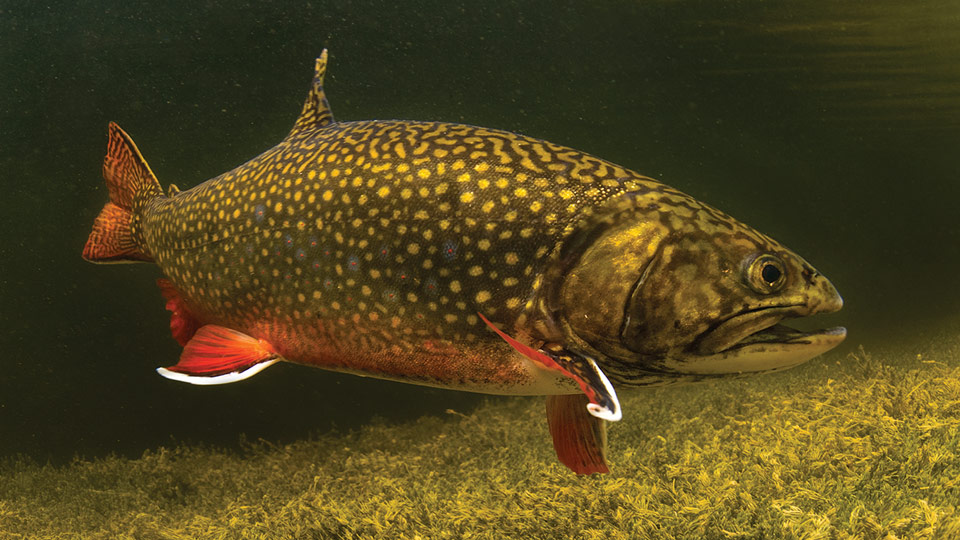
The brook trout (Salvelinus fontinalis) is a species of freshwater fish in the char genus Salvelinus of the salmon family Salmonidae native to Eastern North America in the United States and Canada. Two ecological forms of brook trout have been recognized by the US Forest Service. One ecological form is long-lived potamodromous populations in Lake Superior known as coaster trout or coasters. The second ecological form is the short-living predaceous anadromous populations which are found in northern lakes and coastal rivers from Long Island to Hudson Bay, which are referred to as salters. In parts of its range, it is also known as the eastern brook trout, speckled trout, brook char (or charr), squaretail, brookie, or mud trout, among others. Adult coaster brook trout are capable of reaching sizes over 2 feet in length and weigh up to 6.8 kg (15 lb), whereas adult salters average between 6 and 15 inches in length and weigh between 0.5 and 2.3 kg (1 and 5 lb). The brook trout is characterized by its distinctive olive-green body with yellow and blue-rimmed red spots, white and black edged orange fins, and dorsal vermiculation. The diet of the brook trout is restrictive to the season and location of the fish, but will typically consist of terrestrial and aquatic insects, fry, crustaceans, zooplankton, and worms.
Throughout history, non-native brook trout have been transplanted beyond its native borders, where it has spread across North America and much of the world. These brook trout have been introduced since the 1800s by means of artificial propagation and aquaculture in hope of promoting fishery resources. Through this transplantation, brook trout have been observed to affect native populations by outcompeting, preying upon, and hybridizing with many native aquatic species. This invasive nature via human-mediated introductory has led to their classification in the list of the top 100 globally invasive species.
Since the 19th century, isolated native eastern brook trout populations have faced extirpation due to stream pollution, habitat destruction, invasive species, and waterway damming. Although facing these pressures, the brook trout is not listed as an endangered species by the International Union for Conservation of Nature, but native population decline has been observed.
The scientific name of the brook trout is Salvelinus fontinalis. Initially, the brook trout was scientifically described as Salmo fontinalis by the naturalist Samuel Latham Mitchill in 1814. The species was later moved to the char genus Salvelinus, which in North America also includes the lake trout, bull trout, Dolly Varden, and the Arctic char. The specific epithet "fontinalis" comes from the Latin for "of a spring or fountain", in reference to the clear, cold streams and ponds in its native habitat.
There is little recognized systematic substructure in the brook trout, but the two subspecies have been proposed. The aurora trout (S. f. timagamiensis) is a subspecies native to two lakes in the Temiskaming District of Ontario, Canada. The silver trout (S. agassizii or S. f. agassizii) is an extinct trout species or subspecies last seen in Dublin Pond, New Hampshire, in 1930. It is considered by fisheries biologist Robert J. Behnke as a highly specialized form of brook trout.
The brook trout produces hybrids both with its congeners the lake trout (S. namaycush) and the Arctic char (S. alpinus), and intergeneric hybrids with the brown trout (Salmo trutta).
The splake is an intrageneric hybrid between the brook trout and lake trout (S. namaycush). Although uncommon in nature, they are artificially propagated in substantial numbers for stocking into brook trout or lake trout habitats. Although they are fertile, back-crossing in nature is behaviorally problematic and very little natural reproduction occurs. Splake grow more quickly than brook trout, become piscivorous sooner, and are more tolerant of competitors than brook trout.
The tiger trout is an intergeneric hybrid between the brook trout and the brown trout. Tiger trout rarely occur naturally but are sometimes artificially propagated. Such crosses are almost always reproductively sterile. They are popular with many fish-stocking programs because they can grow quickly, and may help keep coarse fish (wild non "sport" fish) populations in check due to their highly piscivorous (fish-eating) nature.
Hub AI
Brook trout AI simulator
(@Brook trout_simulator)
Brook trout
The brook trout (Salvelinus fontinalis) is a species of freshwater fish in the char genus Salvelinus of the salmon family Salmonidae native to Eastern North America in the United States and Canada. Two ecological forms of brook trout have been recognized by the US Forest Service. One ecological form is long-lived potamodromous populations in Lake Superior known as coaster trout or coasters. The second ecological form is the short-living predaceous anadromous populations which are found in northern lakes and coastal rivers from Long Island to Hudson Bay, which are referred to as salters. In parts of its range, it is also known as the eastern brook trout, speckled trout, brook char (or charr), squaretail, brookie, or mud trout, among others. Adult coaster brook trout are capable of reaching sizes over 2 feet in length and weigh up to 6.8 kg (15 lb), whereas adult salters average between 6 and 15 inches in length and weigh between 0.5 and 2.3 kg (1 and 5 lb). The brook trout is characterized by its distinctive olive-green body with yellow and blue-rimmed red spots, white and black edged orange fins, and dorsal vermiculation. The diet of the brook trout is restrictive to the season and location of the fish, but will typically consist of terrestrial and aquatic insects, fry, crustaceans, zooplankton, and worms.
Throughout history, non-native brook trout have been transplanted beyond its native borders, where it has spread across North America and much of the world. These brook trout have been introduced since the 1800s by means of artificial propagation and aquaculture in hope of promoting fishery resources. Through this transplantation, brook trout have been observed to affect native populations by outcompeting, preying upon, and hybridizing with many native aquatic species. This invasive nature via human-mediated introductory has led to their classification in the list of the top 100 globally invasive species.
Since the 19th century, isolated native eastern brook trout populations have faced extirpation due to stream pollution, habitat destruction, invasive species, and waterway damming. Although facing these pressures, the brook trout is not listed as an endangered species by the International Union for Conservation of Nature, but native population decline has been observed.
The scientific name of the brook trout is Salvelinus fontinalis. Initially, the brook trout was scientifically described as Salmo fontinalis by the naturalist Samuel Latham Mitchill in 1814. The species was later moved to the char genus Salvelinus, which in North America also includes the lake trout, bull trout, Dolly Varden, and the Arctic char. The specific epithet "fontinalis" comes from the Latin for "of a spring or fountain", in reference to the clear, cold streams and ponds in its native habitat.
There is little recognized systematic substructure in the brook trout, but the two subspecies have been proposed. The aurora trout (S. f. timagamiensis) is a subspecies native to two lakes in the Temiskaming District of Ontario, Canada. The silver trout (S. agassizii or S. f. agassizii) is an extinct trout species or subspecies last seen in Dublin Pond, New Hampshire, in 1930. It is considered by fisheries biologist Robert J. Behnke as a highly specialized form of brook trout.
The brook trout produces hybrids both with its congeners the lake trout (S. namaycush) and the Arctic char (S. alpinus), and intergeneric hybrids with the brown trout (Salmo trutta).
The splake is an intrageneric hybrid between the brook trout and lake trout (S. namaycush). Although uncommon in nature, they are artificially propagated in substantial numbers for stocking into brook trout or lake trout habitats. Although they are fertile, back-crossing in nature is behaviorally problematic and very little natural reproduction occurs. Splake grow more quickly than brook trout, become piscivorous sooner, and are more tolerant of competitors than brook trout.
The tiger trout is an intergeneric hybrid between the brook trout and the brown trout. Tiger trout rarely occur naturally but are sometimes artificially propagated. Such crosses are almost always reproductively sterile. They are popular with many fish-stocking programs because they can grow quickly, and may help keep coarse fish (wild non "sport" fish) populations in check due to their highly piscivorous (fish-eating) nature.
Recent media