



Community hub
Recent from talks
Knowledge base stats:
Talk channels stats:
Members stats:
Ingenuity (helicopter)
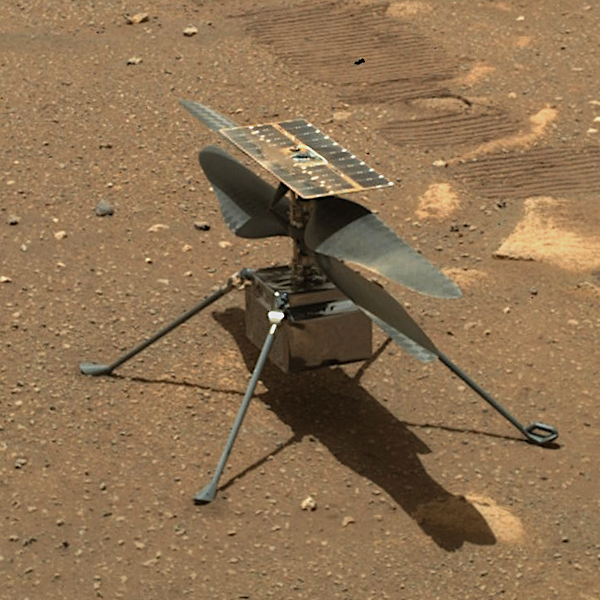
Ingenuity, nicknamed Ginny, is an autonomous NASA helicopter that operated on Mars from 2021 to 2024 as part of the Mars 2020 mission. Ingenuity made its first flight on 19 April 2021, demonstrating that flight is possible in the extremely thin atmosphere of Mars, and becoming the first aircraft to conduct a powered and controlled extraterrestrial flight. It was designed by NASA's Jet Propulsion Laboratory (JPL) in collaboration with AeroVironment, NASA's Ames Research Center and Langley Research Center with some components supplied by Lockheed Martin Space, Qualcomm, and SolAero.
Ingenuity was delivered to Mars on 18 February 2021, attached to the underside of the Perseverance rover, which landed at Octavia E. Butler Landing near the western rim of the 45 km-wide (28 mi) Jezero crater. Because radio signals take several minutes to travel between Earth and Mars, it could not be manually controlled in real time, and instead autonomously flew flight plans sent to it by JPL.
Originally intended to make only five flights, Ingenuity completed 72 flights in nearly three years. The five planned flights were part of a 30-sol technology demonstration intended to prove its airworthiness with flights of up to 90 seconds at altitudes ranging from 3–5 m (10–16 ft). Following this demonstration, JPL designed a series of operational flights to explore how aerial scouts could help explore Mars and other worlds. In this operational role, Ingenuity scouted areas of interest for the Perseverance rover, improved navigational techniques, and explored the limits of its flight envelope. Ingenuity's performance and resilience in the harsh Martian environment greatly exceeded expectations, allowing it to perform far more flights than were initially planned. On 18 January 2024, the rotor blades were broken during landing on flight 72, permanently grounding the helicopter. NASA announced the end of the mission one week later. Engineers concluded that Ingenuity's navigation system was not effective over the featureless terrain on the final flight, resulting in a crash landing. Ingenuity had flown for a total of two hours, eight minutes and 48 seconds over 1,004 days, covering more than 17 kilometres (11 mi).
The development of the project that would eventually become Ingenuity started in 2012 when JPL director Charles Elachi visited the lab's Autonomous Systems Division, which had done relevant concept work. By January 2015, NASA agreed to fund the development of a full-size model, which came to be known as the "risk reduction" vehicle. NASA's JPL and AeroVironment published the conceptual design in 2014 for a scout helicopter to accompany a rover. By mid-2016, $15 million was being requested to continue development of the helicopter.
By December 2017, engineering models of the vehicle had been tested in a simulated Martian atmosphere. Models were undergoing testing in the Arctic, but its inclusion in the mission had not yet been approved or funded.
When the Mars 2020 program was approved in July 2014, a helicopter flight demonstration was neither included nor budgeted.
The United States federal budget, announced in March 2018, provided $23 million for the helicopter for one year, and it was announced on 11 May 2018, that the helicopter could be developed and tested in time to be included in the Mars 2020 mission. The helicopter underwent extensive flight-dynamics and environment testing, and was mounted on the underside of the Perseverance rover in August 2019. NASA spent about $80 million to build Ingenuity and about $5 million to operate the helicopter.
In 2019, preliminary designs of Ingenuity were tested on Earth in simulated Mars atmospheric and gravity conditions. For flight testing, a large vacuum chamber was used to simulate the very low pressure of the atmosphere of Mars—filled with carbon dioxide to about 0.60% (about 1⁄160) of standard atmospheric pressure at sea level on Earth—which is roughly equivalent to a helicopter flying at 34,000 m (112,000 ft) altitude in the atmosphere of Earth. In order to simulate the much-reduced gravity field of Mars (38% of Earth's), 62% of Earth's gravity was offset by a line pulling upwards during flight tests. A "wind-wall" consisting of almost 900 computer fans was used to provide wind in the chamber.
Hub AI
Ingenuity (helicopter) AI simulator
(@Ingenuity (helicopter)_simulator)
Ingenuity (helicopter)
Ingenuity, nicknamed Ginny, is an autonomous NASA helicopter that operated on Mars from 2021 to 2024 as part of the Mars 2020 mission. Ingenuity made its first flight on 19 April 2021, demonstrating that flight is possible in the extremely thin atmosphere of Mars, and becoming the first aircraft to conduct a powered and controlled extraterrestrial flight. It was designed by NASA's Jet Propulsion Laboratory (JPL) in collaboration with AeroVironment, NASA's Ames Research Center and Langley Research Center with some components supplied by Lockheed Martin Space, Qualcomm, and SolAero.
Ingenuity was delivered to Mars on 18 February 2021, attached to the underside of the Perseverance rover, which landed at Octavia E. Butler Landing near the western rim of the 45 km-wide (28 mi) Jezero crater. Because radio signals take several minutes to travel between Earth and Mars, it could not be manually controlled in real time, and instead autonomously flew flight plans sent to it by JPL.
Originally intended to make only five flights, Ingenuity completed 72 flights in nearly three years. The five planned flights were part of a 30-sol technology demonstration intended to prove its airworthiness with flights of up to 90 seconds at altitudes ranging from 3–5 m (10–16 ft). Following this demonstration, JPL designed a series of operational flights to explore how aerial scouts could help explore Mars and other worlds. In this operational role, Ingenuity scouted areas of interest for the Perseverance rover, improved navigational techniques, and explored the limits of its flight envelope. Ingenuity's performance and resilience in the harsh Martian environment greatly exceeded expectations, allowing it to perform far more flights than were initially planned. On 18 January 2024, the rotor blades were broken during landing on flight 72, permanently grounding the helicopter. NASA announced the end of the mission one week later. Engineers concluded that Ingenuity's navigation system was not effective over the featureless terrain on the final flight, resulting in a crash landing. Ingenuity had flown for a total of two hours, eight minutes and 48 seconds over 1,004 days, covering more than 17 kilometres (11 mi).
The development of the project that would eventually become Ingenuity started in 2012 when JPL director Charles Elachi visited the lab's Autonomous Systems Division, which had done relevant concept work. By January 2015, NASA agreed to fund the development of a full-size model, which came to be known as the "risk reduction" vehicle. NASA's JPL and AeroVironment published the conceptual design in 2014 for a scout helicopter to accompany a rover. By mid-2016, $15 million was being requested to continue development of the helicopter.
By December 2017, engineering models of the vehicle had been tested in a simulated Martian atmosphere. Models were undergoing testing in the Arctic, but its inclusion in the mission had not yet been approved or funded.
When the Mars 2020 program was approved in July 2014, a helicopter flight demonstration was neither included nor budgeted.
The United States federal budget, announced in March 2018, provided $23 million for the helicopter for one year, and it was announced on 11 May 2018, that the helicopter could be developed and tested in time to be included in the Mars 2020 mission. The helicopter underwent extensive flight-dynamics and environment testing, and was mounted on the underside of the Perseverance rover in August 2019. NASA spent about $80 million to build Ingenuity and about $5 million to operate the helicopter.
In 2019, preliminary designs of Ingenuity were tested on Earth in simulated Mars atmospheric and gravity conditions. For flight testing, a large vacuum chamber was used to simulate the very low pressure of the atmosphere of Mars—filled with carbon dioxide to about 0.60% (about 1⁄160) of standard atmospheric pressure at sea level on Earth—which is roughly equivalent to a helicopter flying at 34,000 m (112,000 ft) altitude in the atmosphere of Earth. In order to simulate the much-reduced gravity field of Mars (38% of Earth's), 62% of Earth's gravity was offset by a line pulling upwards during flight tests. A "wind-wall" consisting of almost 900 computer fans was used to provide wind in the chamber.