


Community hub
Recent from talks
Contribute something
Nothing was collected or created yet.
Inosculation
View on Wikipedia

Inosculation[a] is a natural phenomenon in which trunks, branches or roots of two trees grow together in a manner biologically similar to the artificial process of grafting. It customarily results when tree limbs are braided or pleached. The branches first grow separately in proximity to each other until they touch. At this point, the bark on the touching surfaces is gradually abraded away as the trees move in the wind. Once the cambium of two trees touches, they sometimes self-graft and grow together as they expand in diameter.
In forestry gemels (from the Latin word for "a pair") are trees that have undergone the process.[1] Inosculation can happen across related species and occurs most commonly for branches of two trees of the same species.
Species
[edit] |
Inosculation is most common among the following taxa due to their thin bark:
Conjoined trees
[edit]Two trees may grow to their mature size adjacent to each other and seemingly grow together or conjoin, demonstrating inosculation. These may be of the same species or even of different genera or families, depending on whether the two trees have become truly grafted together (once the cambium of two trees touches, they self-graft and grow together). Usually grafting is only between two trees of the same or closely related species or genera, but the appearance of grafting can be given by two trees that are physically touching, rubbing, intertwined, or entangled.[2] Both conifers and deciduous trees can become conjoined. Beech trees in particular are frequent conjoiners, as is blackthorn (Prunus spinosa).

Such trees are often colloquially referred to as "husband and wife" trees, or "marriage trees". The straightforward application of the term comes from the obvious unification of two separate individual trees, although a more humorous use of the term relates to the sexually suggestive appearance of some natural examples. There may be a degree of religious intent, as some cults are organized around beliefs that trees contain a hidden or sacred power to cure or to enhance fertility, or that they contain the souls of ancestors or of the unborn.[3]
Examples
[edit]On his Tour of Scotland, published in 1800, T. Garnett notes a tree near Inveraray that the locals called the Marriage tree, formed from a lime tree with two trunks that have been joined by a branch in the manner of a person putting an arm around another (see illustration) as would a married couple.[4]
On the way to the Heavenly Lake near Urumqi in China are a pair of trees that local people have called the Husband and Wife trees because they are connected by a living branch.[5] The Tatajia Husband and Wife trees are in Taiwan[6] and in Yakushima, Kagoshima-ken, Japan, are a pair of Husband and Wife trees formed from conjoined cedars.[7]
In Lambeg, Co. Down, slightly north of Wolfenden's Bridge, stand two beech trees (see 'Gallery') at the entrance to Chrome Hill, on the Lambeg to Ballyskeagh road. In the late 18th century, John Wesley was staying at Chrome Hill and decided to weave together two young beech trees to act as a symbol of unity between the Methodist Church and the Church of Ireland.[citation needed]
At Doonholm near Ayr an ancient sycamore maple (Acer pseudoplatanus) was famous for the multiple fusion of its boughs that gave it a unique appearance and greatly strengthened it.[8]
Gallery
[edit]-
 The John Wesley tree
 -
 Conjoined sycamore maples
 -
 Acer pseudoplatanus showing inosculation
 -
 Beech tree trunks conjoined
 -
 Garnett's 18th century "Marriage tree"
 -
 Inosculation of willow (Salix sp.)
 -
 Conjoined beech tree roots
 -
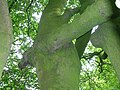 A classic "husband and wife" tree with branches conjoined
 -
 Fused chestnut trees showing a bark pocket (Castanea sativa)
 -
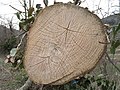 Fused ash trees (Fraxinus excelsior)
 -
 Fused ash trees, side view (Fraxinus excelsior)
 -
 Fused sycamore trees (Platanus occidentalis)
 -
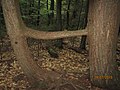 In Vermont
 -
 The fused tree looks like a single tree.
 -
 Inosculation case, Picea abies (European spruce), Dolomites


.jpg)


See also
[edit]Notes
[edit]References
[edit]- ^ Morton 1712, p. 35
- ^ Multitrunk and other tree forms Archived 2010-04-21 at the Wayback Machine www.nativetreesociety.org, accessed 3 August 2023
- ^ Tree-marriage, Encyclopædia Britannica, accessed 3 August 2023
- ^ Garnett 1800, p. 88
- ^ Married couple trees archived from www.silkroadcn.com, accessed 3 August 2023
- ^ "Conjoined trees in Yushan National Park at Sun-Moon-Lake. Scroll down for image". jasonmumbles.com. Archived from the original on 2009-08-02.
- ^ Husband and wife trees, Trail to Jomon cedar, Yakushima, Kagoshima-ken, Japan Archived 2010-06-15 at the Wayback Machine Conjoined cedars, www.reggie.net, accessed 3 August 2023
- ^ MacArthur 1952, p. 81
Sources
[edit]- Garnett, T. (1800). Observations on a Tour of the Highlands and part of the Western Isles of Scotland. London: Cadell & Davies.
- MacArthur, Wilson (1952). The River Doon. London: Cassell & Co. Ltd.
- Morton, John (1712). The Natural History of Northhamptonshire. London: R. Knaplock.
External links
[edit]
Inosculation
View on GrokipediaFundamentals
Definition
Inosculation is a natural phenomenon in which the living tissues of two or more plants, typically trees, grow together and fuse, establishing a continuous vascular connection that resembles the outcome of artificial grafting techniques.[5] This process involves the merging of vascular systems, allowing the plants to share water, nutrients, and photosynthetic products through interconnected conductive tissues.[6] Unlike simple physical contact between plants or superficial wounding from environmental factors, inosculation requires the active mutual penetration and integration of the cambium layers—the lateral meristem responsible for secondary growth in woody plants—resulting in a functional union that supports bidirectional transport and mechanical stability.[7] This fusion creates a single physiologically integrated unit, distinct from mere adjacency, as evidenced by the formation of callus tissue and aligned vascular elements that enable resource exchange.[5] In the context of plant biology, inosculation serves as an analogue to anastomosis, the joining of vascular structures in animals, and parallels artificial inosculation methods used in surgery to reconnect tissues, though it is uniquely driven by the regenerative capacity of plant cambium without human intervention.[7]Etymology and History
The term inosculation derives from the Latin prefix in- ("into") and osculari ("to kiss"), evoking the intimate union of tissues, and was first attested in English in 1672 as the verb form, with the noun appearing in 1673 to describe the anastomosis of blood vessels in anatomical contexts.[8][9] In botany, the concept emerged from observations of natural tissue fusion, inspiring ancient grafting practices documented as early as 300 BCE by Theophrastus, who described methods akin to inducing inosculation by joining plant parts, though without using the term.[10] By the 19th century, botanists recognized spontaneous unions in closely growing trees, often in hedgerows, as a natural analog to artificial grafting, with illustrations by figures like Arthur Wiechula depicting inosculated branches in landscape designs around 1900.[11] The understanding evolved from folklore, where intertwined trees symbolized enduring bonds, as in the Greek myth of Philemon and Baucis who were transformed into an oak and linden tree growing together, to rigorous scientific classification in the 20th century.[2] In 1938, forester Henry A. Baldwin differentiated "true grafts" in inosculated trees by the complete union of vascular tissues, establishing it as a form of natural vegetative propagation in forestry and botany.[2]Biological Mechanism
Initiation Process
The initiation of inosculation is primarily triggered by friction at contact points between adjacent plant stems, branches, or roots, leading to the abrasion of the outer bark layers. This friction often results from environmental forces such as wind-induced swaying, the mechanical pressure from ongoing growth and expansion, or occasional disturbances that bring plant parts into repeated contact. In natural settings, these interactions erode the protective bark, setting the stage for deeper tissue exposure without requiring human intervention.[2][12] The process advances through distinct early stages, beginning with the gradual erosion of the outer bark, which exposes the vulnerable cambium layer beneath. Once the cambium surfaces of the two plants align and touch, a wound healing response activates, characterized by the proliferation of callus tissue from the exposed areas. This callus, a form of undifferentiated scar tissue, begins to form tentative bridges across the contact site, stabilizing the connection and preparing for potential vascular integration. These stages typically unfold over weeks to months, depending on environmental conditions and plant vigor.[2][3] Proximity plays a critical role in enabling these triggers, with inosculation most commonly observed in dense natural stands or crowded plantings where stems or roots are positioned closely enough—often within a few centimeters—to facilitate ongoing friction and contact. Such conditions are prevalent in forests with high tree densities, where spatial competition naturally promotes these interactions. Susceptibility to this initiation phase can vary by species, influenced by factors like bark thickness and growth patterns, though details on specific taxa are addressed elsewhere.[12][3]Tissue Fusion and Physiology
During inosculation, once the cambium layers of adjacent plant tissues come into sustained contact, typically following mechanical abrasion, these meristematic layers align and initiate a regenerative response. Cambial cells proliferate to form callus tissue, which bridges the interface between the two plants within days to weeks, creating a foundational scaffold for integration. Over subsequent months to years, depending on species and environmental conditions, undifferentiated callus cells differentiate into vascular elements, including secondary xylem for water transport and phloem for nutrient distribution, establishing continuous vascular connections across the fusion site. In woody plants, full vascularization of these callus bridges often requires several months to years, as observed in long-term studies of conjoined tree stems.[13][1] This tissue fusion yields several physiological advantages, enabling the conjoined plants to function as an integrated system. The shared vascular network facilitates bidirectional exchange of water, nutrients, and photosynthates, enhancing resource allocation and potentially improving resilience to localized deficiencies. Mechanically, the fusion increases structural stability, distributing loads such as wind forces across multiple stems and reducing the risk of individual branch failure. If the fusing plants are genetically distinct, such as different varieties or species, inosculation can provide complementary physiological benefits, boosting overall growth and productivity through shared resources and trait interactions.[13][1][14] In the long term, successful inosculation results in the formation of a single functional physiological unit, where the fused tissues exhibit coordinated growth rings and synchronized responses to environmental cues. Hormone signaling, particularly auxin-mediated pathways in the cambium, plays a critical role in promoting cell division and expansion at the fusion site, often triggered by wound-induced stress to accelerate healing and vascular development. This integration can persist indefinitely, contributing to enhanced longevity and adaptive capacity in the conjoined organism.[13][15]Natural Occurrence
Species and Habitats
Inosculation is most frequently documented among deciduous trees in temperate regions, particularly species with relatively thin bark that facilitates contact and fusion between adjacent stems or branches. Prominent examples include the European beech (Fagus sylvatica), which exhibits this phenomenon in crowded forest stands where branches rub against one another, and the English oak (Quercus robur), often seen in hedgerows and woodlands where multiple trunks grow in close proximity.[16][17] Other common deciduous species prone to inosculation encompass maples (Acer spp., such as Acer platanoides and red maple Acer rubrum), birches (Betula pendula), and ashes (Fraxinus spp.), which form natural grafts in dense groupings.[2][1] Shrubs like hazel (Corylus avellana) also display inosculation, especially in layered or coppiced growth forms typical of managed or natural thickets. Less common instances occur in conifers, such as pines (Pinus spp., including eastern white pine Pinus strobus), where root or branch fusion is observed but at lower rates due to thicker bark and different growth patterns compared to deciduous trees.[2][1] Yew (Taxus baccata), a coniferous evergreen, similarly shows occasional inosculation in shaded understories, though documentation is sparser. In tropical and subtropical environments, species like fig trees (Ficus spp., including strangler figs Ficus aurea and Ficus citrifolia) demonstrate inosculation through root anastomoses in dense forest canopies or along waterways.[18] Other tropical examples include gumbo limbo (Bursera simaruba), which forms self-grafts in hammock forests. Root inosculation is particularly common in conifers and tropical species, while branch fusion is more frequent in temperate deciduous trees.[1][2] Inosculation is rare in monocots due to their scattered vascular bundles and lack of a continuous vascular cambium, which is essential for secondary growth and tissue fusion.[19] This natural phenomenon arises predominantly in temperate woodlands, hedgerows, and riverbanks, where physical crowding from wind, leaning, or dense planting encourages prolonged contact between plants. In Europe, such as in German temperate forests (e.g., around Nagold and Stuttgart), inosculation is well-recorded among native deciduous species along streams and in mixed stands.[1] North American habitats, including New England woodlands and riverine areas, similarly host frequent occurrences in species like American beech (Fagus grandifolia) and eastern cottonwood (Populus deltoides).[2] While globally distributed wherever suitable woody plants grow in proximity, detailed observations are more abundant in Europe and North America due to extensive botanical surveys in these regions; tropical cases, such as in Florida's subtropical hammocks or India's Meghalaya forests, are noted but less systematically studied.[18][1]Environmental Influences
In natural settings, inosculation is facilitated by environmental conditions that promote wound healing and sustained tissue contact between adjacent trees. High humidity levels enhance callus development by reducing moisture loss at abrasion sites and supporting cellular proliferation during the initial healing phase.[20] Moderate temperatures between 10°C and 25°C, typical of temperate growing seasons, optimize callus formation and vascular reconnection, as extreme heat or cold slows metabolic processes essential for tissue fusion.[21] Adequate soil nutrients bolster tree vigor and support wound healing, thereby accelerating callus growth and strengthening the structural integrity of fusing tissues.[20] Several ecological factors further encourage inosculation by ensuring mechanical interaction and optimal growth conditions. Wind exposure generates the friction necessary to abrade bark and expose cambial layers, initiating the healing process that leads to fusion, particularly in windy habitats like hillslopes.[2] Dense planting arrangements with high canopy closure promote close proximity between trees (typically less than 1-2 meters apart), sustaining contact and reducing light competition to favor branch interlocking.[22] Mature trees over 20 years old exhibit higher rates of successful inosculation, as their developed root systems and larger girths (e.g., 30-60 cm) enable more robust graft formation compared to younger saplings.[23] Conversely, certain conditions impede inosculation by disrupting healing or preventing contact. Dry climates with low humidity hinder callus proliferation and increase desiccation risk at wound edges, often resulting in incomplete fusions.[20] Air pollution, including elevated ozone and particulate matter, stresses trees and impairs photosynthetic efficiency, indirectly slowing wound closure.[24] Pathogens such as wood-decay fungi exploit open wounds, colonizing tissues before callus can form barriers and leading to rot that prevents vascular joining.[25] Inosculation remains rare in open fields or sparse stands due to insufficient sustained physical contact, as isolated trees lack the rubbing action needed to initiate the process.[2]Human Applications
Horticultural Practices
In horticulture, inosculation is intentionally induced via approach grafting, a technique that entails wounding complementary stems or branches of two plants—typically by removing bark or making matching cuts—and securely binding them together to promote cambial contact and fusion, thereby emulating the natural friction that initiates tissue bonding.[26] This method is commonly applied in fruit orchards to propagate rootstocks, where a scion from a desired variety is joined to a potted or established rootstock plant, both remaining connected to their own root systems until a stable union forms, often within four weeks during active growth.[27] The process leverages the plants' innate mechanism of vascular alignment, ensuring high success rates even in challenging environments like those with soil-borne diseases or nutrient deficiencies.[26] Key benefits of this practice include the efficient propagation of disease-resistant hybrids, achieved by grafting tolerant rootstocks—such as those resistant to collar rot in apples—onto high-quality scions, which imparts resilience against pathogens without altering the scion's fruit characteristics.[28] In apple orchards, for example, rootstocks like M.26 enable precocious fruiting as early as the first year post-planting while enhancing yield through improved vigor and nutrient efficiency.[28] For vine crops, approach grafting similarly boosts productivity by fostering robust structural connections that support higher loads and better water distribution, contributing to overall crop stability.[29] The historical roots of inducing inosculation through approach grafting trace back to 18th-century European pomology, where Stephen Hales conducted pioneering experiments on sap circulation by joining three trees, observing sustained vitality in the central tree after severing its original roots, thus validating the functional union of tissues.[30] In modern organic farming, this technique remains vital for sustainable propagation, as it relies on natural physiological processes to avoid synthetic chemical aids like auxins, aligning with agro-ecological standards that prioritize untreated planting material and biodiversity.[31]Bonsai and Ornamental Design
In bonsai cultivation, inosculation techniques can be used to create artificial multi-trunk structures resembling the traditional kabudachi style in Japanese traditions, where multiple young trunks or rooted cuttings are bound together to fuse into a unified structure emerging from a single root system.[32] This approach creates a natural, clustered appearance that mimics forest groupings on a miniature scale. Practitioners achieve fusion by wiring trunks tightly with copper or aluminum wire and intentionally scarring the bark to expose cambium layers, allowing the living tissues to knit together over time; this method, while evoking ancient aesthetic principles, was formalized as a grafting technique in modern bonsai literature by the mid-20th century.[32] Beyond bonsai, inosculation enhances ornamental garden design through techniques like pleaching, where branches of trees such as lindens (Tilia spp.), hornbeams (Carpinus spp.), or beeches (Fagus spp.) are interwoven and secured to form fused hedges, arches, or espalier patterns against walls or trellises.[33] These living structures, often shaped into topiaries or geometric forms, add architectural interest to landscapes while promoting structural integrity as fused branches support one another.[34] In landscaping, such designs not only maximize space in formal gardens but also symbolize unity and harmony between elements, drawing on the natural fusion to evoke interconnectedness in ornamental compositions.[34] In fields like baubotanik, or "building with living plants," inosculation is harnessed to create sustainable structures such as living bridges from Ficus elastica roots in India or shaped canopies in European "Tanzlinden" (dancing lime trees). These applications enhance structural stability and resource sharing, contributing to urban green infrastructure for climate adaptation.[1] Post-fusion care in these applications emphasizes maintaining high humidity to support tissue healing and prevent desiccation of the scarred areas. Techniques include enclosing fused sections under humidity domes or trays during the initial recovery phase, with regular misting to sustain moist conditions around the binding sites.[32] Species like maples (Acer spp.), prized for their fine branching and vibrant foliage, respond particularly well to these methods, yielding dramatic multi-trunk bonsai or espalier displays with enhanced aesthetic depth through seamless unions.[32]Notable Examples
Famous Conjoined Trees
One notable example of inosculation is the pair of beech trees known as the Wesley Beeches, located in Lambeg, County Antrim, Northern Ireland. Planted in 1787 by Methodist founder John Wesley, who twisted two young beech saplings (Fagus sylvatica) together as a symbol of unity between the Methodist Church and the Church of Ireland, the trees have since fused at multiple points along their trunks and branches through natural grafting. The conjoined structure now forms a single, intertwined entity, demonstrating over 230 years of physiological integration. These trees are recognized for their historical and ecological value and are maintained as a local landmark.[35] Another historic instance is the Marriage Tree near Inveraray, Argyll, Scotland, documented in the early 19th century as a lime tree (Tilia spp.) featuring two trunks fused by a lateral branch. Noted by physician and traveler Thomas Garnett in his 1800 account of a tour through Scotland, the tree's conjoined form was already well-established by then, with locals attributing its name to the intimate union of its parts. Although specific conservation efforts are not recorded, the tree's mention in historical surveys underscores its enduring botanical significance.[36] Further afield, the Curtain Fig Tree (Ficus virens) in the Yungaburra region of Queensland's Atherton Tablelands, Australia, exemplifies root inosculation in rainforest environments. This strangler fig, estimated at 500 years old, has developed a vast network of aerial roots that have fused into a continuous "curtain" with roots dropping about 15 meters to the forest floor and encircling a host tree's remnants, with the main trunk girth measuring approximately 39 meters. The fusion provides mechanical support in the humid tropics, and the tree is protected as a heritage-listed natural attraction within the Wet Tropics of Queensland World Heritage Area, drawing conservation attention due to tourism impacts.[37]Cultural and Symbolic Interpretations
In European folklore, inosculated trees have often been interpreted as symbols of eternal bonds, particularly in tales of lovers whose souls intertwine beyond death. A prominent example appears in the Irish myth of Deirdre and Naoise from the Ulster Cycle, where yew trees sprouted from the lovers' adjacent graves after their tragic deaths, their branches growing together to form an inseparable union, signifying the merging of their spirits in the afterlife.[38] Such narratives portray fused trees as emblems of shared souls, evoking themes of undying love and marital fidelity that transcend mortality.[39] In Celtic traditions, trees more broadly held mystical significance as potential gateways to the Otherworld, a supernatural realm of eternal youth and the divine, with certain sacred groves or world trees serving as liminal portals for spirits and heroes.[40] While specific legends of fused oaks as portals are less documented, the intertwined forms of inosculated trees align with this lore, suggesting hidden connections between the earthly and spiritual domains.[41] Artistic representations of inosculation and intertwined trees have emphasized themes of unity and natural harmony, particularly during the Romantic era. In 19th-century paintings, such as those by Caspar David Friedrich, solitary or grouped trees often symbolized the soul's communion with nature, evoking a profound interconnectedness between human emotion and the organic world.[42] This motif extended to depictions of branching forms that suggest fusion, reinforcing ideas of wholeness amid isolation. In modern contexts, inosculation inspires eco-poetry and photography, where fused trees illustrate ecological interdependence, as seen in literary works exploring posthuman bonds between species.[43] Symbolically, inosculation embodies interconnectedness in environmentalism, representing how living systems merge to sustain resilience and shared vitality in ecosystems.[2] These fused trees are frequently invoked in weddings as "marriage trees" or "husband and wife" formations, emblematic of enduring partnerships that grow stronger through union.[2] Similarly, in memorials, they serve as poignant reminders of lasting connections, drawing on folklore to honor the deceased through symbols of perpetual intertwining.[44]References
- https://en.wiktionary.org/wiki/inosculate