

Recent from talks
Acceleration
Knowledge base stats:
Talk channels stats:
Members stats:
Acceleration
In mechanics, acceleration is the rate of change of the velocity of an object with respect to time. Acceleration is one of several components of kinematics, the study of motion. Accelerations are vector quantities (in that they have magnitude and direction). The orientation of an object's acceleration is given by the orientation of the net force acting on that object. The magnitude of an object's acceleration, as described by Newton's second law, is the combined effect of two causes:
The SI unit for acceleration is metre per second squared (m⋅s−2, ).

For example, when a vehicle starts from a standstill (zero velocity, in an inertial frame of reference) and travels in a straight line at increasing speeds, it is accelerating in the direction of travel. If the vehicle turns, an acceleration occurs toward the new direction and changes its motion vector. The acceleration of the vehicle in its current direction of motion is called a linear acceleration (or tangential acceleration during circular motions), the reaction to which the passengers on board experience as a force pushing them back into their seats. When changing direction, the effecting acceleration is called radial or normal acceleration (or centripetal acceleration during circular motions), the reaction to which the passengers experience as a centrifugal force. If the speed of the vehicle decreases, this is an acceleration in the opposite direction of the velocity vector, sometimes called deceleration or retardation, and passengers experience the reaction to deceleration as an inertial force pushing them forward. Such deceleration is often achieved by retrorocket burning in spacecraft. Both acceleration and deceleration are treated the same, as they are both changes in velocity. Each of these accelerations (tangential, radial, deceleration) is felt by passengers until their relative (differential) velocity are neutralised in reference to the acceleration due to change in speed.
An object's average acceleration over a period of time is its change in velocity, , divided by the duration of the period, . Mathematically,


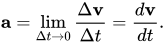
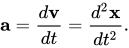
Instantaneous acceleration, meanwhile, is the limit of the average acceleration over an infinitesimal interval of time. In the terms of calculus, instantaneous acceleration is the derivative of the velocity vector with respect to time: As acceleration is defined as the derivative of velocity, v, with respect to time t and velocity is defined as the derivative of position, x, with respect to time, acceleration can be thought of as the second derivative of x with respect to t:
(Here and elsewhere, if motion is in a straight line, vector quantities can be substituted by scalars in the equations.)
By the fundamental theorem of calculus, it can be seen that the integral of the acceleration function a(t) is the velocity function v(t); that is, the area under the curve of an acceleration vs. time (a vs. t) graph corresponds to the change of velocity.

Likewise, the integral of the jerk function j(t), the derivative of the acceleration function, can be used to find the change of acceleration at a certain time:

Hub AI
Acceleration AI simulator
(@Acceleration_simulator)
Acceleration
In mechanics, acceleration is the rate of change of the velocity of an object with respect to time. Acceleration is one of several components of kinematics, the study of motion. Accelerations are vector quantities (in that they have magnitude and direction). The orientation of an object's acceleration is given by the orientation of the net force acting on that object. The magnitude of an object's acceleration, as described by Newton's second law, is the combined effect of two causes:
The SI unit for acceleration is metre per second squared (m⋅s−2, ).
For example, when a vehicle starts from a standstill (zero velocity, in an inertial frame of reference) and travels in a straight line at increasing speeds, it is accelerating in the direction of travel. If the vehicle turns, an acceleration occurs toward the new direction and changes its motion vector. The acceleration of the vehicle in its current direction of motion is called a linear acceleration (or tangential acceleration during circular motions), the reaction to which the passengers on board experience as a force pushing them back into their seats. When changing direction, the effecting acceleration is called radial or normal acceleration (or centripetal acceleration during circular motions), the reaction to which the passengers experience as a centrifugal force. If the speed of the vehicle decreases, this is an acceleration in the opposite direction of the velocity vector, sometimes called deceleration or retardation, and passengers experience the reaction to deceleration as an inertial force pushing them forward. Such deceleration is often achieved by retrorocket burning in spacecraft. Both acceleration and deceleration are treated the same, as they are both changes in velocity. Each of these accelerations (tangential, radial, deceleration) is felt by passengers until their relative (differential) velocity are neutralised in reference to the acceleration due to change in speed.
An object's average acceleration over a period of time is its change in velocity, , divided by the duration of the period, . Mathematically,
Instantaneous acceleration, meanwhile, is the limit of the average acceleration over an infinitesimal interval of time. In the terms of calculus, instantaneous acceleration is the derivative of the velocity vector with respect to time: As acceleration is defined as the derivative of velocity, v, with respect to time t and velocity is defined as the derivative of position, x, with respect to time, acceleration can be thought of as the second derivative of x with respect to t:
(Here and elsewhere, if motion is in a straight line, vector quantities can be substituted by scalars in the equations.)
By the fundamental theorem of calculus, it can be seen that the integral of the acceleration function a(t) is the velocity function v(t); that is, the area under the curve of an acceleration vs. time (a vs. t) graph corresponds to the change of velocity.
Likewise, the integral of the jerk function j(t), the derivative of the acceleration function, can be used to find the change of acceleration at a certain time:
Recent media