
Hubbry Logo
Integrability conditions for differential systemsIntegrability conditions for differential systemsMain
Open search
Integrability conditions for differential systems
Community hub
Integrability conditions for differential systems
logo
7 pages, 0 posts
0 subscribers
Be the first to start a discussion here.
Integrability conditions for differential systems
from Wikipedia

In mathematics, certain systems of partial differential equations are usefully formulated, from the point of view of their underlying geometric and algebraic structure, in terms of a system of differential forms. The idea is to take advantage of the way a differential form restricts to a submanifold, and the fact that this restriction is compatible with the exterior derivative. This is one possible approach to certain over-determined systems, for example, including Lax pairs of integrable systems.

Mathematical formulation

[edit]

A Pfaffian system is specified by 1-forms alone, but the theory includes other types of example of differential system. To elaborate, a Pfaffian system is a set of 1-forms on a smooth manifold (which one sets equal to 0 to find solutions to the system).

Given a collection of differential 1-forms on an -dimensional manifold , an integral manifold is an immersed (not necessarily embedded) submanifold whose tangent space at every point is annihilated by (the pullback of) each .

A maximal integral manifold is an immersed (not necessarily embedded) submanifold

such that the kernel of the restriction map on forms

is spanned by the at every point of . If in addition the are linearly independent, then is ()-dimensional.

A Pfaffian system is said to be completely integrable if admits a foliation by maximal integral manifolds. (Note that the foliation need not be regular; i.e. the leaves of the foliation might not be embedded submanifolds.)

An integrability condition is a condition on the to guarantee that there will be integral submanifolds of sufficiently high dimension.

Intuition

[edit]
The standard contact structure on , defined by the 1-form . Due to the twisting, it is completely non-integrable anywhere.

A Pfaffian system is specified by 1-forms. At each point , the set of 1-forms can be visualized as a set of hyperplanes, or contact elements, centered on the point. The hyperplanes intersect, producing a linear subspace of the local tangent space . This field of linear subspaces locally look like infinitesimal pieces of a maximal integral manifold, but it might be impossible to put together these infinitesimal pieces into a maximal integral manifold. The pieces might twist against each other, breaking any attempt to piece them together.

For example, if has 3 dimensions, then a single 1-form produces a field of planes, while two 1-forms that are linearly independent at every point produces a field of lines. Integrating a field of lines is always possible, but integrating a field of planes may be impossible, due to "twisting". Locally, such non-integrable field of planes look like the standard contact structure on , defined by the 1-form .

Necessary and sufficient conditions

[edit]

The necessary and sufficient conditions for complete integrability of a Pfaffian system are given by the Frobenius theorem. One version states that if the ideal algebraically generated by the collection of αi inside the ring Ω(M) is differentially closed, in other words

then the system admits a foliation by maximal integral manifolds. (The converse is obvious from the definitions.)

Examples

[edit]

Integrable regular systems

[edit]

Given any regular foliation, we can simply take its differentials to obtain a integrable regular system. The rank of the system is the codimension of the foliation.

The Hopf fibration is a foliation of the 3-sphere into circles, which is a regular foliation of codimension 2.

Integrable singular systems

[edit]

Similar to integrable regular systems, a singular foliation produces an integrable singular system. For example, can be foliated into concentric circles with a singular point at the origin. This corresponds to an integrable singular system

Completely non-integrable systems

[edit]

Not every Pfaffian system is completely integrable in the Frobenius sense. For example, consider the following one-form on R3 ∖ (0,0,0):

If were in the ideal generated by θ we would have, by the skewness of the wedge product

But a direct calculation gives

which is a nonzero multiple of the standard volume form on R3. Therefore, there are no two-dimensional leaves, and the system is not completely integrable.

On the other hand, for the curve defined by

then θ defined as above is 0, and hence the curve is easily verified to be a solution (i.e. an integral curve) for the above Pfaffian system for any nonzero constant c.

In general, a 1-form in a manifold of dimension is completely non-integrable iff everywhere. By a theorem of Pfaff, generalized by Darboux's theorem, there exists local coordinates in which it is of the form . Such structures are contact structures.

Analogously, in an even-dimensional manifold, a 1-form in a manifold of dimension is completely non-integrable iff everywhere. Such structures are even-contact structures.

The 3-sphere can be given a contact structure by considering it as the unit sphere in . The standard contact form on is:where are coordinates on .

Partially integrable system

[edit]

Some Pfaffian systems do not have a maximal integrable foliation, but are also not completely non-integrable.

For example, the standard contact structure on , defined by the 1-form , is completely non-integrable, in the sense that any integral manifold of it can have only 1 dimension (these are called the Legendrian submanifolds). However, if we were to extend to , then can have an integral manifold of 3 dimensions. This is not the lowest dimension achievable, so it is neither completely integrable nor completely non-integrable, making it partially integrable.

In , a completely integrable 1-form would have integral manifolds of 4 dimensions, and the standard contact structure can only have integral manifolds of 2 dimensions, which makes it completely non-integrable.

Applications

[edit]

In pseudo-Riemannian geometry, we may consider the problem of finding an orthogonal coframe θi, i.e., a collection of 1-forms that form a basis of the cotangent space at every point with that are closed (i = 0, i = 1, 2, ..., n). By the Poincaré lemma, the θi locally will have the form dxi for some functions xi on the manifold, and thus provide an isometry of an open subset of M with an open subset of Rn. Such a manifold is called locally flat.

This problem reduces to a question on the coframe bundle of M. Suppose we had such a closed coframe

If we had another coframe , then the two coframes would be related by an orthogonal transformation

If the connection 1-form is ω, then we have

On the other hand,
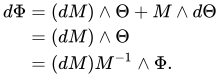
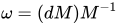
But is the Maurer–Cartan form for the orthogonal group. Therefore, it obeys the structural equation , and this is just the curvature of M: After an application of the Frobenius theorem, one concludes that a manifold M is locally flat if and only if its curvature vanishes.

Generalizations

[edit]

Many generalizations exist to integrability conditions on differential systems that are not necessarily generated by one-forms. The most famous of these are the Cartan–Kähler theorem, which only works for real analytic differential systems, and the Cartan–Kuranishi prolongation theorem. See § Further reading for details. The Newlander–Nirenberg theorem gives integrability conditions for an almost-complex structure.

Further reading

[edit]
Revisions and contributorsEdit on WikipediaRead on Wikipedia
from Grokipedia
Integrability conditions for differential systems are the necessary and sufficient criteria that determine whether a given of partial differential equations, often represented as a system of 1-forms or a subbundle of the on a manifold, admits a by integral submanifolds whose tangent spaces align with the prescribed distribution. The central theorem in this field, known as the Frobenius theorem, establishes that such a distribution is completely integrable if and only if it is involutive, meaning that the Lie bracket of any two smooth vector fields spanning the distribution at each point lies within the distribution itself. This condition ensures the local existence of a in which the integral manifolds are coordinate hypersurfaces. The Frobenius theorem originated in the late as a resolution to the problem, which sought conditions for the integrability of systems of linear partial differential equations arising from constraints in and . provided the complete solution in , proving both for integrability in the smooth category. Subsequent developments extended the result to more general settings, including analytic and holomorphic cases, with proofs relying on the existence and uniqueness theorems for ordinary differential equations to construct local integral manifolds inductively. The theorem's enduring influence stems from its role in bridging local differential constraints with global geometric structures, such as foliations of manifolds. Mathematically, for a rank-m distribution Δ on an n-dimensional manifold M (m < n), spanned locally by smooth vector fields ξ₁, …, ξₘ, involutivity requires that [ξⱼ, ξₖ] = ∑ cᵢⱼₖ ξᵢ for smooth functions cᵢⱼₖ. Equivalently, in the dual formulation for a Pfaffian system defined by independent 1-forms ω₁, …, ωᵣ (r = n - m), with Ω = ω₁ ∧ ⋯ ∧ ωᵣ, the integrability condition is dωⱼ ∧ Ω = 0 for each j, or more compactly, dΩ = α ∧ Ω for some 1-form α. These conditions are checked via exterior derivatives and ensure that the annihilator ideal generated by the forms is closed under differentiation, allowing the system to be expressed as exact forms ωⱼ = ∑ Fⱼₖ dGₖ locally, where the level sets of the Gₖ define the integral manifolds. Failure of involutivity, as in the nonholonomic constraints of a rolling disk, prevents complete integration and leads to accessible but non-integrable distributions. The Frobenius theorem finds broad applications across differential geometry, Lie theory, and applied fields. In Lie group theory, it underpins the proofs of the fundamental theorems by ensuring that left-invariant distributions on Lie groups integrate to submanifolds, facilitating the construction of exponential maps and adjoint representations. In control theory and nonholonomic mechanics, it distinguishes holonomic (integrable) constraints from nonholonomic ones, guiding the design of controllable systems like robotic locomotion. Geometrically, it characterizes foliations and is essential for studying complex structures, where the Newlander-Nirenberg theorem provides a holomorphic analogue for integrable almost complex structures. Extensions to generalized distributions and infinite-dimensional settings further apply to partial differential equations in physics, such as those in general relativity and gauge theories.

Preliminaries

Differential Forms and Pfaffian Systems

Differential forms provide a fundamental framework for studying differential systems on manifolds, generalizing the notions of scalars, vectors, and higher-order tensors in a coordinate-independent manner. On a smooth manifold MM of dimension nn, a differential kk-form is a smooth section of the kk-th exterior power of the cotangent bundle TMT^*M, assigning to each point pMp \in M an alternating multilinear map from the kk-fold product of the tangent space TpMT_pM to the real numbers. Specifically, for k=1k=1, a 1-form α\alpha at pp is a linear functional on TpMT_pM, often denoted as αp:TpMR\alpha_p: T_pM \to \mathbb{R}, and globally, α\alpha is a smooth assignment of such functionals across MM. The exterior derivative dd is a key operator on differential forms, mapping a kk-form to a (k+1)(k+1)-form in a manner that generalizes the gradient, curl, and divergence from vector calculus. For a 0-form (smooth function) fC(M)f \in C^\infty(M), dfdf is the 1-form such that dfp(v)=v(f)df_p(v) = v(f) for vTpMv \in T_pM, where v(f)v(f) is the directional derivative. More generally, for a kk-form ω=IωIdxi1dxik\omega = \sum_I \omega_I dx^{i_1} \wedge \cdots \wedge dx^{i_k} in local coordinates, the exterior derivative is given by dω=IdωIdxi1dxik,d\omega = \sum_I d\omega_I \wedge dx^{i_1} \wedge \cdots \wedge dx^{i_k}, satisfying d2=0d^2 = 0 and the Leibniz rule d(ωη)=dωη+(1)kωdηd(\omega \wedge \eta) = d\omega \wedge \eta + (-1)^k \omega \wedge d\eta. This operator is intrinsic, independent of coordinates, and plays a central role in analyzing the structure of differential systems. A Pfaffian system on a smooth manifold MM is defined as a collection of linearly independent 1-forms {α1,,αk}\{\alpha_1, \dots, \alpha_k\} on MM, with the system consisting of the equations αi=0\alpha_i = 0 for i=1,,ki=1,\dots,k. This setup generates a codimension-kk distribution ΔTM\Delta \subset TM, where Δp=i=1kkerαi,p\Delta_p = \bigcap_{i=1}^k \ker \alpha_{i,p} at each point pMp \in M, assuming the αi\alpha_i are independent so that dimΔp=nk\dim \Delta_p = n - k. Geometrically, the Pfaffian system encodes a constrained distribution on the tangent bundle TMTM, dual to the subbundle spanned by the αi\alpha_i in the cotangent bundle TMT^*M. The Pfaffian system further generates an annihilator ideal I\mathcal{I} in the exterior algebra Λ(TM)\Lambda^*(T^*M) of differential forms on MM, defined as the ideal generated by the αi\alpha_i and closed under exterior multiplication and differentiation. Specifically, I={βjαj+γldαlβj,γlΛ(TM)}\mathcal{I} = \{\sum \beta_j \wedge \alpha_j + \sum \gamma_l \wedge d\alpha_l \mid \beta_j, \gamma_l \in \Lambda^*(T^*M)\}, capturing the algebraic structure of the constraints imposed by the system. This ideal perspective allows the Pfaffian system to be viewed as part of a broader exterior differential system, where integrability concerns the closure properties of I\mathcal{I}. The terminology "Pfaffian system" originates from the work of the German mathematician Johann Friedrich Pfaff (1765–1825), who in 1815 introduced methods for integrating systems of partial differential equations using total differentials, laying early groundwork for the geometric interpretation of such constraints. The modern formulation, integrating Pfaff's ideas with exterior algebra and manifold theory, emerged in the 20th century through contributions from geometers like Élie Cartan and others developing exterior differential systems.

Integral Manifolds and Foliations

In the context of a smooth distribution Δ\Delta on a manifold MM, an integral manifold of Δ\Delta is defined as a submanifold NMN \subset M such that for every point pNp \in N, the tangent space TpNT_p N is contained in Δp\Delta_p. More precisely, if Δ\Delta is of constant rank kk, then NN is an immersed kk-dimensional submanifold satisfying TpN=ΔpT_p N = \Delta_p for all pNp \in N. This geometric object represents a "slice" through MM that is everywhere tangent to the distribution, capturing the directions prescribed by Δ\Delta. Maximal integral manifolds extend this notion by being connected integral manifolds that cannot be properly contained in any larger integral manifold of Δ\Delta. When a distribution admits a family of maximal integral manifolds that partition the entire manifold MM, these form a foliation of MM by Δ\Delta. A foliation is thus a decomposition of MM into a disjoint union of immersed submanifolds, called leaves, each of which is a maximal integral manifold tangent to Δ\Delta, with the property that nearby leaves fit together smoothly. Importantly, the leaves in such a foliation are typically immersed rather than embedded submanifolds, allowing for potential self-intersections or non-injectivity in the immersion map, which distinguishes foliations from more rigid partitions like those by embedded submanifolds. The existence of integral manifolds can be local or global. Locally, around any point pMp \in M, there always exists an integral manifold of Δ\Delta passing through pp, constructed via the flows of vector fields spanning Δ\Delta, provided Δ\Delta is smooth. However, global integral manifolds—those extending over the entire connected component of MM—may not exist without additional topological or completeness assumptions on MM and Δ\Delta, as local pieces might fail to glue consistently across the manifold. Maximal integral manifolds bridge this gap by providing the largest possible connected extensions, though they need not cover MM unless the distribution supports a foliation. This framework relates directly to overdetermined systems of partial differential equations (PDEs), where a Pfaffian system on MM, consisting of 1-forms whose kernels define Δ\Delta, encodes first-order PDEs of the form ωi(f)=0\omega_i(f) = 0 for functions ff on MM. Integral manifolds then correspond to the solution submanifolds where these PDEs are satisfied, reducing the solvability of the overdetermined system to the geometry of such submanifolds tangent to Δ\Delta.

Core Theory

Frobenius Integrability Theorem

The Frobenius integrability theorem provides the necessary and sufficient conditions for the complete integrability of a Pfaffian system on a smooth manifold, establishing a foundational result in the theory of differential systems. Originally formulated by Georg Frobenius in 1877 as part of his work on Pfaff's problem, the theorem addresses the solvability of systems of partial differential equations through the existence of integral manifolds. Élie Cartan later extended and reformulated the theorem within the framework of exterior differential systems in the late 19th and early 20th centuries, incorporating advanced tools like moving frames to generalize its applicability. In its modern geometric interpretation, the theorem states that a Pfaffian system defined by a distribution ΔTM\Delta \subset TM of constant rank kk on an nn-dimensional manifold MM is completely integrable if and only if Δ\Delta is involutive, meaning that for any smooth vector fields X,YΔX, Y \in \Delta, their Lie bracket satisfies [X,Y]Δ[X, Y] \in \Delta. This involutivity condition ensures that the distribution is closed under the Lie bracket operation, allowing the local construction of a foliation by integral submanifolds of dimension kk. An equivalent formulation in terms of differential forms considers the ideal I\mathcal{I} generated by the Pfaffian 1-forms {α1,,αnk}\{\alpha_1, \dots, \alpha_{n-k}\} annihilating Δ\Delta; the system is integrable if and only if I\mathcal{I} is closed under exterior differentiation, i.e., dIId\mathcal{I} \subset \mathcal{I}. Under these conditions, the theorem guarantees local existence: around each point pMp \in M, there exist local coordinates (x1,,xk,z1,,znk)(x_1, \dots, x_k, z_1, \dots, z_{n-k}) such that the Pfaffian forms simplify to αi=dzi\alpha_i = d z_i for i=1,,nki = 1, \dots, n-k, reducing the system to total differentials whose integral manifolds are level sets zi=constantz_i = \text{constant}. This rectification property highlights the theorem's role in straightening out integrable distributions. The result holds under standard topological assumptions on MM, such as being a smooth, Hausdorff, second-countable manifold, which implies paracompactness and ensures the existence of smooth partitions of unity necessary for global foliation constructions.

Algebraic and Differential Conditions

In the context of Pfaffian systems defined by a set of linearly independent 1-forms {α1,,αk}\{\alpha_1, \dots, \alpha_k\} on a manifold, the algebraic condition for integrability requires that each exterior derivative dαid\alpha_i vanishes when wedged with the volume form generated by the basis, i.e., dαiα1αk=0d\alpha_i \wedge \alpha_1 \wedge \dots \wedge \alpha_k = 0 for all i=1,,ki = 1, \dots, k. This condition ensures that dαid\alpha_i lies in the algebraic ideal generated by the αj\alpha_j, meaning the system is closed under exterior differentiation in a modular sense. The differential condition extends this by expressing the exterior derivatives explicitly through structure equations: dαi=j=1kβijαjd\alpha_i = \sum_{j=1}^k \beta_{ij} \wedge \alpha_j, where the βij\beta_{ij} are auxiliary 1-forms determined by the system's geometry. These equations, first systematically developed in the analysis of Pfaffian systems, capture the intrinsic torsion and provide a local frame for checking closure of the ideal under differentiation. Seminal work by Élie Cartan on exterior differential systems formalized these relations, showing their necessity for the existence of integral manifolds. From the dual perspective of distributions, involutivity translates to the condition that the Lie algebra generated by smooth sections of the distribution Δ\Delta (spanned by vector fields annihilated by the αi\alpha_i) is closed under the Lie bracket, i.e., [Δ,Δ]Δ[\Delta, \Delta] \subseteq \Delta. This algebraic closure ensures the distribution forms a Lie subalgebra of the full Lie algebra of vector fields on the manifold, aligning with the Frobenius criterion for complete integrability. To verify these conditions computationally, an algorithm involves normalizing the 1-forms to a canonical frame (e.g., via adapted coordinates or moving frames) and iteratively computing exterior derivatives while reducing modulo the ideal generated by the basis forms. Successive derivatives are checked for closure until the system stabilizes, confirming involutivity. Modern symbolic computation tools, such as REDUCE and Maple, facilitate this verification by automating wedge product expansions and ideal membership tests for complex systems.

Illustrative Examples

Integrable Systems

Integrable systems arise when the integrability conditions, such as those from the Frobenius theorem, are satisfied, allowing the differential system to define a foliation by integral manifolds. A basic illustration is provided by a codimension-one Pfaffian system generated by an exact 1-form α=df=0\alpha = df = 0, where ff is a smooth function on the manifold; this system is integrable, with the integral manifolds consisting of the level sets {f=c}\{f = c\} for constants cc. In local coordinates where one coordinate zz aligns with ff, the form simplifies to α=dz=0\alpha = dz = 0, straightening the foliation so that the integral manifolds are slices z=constantz = \text{constant}. Another exact example, albeit singular, occurs on R3{0}\mathbb{R}^3 \setminus \{0\} with the Pfaffian system α=xdx+ydy+zdz=0\alpha = x \, dx + y \, dy + z \, dz = 0; since α=d(12(x2+y2+z2))\alpha = d\left(\frac{1}{2}(x^2 + y^2 + z^2)\right), it satisfies the integrability condition dαα=0d\alpha \wedge \alpha = 0 and foliates the space by concentric spheres {x2+y2+z2=r2}\{x^2 + y^2 + z^2 = r^2\} for r>0r > 0. The singularity at the origin prevents a complete global foliation, but locally away from the origin, coordinate charts (e.g., spherical coordinates with radial adjustment) render the form proportional to dr=0dr = 0, confirming the spheres as manifolds. For constant-rank distributions of full rank nn on an nn-dimensional manifold, integrability holds trivially as the distribution is the entire , foliating the manifold by itself; parallelizable manifolds, such as Rn\mathbb{R}^n, tori TnT^n, or S3S^3, admit global frame vector fields spanning this distribution, ensuring the Pfaffian system (empty, or equivalently the zero ideal) is integrable. In such cases, coordinate charts are simply the manifold's own coordinates, where the "forms" vanish identically, reflecting the absence of constraints.

Non-Integrable Systems

Non-integrable systems arise when the Frobenius integrability condition fails, preventing the existence of integral manifolds that foliate the ambient space through the distribution. In such cases, the of the defining forms does not lie in the ideal generated by the , leading to obstructions that manifest as inconsistencies in attempting to solve the associated partial differential equations (PDEs). A classic example is the contact structure on R3\mathbb{R}^3 defined by the 1-form θ=dzydx\theta = dz - y \, dx. Here, the distribution is the kernel of θ\theta, and the Frobenius condition requires dθ0(modθ)d\theta \equiv 0 \pmod{\theta}. Computing the exterior derivative yields dθ=dxdyd\theta = dx \wedge dy, which is nonzero modulo θ\theta since dxdydx \wedge dy cannot be expressed as θη\theta \wedge \eta for any 1-form η\eta. Consequently, this system admits no global foliation by surfaces tangent to the distribution; instead, it defines a contact manifold where integral curves, known as Legendrian curves, play a central role in the geometry. Another prominent case involves almost complex structures. Consider an almost complex structure JJ on R2n\mathbb{R}^{2n}, which is a smooth endomorphism satisfying J2=IJ^2 = -I. The Nijenhuis tensor NJ(X,Y)=[X,Y]+J[JX,Y]+J[X,JY][JX,JY]N_J(X, Y) = [X, Y] + J[JX, Y] + J[X, JY] - [JX, JY] measures the failure of integrability. The structure is non-integrable if NJ0N_J \neq 0, as this violation implies that the +i eigenspace of JJ (viewed as a ) does not define a holomorphic , obstructing the existence of local complex coordinates. Integrability holds precisely when NJ=0N_J = 0, allowing the manifold to be locally complex. The violation of integrability conditions generally results in overdetermined PDE systems lacking solutions, as the Frobenius theorem identifies the exterior derivatives as the precise obstructions to solvability. For instance, attempting to find manifolds leads to incompatible equations where the compatibility conditions derived from the brackets cannot be satisfied simultaneously. In , non-holonomic constraints provide a physical of non-integrability, such as the rolling of a on a plane without slipping. The constraints on the components—preventing sliding in the contact point directions—are linear and non-integrable, as their differential forms do not close under exterior differentiation, restricting the accessible configurations to a proper without allowing reduction to . This results in dynamics that cannot be derived from a time-independent Lagrangian on the full configuration space, highlighting the geometric obstruction.

Applications

In Differential Geometry

In pseudo-Riemannian geometry, integrability conditions play a crucial role in determining the existence of orthogonal coframes that diagonalize the . For a (M,g)(M, g) of signature (p,q)(p, q), an orthogonal coframe {θi}\{\theta^i\} satisfies g=i=1p(θi)2i=p+1p+q(θi)2g = \sum_{i=1}^p (\theta^i)^2 - \sum_{i=p+1}^{p+q} (\theta^i)^2. The integrability of this coframe is governed by Cartan's structure equations, where the exterior derivatives dθi=jωjiθj+Θid\theta^i = \sum_j \omega^i_j \wedge \theta^j + \Theta^i must have vanishing torsion forms Θi=0\Theta^i = 0 for the coframe to be compatible with a connection, and further, the curvature forms Ωji=dωji+kωkiωjk\Omega^i_j = d\omega^i_j + \sum_k \omega^i_k \wedge \omega^k_j must satisfy Ωji=0\Omega^i_j = 0 to ensure local flatness. This condition implies that the metric is locally Euclidean (or Minkowski in Lorentzian case), allowing the manifold to be covered by coordinate charts where the metric takes constant diagonal form. Such integrability yields locally flat metrics, which are essential for classifying pseudo-Riemannian structures up to local isometry, as non-vanishing curvature obstructs the existence of global flat coordinates. In foliation theory, integrability conditions for distributions on manifolds directly yield codimension-kk foliations, partitioning the manifold into immersed submanifolds (leaves) of dimension dimMk\dim M - k. A distribution DTMD \subset TM of rank rr is integrable if it satisfies the Frobenius condition [X,Y]Γ(D)[X, Y] \in \Gamma(D) for all sections X,YΓ(D)X, Y \in \Gamma(D), enabling the local construction of leaf coordinates where the foliation appears as level sets of kk independent functions. These foliations classify manifolds by their transverse structure, such as in the study of Riemannian foliations where the leaves inherit a metric from the ambient space, preserving orthogonality along the transverse directions. The Ehresmann connection on a π:EM\pi: E \to M defines a horizontal distribution HTEH \subset TE complementary to the vertical V=kerdπV = \ker d\pi, and its integrability requires the 2-form ΩΩ2(E,g)\Omega \in \Omega^2(E, \mathfrak{g}) to vanish, where Ω(X,Y)=dω(X,Y)\Omega(X, Y) = d\omega(X, Y) for horizontal vectors X,YX, Y and ω\omega. When Ω=0\Omega = 0, the horizontal distribution is involutive, allowing local trivializations of the bundle into product form EU×FE \cong U \times F over open sets UMU \subset M, with horizontal lifts integrating to sections. This flatness condition is pivotal in reducing bundle structures to their base, facilitating computations in and geometry. For the Levi-Civita connection \nabla on a Riemannian manifold (M,g)(M, g), which is torsion-free and metric-compatible (g=0\nabla g = 0), integrability of a distribution orthogonal to parallel vector fields relates to closed geodesics and parallel transport. Specifically, if DD^\perp is the orthogonal complement to a parallel subbundle, its integrability via Frobenius ensures parallel transport along geodesics preserves the distribution, yielding totally geodesic submanifolds where the second fundamental form vanishes. This is computed as the horizontal lift in the orthonormal frame bundle, where vanishing curvature on DD^\perp implies the transport is path-independent within leaves. In , integrability conditions underpin the structure of symplectic foliations, where a presymplectic form ω\omega of constant rank induces an integrable characteristic distribution kerωTM\ker \omega \subset TM, foliating the manifold into symplectic leaves equipped with the induced non-degenerate 2-form. For a (M,π)(M, \pi), the symplectic foliation arises from the integrable distribution generated by Hamiltonian vector fields, with leaf dimensions varying according to the rank of π\pi, enabling the classification of Poisson structures via their symplectic reductions. This integrability, verified by the closure of the ideal generated by π\pi in the , allows local Darboux-like coordinates on each leaf, where the symplectic form takes standard . The Frobenius integrability theorem provides the foundational tool for constructing these geometric structures on manifolds.

In Physics

In physics, integrability conditions play a pivotal role in analyzing non-holonomic constraints, which impose restrictions on velocities rather than positions directly. A non-holonomic constraint is integrable if the associated system admits manifolds, meaning the constraint can be derived from a holonomic (position-based) constraint through differentiation. For instance, in , constraints like those in rolling without slipping are non-holonomic and integrable only if the Frobenius condition holds, allowing reduction to a lower-dimensional configuration ; otherwise, the system retains additional in . In completely integrable Hamiltonian systems on symplectic , the existence of sufficiently many independent Poisson-commuting integrals ensures, via the Frobenius theorem on the spanned involutive distribution, the local existence of action-angle coordinates, leading to a by invariant Liouville . This structure implies that motion on each torus is quasi-periodic, governed by independent frequencies, and preserves volumes via , which underpins the long-term stability of integrable systems like the . The Maxwell equations in form an integrable Pfaffian system on four-dimensional , where the electromagnetic 2-form satisfies the Bianchi identities, ensuring the existence of integral surfaces that describe field propagation without singularities in vacuum. This integrability allows the formulation of characteristic surfaces, such as light cones, along which electromagnetic disturbances propagate. A prominent example of non-integrability in physical systems is the Chaplygin sleigh, a with two fixed wheels and a sliding rear skate on a plane, subject to a non-holonomic constraint on the rear velocity. The constraint distribution is non-integrable, resulting in conserved momentum that leads to non-trivial asymptotic motion, including elliptical paths and, under perturbations like parametric excitation, chaotic dynamics. In , integrability conditions for distributions enable of nonlinear systems, transforming them into linear controllable forms via state feedback. For affine systems, the involutivity and integrability of the control distribution allow exact linearization in a neighborhood, facilitating the design of stabilizing controllers for mechanical systems like robotic manipulators.

Generalizations

Cartan-Kähler Theory

The Cartan-Kähler theory provides a framework for determining the existence of integral manifolds for real-analytic exterior differential systems (EDS), extending classical integrability results to more general overdetermined systems. At its core, the Cartan-Kähler theorem states that for a real-analytic EDS (M,I)(M, I) on a manifold MM, if the system is involutive and the integral elements are regular (meaning they have constant rank), then there exist local integral manifolds of all dimensions tangent to those elements. Specifically, given a connected kk-dimensional regular integral manifold PMP \subset M with rank r(P)0r(P) \geq 0, and a real-analytic submanifold RR of codimension r(P)r(P) containing PP such that dim(TpRH(TpP))=k+1\dim(T_p R \cap H(T_p P)) = k+1 for all pPp \in P, there exists a unique (k+1)(k+1)-dimensional real-analytic integral manifold XX with PXRP \subset X \subset R. This result ensures that solutions to the system can be constructed inductively by dimension, relying on the analyticity to apply the Cauchy-Kowalevski theorem for local uniqueness. Involution in the Cartan-Kähler sense requires the EDS to be differentially closed, meaning the exterior derivative of any form in the ideal II lies in II modulo forms of higher degree, and extends to all orders through successive prolongations of the symbol or tableau. The tableau, which encodes the algebraic structure of the system via a graded module of polynomials, must satisfy involutivity conditions such as the dimension of the first prolongation equaling isi\sum i s_i' (where sis_i' are the Cartan characters) and vanishing Koszul homology groups Hi(F(q))=0H_i(F(q)) = 0 for i0i \neq 0 and all q0q \geq 0. Polarization involves analyzing the polar space H(E)H(E) of an integral element EE, which consists of vectors annihilating the forms in II on EE, and decomposing the system into independent and dependent variables to ensure no obstructions arise in higher-order derivatives. These successive derivatives in the tableau, computed via prolongations A(q)A^{(q)}, confirm that the system generates no new integrability conditions, allowing for formal integrability and the construction of solutions depending on arbitrary analytic functions specified by the Cartan characters (e.g., s0s_0 constants and s1s_1 functions of one variable). Unlike the Frobenius theorem, which applies to smooth systems of constant rank generated by 1-forms and yields foliations via bracket closure, the Cartan-Kähler theory accommodates non-constant rank, higher-codimension, and overdetermined systems under analytic assumptions, using prolongations to handle formal integrability beyond local closure. This generalization is crucial for systems where the characteristic variety is non-trivial. Historically, developed the in the 1930s, building on his 1927 proof of local isometric embeddings via involutive systems, primarily to solve equivalence problems between differential structures such as metrics or connections. The approach integrates moving frames, where coframes are adapted to the , and Maurer-Cartan forms, whose equations dω=12[ω,ω]d\omega = -\frac{1}{2}[\omega, \omega] encode the intrinsic torsion and , facilitating coordinate-free analysis of integrability in actions and pseudogroups.

Newlander-Nirenberg Theorem

The Newlander-Nirenberg establishes a precise criterion for when an almost complex structure on a smooth manifold defines a genuine complex structure. An almost complex structure JJ on an even-dimensional manifold MM is a smooth bundle J:TMTMJ: TM \to TM satisfying J2=IdJ^2 = -\mathrm{Id}. The states that JJ is integrable—meaning it arises from a complex atlas on MM—if and only if the Nijenhuis tensor NJN_J vanishes identically. The Nijenhuis tensor is given by NJ(X,Y)=[JX,JY]J[JX,Y]J[X,JY]+[X,Y]N_J(X, Y) = [JX, JY] - J[JX, Y] - J[X, JY] + [X, Y] for all smooth vector fields X,YX, Y on MM, where [,][\cdot, \cdot] denotes the Lie bracket. This vanishing condition NJ=0N_J = 0 is equivalent to the involutivity of the subbundle T0,1MT^{0,1}M of the complexified tangent bundle TMCTM \otimes \mathbb{C}, defined as the +i+i-eigenspace of JCJ \otimes \mathbb{C}: T0,1M={viJvvTM}T^{0,1}M = \{ v - i Jv \mid v \in TM \}. Involutivity means that the Lie bracket of any two sections of T0,1MT^{0,1}M remains in T0,1MT^{0,1}M, ensuring the distribution is closed under the manifold's bracket operation. This formulation parallels the Frobenius integrability theorem for real distributions but applies specifically to the anti-holomorphic eigenspace in the complex setting. Proved by Newlander and Nirenberg in 1957, the theorem further guarantees that if NJ=0N_J = 0, then for every point in MM, there exist local coordinates (z1,,zn)(z^1, \dots, z^n) in which JJ coincides with the standard complex structure on Cn\mathbb{C}^n, and these coordinates are biholomorphic with respect to the induced complex structure. This local equivalence implies that integrable almost complex structures are precisely those compatible with a holomorphic atlas, providing a diffeomorphism-invariant characterization of complex manifolds. The plays a central role in classifying complex manifolds, as it equates the geometric condition NJ=0N_J = 0 with the of holomorphic coordinates. When NJ0N_J \neq 0, the almost complex fails to be integrable, and in the context of an almost Hermitian manifold (equipped with a compatible Riemannian metric gg such that g(J,J)=g(,)g(J\cdot, J\cdot) = g(\cdot, \cdot)), this non-vanishing can yield nearly Kähler structures, where J\nabla J (the ) satisfies (XJ)X=0(\nabla_X J)X = 0 for all XX but does not reduce to zero. Modern extensions broaden the to almost Hermitian settings, incorporating conditions on both JJ and gg to ensure local holomorphic frames compatible with the metric, as well as generalizations to manifolds with lower regularity (e.g., Hölder continuous structures) or boundaries.

References

Add your contribution
Related Hubs
User Avatar
No comments yet.
