Hubbry Logo
Symplectic geometrySymplectic geometryMain
Open search
Symplectic geometry
Community hub
Symplectic geometry
logo
8 pages, 0 posts
0 subscribers
Be the first to start a discussion here.
Symplectic geometry
Symplectic geometry
from Wikipedia
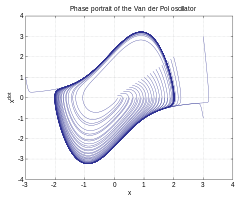
Phase portrait of the Van der Pol oscillator, a one-dimensional system. Phase space was the original object of study in symplectic geometry.

Symplectic geometry is a branch of differential geometry and differential topology that studies symplectic manifolds; that is, differentiable manifolds equipped with a closed, nondegenerate 2-form. Symplectic geometry has its origins in the Hamiltonian formulation of classical mechanics where the phase space of certain classical systems takes on the structure of a symplectic manifold.[1]

Etymology

[edit]

The term "symplectic", as adopted into mathematics by Hermann Weyl,[2][3] is a neo-Greek calque of "complex". Previously, the "symplectic group" had been called the "line complex group". "Complex" comes from the Latin com-plexus, meaning "braided together" (co- + plexus), while "symplectic" represents the corresponding Greek sym-plektikos (συμπλεκτικός "twining or plaiting together, copulative"). In both cases, the stems come from the Indo-European root *pleḱ-, expressing the concept of folding or weaving, and the prefixes suggest "togetherness". The name reflects the deep connections between complex and symplectic structures.

By Darboux's theorem, symplectic manifolds are locally isomorphic to the standard symplectic vector space. Hence they have only global (topological) invariants. The term "symplectic topology" is often used interchangeably with "symplectic geometry".

Overview

[edit]

The name "complex group" formerly advocated by me in allusion to line complexes, as these are defined by the vanishing of antisymmetric bilinear forms, has become more and more embarrassing through collision with the word "complex" in the connotation of complex number. I therefore propose to replace it by the corresponding Greek adjective "symplectic". Dickson called the group the "Abelian linear group" in homage to Abel who first studied it.

Weyl (1939, p. 165)

A symplectic geometry is defined on a smooth even-dimensional space that is a differentiable manifold. On this space is defined a geometric object, the symplectic 2-form, that allows for the measurement of sizes of two-dimensional objects in the space. The symplectic form in symplectic geometry plays a role analogous to that of the metric tensor in Riemannian geometry. Where the metric tensor measures lengths and angles, the symplectic form measures oriented areas.[4]

Symplectic geometry arose from the study of classical mechanics and an example of a symplectic structure is the motion of an object in one dimension. To specify the trajectory of the object, one requires both the position q and the momentum p, which form a point (p,q) in the Euclidean plane . In this case, the symplectic form is

and is an area form that measures the area A of a region S in the plane through integration:

The area is important because as conservative dynamical systems evolve in time, this area is invariant.[4]

Higher dimensional symplectic geometries are defined analogously. A 2n-dimensional symplectic geometry is formed of pairs of directions

in a 2n-dimensional manifold along with a symplectic form

This symplectic form yields the size of a 2n-dimensional region V in the space as the sum of the areas of the projections of V onto each of the planes formed by the pairs of directions[4]

Comparison with Riemannian geometry

[edit]

Riemannian geometry is the study of differentiable manifolds equipped with nondegenerate, symmetric 2-tensors (called metric tensors). Symplectic geometry has a number of similarities with and differences from Riemannian geometry.

Unlike in the Riemannian case, symplectic manifolds have no local invariants such as curvature. This is a consequence of Darboux's theorem which states that a neighborhood of any point of a 2n-dimensional symplectic manifold is isomorphic to the standard symplectic structure on an open set of .

Another difference with Riemannian geometry is that not every differentiable manifold can admit a symplectic form; there are certain topological restrictions. For example, every symplectic manifold is even-dimensional and orientable. Additionally, if M is a closed symplectic manifold, then the 2nd de Rham cohomology group H2(M) is nontrivial; this implies, for example, that the only n-sphere that admits a symplectic form is the 2-sphere.

A parallel that one can draw between the two subjects is the analogy between geodesics in Riemannian geometry and pseudoholomorphic curves in symplectic geometry. Geodesics are curves of shortest length (locally), while pseudoholomorphic curves are surfaces of minimal area. Both concepts play a fundamental role in their respective disciplines.

Examples and structures

[edit]

Every Kähler manifold is also a symplectic manifold. Well into the 1970s, symplectic experts were unsure whether any compact non-Kähler symplectic manifolds existed, but since then many examples have been constructed (the first was due to William Thurston); in particular, Robert Gompf has shown that every finitely presented group occurs as the fundamental group of some symplectic 4-manifold, in marked contrast with the Kähler case.

Most symplectic manifolds, one can say, are not Kähler; and so do not have an integrable complex structure compatible with the symplectic form. Mikhail Gromov, however, made the important observation that symplectic manifolds do admit an abundance of compatible almost complex structures, so that they satisfy all the axioms for a Kähler manifold except the requirement that the transition maps be holomorphic.

Gromov used the existence of almost complex structures on symplectic manifolds to develop a theory of pseudoholomorphic curves,[5] which has led to a number of advancements in symplectic topology, including a class of symplectic invariants now known as Gromov–Witten invariants. Later, using the pseudoholomorphic curve technique Andreas Floer invented another important tool in symplectic geometry known as the Floer homology.[6]

See also

[edit]

Notes

[edit]

References

[edit]
[edit]
Revisions and contributorsEdit on WikipediaRead on Wikipedia
from Grokipedia
Symplectic geometry is a branch of that studies symplectic manifolds, which are smooth manifolds equipped with a closed, non-degenerate 2-form called the symplectic form, providing a canonical structure for phase spaces in . This form, denoted ω, is skew-symmetric and ensures that the manifold is even-dimensional, with local coordinates (q₁, ..., qₙ, p₁, ..., pₙ) where ω takes the standard Darboux form ∑ dqᵢ ∧ dpᵢ. The field originated in the mathematical formulation of Hamiltonian dynamics, where the of a configuration space serves as a prototypical , modeling positions and momenta. Key concepts in symplectic geometry include Hamiltonian vector fields, defined by the relation ι_{X_H} ω = -dH for a smooth function H (the Hamiltonian), which generate flows preserving the symplectic form and thus describe the of mechanical systems. Symplectomorphisms, diffeomorphisms that pull back the symplectic form to itself, form the group of symmetries, while Lagrangian submanifolds—maximal submanifolds on which ω vanishes—play a central role in applications like integrable systems and . Notable theorems, such as guaranteeing the local standard form of ω and Gromov's non-squeezing theorem illustrating the rigidity of symplectic structures compared to volume-preserving diffeomorphisms, highlight the field's blend of geometric intuition and topological constraints. Historically, the term "symplectic" was coined by Hermann Weyl in 1939, drawing from the Greek for "complex" to describe the analogous structure in linear algebra, with foundational developments in the mid-20th century by figures like Jean-Marie Souriau and Vladimir Arnold linking it to Lie groups and dynamical systems. Beyond physics, symplectic geometry intersects with complex geometry through Kähler manifolds, where the symplectic form aligns with the Kähler form, and with symplectic topology, exploring invariants like symplectic capacities. Its applications extend to partial differential equations, mirror symmetry in string theory, and even geometrical optics, underscoring its versatility as a foundational tool in modern mathematics and theoretical physics.

Introduction

Overview

Symplectic geometry is the study of symplectic manifolds, which are even-dimensional smooth manifolds MM equipped with a symplectic form ω\omega, a closed non-degenerate 2-form satisfying dω=0d\omega = 0. The non-degeneracy condition ensures that, at every point pMp \in M and for any nonzero vTpMv \in T_p M, there exists a tangent vector wTpMw \in T_p M such that ωp(v,w)0\omega_p(v, w) \neq 0. This structure arises in the context of , where the of a classical mechanical system is naturally endowed with a symplectic form, providing the geometric framework for Hamilton's equations. In modern mathematics, symplectic geometry bridges , , and dynamical systems, enabling the study of invariants and properties that are preserved under symplectomorphisms. The dimension of a is always even, commonly expressed as 2n2n, where nn denotes the symplectic dimension.

Etymology

The term "symplectic" was coined by mathematician in 1939, in his influential book The Classical Groups: Their Invariants and Representations, where he introduced it to denote the group preserving a skew-symmetric . Weyl derived the word from the Greek adjective symplektikos, meaning "plaited together" or "interwoven," as a deliberate parallel to the Latin-rooted "complex," which had previously been used for the same group; this choice highlighted the intertwined pairing of dual coordinates, such as position and momentum in . Prior to Weyl's adoption, the group was termed the "complex group" by in his work during the on groups and their representations, reflecting an earlier algebraic perspective without the Greek etymological shift. Weyl's terminology contrasted sharply with "orthogonal," which describes groups preserving symmetric bilinear forms in linear algebra, underscoring the fundamentally skew-symmetric and non-degenerate nature of symplectic structures that forbid such . Originally rooted in the study of groups, the term "symplectic" evolved in the mid- to late and to encompass the broader geometric setting of symplectic manifolds, as researchers like , Jerrold Marsden, and Alan Weinstein developed the modern framework integrating with Hamiltonian dynamics.

Historical Development

Early Motivations from Mechanics

The origins of symplectic geometry can be traced to early 19th-century developments in , particularly in the context of where mathematicians sought to describe the evolution of mechanical systems through algebraic structures that preserved dynamical invariants. In 1809, introduced the as a tool to analyze perturbations in celestial bodies, enabling the computation of time derivatives of functions on while accounting for small variations in orbital parameters. This bracket, defined for coordinate functions in and momenta, facilitated the study of stability and long-term behavior in multi-body systems, laying foundational algebraic groundwork that later connected to geometric invariance. Poisson's innovation appeared in his memoir addressing the variation of arbitrary constants in mechanical problems, marking a shift toward coordinate-free descriptions of dynamics. Building on this, reformulated in the 1830s by introducing consisting of generalized positions qiq_i and conjugate momenta pip_i, which together parameterize the of a system. This approach, detailed in Hamilton's 1834 essay on dynamics, transformed Lagrange's second-order equations into a symmetric set of first-order partial differential equations, emphasizing the role of the Hamiltonian function as the generator of time evolution. The formulation highlighted the symplectic structure implicitly through the preservation of certain bilinear forms during dynamical flows, providing a framework for understanding conservation laws in terms of coordinate transformations. Hamilton's work, extended in his 1835 paper, unified and under variational principles, influencing subsequent geometric interpretations. Central to this reformulation were canonical transformations, which preserve the structure and thus maintain the form of Hamilton's equations under changes of coordinates. These transformations, first systematically explored by in his 1837 article on the integration of mechanical systems, allowed for the simplification of complex Hamiltonians while conserving the underlying dynamical invariants, such as and . Jacobi's contributions in the 1840s, including his lectures on analytical dynamics, further advanced integrability conditions by linking the Poisson bracket to the separability of the Hamilton-Jacobi equation, enabling explicit solutions for integrable systems like the . This emphasis on bracket-preserving maps foreshadowed the geometric notion of symplectomorphisms. Gaston Darboux advanced these ideas in 1882 by studying the integration of ian equations, demonstrating that certain nondegenerate differential 2-forms on even-dimensional spaces admit local coordinates where the form takes the standard expression ω=dqidpi\omega = \sum dq_i \wedge dp_i. on Pfaff systems provided the first rigorous local normal form for what would later be called symplectic structures, connecting algebraic preservation in to . His work bridged the gap between Poisson-Hamiltonian formalism and modern manifold theory, showing how volume-preserving flows in arise naturally from closed exterior forms. The transition to a fully modern geometric perspective occurred in the mid-20th century, with Ralph Abraham emphasizing symplectic invariance in variational principles in the 1960s and culminating in his foundational texts. Abraham's analyses highlighted how the symplectic form encodes the geometry of constrained mechanical systems, ensuring that least-action paths respect preservation, thus unifying early analytic mechanics with . This viewpoint solidified symplectic geometry as the natural framework for Hamiltonian dynamics beyond celestial applications.

Key Milestones and Contributors

laid foundational groundwork for symplectic geometry in his 1939 book The Classical Groups: Their Invariants and Representations, where he systematically studied the symplectic groups as part of the classical Lie groups and explored their geometric invariants and representations. In the early 1960s, advanced the field through his work on Lie algebras and groups, including early insights into coadjoint orbits that later revealed their natural symplectic structure, connecting to . In 1957, contributed significantly by demonstrating that Siegel's half-space is a and thus symplectic, utilizing the Sp(2n, R) and Hermitian differential forms in his work on modular groups, building on Élie Cartan's earlier foundational developments in differential forms. In the 1960s, Jean-Marie Souriau developed , establishing the symplectic structure on coadjoint orbits and linking it to physical systems. Vladimir Arnold played a pivotal role in the 1960s by applying symplectic geometry to dynamical systems, notably proving in 1963 the persistence of quasi-periodic motions under small perturbations in his work on Kolmogorov's theorem, which formed a cornerstone of KAM theory and highlighted the stability of Hamiltonian systems on symplectic manifolds. Arnold further popularized the concept of symplectic manifolds in his 1974 book Mathematical Methods of Classical Mechanics (first Russian edition 1974; English translation 1978), where he integrated symplectic geometry with to analyze phase spaces and flows, making it accessible to a broader mathematical audience. In 1965, Jürgen Moser established a key result on the equivalence of volume forms on compact manifolds, showing that any two volume forms with the same total volume are related by a ; this theorem, often called Moser's trick, extended naturally to symplectic forms and became essential for deformation and isotopy questions in symplectic geometry. During the 1970s, extended to infinite-dimensional settings relevant to symplectic manifolds, applying topological techniques to study the structure of dynamical systems and equilibria on phase spaces, thereby bridging with symplectic invariants. In the late 20th and early 21st centuries, symplectic topology emerged as a vibrant subfield, with Dusa McDuff and Dietmar Salamon making seminal contributions through their joint 1995 book Introduction to Symplectic Topology (revised editions 1998 and 2017), which systematized Gromov nonsqueezing and J-holomorphic curves, and through McDuff's subsequent work on symplectic embeddings. Advances in symplectic capacities during the 2000s included McDuff's 2010 resolution of the ellipsoid embedding problem in four dimensions, providing sharp obstructions via ECH capacities and continued fractions, which quantified the "size" of symplectic manifolds and refined Gromov's nonsqueezing theorem.

Fundamental Definitions

Symplectic Forms

A symplectic form on a smooth manifold MM of even dimension 2n2n is a differential 2-form ω\omega that is closed, meaning dω=0d\omega = 0, and non-degenerate. Closedness ensures that ω\omega defines a class in H2(M;R)H^2(M; \mathbb{R}), while non-degeneracy implies that at every point pMp \in M, the ωp:TpM×TpMR\omega_p: T_pM \times T_pM \to \mathbb{R} has maximal rank 2n2n, pairing tangent vectors without kernel. As a 2-form, ω\omega is skew-symmetric, satisfying ω(u,v)=ω(v,u)\omega(u, v) = -\omega(v, u) for all vectors u,vTpMu, v \in T_pM. In local coordinates (q1,,qn,p1,,pn)(q^1, \dots, q^n, p^1, \dots, p^n) on MM, ω\omega can be expressed as ω=i,j=12nωijdqidqj\omega = \sum_{i,j=1}^{2n} \omega_{ij} \, dq^i \wedge dq^j, where the coefficient matrix (ωij)(\omega_{ij}) is skew-symmetric, i.e., ωij=ωji\omega_{ij} = -\omega_{ji}. The non-degeneracy condition is equivalent to the musical isomorphism ω:TpMTpM\flat_\omega: T_pM \to T_p^*M defined by vιvωv \mapsto \iota_v \omega (the interior product), with inverse ω:TpMTpM\sharp_\omega: T_p^*M \to T_pM, being an of vector spaces, ensuring that ω\omega induces between TpMT_pM and itself via this map. Given a smooth function f:MRf: M \to \mathbb{R}, the associated XfX_f is uniquely determined by the equation ιXfω=df\iota_{X_f} \omega = -df, which links the symplectic structure to the dynamics of Hamiltonian systems. In the context of Kähler geometry, a symplectic form ω\omega may be compatible with an almost complex structure JJ on MM, meaning ω(Ju,Jv)=ω(u,v)\omega(Ju, Jv) = \omega(u, v) for all u,vu, v, and the metric g(u,v)=ω(u,Jv)g(u, v) = \omega(u, Jv) is positive definite, thus defining a Riemannian metric on MM.

Symplectic Manifolds

A is a pair (M,ω)(M, \omega), where MM is a smooth manifold and ω\omega is a closed, non-degenerate 2-form on MM. The non-degeneracy of ω\omega implies that the associated on the tangent spaces is invertible at every point, which in turn requires that dimM=2n\dim M = 2n for some n1n \geq 1. This even dimensionality arises because a non-degenerate alternating on a can only exist in even dimensions, as the or considerations show that odd-dimensional cases lead to degeneracy. The powers of the symplectic form induce a canonical orientation on MM: specifically, ωn\omega^n is a nowhere-vanishing top-degree form, hence a , making MM orientable. More precisely, the form ωnn!\frac{\omega^n}{n!} serves as the Liouville volume form, providing a natural measure on MM that is invariant under symplectomorphisms and plays a central role in integrating over subsets, such as mω(U)=Uωnn!m_\omega(U) = \int_U \frac{\omega^n}{n!}. A diffeomorphism ϕ:(M1,ω1)(M2,ω2)\phi: (M_1, \omega_1) \to (M_2, \omega_2) between symplectic manifolds preserves the symplectic structure if ϕω2=ω1\phi^*\omega_2 = \omega_1; such maps are called symplectomorphisms and form the group Sympl(M,ω)\mathrm{Sympl}(M, \omega). This pullback condition ensures that the symplectic form is transported consistently, preserving non-degeneracy and closedness. Symplectic manifolds need not be compact; non-compact examples abound, such as cotangent bundles of arbitrary manifolds, while compact ones exist but exhibit distinct geometric behaviors. Unlike Kähler manifolds, which benefit from a maximum principle for plurisubharmonic functions due to their compatible complex structure, compact symplectic manifolds lack an inherent such principle, allowing for more flexible holomorphic curve techniques in topology. Although the standard definition emphasizes closed non-degenerate 2-forms, almost symplectic structures—non-degenerate 2-forms without the closedness condition—provide a relaxed framework, often used in deformations or compatibility with almost complex structures. In degenerate cases, pre-symplectic forms are closed 2-forms of constant but non-maximal rank, leading to foliations by symplectic leaves and applications in reduction procedures.

Core Properties and Theorems

Local Normal Forms

In symplectic geometry, the Darboux theorem establishes a canonical local coordinate system around any point on a . Specifically, for a (M,ω)(M, \omega) of dimension 2n2n and any point pMp \in M, there exist local coordinates (q1,,qn,p1,,pn)(q^1, \dots, q^n, p^1, \dots, p^n) centered at pp such that the symplectic form takes the standard expression ω=i=1ndqidpi.\omega = \sum_{i=1}^n \, dq^i \wedge dp^i. This normal form implies that the only local invariant of a symplectic structure is its dimension, distinguishing symplectic geometry from , where local invariants exist and determine the structure up to local . A sketch of the proof relies on the non-degeneracy of ω\omega, which ensures the existence of Hamiltonian vector fields, and proceeds via Moser's homotopy method. Given two symplectic forms agreeing to first order at pp, one constructs a path connecting them using time-dependent Hamiltonian vector fields XtX_t satisfying ιXtωt=dHt\iota_{X_t} \omega_t = -dH_t, where the flows generated by these fields adjust the form to the standard one without altering the pointwise value at pp. The non-degeneracy guarantees the invertibility of the map from vector fields to 1-forms induced by ω\omega, enabling this rectification. For symplectic manifolds, where ω=dα\omega = d\alpha globally, the Darboux coordinates further yield a Weierstrass normal form for the primitive 1-form locally: α=i=1npidqi\alpha = \sum_{i=1}^n p^i \, dq^i. This canonical realization underscores the structure locally inherent to symplectic forms. The defining relation for a XHX_H associated to a function HH is ιXHω=dH\iota_{X_H} \omega = -dH, ensuring that the flow of XHX_H preserves ω\omega and generates symplectomorphisms. Similarly, in , a Darboux theorem provides local coordinates (x1,,xn,y1,,yn,z)(x^1, \dots, x^n, y^1, \dots, y^n, z) around any point such that the contact form is α=dzi=1nyidxi\alpha = dz - \sum_{i=1}^n y^i \, dx^i.

Isotopy and Deformation

In symplectic geometry, isotopy and deformation address the flexibility and rigidity of symplectic structures under continuous changes, particularly focusing on how symplectic forms can be transformed via diffeomorphisms isotopic to the identity while preserving key invariants like classes. A central result in this area is Moser's theorem, which establishes that on a compact manifold MM, two symplectic forms ω0\omega_0 and ω1\omega_1 are isotopic if they belong to the same class in H2(M;R)H^2(M; \mathbb{R}). Specifically, there exists a ϕ:MM\phi: M \to M isotopic to the identity such that ϕω1=ω0\phi^* \omega_1 = \omega_0. The proof of Moser's theorem relies on constructing a smooth path of symplectic forms connecting ω0\omega_0 and ω1\omega_1. Define ωt=(1t)ω0+tω1\omega_t = (1-t) \omega_0 + t \omega_1 for t[0,1]t \in [0,1]. Since [ω0]=[ω1][\omega_0] = [\omega_1], the difference ω1ω0=dα\omega_1 - \omega_0 = d\alpha for some 1-form α\alpha, so ωt=ω0+tdα\omega_t = \omega_0 + t \, d\alpha, ensuring that each ωt\omega_t is closed. Non-degeneracy of ωt\omega_t follows from the fact that ωt\omega_t is cohomologous to ω0\omega_0 and the path avoids degeneracy via a argument. To find the isotopy, solve for a time-dependent XtX_t satisfying the equation ddtϕtωt=0\frac{d}{dt} \phi_t^* \omega_t = 0, where ϕt\phi_t is the flow generated by XtX_t. This leads to the condition LXtωt+ω˙t=0\mathcal{L}_{X_t} \omega_t + \dot{\omega}_t = 0, or equivalently, iXtωt=αi_{X_t} \omega_t = -\alpha, where ω˙t=dα\dot{\omega}_t = d\alpha, which can be solved for XtX_t using the non-degeneracy of ωt\omega_t. The exactness of ω˙t\dot{\omega}_t guarantees solvability on compact manifolds. This theorem has significant applications to the stability of symplectic structures, particularly under perturbations that preserve the class, such as volume-preserving in low dimensions. For instance, on compact surfaces, the class determines the total symplectic area, so any two symplectic forms with the same area are isotopic via a preserving form induced by the symplectic structure. In higher dimensions, Moser's result implies that small deformations within the same class do not yield essentially new symplectic manifolds up to , providing a form of for Hamiltonian systems and . Despite this flexibility, symplectic isotopies exhibit notable rigidity, as highlighted by Gromov's non-squeezing theorem from , a milestone that reveals topological obstructions to symplectic embeddings. The theorem states that there is no symplectic embedding of a of radius RR into a of radius r<Rr < R in R2n\mathbb{R}^{2n}, even though such an embedding exists as a volume-preserving . This contrasts with the local flexibility from Moser and underscores global constraints in symplectic topology, limiting the extent to which symplectic structures can be deformed without altering invariants beyond classes.

Comparisons with Other Geometries

Relation to Riemannian Geometry

Riemannian geometry is founded on a positive definite metric tensor gg, which provides a way to measure lengths, angles, and volumes on a manifold, enabling the study of geodesics as shortest paths and local invariants such as sectional curvature that vary pointwise and capture intrinsic geometry. In contrast, symplectic geometry relies on a closed, nondegenerate 2-form ω\omega, which is skew-symmetric and induces a natural pairing between vectors without defining lengths or angles, instead facilitating the preservation of phase space volumes in dynamical systems. This structural difference means that while Riemannian metrics allow for a rich local theory of curvature and rigidity, symplectic forms yield no local differential invariants, as all symplectic manifolds of the same dimension are locally diffeomorphic via the Darboux theorem. A key point of intersection arises through compatible triples (J,g,ω)(J, g, \omega), where JJ is an almost complex structure satisfying J2=idJ^2 = -\mathrm{id}, ω\omega is symplectic, and gg is a Riemannian metric defined by g(u,v)=ω(u,Jv)g(u,v) = \omega(u, Jv), ensuring gg is positive definite and compatible with both ω\omega and JJ. Such triples equip the manifold with an almost Hermitian structure, where ω\omega serves as the fundamental 2-form. If JJ is integrable, the triple defines a , blending symplectic, complex, and Riemannian geometries, with gg becoming Hermitian and the preserving the complex structure. Every admits such compatible almost complex structures, and the space of them is contractible, allowing flexibility in choosing JJ while preserving ω\omega. Unlike , where provides a local measure of deviation from flatness, symplectic geometry lacks a direct analogue of such invariants due to the local uniformity imposed by Darboux coordinates. Instead, in the symplectic context often manifests through topological invariants like Chern classes of the almost complex , which are independent of the choice of compatible JJ and capture global symplectic properties, such as obstructions to the existence of certain embeddings. This shift from local to global invariants highlights the lesser local rigidity of symplectic manifolds compared to their counterparts, where can distinguish geometries arbitrarily closely. Dynamically, features flows on the , generated by the Hamiltonian with respect to a compatible symplectic on TMT^*M, which minimize energy along paths preserving the metric. In symplectic geometry, Hamiltonian flows on the manifold itself, defined by vector fields XHX_H satisfying ω(XH,)=dH\omega(X_H, \cdot) = -dH, preserve the symplectic form ω\omega and thus the total volume, contrasting with the length-minimizing nature of . These flows exhibit symplectic rigidity phenomena, such as nonsqueezing, absent in general Riemannian dynamics.

Relation to Poisson Geometry

A Poisson manifold is a smooth manifold MM equipped with a bivector field πΓ(2TM)\pi \in \Gamma(\wedge^2 TM) satisfying the integrability condition [π,π]S=0[\pi, \pi]_S = 0, where [,]S[ \cdot, \cdot ]_S denotes the Schouten-Nijenhuis bracket. This condition ensures that the associated Poisson bracket {f,g}=π(df,dg)\{f, g\} = \pi(df, dg) on smooth functions C(M)C^\infty(M) defines a Lie algebra structure, satisfying bilinearity, skew-symmetry, the Jacobi identity, and the Leibniz rule. The map π:TMTM\pi^\sharp: T^*M \to TM given by π(α)=iαπ\pi^\sharp(\alpha) = i_\alpha \pi then endows the cotangent bundle TMT^*M with a Lie algebroid structure, whose anchor is π\pi^\sharp and whose bracket on sections (1-forms) is derived from the Koszul bracket on multivectors. Symplectic geometry arises as the non-degenerate case of Poisson geometry, where π\pi^\sharp is an , making π\pi invertible. In this setting, the inverse defines a symplectic form ω=(π)1Γ(2TM)\omega = (\pi^\sharp)^{-1} \in \Gamma(\wedge^2 T^*M), which is closed and non-degenerate, recovering the standard symplectic structure. More generally, any decomposes locally into symplectic leaves—integrable submanifolds where the restriction of π\pi is non-degenerate—forming a symplectic foliation, with the transverse structure captured by a zero-Poisson component via Weinstein's local splitting theorem. This theorem states that around any point, there exist coordinates where π\pi splits as the sum of a symplectic on the leaf directions and zero elsewhere, highlighting how Poisson structures generalize symplectic ones by allowing degeneracy. Dirac structures provide a unified framework encompassing both Poisson and presymplectic geometries, extending to symplectic cases. A Dirac structure on MM is a maximally isotropic subbundle LTMTML \subset TM \oplus T^*M that is integrable under the Courant bracket [(X,α),(Y,β)]C=([X,Y],LXβiYdα)[(X, \alpha), (Y, \beta)]_C = ([X, Y], \mathcal{L}_X \beta - i_Y d\alpha), where L\mathcal{L} is the . For a Poisson bivector π\pi, the graph Graph(π)={(π(α),α)αTM}\text{Graph}(\pi^\sharp) = \{(\pi^\sharp(\alpha), \alpha) \mid \alpha \in T^*M\} forms a Dirac structure, while for a presymplectic form ω\omega (closed but possibly degenerate), the graph of ω:TMTM\omega^\flat: TM \to T^*M does the same; non-degeneracy recovers the full symplectic case. This unification facilitates the study of gauge transformations and reductions in both settings. A prominent example of a degenerate Poisson structure is the Lie-Poisson manifold on the dual g\mathfrak{g}^* of a g\mathfrak{g}, where π(μ)(α,β)=μ,[α,β]g\pi(\mu)(\alpha, \beta) = \langle \mu, [\alpha, \beta]_{\mathfrak{g}} \rangle for μg\mu \in \mathfrak{g}^* and α,βTμgg\alpha, \beta \in T^*_\mu \mathfrak{g}^* \cong \mathfrak{g}, where α,β\alpha, \beta are identified with elements of g\mathfrak{g}. Here, π\pi is linear and degenerate unless g\mathfrak{g} is abelian, with symplectic leaves given by the coadjoint orbits, which carry the Kirillov-Kostant-Souriau symplectic structure. For instance, on so(3)R3\mathfrak{so}(3)^* \cong \mathbb{R}^3, the leaves are spheres of constant norm, illustrating reduced dynamics in motion. Poisson geometry emerged as a distinct field in the through Alan Weinstein's program, which emphasized global integration via symplectic groupoids and the decomposition of Poisson structures into symplectic components, bridging local normal forms with broader geometric realizations. Post-2000 developments, including deeper integrations with Dirac geometry, continue to explore generalizations like twisted Poisson structures and their quantization, though the field remains active with open questions on integrability and .

Examples and Structures

Canonical Examples

The prototypical example of a symplectic manifold is the standard R2n\mathbb{R}^{2n} equipped with the constant symplectic form ω0=i=1ndxidyi\omega_0 = \sum_{i=1}^n dx_i \wedge dy_i, where (x1,,xn,y1,,yn)(x_1, \dots, x_n, y_1, \dots, y_n) are the standard coordinates. This form is closed and non-degenerate, making R2n\mathbb{R}^{2n} a model for local behavior of all symplectic manifolds via . Open subsets of R2n\mathbb{R}^{2n} inherit this structure as well. A fundamental construction yielding symplectic manifolds of arbitrary even dimension is the TQT^*Q of any smooth manifold QQ of dimension nn. It carries a symplectic form derived from the Liouville 1-form θ=pidqi\theta = \sum p_i \, dq_i in local coordinates (qi,pi)(q_i, p_i), defined by ω=dθ=dqidpi\omega = -d\theta = \sum dq_i \wedge dp_i. This form is independent of coordinate choices and closed, ensuring TQT^*Q is symplectic. Compact examples include the tori T2n=R2n/Z2nT^{2n} = \mathbb{R}^{2n} / \mathbb{Z}^{2n}, which admit a flat symplectic structure induced by the standard form ω0\omega_0 on R2n\mathbb{R}^{2n}, as the integer lattice preserves the form under the quotient map. For n=1n=1, the 2-torus T2T^2 with ω=dθ1dθ2\omega = d\theta_1 \wedge d\theta_2 (in angular coordinates) exemplifies a compact abelian symplectic manifold. Kähler manifolds provide rich symplectic examples, where the Kähler form serves as the symplectic structure. Notably, complex projective space CPn\mathbb{CP}^n is equipped with the Fubini-Study symplectic form ωFS\omega_{FS}, obtained as the curvature form of the associated Hermitian metric on the tautological line bundle over CPn\mathbb{CP}^n. This positive (1,1)-form is closed and non-degenerate, rendering CPn\mathbb{CP}^n a compact Kähler symplectic manifold of dimension 2n2n. Coadjoint orbits of Lie groups furnish another canonical class of symplectic manifolds. For a Lie group GG with Lie algebra g\mathfrak{g} and dual g\mathfrak{g}^*, the coadjoint orbit through ξg\xi \in \mathfrak{g}^* inherits the Kirillov-Kostant-Souriau symplectic form ωξ(X^,Y^)=ξ([X,Y])\omega_\xi(\hat{X}, \hat{Y}) = -\xi([X, Y]), where X^,Y^\hat{X}, \hat{Y} are tangent vectors induced by Lie algebra elements X,YgX, Y \in \mathfrak{g}. This 2-form is closed and non-degenerate on the orbit, as established in foundational works. Calabi-Yau manifolds, as compact Kähler manifolds with trivial canonical bundle, are special cases where the Kähler form provides the symplectic structure, often with additional Ricci-flat conditions enhancing their geometric properties.

Symplectic Group and Lie Algebra

The symplectic group Sp(2n,R)\mathrm{Sp}(2n, \mathbb{R}) consists of all 2n×2n2n \times 2n real matrices AA that preserve the standard symplectic form on R2n\mathbb{R}^{2n}, satisfying ATJA=JA^T J A = J, where J=(0InIn0)J = \begin{pmatrix} 0 & I_n \\ -I_n & 0 \end{pmatrix} is the block-diagonal matrix with InI_n the n×nn \times n identity. This group is a non-compact real Lie group of dimension n(2n+1)n(2n+1), acting linearly on the standard symplectic vector space R2n\mathbb{R}^{2n}. The sp(2n,R)\mathfrak{sp}(2n, \mathbb{R}) comprises the 2n×2n2n \times 2n real matrices XX such that XTJ+JX=0X^T J + J X = 0, which are the infinitesimal generators of the symplectic group action. This has dimension n(2n+1)n(2n+1), matching that of the group, and consists precisely of the Hamiltonian matrices arising from quadratic Hamiltonian functions on R2n\mathbb{R}^{2n}. Elements of sp(2n,R)\mathfrak{sp}(2n, \mathbb{R}) generate one-parameter subgroups of symplectic transformations via the matrix exponential, preserving the symplectic infinitesimally. The complexification of Sp(2n,R)\mathrm{Sp}(2n, \mathbb{R}) yields Sp(2n,C)\mathrm{Sp}(2n, \mathbb{C}), the of 2n×2n2n \times 2n complex matrices preserving the same form over C\mathbb{C}. A maximal compact of Sp(2n,R)\mathrm{Sp}(2n, \mathbb{R}) is the U(n)U(n), embedded via the identification of R2n\mathbb{R}^{2n} with Cn\mathbb{C}^n where symplectic matrices restrict to unitary ones. The fundamental representation of Sp(2n,R)\mathrm{Sp}(2n, \mathbb{R}) is its defining action on the 2n2n-dimensional real , which is irreducible and preserves the symplectic form. Higher representations can be constructed via tensor powers or oscillator realizations, but the fundamental one underlies the group's in GL(2n,R)\mathrm{GL}(2n, \mathbb{R}). Infinite-dimensional analogues of the arise in the context of loop groups, such as the loop group of Sp(2n,R)\mathrm{Sp}(2n, \mathbb{R}) over the circle, which inherits similar preservation properties in infinite dimensions. Recent developments post-2010 in the metaplectic representation, a double cover of the , have explored its extensions to infinite-dimensional settings and applications in quantization, including analyses of the symplectic via metaplectic operators.

Applications

In Classical Mechanics

In classical mechanics, the of a mechanical system is modeled as the TQT^*Q of the configuration space QQ, equipped with the canonical symplectic form ωcan=dqidpi\omega_{\text{can}} = \sum dq_i \wedge dp_i, where qiq_i are coordinates on QQ and pip_i the conjugate momenta. This structure captures the geometry of possible states, with the symplectic form encoding the relations fundamental to Hamiltonian dynamics. Hamiltonian mechanics is formulated on this symplectic phase space using a Hamiltonian function H:TQRH: T^*Q \to \mathbb{R}, which generates the dynamics via Hamilton's equations: q˙i=Hpi\dot{q}_i = \frac{\partial H}{\partial p_i}, p˙i=Hqi\dot{p}_i = -\frac{\partial H}{\partial q_i}. In symplectic terms, these equations describe the XHX_H defined by ω(XH,)=dH\omega(X_H, \cdot) = -dH, ensuring that the flow ϕtH\phi_t^H preserves the symplectic form ω\omega. A key consequence is , which states that the Hamiltonian flow preserves the ωnn!\frac{\omega^n}{n!} on the 2n2n-dimensional phase space, implying incompressible flow and conservation of phase space volumes. This preservation arises directly from the symplectomorphism property of ϕtH\phi_t^H, as the pullback satisfies (ϕtH)ω=ω(\phi_t^H)^* \omega = \omega, leading to volume invariance essential for . For integrable Hamiltonian systems, possessing nn independent commuting conserved quantities in involution, action-angle coordinates (Ij,θj)(I_j, \theta_j) transform the phase space locally into a product of tori, where the symplectic form becomes ω=dIjdθj\omega = \sum dI_j \wedge d\theta_j and the Hamiltonian depends only on the actions H=H(I)H = H(I). These coordinates linearize the flow to constant angular velocities θ˙j=HIj\dot{\theta}_j = \frac{\partial H}{\partial I_j}, I˙j=0\dot{I}_j = 0, facilitating quasi-periodic motion analysis. Symplectic reduction addresses systems with symmetries, such as actions preserving ω\omega. The Marsden-Weinstein reduction theorem constructs a reduced as the quotient (TQ×g)//G(T^*Q \times \mathfrak{g}^*) // G at a coadjoint , where g\mathfrak{g}^* is the dual , inheriting a reduced symplectic form and Hamiltonian, thus simplifying dynamics by eliminating redundant degrees of freedom. Noether's theorem in this framework asserts that every symmetry generated by a preserving ω\omega—i.e., a —yields a conserved momentum map J:TQgJ: T^*Q \to \mathfrak{g}^*, with components constant along the flow. This geometric perspective unifies conservation laws with the symplectic structure, extending classical results to general manifolds. Symplectic geometry also bridges to , where the prequantum over is quantized via half-forms and polarization, leading to Berezin-Toeplitz operators that approximate classical observables through asymptotic expansions on Kähler manifolds in the semiclassical limit during the 1980s–2000s.

In Symplectic Topology

Symplectic topology emerged as a vibrant field in the late , leveraging the rigidity of symplectic structures to study topological properties of manifolds that are invisible in smooth alone. Unlike general smooth manifolds, symplectic manifolds exhibit constraints that prevent certain embeddings and deformations, leading to powerful invariants and theorems that classify symplectic phenomena. This rigidity, first highlighted by Mikhail Gromov's foundational work in 1985, has driven rapid developments since the 1990s, transforming symplectic geometry into a cornerstone of modern . Gromov-Witten invariants provide a key tool for counting holomorphic curves in symplectic manifolds, encoding enumerative invariants that relate to symplectic . These invariants, originally developed to solve problems in , count the number of rational curves passing through specified points in complex projective spaces, with applications to and quantum cohomology. For instance, in CP2\mathbb{CP}^2, the Gromov-Witten invariant for lines through two points is 1, reflecting the symplectic count of such curves. The theory was formalized by in the context of and rigorously defined by mathematicians like Jun Li and Gang Tian. Floer homology extends Morse theory to infinite-dimensional spaces of symplectomorphisms and Lagrangian submanifolds, providing a homology theory that detects symplectic isotopy classes. Developed by Floer in the 1980s, it assigns a to the space of periodic orbits of a Hamiltonian flow, with differential given by counting holomorphic strips between orbits; this yields invariants invariant under symplectomorphisms. In the context of symplectomorphisms, serves as an infinite-dimensional Morse homology, distinguishing non-isotopic maps on manifolds like the . Its foundational role in understanding symplectic rigidity was established in Floer's original papers on the Arnold conjecture. Symplectic capacities, such as the Hofer-Zehnder capacity, quantify the "size" of symplectic manifolds in a way that respects the non-squeezing phenomenon, providing numerical invariants that bound embedding properties. The Hofer-Zehnder capacity of a domain measures the minimal action of periodic orbits under Hamiltonian flows, with the unit ball in R2n\mathbb{R}^{2n} having capacity π\pi, equal to that of the cylinder B2(1)×R2n2B^2(1) \times \mathbb{R}^{2n-2}. Introduced by Helmut Hofer and Eduard Zehnder, these capacities highlight symplectic rigidity by showing that certain embeddings are impossible despite being feasible in the smooth category. Embedding theorems underscore this rigidity, with Gromov's non-squeezing theorem stating that a symplectic embedding of a ball B2n(r)B^{2n}(r) into a cylinder Z2n(R)=B2(R)×R2n2Z^{2n}(R) = B^2(R) \times \mathbb{R}^{2n-2} requires rRr \leq R, preventing "squeezing" of higher-dimensional balls into thinner cylinders. Relatedly, displacement energy measures the minimal energy needed to displace a via a Hamiltonian , with the energy of a being πr2\pi r^2, ensuring non-contractible sets cannot be arbitrarily moved. These results, central to symplectic embedding problems, were pioneered by Gromov and further developed by Hofer and Zehnder. Contact geometry arises naturally as the boundary theory of symplectic manifolds, where a contact structure on a bounds a symplectic filling via Weinstein neighborhoods, which model the neighborhood of a Lagrangian as a neighborhood of the zero section in its . This connection allows symplectic to inform contact , with Weinstein's guaranteeing that any transverse intersection with a admits such a neighborhood. The interplay has been crucial in studying symplectic fillings of contact manifolds. The field has seen explosive growth since 1990, with innovations like embedded contact homology (ECH), developed in the 2010s by Michael Hutchings, providing a contact invariant via holomorphic curve counts in cobordisms. Notably, Chris Taubes in the established deep links between ECH and Seiberg-Witten monopoles, proving that ECH equals the Seiberg-Witten invariant for 3-manifolds, bridging and symplectic topology. Recent advances in the 2020s, such as those on symplectic fillings by Marco Golla and others, explore minimal fillings and their obstructions using wrapped , refining classification of contact structures.

References

Add your contribution
Related Hubs
User Avatar
No comments yet.