Hubbry Logo
Interest rate cap and floorInterest rate cap and floorMain
Open search
Interest rate cap and floor
Community hub
Interest rate cap and floor
logo
7 pages, 0 posts
0 subscribers
Be the first to start a discussion here.
Interest rate cap and floor
from Wikipedia

In finance, an interest rate cap is a type of interest rate derivative in which the buyer receives payments at the end of each period in which the interest rate exceeds the agreed strike price. An example of a cap would be an agreement to receive a payment for each month the LIBOR rate exceeds 2.5%.

Similarly, an interest rate floor is a derivative contract in which the buyer receives payments at the end of each period in which the interest rate is below the agreed strike price.

Caps and floors can be used to hedge against interest rate fluctuations. For example, a borrower who is paying the LIBOR rate on a loan can protect himself against a rise in rates by buying a cap at 2.5%. If the interest rate exceeds 2.5% in a given period the payment received from the derivative can be used to help make the interest payment for that period, thus the interest payments are effectively "capped" at 2.5% from the borrowers' point of view.

Interest rate cap

[edit]

An interest rate cap is a derivative in which the buyer receives payments at the end of each period in which the interest rate exceeds the agreed strike price. An example of a cap would be an agreement to receive a payment for each month the LIBOR rate exceeds 2.5%. They are most frequently taken out for periods of between 2 and 5 years, although this can vary considerably.[1] Since the strike price reflects the maximum interest rate payable by the purchaser of the cap, it is frequently a whole number integer, for example 5% or 7%.[1] By comparison the underlying index for a cap is frequently a LIBOR rate, or a national interest rate.[1] The extent of the cap is known as its notional profile and can change over the lifetime of a cap, for example, to reflect amounts borrowed under an amortizing loan.[1] The purchase price of a cap is a one-off cost and is known as the premium.[1]

The purchaser of a cap will continue to benefit from any rise in interest rates above the strike price, which makes the cap a popular means of hedging a floating rate loan for an issuer.[1]

The interest rate cap can be analyzed as a series of European call options, known as caplets, which exist for each period the cap agreement is in existence. To exercise a cap, its purchaser generally does not have to notify the seller, because the cap will be exercised automatically if the interest rate exceeds the strike (rate).[1] Note that this automatic exercise feature is different from most other types of options. Each caplet is settled in cash at the end of the period to which it relates.[1]

In mathematical terms, a caplet payoff on a rate L struck at K is

where N is the notional value exchanged and is the day count fraction corresponding to the period to which L applies. For example, suppose that it is January 2007 now and you own a caplet on the six month USD LIBOR rate with an expiry of 1 February 2007 struck at 2.5% with a notional of 1 million dollars. Next, if on 1 February the USD LIBOR rate sets at 3%, then you will receive the following payment:


Customarily the payment is made at the end of the rate period, in this case on 1 August 2007.

Interest rate floor

[edit]

An interest rate floor is a series of European put options or floorlets on a specified reference rate, usually LIBOR. The buyer of the floor receives money if on the maturity of any of the floorlets, the reference rate is below the agreed strike price of the floor.

Interest rate collars and reverse collars

[edit]

An interest rate collar is the simultaneous purchase of an interest rate cap and sale of an interest rate floor on the same index for the same maturity and notional principal amount.

  • The cap rate is set above the floor rate.
  • The objective of the buyer of a collar is to protect against rising interest rates (while agreeing to give up some of the benefit from lower interest rates).
  • The purchase of the cap protects against rising rates while the sale of the floor generates premium income.
  • A collar creates a band within which the buyer's effective interest rate fluctuates

A reverse interest rate collar is the simultaneous purchase of an interest rate floor and simultaneously selling an interest rate cap.

  • The objective is to protect the bank from falling interest rates.
  • The buyer selects the index rate and matches the maturity and notional principal amounts for the floor and cap.
  • Buyers can construct zero cost reverse collars when it is possible to find floor and cap rates with the same premiums that provide an acceptable band.

Valuation of interest rate caps

[edit]

The size of cap and floor premiums are impacted by a wide range of factors, as follows; the price calculation itself is performed by one of several approaches discussed below.

  • The relationship between the strike rate and the prevailing 3-month LIBOR
    • premiums are highest for in the money options and lower for at the money and out of the money options
  • Premiums increase with maturity.
    • The option seller must be compensated more for committing to a fixed-rate for a longer period of time.
  • Prevailing economic conditions, the shape of the yield curve, and the volatility of interest rates.
    • upsloping yield curve—caps will be more expensive than floors.
    • the steeper is the slope of the yield curve, ceteris paribus, the greater are the cap premiums.
    • floor premiums reveal the opposite relationship.

Black model

[edit]

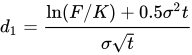
The simplest and most common valuation of interest rate caplets is via the Black model. Under this model we assume that the underlying rate is distributed log-normally with volatility . Under this model, a caplet on a LIBOR expiring at t and paying at T has present value


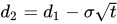
where

P(0,T) is today's discount factor for T
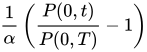
F is the forward price of the rate. For LIBOR rates this is equal to
K is the strike
N is the standard normal CDF.

and

Notice that there is a one-to-one mapping between the volatility and the present value of the option. Because all the other terms arising in the equation are indisputable, there is no ambiguity in quoting the price of a caplet simply by quoting its volatility. This is what happens in the market. The volatility is known as the "Black vol" or implied vol.

As negative interest rates became a possibility and then reality in many countries at around the time of Quantitative Easing, so the Black model became increasingly inappropriate (as it implies a zero probability of negative interest rates). Many substitute methodologies have been proposed, including shifted log-normal, normal and Markov-Functional, though a new standard is yet to emerge.[2]

As a bond put

[edit]

It can be shown that a cap on a LIBOR from t to T is equivalent to a multiple of a t-expiry put on a T-maturity bond. Thus if we have an interest rate model in which we are able to value bond puts, we can value interest rate caps. Similarly a floor is equivalent to a certain bond call. Several popular short-rate models, such as the Hull–White model have this degree of tractability. Thus we can value caps and floors in those models.

Valuation of CMS Caps

[edit]

Caps based on an underlying rate (like a Constant Maturity Swap Rate) cannot be valued using simple techniques described above. The methodology for valuation of CMS Caps and Floors can be referenced in more advanced papers.

Implied Volatilities

[edit]
  • An important consideration is cap and floor (so called Black) volatilities. Caps consist of caplets with volatilities dependent on the corresponding forward LIBOR rate. But caps can also be represented by a "flat volatility", a single number which if plugged in the formula for valuing each caplet recovers the price of the cap i.e. the net of the caplets still comes out to be the same. To illustrate: (Black Volatilities) → (Flat Volatilities) : (15%,20%,....,12%) → (16.5%,16.5%,....,16.5%)
    • Therefore, one cap can be priced at one vol. This is extremely useful for market practitioners as it reduces greatly the dimensionality of the problem: instead of tracking n caplet Black volatilities, you need to track just one: the flat volatility.
  • Another important relationship is that if the fixed swap rate is equal to the strike of the caps and floors, then we have the following put–call parity: Cap-Floor = Swap.
  • Caps and floors have the same implied vol too for a given strike.
    • Imagine a cap with 20% vol and floor with 30% vol. Long cap, short floor gives a swap with no vol. Now, interchange the vols. Cap price goes up, floor price goes down. But the net price of the swap is unchanged. So, if a cap has x vol, floor is forced to have x vol else you have arbitrage.
  • Assuming rates can't be negative, a Cap at strike 0% equals the price of a floating leg (just as a call at strike 0 is equivalent to holding a stock) regardless of volatility cap.

Compare

[edit]

Notes

[edit]

References

[edit]
[edit]
Revisions and contributorsEdit on WikipediaRead on Wikipedia
from Grokipedia
An interest rate cap is a financial contract that provides the buyer with protection against rising s by limiting the on a floating-rate or to a predetermined , while an interest rate floor offers protection against falling rates by guaranteeing a minimum level. These over-the-counter (OTC) instruments are structured as series of options—known as caplets for caps and floorlets for floors—each covering a specific period, and they are commonly used by borrowers, lenders, and investors to manage in variable-rate environments. Interest rate caps function by making periodic payments to the buyer when the reference interest rate, such as the Secured Overnight Financing Rate (SOFR), exceeds the agreed-upon during the contract's term. The payoff for each caplet is calculated as the maximum of zero or the difference between the reference rate and the strike rate, multiplied by the notional principal amount and the fraction of the year covered by the period (e.g., 0.5 for semi-annual settlements). Key terms include the notional amount (the principal covered, often matching the size), the term (typically 1 to 7 years), the strike rate (the cap threshold), and the reference rate and settlement frequency (e.g., quarterly or semi-annually). Buyers pay an upfront premium to the seller, and the cap effectively caps the borrower's interest expense at the strike rate plus any spread, allowing participation in rate declines below the strike. In contrast, floors ensure that the buyer receives payments when the reference rate falls below the , thereby maintaining a on the for floating-rate assets. The payoff mirrors that of a cap but in reverse: the maximum of zero or the difference between the and the reference rate, adjusted by the notional and time fraction. Floors are particularly valuable for lenders or investors holding variable-rate securities, as they protect against income erosion in low-rate scenarios, such as when market rates approach zero. Like caps, floors involve an upfront premium and are customized OTC, with terms aligned to the underlying exposure's maturity and payment schedule. Caps and floors are integral to management, often embedded in adjustable-rate mortgages, corporate loans, or structured as standalone to exposures in banking and portfolios. They can be combined into a collar, where a purchased cap is paired with a sold to offset premium costs, creating a range-bound corridor that balances protection with affordability. Valuation of these instruments relies on option models, such as Black's model, which discount expected payoffs under risk-neutral measures, and they are subject to regulatory oversight to mitigate systemic risks in markets.

Fundamentals

Definitions and Purposes

An cap is a financial that provides the holder with periodic payments when a specified reference , such as or , exceeds a predetermined , effectively functioning as a series of call options on s. This instrument allows the buyer to limit exposure to rising rates without forgoing potential benefits from declining rates. Conversely, an floor is a that delivers payments to the holder when the reference rate falls below the , operating as a series of put options on s to establish a minimum rate level. The primary purpose of an cap is to against adverse increases in borrowing costs for entities with floating-rate liabilities, such as loans or bonds, thereby capping the effective interest expense at the plus any credit spread, multiplied by the notional principal. For instance, borrowers can use caps to protect against rate spikes on variable-rate , ensuring predictable payments while retaining upside if rates decrease. Interest rate floors, in contrast, serve lenders or investors with floating-rate assets, such as mortgages or adjustable-rate securities, by safeguarding income streams against rate declines and guaranteeing a floor on returns. Interest rate caps and floors emerged in the 1980s amid heightened volatility in financial markets following regulatory , particularly the Depository Institutions and Monetary Control Act of 1980, which phased out ceilings on deposits and intensified competition among financial institutions. This period of instability, marked by sharp fluctuations in short-term rates, spurred the development of these over-the-counter derivatives as essential tools for . At their core, both instruments are structured as portfolios of individual options—caplets for caps and floorlets for floors—exercisable at discrete intervals over the contract's term, with payments scaled to a notional principal amount that reflects the underlying exposure being hedged, typically without any exchange of the principal itself.

Key Components and Terminology

Interest rate caps and floors are structured as series of options on s, with several core components defining their operation. The notional principal is the hypothetical amount on which interest payments are calculated, serving as the basis for determining the size of any cash flows without any actual principal exchange occurring; for instance, it might equal the principal of an underlying , such as $10 million. The strike rate represents the fixed threshold specified in the contract, above which (for caps) or below which (for floors) payments are triggered; a common example is a strike of 5%. The reference rate is the floating benchmark against which the strike is compared to determine payoff eligibility, historically LIBOR, but now transitioned to risk-free rates like SOFR following the complete phase-out of LIBOR by September 30, 2024. As of 2025, SOFR is the primary reference rate for these instruments in USD markets. The accrual period denotes the time interval over which the reference rate is observed and applied, typically aligning with payment dates such as quarterly (e.g., 90 days). The tenor specifies the overall duration of the cap or floor , commonly ranging from 2 to 10 years, encompassing multiple accrual periods. Key terminology includes the caplet, which is an individual option within a cap covering a single accrual period, functioning like a European call on a , and the floorlet, its counterpart in a floor akin to a European put. The premium is the upfront payment made by the buyer to the seller to acquire the cap or floor. These instruments typically follow a European exercise style, meaning they can only be exercised at the end of each accrual period, with settlement occurring in arrears based on the realized reference rate. Notional profiles vary to match underlying exposures: a constant profile maintains a fixed notional amount throughout the tenor; an amortizing profile decreases the notional over time, often mirroring scheduled principal repayments on a loan; and an accreting profile increases it, such as for growing project financing. Settlement methods include cash settlement, where the net payment is the difference between the reference rate and strike (multiplied by notional and accrual fraction) if in the money, or physical settlement, which adjusts the effective interest rate on the underlying obligation; cash settlement predominates in over-the-counter markets. Settlement frequency aligns with the underlying rate resets, ensuring payments coincide with interest periods on the hedged instrument, such as semi-annually for six-month reference rates.

Interest Rate Caps

Mechanics and Payoff Structure

An cap is a instrument composed of a series of caplets, each functioning as a European call option on a , providing against rising rates by ensuring a maximum on floating-rate loans. The mechanics operate on predetermined reset dates, typically aligned with the underlying floating-rate instrument, such as . At each reset date tt, the rate LtL_t is observed; if LtL_t exceeds the agreed KK, the cap holder receives a at the end of the accrual period to compensate for the excess. This is calculated and settled in arrears, meaning it is determined based on the rate fixed at the start of the period but disbursed at its conclusion, ensuring alignment with the cash flows of the underlying floating-rate liability. The payoff for a single caplet is given by the formula: δ×N×max(LtK,0)\delta \times N \times \max(L_t - K, 0) where δ\delta is the day-count fraction for the accrual period (e.g., actual/360 for USD SOFR), NN is the notional principal amount, KK is the strike rate, and LtL_t is the reference rate observed at time tt. This structure guarantees a positive payment only when the reference rate rises above the strike, with the amount scaled by the notional and time fraction to reflect the economic impact on the underlying exposure. The full cap's total payoff across multiple periods is the sum of the individual caplet payoffs, providing cumulative protection over the contract's tenor. Settlement occurs automatically at the end of each period without physical delivery, typically via between the buyer (holder) and seller () of the , based on the OTC agreement's terms. In environments with negative rates, as observed in certain markets since the (e.g., ), the payoff formula remains applicable; if LtL_t is negative and below KK (assuming K0K \geq 0), the payment is zero, as the is designed for against rate increases, which are unlikely in deeply negative rate scenarios. Unlike interest rate floors, which provide downside protection through a minimum rate floor, caps offer symmetric but inverse upside protection by establishing a maximum rate ceiling, with payoffs triggered in the opposite direction relative to the reference rate movement.

Practical Examples

Interest rate caps are commonly employed by borrowers to safeguard against rising interest rates on floating-rate liabilities. Consider a borrower with a $10 million floating-rate tied to the Secured Overnight Financing Rate (), which charges interest based on plus a fixed spread. To protect against potential rate increases, the borrower purchases a two-year interest rate cap with a 2% strike rate, paying an upfront premium of approximately $30,000, or 0.3% of the notional amount. If subsequently rises to 3% during a period, the cap counterparty compensates the borrower with 1% of the $10 million notional (i.e., $100,000 annually), effectively ensuring the borrower pays no more than the equivalent of a 2% rate on the underlying . In another scenario, a corporate borrower managing a portfolio of adjustable-rate might use a to maintain a maximum borrowing amid fluctuating rates. For instance, suppose the portfolio consists of $50 million in floating-rate notes indexed to plus a 2% margin, with expected resets over five years. The borrower acquires a at a 2.5% strike to guarantee an upper limit on costs, particularly as the portfolio's notional grows due to new issuances (an accreting structure matching the increasing exposure). If rates rise above the strike, the cap delivers payments that offset the excess, preserving the portfolio's targeted maximum of 4.5%. This approach is especially valuable for corporate borrowers in environments where rates trend upward, ensuring stable expense streams without altering the underlying . The cost of purchasing such caps must be weighed against their protective value, particularly in prolonged high-rate periods like the post-2022 tightening cycle, when central banks raised benchmark rates significantly, heightening the appeal of caps for cost protection. Premiums for these instruments can range from 1% to 5% of notional depending on , strike, and market conditions, but in rising-rate settings, the embedded time value often justifies the expense by mitigating borrowing cost escalation. Caps have proven particularly relevant in transitioning to risk-free rates, such as the shift from to completed by 2023. For example, a borrower facing a seven-year -based might purchase a 3% to against further increases; if rises to 4%, the cap activates, compensating the borrower with 1% on the notional, thereby avoiding higher interest expenses. In one illustrative case as of , a at 3% carried a of approximately 2-4% of the notional (combining intrinsic and time value), underscoring the premium's role in hedging against rises above prevailing rates around 1-2%.

Interest Rate Floors

Mechanics and Payoff Structure

An floor is a instrument composed of a series of floorlets, each functioning as a European put option on a reference , providing against declining rates by ensuring a minimum return on floating-rate investments. The mechanics operate on predetermined reset dates, typically aligned with the underlying floating-rate instrument, such as . At each reset date tt, the reference rate LtL_t is observed; if LtL_t falls below the agreed KK, the floor holder receives a payment at the end of the period to compensate for the shortfall. This payment is calculated and settled in arrears, meaning it is determined based on the rate fixed at the start of the period but disbursed at its conclusion, ensuring alignment with the cash flows of the underlying floating-rate asset. The payoff for a single floorlet is given by the formula: δ×N×max(KLt,0)\delta \times N \times \max(K - L_t, 0) where δ\delta is the day-count fraction for the accrual period (e.g., actual/360 for USD SOFR), NN is the notional principal amount, KK is the strike rate, and LtL_t is the reference rate observed at time tt. This structure guarantees a positive payment only when the reference rate dips below the strike, with the amount scaled by the notional and time fraction to reflect the economic impact on the underlying exposure. The full floor's total payoff across multiple periods is the sum of the individual floorlet payoffs, providing cumulative protection over the contract's tenor. Settlement occurs automatically at the end of each period without physical delivery, typically via between the buyer (holder) and seller () of the floor, based on the OTC agreement's terms. In environments with negative interest rates, as observed in certain markets since the (e.g., ), the payoff formula remains applicable; if LtL_t is negative and below KK (assuming K0K \geq 0), the payment is still positive, effectively shielding the holder from the full extent of subzero rates without altering the contract's mechanics. Unlike interest rate caps, which provide upside protection through a maximum rate ceiling, floors offer symmetric but inverse downside protection by establishing a minimum rate , with payoffs triggered in the opposite direction relative to the rate movement.

Practical Examples

Interest rate floors are commonly employed by lenders and investors to safeguard against declining rates on floating-rate assets. Consider a lender holding a $10 million floating-rate note tied to the Secured Overnight Financing Rate (SOFR), which pays based on SOFR plus a fixed spread. To protect against potential rate drops, the lender purchases a two-year interest rate with a 2% strike rate, paying an upfront premium. If SOFR subsequently falls to 1% during a payment period, the floor counterparty compensates the lender with 1% of the $10 million notional (i.e., $100,000 annually), effectively ensuring the lender receives at least the equivalent of a 2% rate on the underlying asset. In another scenario, an investor managing a portfolio of adjustable-rate mortgages (ARMs) might use a floor to maintain a minimum yield amid fluctuating rates. For instance, suppose the portfolio consists of $50 million in ARMs indexed to a benchmark like SOFR plus a 2% margin, with expected resets over five years. The investor acquires a floor at a 2.5% strike to guarantee a baseline return, particularly as the portfolio's notional grows due to new originations (an accreting structure matching the increasing exposure). If rates drop below the strike, the floor delivers payments that offset the shortfall, preserving the portfolio's targeted yield of at least 4.5%. This approach is especially valuable for mortgage investors in environments where rates trend downward, ensuring stable income streams without altering the underlying loans. The cost of purchasing such floors must be weighed against their protective value, particularly in prolonged low-rate periods like the post-2008 era, when central banks drove benchmark rates near zero, heightening the appeal of floors for income protection. Premiums for these instruments can range from 1% to 5% of notional depending on , strike, and market conditions, but in low-rate settings, the embedded time value often justifies the expense by mitigating yield erosion. Floors have proven particularly relevant in negative rate environments, such as the European context during the when the implemented negative policy rates. For example, a lender facing a seven-year -based might embed a 0% to prevent payouts on negative fixings; if dips to -0.5%, the activates, compensating the lender with 0.5% on the notional, thereby avoiding losses from sub-zero rates. In one illustrative case from 2015, when was at 0.25%, a at 1% carried a of 4.23% of the amount (combining 2.55% intrinsic and 1.68% time value), underscoring the premium's role in hedging against further declines.

Interest Rate Collars

An interest rate collar is a derivative instrument that combines the purchase of an cap with the sale of an interest rate floor, both typically indexed to the same reference rate, such as , to establish upper and lower boundaries around the effective exposure. This structure allows the holder, often a borrower with floating-rate , to against adverse rate movements while potentially reducing or eliminating the upfront cost. In mechanics, the collar activates based on the reference rate relative to the chosen strike levels: if the floating rate exceeds the strike, the seller compensates the buyer for the excess, effectively capping the borrower's payments; conversely, if the rate falls below the strike, the buyer compensates the seller for the shortfall, limiting the borrower's benefit from lower rates. The strikes are selected at different levels, with the strike higher than the strike to create the "collar" range, and the net premium is frequently structured to be zero or near-zero by matching the sale proceeds against the purchase cost. The payoff profile of a collar provides downside protection funded by relinquishing upside potential, resulting in a bounded effective rate that remains stable within the strike range and incurs no net cash flows outside it unless the rate breaches the boundaries. This zero-cost or low-cost nature makes collars attractive for cost-conscious hedgers, as the premium received from selling the offsets the expense of buying the , though it introduces the risk of if rates move favorably beyond the . Collars gained prominence among borrowers during the volatile environments of the and , serving as a practical tool to manage floating-rate in uncertain markets by selecting strikes aligned with expected rate paths. A common variation is the zero-cost collar, where the strikes are precisely calibrated so that the premium exactly equals the premium, ensuring no initial outlay while still providing the range-bound .

Reverse Collars and Other Combinations

A reverse interest rate collar is a hedging involving the simultaneous purchase of an and sale of an , primarily used by lenders or floating-rate receivers to protect against declining s that could reduce income. This structure provides a minimum rate for receipts while capping potential gains if rates rise, with the premium from the sold typically offsetting the of the purchased to achieve a zero or low net . For instance, a lender might buy a at 3% and sell a at 5% on a floating-rate , receiving payments if rates drop below 3% but paying out if they exceed 5%. The mechanics of a reverse collar yield a net payoff that integrates the floor's protection against low rates and the cap's obligation at high rates: the holder receives compensation when the reference rate falls below the floor strike and must pay when it exceeds the cap strike, effectively locking interest receipts within a band. This contrasts with standard collars by focusing on downside protection for income earners rather than cost control for borrowers. Beyond reverse collars, other combinations include participating caps, where the cap buyer forgoes a portion of the benefit from rates staying below the strike in exchange for a reduced or zero premium, allowing partial participation in favorable low-rate scenarios while still hedging against rises. Cylinder options represent collar variants with uneven strike levels, often structured as zero-cost cylinders by selecting out-of-the-money strikes so premiums balance, providing asymmetric protection tailored to specific risk tolerances. These structures offer advantages such as customized profiles for diverse market views and integration into structured products, which saw innovations in the late 1980s and 1990s as collars and floors grew in popularity for embedding hedges in notes and bonds. However, they carry risks including opportunity costs if rates remain within the strike band, forgoing full upside or downside without compensation.

Valuation Methods

Black Model

The Black model, introduced by Fischer Black in 1976 as an adaptation of the Black-Scholes framework for pricing options on futures contracts, provides the standard method for valuing individual caplets and floorlets in interest rate caps and floors. It assumes that the forward interest rate follows a under the appropriate forward measure, ensuring the discounted expected payoff can be computed analytically while maintaining no-arbitrage conditions. This lognormal assumption implies that rates remain positive, with volatility applied to the forward rate itself rather than the spot price. For a caplet with payoff δmax(L(Ti,Ti+1)K,0)\delta \max(L(T_i, T_{i+1}) - K, 0) paid at Ti+1T_{i+1}, where δ=Ti+1Ti\delta = T_{i+1} - T_i is the accrual period, L(Ti,Ti+1)L(T_i, T_{i+1}) is the forward rate fixing at TiT_i for the period to Ti+1T_{i+1}, and KK is the strike, the Black model value at time 0 is: V=δP(0,Ti+1)[F0N(d1)KN(d2)],V = \delta \, P(0, T_{i+1}) \left[ F_0 N(d_1) - K N(d_2) \right], where F0=L(0,Ti+1)F_0 = L(0, T_{i+1}) is the initial forward rate, P(0,Ti+1)P(0, T_{i+1}) is the discount factor to Ti+1T_{i+1}, N()N(\cdot) is the cumulative standard normal distribution, σ\sigma is the constant Black volatility of the forward rate over [0,Ti][0, T_i], t=Tit = T_i, and d1=ln(F0/K)+12σ2tσt,d2=d1σt.d_1 = \frac{\ln(F_0 / K) + \frac{1}{2} \sigma^2 t}{\sigma \sqrt{t}}, \quad d_2 = d_1 - \sigma \sqrt{t}.
Add your contribution
Related Hubs
User Avatar
No comments yet.