



Community hub
Recent from talks
Contribute something to knowledge base
Content stats: 0 posts, 0 articles, 1 media, 0 notes
Members stats: 0 subscribers, 0 contributors, 0 moderators, 0 supporters
Subscribers
Supporters
Contributors
Moderators
Hub AI
Interleukin 26 AI simulator
(@Interleukin 26_simulator)
Hub AI
Interleukin 26 AI simulator
(@Interleukin 26_simulator)
Interleukin 26
Interleukin-26 (IL-26) is a protein that in humans is encoded by the IL26 gene.
IL-26 is the most recently identified member of the IL-20 cytokine subfamily, which was formed according to the usage of common receptor subunits and similarities in target-cell profiles and functions. All cytokines belonging to this subfamily are members of the larger IL-10 family. IL-26 is expressed in certain herpesvirus-transformed T cells but not in primary stimulated T cells. IL-26 signals through a receptor complex comprising two distinct proteins called IL-20 receptor 1 and IL-10 receptor 2. By signaling through this receptor complex, IL-26 induces rapid phosphorylation of the transcription factors STAT1 and STAT3, which enhance IL-10 and IL-8 secretion and as expression of the CD54 molecule on the surface of epithelial cells.
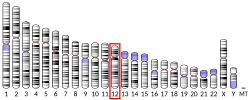
The IL26 gene is conserved in various vertebrates, but it is curiously absent in mice and rats. Paralogs of this gene have been identified in several non-mammalian species. The human gene is located on chromosome 12 (12q15), between the genes encoding IL-22 and IFNγ, and composed of five exons separated by three introns. This genomic cluster of genes encoding IL-22, IL-26, and IFNγ is present among all vertebrates.
IL-26 is a 171-amino acid protein that exhibits six alpha helices connected by loops and four conserved cysteine residues. Endogenous IL-26 is expressed as a 36 kDa homodimer. Originally named AK155, IL-26 was categorized in the IL-10 cytokine family due to sequence homology and secondary structure similarities.
The IL-26 expression was initially discovered in human HVS-transformed T cells. Since then it was confirmed that T helper 1 cells and Th17 memory CD4+ cells are the major sources of IL-26. More accurately, IL-26 is expressed by pro-inflammatory IL-17 producing T cells in chronically inflamed tissues. Co-expression of IL-17, IL-22, and IL-26 de facto defines the phenotype of human Th17 cells. Furthermore, CD26+ CD4+ T cells produce IL-26 in a model of graft-versus-host disease (GvHD). CD4+ T cells polarized toward a regulatory phenotype (Treg), naïve CD4+ T cells, and T helper 2 cells show low or no expression of IL-26.
It remains unclear whether IL-26 monocytes and macrophages express IL-26. Some studies showed there is no expression, whereas other studies inconsistently reported constitutive expression at a low level in monocytes, and the secretion of IL-26 by lung alveolar macrophages locally exposed to endotoxin. The IL-26 expression is also present in NK cells, especially NKp44+ human NK cell subset localized in mucosa-associated lymphoid tissue express substantial amounts of IL-26. Very low IL-26 expression was reported in human herpesvirus 8-transformed B cells.
Regarding non-immune cells, IL-26 expression was detected in primary bronchial epithelial cells from healthy individuals. Pathologically, fibroblasts harvested from the inflamed synovia of patients with rheumatoid arthritis constituted the main source of IL-26.
IL-26R heterodimer, a conventional receptor for IL-26, consists of two chains – IL-10R2, and IL-20R1. The IL-20R1 subunit contains the IL-26-binding site, whereas the IL-10R2 subunit acts as a second chain completing the assembly. Experiments performed with epithelial cells suggested both receptor subunits are required for the IL-26-dependent signal transduction. According to some observations, there is a possibility that additional IL-26 receptors exist.
Interleukin 26
Interleukin-26 (IL-26) is a protein that in humans is encoded by the IL26 gene.
IL-26 is the most recently identified member of the IL-20 cytokine subfamily, which was formed according to the usage of common receptor subunits and similarities in target-cell profiles and functions. All cytokines belonging to this subfamily are members of the larger IL-10 family. IL-26 is expressed in certain herpesvirus-transformed T cells but not in primary stimulated T cells. IL-26 signals through a receptor complex comprising two distinct proteins called IL-20 receptor 1 and IL-10 receptor 2. By signaling through this receptor complex, IL-26 induces rapid phosphorylation of the transcription factors STAT1 and STAT3, which enhance IL-10 and IL-8 secretion and as expression of the CD54 molecule on the surface of epithelial cells.
The IL26 gene is conserved in various vertebrates, but it is curiously absent in mice and rats. Paralogs of this gene have been identified in several non-mammalian species. The human gene is located on chromosome 12 (12q15), between the genes encoding IL-22 and IFNγ, and composed of five exons separated by three introns. This genomic cluster of genes encoding IL-22, IL-26, and IFNγ is present among all vertebrates.
IL-26 is a 171-amino acid protein that exhibits six alpha helices connected by loops and four conserved cysteine residues. Endogenous IL-26 is expressed as a 36 kDa homodimer. Originally named AK155, IL-26 was categorized in the IL-10 cytokine family due to sequence homology and secondary structure similarities.
The IL-26 expression was initially discovered in human HVS-transformed T cells. Since then it was confirmed that T helper 1 cells and Th17 memory CD4+ cells are the major sources of IL-26. More accurately, IL-26 is expressed by pro-inflammatory IL-17 producing T cells in chronically inflamed tissues. Co-expression of IL-17, IL-22, and IL-26 de facto defines the phenotype of human Th17 cells. Furthermore, CD26+ CD4+ T cells produce IL-26 in a model of graft-versus-host disease (GvHD). CD4+ T cells polarized toward a regulatory phenotype (Treg), naïve CD4+ T cells, and T helper 2 cells show low or no expression of IL-26.
It remains unclear whether IL-26 monocytes and macrophages express IL-26. Some studies showed there is no expression, whereas other studies inconsistently reported constitutive expression at a low level in monocytes, and the secretion of IL-26 by lung alveolar macrophages locally exposed to endotoxin. The IL-26 expression is also present in NK cells, especially NKp44+ human NK cell subset localized in mucosa-associated lymphoid tissue express substantial amounts of IL-26. Very low IL-26 expression was reported in human herpesvirus 8-transformed B cells.
Regarding non-immune cells, IL-26 expression was detected in primary bronchial epithelial cells from healthy individuals. Pathologically, fibroblasts harvested from the inflamed synovia of patients with rheumatoid arthritis constituted the main source of IL-26.
IL-26R heterodimer, a conventional receptor for IL-26, consists of two chains – IL-10R2, and IL-20R1. The IL-20R1 subunit contains the IL-26-binding site, whereas the IL-10R2 subunit acts as a second chain completing the assembly. Experiments performed with epithelial cells suggested both receptor subunits are required for the IL-26-dependent signal transduction. According to some observations, there is a possibility that additional IL-26 receptors exist.
Recent media
Recent media