
Recent from talks
Internal combustion engine
Knowledge base stats:
Talk channels stats:
Members stats:
Internal combustion engine
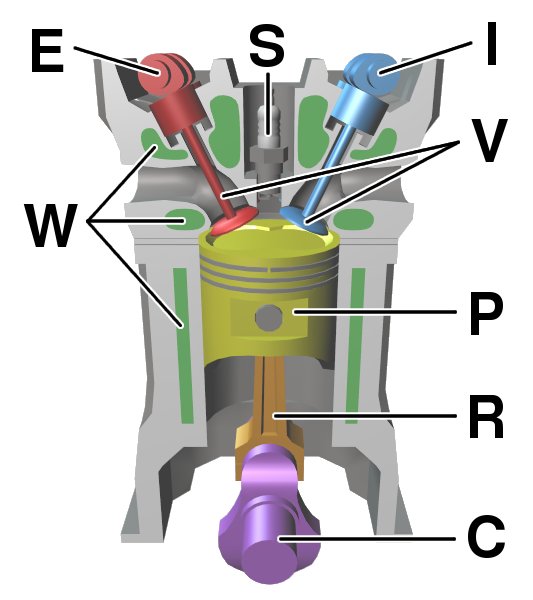
An internal combustion engine (ICE or IC engine) is a heat engine in which the combustion of a fuel occurs with an oxidizer (usually air) in a combustion chamber that is an integral part of the working fluid flow circuit. In an internal combustion engine, the expansion of the high-temperature and high-pressure gases produced by combustion applies direct force to components of the engine. The force is typically applied to pistons (piston engine), turbine blades (gas turbine), a rotor (Wankel engine), or a nozzle (jet engine). This force moves the component over a distance. This process transforms chemical energy into kinetic energy which is used to propel, move or power whatever the engine is attached to.
The first commercially successful internal combustion engines were invented in the mid-19th century. The first modern internal combustion engine, the Otto engine, was designed in 1876 by the German engineer Nicolaus Otto. The term internal combustion engine usually refers to an engine in which combustion is intermittent, such as the more familiar two-stroke and four-stroke piston engines, along with variants, such as the six-stroke piston engine and the Wankel rotary engine. A second class of internal combustion engines use continuous combustion: gas turbines, jet engines and most rocket engines, each of which are internal combustion engines on the same principle as previously described. In contrast, in external combustion engines, such as steam or Stirling engines, energy is delivered to a working fluid not consisting of, mixed with, or contaminated by combustion products. Working fluids for external combustion engines include air, hot water, pressurized water or even boiler-heated liquid sodium.
While there are many stationary applications, most ICEs are used in mobile applications and are the primary power supply for vehicles such as cars, aircraft and boats. ICEs are typically powered by hydrocarbon-based fuels like natural gas, gasoline, diesel fuel, or ethanol. Renewable fuels like biodiesel are used in compression ignition (CI) engines and bioethanol or ETBE (ethyl tert-butyl ether) produced from bioethanol in spark ignition (SI) engines. As early as 1900 the inventor of the diesel engine, Rudolf Diesel, was using peanut oil to run his engines. Renewable fuels are commonly blended with fossil fuels. Hydrogen, which is rarely used, can be obtained from either fossil fuels or renewable energy.
Various scientists and engineers contributed to the development of internal combustion engines. In 1791, John Barber developed the gas turbine. In 1794 Thomas Mead patented a gas engine. Also in 1794, Robert Street patented an internal combustion engine, which was also the first to use liquid fuel, and built an engine around that time. In 1798, John Stevens built the first American internal combustion engine. In 1807, French engineers Nicéphore Niépce (who went on to invent photography) and Claude Niépce ran a prototype internal combustion engine, using controlled dust explosions, the Pyréolophore, which was granted a patent by Napoleon Bonaparte. This engine powered a boat on the Saône river in France. In the same year, Swiss engineer François Isaac de Rivaz invented a hydrogen-based internal combustion engine and powered the engine by electric spark. In 1808, De Rivaz fitted his invention to a primitive working vehicle – "the world's first internal combustion powered automobile". In 1823, Samuel Brown patented the first internal combustion engine to be applied industrially.
In 1854, in the UK, the Italian inventors Eugenio Barsanti and Felice Matteucci obtained the certification: "Obtaining Motive Power by the Explosion of Gases". In 1857 the Great Seal Patent Office conceded them patent No.1655 for the invention of an "Improved Apparatus for Obtaining Motive Power from Gases". Barsanti and Matteucci obtained other patents for the same invention in France, Belgium and Piedmont between 1857 and 1859. In 1860, Belgian engineer Jean Joseph Etienne Lenoir produced a gas-fired internal combustion engine. In 1864, Nicolaus Otto patented the first atmospheric gas engine. In 1872, American George Brayton invented the first commercial liquid-fueled internal combustion engine. In 1876, Nicolaus Otto began working with Gottlieb Daimler and Wilhelm Maybach, patented the compressed charge, four-cycle engine. In 1879, Karl Benz patented a reliable two-stroke gasoline engine. Later, in 1886, Benz began the first commercial production of motor vehicles with an internal combustion engine, in which a three-wheeled, four-cycle engine and chassis formed a single unit. In 1892, Rudolf Diesel developed the first compressed charge, compression ignition engine. In 1926, Robert Goddard launched the first liquid-fueled rocket. In 1939, the Heinkel He 178 became the world's first jet aircraft.
In the past, the word engine (via Old French, from Latin ingenium, "ability") meant any piece of machinery—a sense that persists in expressions such as siege engine. A "motor" (from Latin motor, "mover") is any machine that produces mechanical power. Traditionally, electric motors are not referred to as "engines"; however, combustion engines are often referred to as "motors". (An electric engine refers to a locomotive operated by electricity.)
In boating, an internal combustion engine that is installed in the hull is referred to as an engine, but the engines that sit on the transom are referred to as motors.
Reciprocating piston engines are by far the most common power source for land and water vehicles, including automobiles, motorcycles, ships and to a lesser extent, locomotives (some are electrical but most use diesel engines). Rotary engines of the Wankel design are used in some automobiles, aircraft and motorcycles. These are collectively known as internal-combustion-engine vehicles (ICEV).
Hub AI
Internal combustion engine AI simulator
(@Internal combustion engine_simulator)
Internal combustion engine
An internal combustion engine (ICE or IC engine) is a heat engine in which the combustion of a fuel occurs with an oxidizer (usually air) in a combustion chamber that is an integral part of the working fluid flow circuit. In an internal combustion engine, the expansion of the high-temperature and high-pressure gases produced by combustion applies direct force to components of the engine. The force is typically applied to pistons (piston engine), turbine blades (gas turbine), a rotor (Wankel engine), or a nozzle (jet engine). This force moves the component over a distance. This process transforms chemical energy into kinetic energy which is used to propel, move or power whatever the engine is attached to.
The first commercially successful internal combustion engines were invented in the mid-19th century. The first modern internal combustion engine, the Otto engine, was designed in 1876 by the German engineer Nicolaus Otto. The term internal combustion engine usually refers to an engine in which combustion is intermittent, such as the more familiar two-stroke and four-stroke piston engines, along with variants, such as the six-stroke piston engine and the Wankel rotary engine. A second class of internal combustion engines use continuous combustion: gas turbines, jet engines and most rocket engines, each of which are internal combustion engines on the same principle as previously described. In contrast, in external combustion engines, such as steam or Stirling engines, energy is delivered to a working fluid not consisting of, mixed with, or contaminated by combustion products. Working fluids for external combustion engines include air, hot water, pressurized water or even boiler-heated liquid sodium.
While there are many stationary applications, most ICEs are used in mobile applications and are the primary power supply for vehicles such as cars, aircraft and boats. ICEs are typically powered by hydrocarbon-based fuels like natural gas, gasoline, diesel fuel, or ethanol. Renewable fuels like biodiesel are used in compression ignition (CI) engines and bioethanol or ETBE (ethyl tert-butyl ether) produced from bioethanol in spark ignition (SI) engines. As early as 1900 the inventor of the diesel engine, Rudolf Diesel, was using peanut oil to run his engines. Renewable fuels are commonly blended with fossil fuels. Hydrogen, which is rarely used, can be obtained from either fossil fuels or renewable energy.
Various scientists and engineers contributed to the development of internal combustion engines. In 1791, John Barber developed the gas turbine. In 1794 Thomas Mead patented a gas engine. Also in 1794, Robert Street patented an internal combustion engine, which was also the first to use liquid fuel, and built an engine around that time. In 1798, John Stevens built the first American internal combustion engine. In 1807, French engineers Nicéphore Niépce (who went on to invent photography) and Claude Niépce ran a prototype internal combustion engine, using controlled dust explosions, the Pyréolophore, which was granted a patent by Napoleon Bonaparte. This engine powered a boat on the Saône river in France. In the same year, Swiss engineer François Isaac de Rivaz invented a hydrogen-based internal combustion engine and powered the engine by electric spark. In 1808, De Rivaz fitted his invention to a primitive working vehicle – "the world's first internal combustion powered automobile". In 1823, Samuel Brown patented the first internal combustion engine to be applied industrially.
In 1854, in the UK, the Italian inventors Eugenio Barsanti and Felice Matteucci obtained the certification: "Obtaining Motive Power by the Explosion of Gases". In 1857 the Great Seal Patent Office conceded them patent No.1655 for the invention of an "Improved Apparatus for Obtaining Motive Power from Gases". Barsanti and Matteucci obtained other patents for the same invention in France, Belgium and Piedmont between 1857 and 1859. In 1860, Belgian engineer Jean Joseph Etienne Lenoir produced a gas-fired internal combustion engine. In 1864, Nicolaus Otto patented the first atmospheric gas engine. In 1872, American George Brayton invented the first commercial liquid-fueled internal combustion engine. In 1876, Nicolaus Otto began working with Gottlieb Daimler and Wilhelm Maybach, patented the compressed charge, four-cycle engine. In 1879, Karl Benz patented a reliable two-stroke gasoline engine. Later, in 1886, Benz began the first commercial production of motor vehicles with an internal combustion engine, in which a three-wheeled, four-cycle engine and chassis formed a single unit. In 1892, Rudolf Diesel developed the first compressed charge, compression ignition engine. In 1926, Robert Goddard launched the first liquid-fueled rocket. In 1939, the Heinkel He 178 became the world's first jet aircraft.
In the past, the word engine (via Old French, from Latin ingenium, "ability") meant any piece of machinery—a sense that persists in expressions such as siege engine. A "motor" (from Latin motor, "mover") is any machine that produces mechanical power. Traditionally, electric motors are not referred to as "engines"; however, combustion engines are often referred to as "motors". (An electric engine refers to a locomotive operated by electricity.)
In boating, an internal combustion engine that is installed in the hull is referred to as an engine, but the engines that sit on the transom are referred to as motors.
Reciprocating piston engines are by far the most common power source for land and water vehicles, including automobiles, motorcycles, ships and to a lesser extent, locomotives (some are electrical but most use diesel engines). Rotary engines of the Wankel design are used in some automobiles, aircraft and motorcycles. These are collectively known as internal-combustion-engine vehicles (ICEV).
Recent media