Hubbry Logo
search
logo
451591

International Docking Adapter

logo
Community Hub0 Subscribers
Read side by side
from Wikipedia

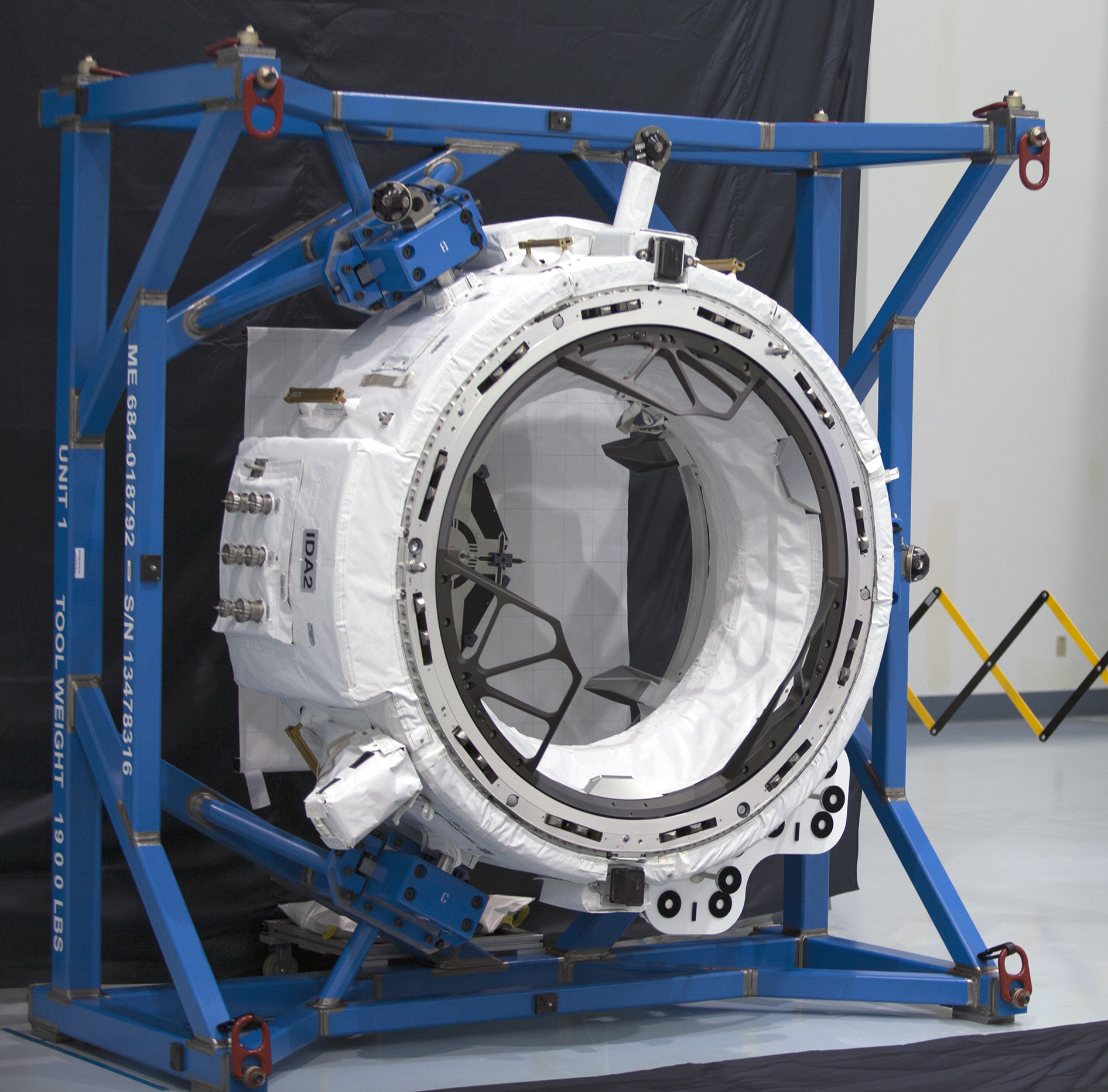
IDA-2 upright

The International Docking Adapter (IDA) is a spacecraft docking system adapter developed to convert APAS-95 to support docking with spacecraft that implement the International Docking System Standard. The IDA uses NASA Docking System (NDS) hardware. An IDA was permanently installed on each of the International Space Station's (ISS) two open Pressurized Mating Adapters (PMAs), both of which are connected to the Harmony module.

History

[edit]

Prior to IDA several different docking adapters were designed to fill a similar role but were never implemented.

APAS to LIDS Adaptor System

[edit]

The APAS to LIDS Adaptor System (ATLAS) was announced in 2008.[1] It would have been placed on the open PMAs and converted APAS-95 to the Low Impact Docking System (LIDS).[1] ATLAS was planned to be launched on Orion's first two missions to the International Space Station.[1] Orion's missions to the ISS were later canceled altogether and its role as a crew transporter was replaced by the Commercial Crew Program.[2]

Common Docking Adapter

[edit]
Rendering of the now-cancelled Common Docking Adapter

The Common Docking Adapter (CDA) was announced in 2009.[3] It was planned to be used to convert the Common Berthing Mechanism to the NASA Docking System.[4] The CDAs would have been attached directly to Node-2 forward and Node-2 zenith.[4] They would have been delivered on the Japanese HTV cargo spacecraft.[4]

Design

[edit]

IDA converts APAS-95 to the NASA Docking System (which complies with the International Docking System Standard) and allows the transfer of crew, cargo, power and data.[5] IDA has a mass of 526 kg (1,160 lb), a height of 110 cm (42 in) and a width of 160 cm (63 in).[5][6] When including the docking targets, laser retro-reflectors and related systems that are arrayed around the outer perimeters, the outer diameter is about 240 cm (94 in).[5]

Boeing is the primary contractor for the IDAs and the adapters were assembled at their Houston Product Support Center.[7][8] Parts from subcontractors came from 25 American states and the primary structure is from Russian company RSC Energia.[5][8]

Deployment of IDA modules

[edit]

Each IDA was delivered as unpressurized cargo in the trunk of a SpaceX Dragon 1. When each IDA arrived, Dextre removed it from Dragon's trunk and moved it to about 30 cm (1 ft) from the front of the PMA. It then moved the IDA carefully into position until it was seated on the PMA and held it there.[8] Astronauts during an Extravehicular activity then completed the electrical connections and permanently connect it to the PMA.[8]

IDA-1 was planned to be attached to Node-2's forward PMA.[9] IDA-2 was originally planned to be attached to Node-2's zenith PMA.[9][10] But following the loss of IDA-1, IDA-2 was instead attached to Node-2's forward PMA (PMA-2).[11][12] IDA-3, a replacement for IDA-1, is installed at Node-2's zenith PMA (PMA-3).[11]

IDA-1

[edit]
IDA-1 with thermal insulation

In February 2015, IDA-1 had been transported to the Kennedy Space Center while IDA-2 was still at Boeing's Houston facility.[8] The systems and targets for IDA-1 were put through about a month of tests at the Space Station Processing Facility before being loaded for launch.[5]

IDA-1 was lost during the launch failure of SpaceX CRS-7 on 28 June 2015.[9][10][13]

IDA-2

[edit]
IDA-2 without thermal insulation

IDA-2 was launched on SpaceX CRS-9 on 18 July 2016.[14] It was attached and connected to PMA-2 during a spacewalk on 19 August 2016.[12] First docking was achieved with the arrival of Crew Dragon Demo-1 on 3 March 2019.[15]

IDA-3

[edit]

IDA-3 was launched on the SpaceX CRS-18 mission in July 2019.[16] IDA-3 is constructed mostly from spare parts to speed construction.[17] It was attached and connected to PMA-3 during a spacewalk on 21 August 2019.[18] First docking was achieved with the arrival of SpaceX CRS-21 on 7 December 2020.[19]

[edit]

References

[edit]
Revisions and contributorsEdit on WikipediaRead on Wikipedia
from Grokipedia
The International Docking Adapter (IDA) is a spacecraft docking mechanism designed to enable the connection of commercial crew vehicles and future international spacecraft to the International Space Station (ISS), serving as a standardized interface for automated docking, power and data transfer, and crew ingress and egress.[1] Developed under NASA's Commercial Crew Program in collaboration with partners like Boeing and SpaceX, the IDA converts existing Pressurized Mating Adapters (PMAs) on the ISS into compatible ports that adhere to the International Docking System Standard (IDSS), a common mechanical, electrical, and data interface established by international space agencies to facilitate interoperability among diverse spacecraft.[2] Each IDA measures approximately 42 inches in height and 63 inches in width, with a 94-inch outer diameter, and incorporates advanced features such as laser-based ranging sensors, machine vision cameras, and structural fittings to support precise alignment and secure attachment during docking operations.[1] The development of the IDA began in the early 2010s as part of efforts to transition ISS access from the retired Space Shuttle to new U.S. commercial vehicles, with Boeing leading the design and fabrication using components sourced from 25 U.S. states and primary structures provided by Russia's RSC-Energia.[1] Originally, three IDAs were planned: IDA-1, IDA-2, and IDA-3. However, IDA-1 was lost during the June 28, 2015, explosion of a SpaceX CRS-7 cargo mission en route to the ISS, leading to its replacement materials being repurposed for IDA-3.[3] IDA-2 was successfully launched aboard SpaceX CRS-9 in July 2016 and installed via extravehicular activity (EVA) on the forward-facing PMA-2 port of the Harmony module in August 2016, marking the first operational IDA.[4] IDA-3 followed, launching on SpaceX CRS-18 in July 2019 and being installed during an EVA on the zenith-facing PMA-3 port of Harmony in August 2019, expanding the station's docking capacity.[5] These adapters have since supported key missions, including the inaugural docking of SpaceX Crew Dragon in 2020 and Boeing Starliner tests as of 2024, while paving the way for broader international compatibility under the IDSS framework.[2][6]

History

Early Concepts

In the post-Space Shuttle era, NASA recognized the need for standardized docking interfaces on the International Space Station (ISS) to enable reliable access by emerging U.S. commercial crew vehicles, such as SpaceX's Crew Dragon and Boeing's Starliner, ensuring compatibility and safety for crew transport missions.[7] This push for standardization arose from the retirement of the Shuttle program in 2011, which left a gap in crewed access to the ISS and necessitated adaptable docking solutions for diverse spacecraft designs. One early concept was the APAS to LIDS Adaptor System (ATLAS), announced in 2008 as part of the Constellation program to facilitate Orion spacecraft dockings to the ISS.[8] ATLAS was designed to convert the Russian Androgynous Peripheral Attach System (APAS-95) ports on the ISS—located on the Harmony and Poisk modules—into compatible interfaces for the U.S. Low Impact Docking System (LIDS) on Orion, allowing low-impact soft capture and alignment without excessive forces on the station.[9] The passive ATLAS adapter was planned for delivery to the ISS via Japan's H-II Transfer Vehicle (HTV) around 2013, with two units intended to outfit the forward APAS ports for Orion's initial crewed missions.[9] However, ATLAS was canceled in 2011 following the redirection of the Orion program away from ISS operations, as NASA's focus shifted toward deep-space exploration with Orion, rendering ISS-specific adaptations unnecessary. Parallel to ATLAS, the Common Docking Adapter (CDA) was announced in 2009 to expand ISS docking capabilities by converting the station's Common Berthing Mechanism (CBM) ports—originally designed for automated cargo vehicles like the Japanese HTV—into active NASA Docking System (NDS) interfaces for future crewed vehicles.[10] The CDA was envisioned as a passive adapter installed on Node-2's forward or zenith CBM port via HTV delivery, providing power, data, and command links to support U.S. spacecraft dockings while maintaining compatibility with existing ISS resources.[10] This concept aimed to leverage the underutilized CBM infrastructure for crew access in the post-Shuttle landscape.[11] Ultimately, the CDA was canceled as docking standards evolved, with NASA opting instead to repurpose existing Pressurized Mating Adapters (PMAs) to align with the emerging International Docking System Standard (IDSS).[12]

Development and Contracts

NASA initiated the development of the International Docking Adapter (IDA) in 2011 following the cancellation of the Constellation Program, as part of efforts to standardize docking interfaces for commercial spacecraft at the International Space Station (ISS) under the Commercial Crew Program. This policy decision aimed to convert the U.S. On-orbit Segment docking ports to the International Docking System Standard (IDSS), building on prior low-impact docking technologies to enable compatible operations with international partners.[13][14] NASA contracted Boeing to design and fabricate the IDAs, incorporating contributions from Russia's RSC Energia for primary structural elements to maintain compatibility with the Androgynous Peripheral Attach System (APAS). Manufacturing occurred at Boeing's facilities in Houston, Texas, with components supplied by suppliers across 25 U.S. states, ensuring a distributed U.S. industrial base. The program's requirements were influenced by earlier adapter concepts like the APAS-to-LIDS Adapter System (ATLAS) and Common Docking Adapter (CDA), which shaped the need for seamless integration with existing ISS infrastructure.[1][15] Production milestones advanced rapidly, with the first IDA achieving delivery readiness by 2015 after rigorous testing of docking mechanisms at NASA's Kennedy Space Center. SpaceX played a key role in the program's logistics, contracted to transport the IDAs to the ISS aboard Dragon cargo resupply missions as part of NASA's broader commercial partnerships. This timeline aligned with preparations for commercial crew vehicles.[1]

Design

Physical Specifications

The International Docking Adapter (IDA) has a height of 110 cm, a width of 160 cm, and an outer diameter of 240 cm including the passive docking targets. It weighs 526 kg.[1][16] The adapter features an aluminum alloy structure, primarily using alloys such as 6061-T6511 compliant with AMS QQ-A-200/8, incorporating passive alignment guides in the form of guide petals and docking targets designed for laser ranging systems like the Proximity Sensor Assembly.[2][17] Qualified for the space environment, the IDA operates in vacuum conditions below 1.0 × 10⁻⁴ Pa and withstands thermal extremes from approximately -150°C to +120°C, with protection against micrometeoroids and orbital debris through integrated shielding.[2][18] Manufacturing was led by Boeing, which assembled the adapter using components from suppliers across 25 U.S. states, while primary structures were produced by RSC Energia in Russia to maintain compatibility with the APAS docking interface.[1]

Docking Interface

The International Docking Adapter (IDA) serves as a conversion mechanism that adapts the legacy Androgynous Peripheral Attach System (APAS-95) ports on the International Space Station's Pressurized Mating Adapters (PMAs) to passive International Docking System Standard (IDSS) ports.[19] This adaptation enables docking with active spacecraft equipped with compatible NASA Docking System (NDS) hardware, such as SpaceX's Dragon 2 or Boeing's Starliner, by providing a standardized passive interface that supports androgynous mating without requiring modifications to the existing PMA structure.[2] The IDA's design ensures seamless integration with the IDSS, facilitating international collaboration in crew and cargo transportation to the ISS.[19] At the core of the IDA's docking interface is an androgynous docking ring that incorporates 3 soft capture latches for initial contact and stabilization, 12 hard capture hooks for final securement, and 3 guide petals to aid in precise alignment during approach.[19] These components work in sequence: the soft capture latches engage first to dampen relative motion and establish a soft mate, followed by the hard capture hooks that lock the vehicles together, while the guide petals provide structural guidance and misalignment correction.[2] Additionally, passive laser reflector targets mounted on the IDA serve as reference points for relative navigation systems on the approaching spacecraft, enabling accurate sensor-based positioning without active emissions from the adapter.[19] The IDA fully complies with IDSS and NDS requirements, accommodating approach misalignments of up to ±10 cm laterally and ±20 cm axially to ensure robust docking performance under varying orbital conditions.[2] Safety is enhanced through a redundant power and data umbilical system, which provides dual pathways for electrical connectivity with a capacity of 25 amps at 126 VDC, minimizing single-point failure risks during power transfer and command/data exchange.[19] Furthermore, the interface distributes structural loads evenly across the capture mechanisms, supporting a maximum design limit of 22,700 kg (50,000 lbf) to withstand the stresses of docking maneuvers and on-orbit operations.[2]

Deployment

Loss of IDA-1

The International Docking Adapter-1 (IDA-1) was manifested as the primary payload on the SpaceX Commercial Resupply Services-7 (CRS-7) mission, launched aboard a Falcon 9 v1.1 rocket from Cape Canaveral Air Force Station in Florida on June 28, 2015.[20][21] Approximately 139 seconds after liftoff, an anomaly occurred in the second stage's liquid oxygen tank pressurization system, leading to a rapid overpressurization event and the subsequent disintegration of the vehicle at an altitude of about 45 kilometers over the Atlantic Ocean.[22][23] The failure resulted in the total loss of the Dragon cargo spacecraft and its payloads, including IDA-1, with no injuries reported as the mission was uncrewed.[22][21] A joint NASA-SpaceX investigation determined that the root cause was the failure of a strut supporting a helium composite overwrapped pressure vessel within the second stage, which allowed the vessel to shift and rupture the liquid oxygen tank; this issue stemmed from an undetected material defect in an industrial-grade stainless steel casting used in the strut.[22] The incident caused significant delays to International Space Station docking port upgrades, as IDA-1 was intended to convert the forward Pressurized Mating Adapter into a NASA Docking System-compatible port for future commercial crew vehicles.[24][1] In response, NASA promptly decided to assemble a replacement IDA module using existing spare parts and components already in inventory, redesignated as IDA-3, to minimize further schedule disruptions to the overall docking adapter program.[25]

Installation of IDA-2

The International Docking Adapter-2 (IDA-2) was constructed by Boeing as a replacement for IDA-1 following its loss during the SpaceX CRS-7 launch failure in June 2015. It launched on July 18, 2016, aboard the SpaceX CRS-9 Dragon cargo spacecraft, carried in the unpressurized trunk section and lifted by a Falcon 9 rocket from Space Launch Complex 40 at Cape Canaveral Air Force Station in Florida.[26][27] The mission delivered approximately 5,970 pounds (2,708 kg) of pressurized cargo, scientific experiments, and the IDA-2 module to support NASA's Commercial Resupply Services program. The Dragon spacecraft autonomously docked to the Harmony module's nadir port on the International Space Station (ISS) on July 20, 2016, after being captured by the Canadarm2 robotic arm. Once berthed, the IDA-2 remained in the trunk for temporary external stowage until robotic operations could extract it. On August 18, 2016, ground controllers used the Canadarm2, with the Special Purpose Dexterous Manipulator (Dextre) end effector, to remove the IDA-2 from the trunk and maneuver it to a position approximately 30 cm from the forward Pressurized Mating Adapter-2 (PMA-2) on the Harmony module, where it was held in place for final attachment.[28][29] The primary installation occurred during U.S. Extravehicular Activity (EVA) 36 on August 19, 2016, conducted by NASA astronauts Jeff Williams and Kate Rubins, lasting 5 hours and 58 minutes. The spacewalkers removed the multi-layer insulation blanket from PMA-2, connected power, video, Ethernet, MIL-STD-1553 data, and heater cables between PMA-2 and IDA-2, installed a ground strap, and released 24 Common Berthing Mechanism latches to secure the adapter in place. This process converted the PMA-2 port to the International Docking System Standard interface, enabling automated docking for future commercial crew vehicles.[30][29] Following the EVA, ground teams and the Expedition 48 crew verified the IDA-2's alignment, structural integrity, and electrical connections through onboard diagnostics and robotic arm surveys, confirming full functionality and readiness for operations. The Dragon spacecraft was unberthed on August 21, 2016, and returned to Earth with cargo, completing the delivery phase.[31][28]

Installation of IDA-3

The International Docking Adapter-3 (IDA-3) was launched aboard SpaceX's Commercial Resupply Services-18 (CRS-18) mission on July 25, 2019, at 6:01 p.m. EDT (22:01 UTC) from Space Launch Complex 40 at Cape Canaveral Air Force Station in Florida, using a Falcon 9 Block 5 rocket.[32] The adapter, built by Boeing, was stowed in the unpressurized trunk of the Dragon cargo spacecraft, which carried approximately 5,000 pounds of additional research experiments, crew supplies, and hardware to the International Space Station (ISS).[33] Following launch, the Dragon spacecraft autonomously approached the ISS and was captured by the Canadarm2 robotic arm at 1:01 p.m. EDT on July 26, 2019, with Expedition 60 Flight Engineer Christina Koch operating the arm from inside the station.[34] The spacecraft was subsequently berthed to the Harmony module's forward port on July 27, marking the first reuse of a Dragon capsule for a third flight.[33] After unloading pressurized cargo, ground controllers at NASA's Johnson Space Center directed Canadarm2 to extract IDA-3 from the Dragon's trunk on August 19, 2019, positioning it temporarily near the installation site.[35] The primary installation of IDA-3 occurred robotically on August 20, 2019, when Canadarm2, in coordination with the Dextre robotic manipulator, transferred the 1,150-pound adapter to the zenith port of the Pressurized Mating Adapter-3 (PMA-3) on the Harmony module, bolting it into place to convert the APAS-89 docking interface to the International Docking System Standard (IDSS). This process built on the installation of IDA-2 in 2016, which involved robotic positioning followed by EVA for final attachment and cable connections, but was adapted for PMA-3's relocated position following its move to Harmony zenith in 2017. On August 21, 2019, NASA astronauts Andrew Morgan and Nick Hague conducted U.S. EVA-55, a 6-hour, 33-minute spacewalk to route and connect power, data, and communication cables, securing the adapter's operational readiness.[36][37] Commissioning of IDA-3 was finalized during Expedition 60, with internal control panel activations and system checks confirming electrical, data, and thermal connections by late August 2019, enabling automated docking capabilities for future commercial crew vehicles such as Boeing's Starliner and SpaceX's Crew Dragon.[36]

Operations

Commercial Crew Dockings

The International Docking Adapters (IDAs) have facilitated the integration of commercial crew vehicles with the International Space Station (ISS), enabling regular crew rotations and private missions following their installation on the Harmony module. The first docking to an IDA occurred during the uncrewed SpaceX Crew Dragon Demo-1 test mission on March 3, 2019, when the spacecraft autonomously connected to IDA-2 on Harmony's forward port, validating the NASA Docking System (NDS) interface for future crewed operations.[38] This milestone paved the way for crewed flights, with the inaugural operational crewed docking achieved by SpaceX's Crew-1 mission on November 16, 2020, also to IDA-2, carrying four astronauts for a six-month expedition. Boeing's CST-100 Starliner achieved its first docking to an IDA during the crewed Crew Flight Test (CFT) on June 6, 2024, connecting to IDA-3 on Harmony's zenith port and transporting NASA astronauts Butch Wilmore and Suni Williams for an extended stay aboard the ISS.[39] Prior to this, Starliner's uncrewed Orbital Flight Test-2 (OFT-2) in May 2022 had served as a backup validation for the docking system at IDA-2, confirming compatibility despite initial thruster concerns during ascent.[40] These events demonstrated the IDAs' role in supporting dual-vehicle redundancy for NASA's Commercial Crew Program, with installations of IDA-2 and IDA-3 enabling such integrations. As of November 2025, SpaceX has completed 16 Crew Dragon dockings across IDA-2 and IDA-3, encompassing NASA crew rotation missions such as Crew-11 (docked August 2025), Axiom Space private expeditions including Ax-4 (docked June 2025), and other commercial flights, significantly enhancing ISS access for international and private astronauts.[41] These operations rely on autonomous docking procedures, where Crew Dragon employs laser-based relative navigation systems—such as thermal and triangulation scanners—to achieve precise alignment and soft capture with the IDAs, typically within 24 hours of launch.[42] Post-capture, pressure checks and equalization between vehicles precede hatch opening, which occurs approximately two hours after docking to ensure safety before crew transfer.[43]

Cargo and Other Missions

The International Docking Adapters (IDAs) have enabled SpaceX Cargo Dragon spacecraft to perform resupply missions to the International Space Station since December 2020, when the CRS-21 mission became the first to autonomously dock to IDA-2 on the forward port of the Harmony module. By November 2025, SpaceX has completed 13 such cargo missions to the IDAs, including CRS-33 (docked August 2025), delivering supplies, scientific payloads, and station hardware essential for ongoing operations.[28] These uncrewed flights typically carry between 3,000 and 6,000 pounds of pressurized cargo per mission, supporting research in areas like biology, materials science, and technology demonstrations. In addition to routine resupply, the IDAs have supported key uncrewed test missions, including Boeing's Starliner Orbital Flight Test-2 (OFT-2), which successfully docked to IDA-2 on May 21, 2022, after launching atop a United Launch Alliance Atlas V rocket.[44] This demonstration validated Starliner's rendezvous, proximity operations, and docking capabilities with the station, carrying over 500 pounds of cargo and conducting more than 80 tests during its four-day stay.[45] For international applications, the IDSS standard integrated into the IDAs has facilitated compatibility demonstrations for potential future European cargo vehicles, such as through the European Space Agency's (ESA) development of the International Berthing and Docking Mechanism (IBDM) as a conceptual successor to the Automated Transfer Vehicle (ATV). The IBDM enables automated docking and berthing compatible with IDAs, supporting low-impact interfaces for resupply and exploration missions.[46] However, Russian Progress cargo spacecraft and Soyuz crew vehicles continue to dock using the legacy Androgynous Peripheral Attach System (APAS) on the Russian Orbital Segment, without direct utilization of the IDAs.[47] As of November 2025, the two operational IDAs have accommodated 31 docking events in total, including crewed and cargo deliveries as well as tests, with a 100% success rate for all mediated dockings since their installation, underscoring the adapters' robust performance and safety.[28]

References

User Avatar
No comments yet.