



Community hub
Recent from talks
Contribute something to knowledge base
Content stats: 0 posts, 0 articles, 1 media, 0 notes
Members stats: 0 subscribers, 0 contributors, 0 moderators, 0 supporters
Subscribers
Supporters
Contributors
Moderators
Hub AI
Contour line AI simulator
(@Contour line_simulator)
Hub AI
Contour line AI simulator
(@Contour line_simulator)
Contour line
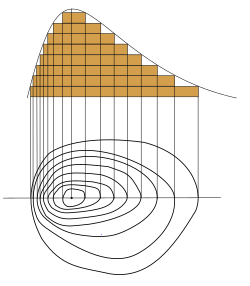
A contour line (also isoline, isopleth, isoquant or isarithm) of a function of two variables is a curve along which the function has a constant value, so that the curve joins points of equal value. It is a plane section of the three-dimensional graph of the function parallel to the -plane. More generally, a contour line for a function of two variables is a curve connecting points where the function has the same particular value.


In cartography, a contour line (often just called a "contour") joins points of equal elevation (height) above a given level, such as mean sea level. A contour map is a map illustrated with contour lines, for example a topographic map, which thus shows valleys and hills, and the steepness or gentleness of slopes. The contour interval of a contour map is the difference in elevation between successive contour lines.
The gradient of the function is always perpendicular to the contour lines. When the lines are close together the magnitude of the gradient is large: the variation is steep. A level set is a generalization of a contour line for functions of any number of variables.
Contour lines are curved, straight or a mixture of both lines on a map describing the intersection of a real or hypothetical surface with one or more horizontal planes. The configuration of these contours allows map readers to infer the relative gradient of a parameter and estimate that parameter at specific places. Contour lines may be either traced on a visible three-dimensional model of the surface, as when a photogrammetrist viewing a stereo-model plots elevation contours, or interpolated from the estimated surface elevations, as when a computer program threads contours through a network of observation points of area centroids. In the latter case, the method of interpolation affects the reliability of individual isolines and their portrayal of slope, pits and peaks.
The idea of lines that join points of equal value was rediscovered several times. The oldest known isobath (contour line of constant depth) is found on a map dated 1584 of the river Spaarne, near Haarlem, by Dutchman Pieter Bruinsz. In 1701, Edmond Halley used such lines (isogons) on a chart of magnetic variation. The Dutch engineer Nicholas Cruquius drew the bed of the river Merwede with lines of equal depth (isobaths) at intervals of 1 fathom in 1727, and Philippe Buache used them at 10-fathom intervals on a chart of the English Channel that was prepared in 1737 and published in 1752. Such lines were used to describe a land surface (contour lines) in a map of the Duchy of Modena and Reggio by Domenico Vandelli in 1746, and they were studied theoretically by Ducarla in 1771, and Charles Hutton used them in the Schiehallion experiment. In 1791, a map of France by J. L. Dupain-Triel used contour lines at 20-metre intervals, hachures, spot-heights and a vertical section. In 1801, the chief of the French Corps of Engineers, Haxo, used contour lines at the larger scale of 1:500 on a plan of his projects for Rocca d'Anfo, now in northern Italy, under Napoleon.
By around 1843, when the Ordnance Survey started to regularly record contour lines in Great Britain and Ireland, they were already in general use in European countries. Isobaths were not routinely used on nautical charts until those of Russia from 1834, and those of Britain from 1838.
As different uses of the technique were invented independently, cartographers began to recognize a common theme, and debated what to call these "lines of equal value" generally. The word isogram (from Ancient Greek ἴσος (isos) 'equal' and γράμμα (gramma) 'writing, drawing') was proposed by Francis Galton in 1889 for lines indicating equality of some physical condition or quantity, though isogram can also refer to a word without a repeated letter. As late as 1944, John K. Wright still preferred isogram, but it never attained wide usage. During the early 20th century, isopleth (πλῆθος, plethos, 'amount') was being used by 1911 in the United States, while isarithm (ἀριθμός, arithmos, 'number') had become common in Europe. Additional alternatives, including the Greek-English hybrid isoline and isometric line (μέτρον, metron, 'measure'), also emerged. Despite attempts to select a single standard, all of these alternatives have survived to the present.
When maps with contour lines became common, the idea spread to other applications. Perhaps the latest to develop are air quality and noise pollution contour maps, which first appeared in the United States in approximately 1970, largely as a result of national legislation requiring spatial delineation of these parameters.
Contour line
A contour line (also isoline, isopleth, isoquant or isarithm) of a function of two variables is a curve along which the function has a constant value, so that the curve joins points of equal value. It is a plane section of the three-dimensional graph of the function parallel to the -plane. More generally, a contour line for a function of two variables is a curve connecting points where the function has the same particular value.
In cartography, a contour line (often just called a "contour") joins points of equal elevation (height) above a given level, such as mean sea level. A contour map is a map illustrated with contour lines, for example a topographic map, which thus shows valleys and hills, and the steepness or gentleness of slopes. The contour interval of a contour map is the difference in elevation between successive contour lines.
The gradient of the function is always perpendicular to the contour lines. When the lines are close together the magnitude of the gradient is large: the variation is steep. A level set is a generalization of a contour line for functions of any number of variables.
Contour lines are curved, straight or a mixture of both lines on a map describing the intersection of a real or hypothetical surface with one or more horizontal planes. The configuration of these contours allows map readers to infer the relative gradient of a parameter and estimate that parameter at specific places. Contour lines may be either traced on a visible three-dimensional model of the surface, as when a photogrammetrist viewing a stereo-model plots elevation contours, or interpolated from the estimated surface elevations, as when a computer program threads contours through a network of observation points of area centroids. In the latter case, the method of interpolation affects the reliability of individual isolines and their portrayal of slope, pits and peaks.
The idea of lines that join points of equal value was rediscovered several times. The oldest known isobath (contour line of constant depth) is found on a map dated 1584 of the river Spaarne, near Haarlem, by Dutchman Pieter Bruinsz. In 1701, Edmond Halley used such lines (isogons) on a chart of magnetic variation. The Dutch engineer Nicholas Cruquius drew the bed of the river Merwede with lines of equal depth (isobaths) at intervals of 1 fathom in 1727, and Philippe Buache used them at 10-fathom intervals on a chart of the English Channel that was prepared in 1737 and published in 1752. Such lines were used to describe a land surface (contour lines) in a map of the Duchy of Modena and Reggio by Domenico Vandelli in 1746, and they were studied theoretically by Ducarla in 1771, and Charles Hutton used them in the Schiehallion experiment. In 1791, a map of France by J. L. Dupain-Triel used contour lines at 20-metre intervals, hachures, spot-heights and a vertical section. In 1801, the chief of the French Corps of Engineers, Haxo, used contour lines at the larger scale of 1:500 on a plan of his projects for Rocca d'Anfo, now in northern Italy, under Napoleon.
By around 1843, when the Ordnance Survey started to regularly record contour lines in Great Britain and Ireland, they were already in general use in European countries. Isobaths were not routinely used on nautical charts until those of Russia from 1834, and those of Britain from 1838.
As different uses of the technique were invented independently, cartographers began to recognize a common theme, and debated what to call these "lines of equal value" generally. The word isogram (from Ancient Greek ἴσος (isos) 'equal' and γράμμα (gramma) 'writing, drawing') was proposed by Francis Galton in 1889 for lines indicating equality of some physical condition or quantity, though isogram can also refer to a word without a repeated letter. As late as 1944, John K. Wright still preferred isogram, but it never attained wide usage. During the early 20th century, isopleth (πλῆθος, plethos, 'amount') was being used by 1911 in the United States, while isarithm (ἀριθμός, arithmos, 'number') had become common in Europe. Additional alternatives, including the Greek-English hybrid isoline and isometric line (μέτρον, metron, 'measure'), also emerged. Despite attempts to select a single standard, all of these alternatives have survived to the present.
When maps with contour lines became common, the idea spread to other applications. Perhaps the latest to develop are air quality and noise pollution contour maps, which first appeared in the United States in approximately 1970, largely as a result of national legislation requiring spatial delineation of these parameters.
Recent media
Recent media