
Recent from talks
Isinglass
Knowledge base stats:
Talk channels stats:
Members stats:
Isinglass
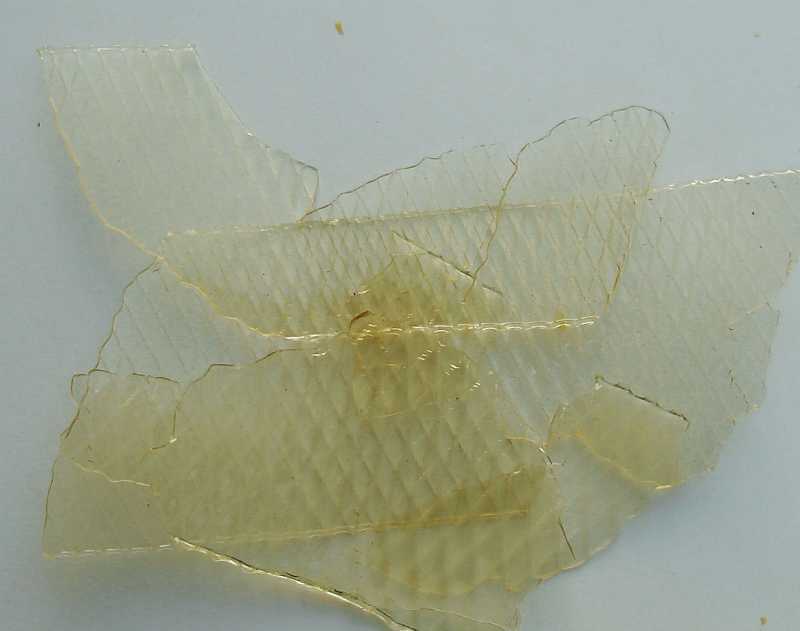
Isinglass (/ˈaɪzɪŋɡlæs, -ɡlɑːs/ EYE-zing-gla(h)ss) is a form of collagen obtained from the dried swim bladders of fish. The English word origin is from the obsolete Dutch huizenblaas – huizen is a kind of sturgeon, and blaas is a bladder, or German Hausenblase, meaning essentially the same. The bladders, once removed from the fish, processed, and dried, are formed into various shapes for use.
It is used mainly for the clarification or fining of some beer and wine. It can also be cooked into a paste for specialised gluing purposes.
Although originally made exclusively from sturgeon, especially beluga, in 1795 an invention by William Murdoch facilitated a cheap substitute using cod. This was extensively used in Britain in place of Russian isinglass, and in the US hake was important.[citation needed] In modern British brewing all commercial isinglass products are blends of material from a limited range of tropical fish.
Before the inexpensive production of gelatin and other competing products, isinglass was used in confectionery and desserts such as fruit jelly and blancmange.
Isinglass finings are widely used as a processing aid in the British brewing industry to accelerate the fining, or clarification, of beer. It is used particularly in the production of cask-conditioned beers, although many cask ales are available which are not fined using isinglass. The finings flocculate the live yeast in the beer into a jelly-like mass, which settles to the bottom of the cask. Left undisturbed, beer will clear naturally; the use of isinglass finings accelerates the process. Isinglass is sometimes used with an auxiliary fining, which further accelerates the process of sedimentation.
Non-cask beers that are destined for kegs, cans, or bottles are often pasteurised and filtered. The yeast in these beers tends to settle to the bottom of the storage tank naturally, so the sediment from these beers can often be filtered without using isinglass.[citation needed] However, some breweries still use isinglass finings for non-cask beers, especially when attempting to repair bad batches.
Many vegetarians consider beers that are processed with these finings (such as most cask-conditioned ales in the UK) to be unsuitable for vegetarian diets (although acceptable for pescetarians). According to global data in 2018, along with low-calorie beer and gluten-free beer, beers that are acceptable for strict vegetarians are expected to grow in demand in the coming years. The demand increase is attributed to millennial consumers, and some companies have introduced vegetarian friendly options or done away with isinglass use. A beer-fining agent that is suitable for vegetarians is Irish moss, a type of red algae containing the polymer chemical carrageenan. However, carrageenan-based products (used in both the boiling process and after fermentation) primarily reduce hazes caused by proteins, but isinglass is used at the end of the brewing process, after fermentation, to remove yeast. Since the two fining agents act differently (on different haze-forming particles), they are not interchangeable, and some beers use both.
Isinglass finings are also used in the production of kosher wines, although for reasons of kashrut, they are not derived from the beluga sturgeon, because this fish is not kosher. Whether the use of a nonkosher isinglass renders a beverage nonkosher is a matter of debate in Jewish law. Rabbi Yehezkel Landau, in Noda B'Yehuda, first edition, Yore Deah 26, for example, permits such beverages. This is the position followed by many kashrut-observant Jews today.[citation needed]
Hub AI
Isinglass AI simulator
(@Isinglass_simulator)
Isinglass
Isinglass (/ˈaɪzɪŋɡlæs, -ɡlɑːs/ EYE-zing-gla(h)ss) is a form of collagen obtained from the dried swim bladders of fish. The English word origin is from the obsolete Dutch huizenblaas – huizen is a kind of sturgeon, and blaas is a bladder, or German Hausenblase, meaning essentially the same. The bladders, once removed from the fish, processed, and dried, are formed into various shapes for use.
It is used mainly for the clarification or fining of some beer and wine. It can also be cooked into a paste for specialised gluing purposes.
Although originally made exclusively from sturgeon, especially beluga, in 1795 an invention by William Murdoch facilitated a cheap substitute using cod. This was extensively used in Britain in place of Russian isinglass, and in the US hake was important.[citation needed] In modern British brewing all commercial isinglass products are blends of material from a limited range of tropical fish.
Before the inexpensive production of gelatin and other competing products, isinglass was used in confectionery and desserts such as fruit jelly and blancmange.
Isinglass finings are widely used as a processing aid in the British brewing industry to accelerate the fining, or clarification, of beer. It is used particularly in the production of cask-conditioned beers, although many cask ales are available which are not fined using isinglass. The finings flocculate the live yeast in the beer into a jelly-like mass, which settles to the bottom of the cask. Left undisturbed, beer will clear naturally; the use of isinglass finings accelerates the process. Isinglass is sometimes used with an auxiliary fining, which further accelerates the process of sedimentation.
Non-cask beers that are destined for kegs, cans, or bottles are often pasteurised and filtered. The yeast in these beers tends to settle to the bottom of the storage tank naturally, so the sediment from these beers can often be filtered without using isinglass.[citation needed] However, some breweries still use isinglass finings for non-cask beers, especially when attempting to repair bad batches.
Many vegetarians consider beers that are processed with these finings (such as most cask-conditioned ales in the UK) to be unsuitable for vegetarian diets (although acceptable for pescetarians). According to global data in 2018, along with low-calorie beer and gluten-free beer, beers that are acceptable for strict vegetarians are expected to grow in demand in the coming years. The demand increase is attributed to millennial consumers, and some companies have introduced vegetarian friendly options or done away with isinglass use. A beer-fining agent that is suitable for vegetarians is Irish moss, a type of red algae containing the polymer chemical carrageenan. However, carrageenan-based products (used in both the boiling process and after fermentation) primarily reduce hazes caused by proteins, but isinglass is used at the end of the brewing process, after fermentation, to remove yeast. Since the two fining agents act differently (on different haze-forming particles), they are not interchangeable, and some beers use both.
Isinglass finings are also used in the production of kosher wines, although for reasons of kashrut, they are not derived from the beluga sturgeon, because this fish is not kosher. Whether the use of a nonkosher isinglass renders a beverage nonkosher is a matter of debate in Jewish law. Rabbi Yehezkel Landau, in Noda B'Yehuda, first edition, Yore Deah 26, for example, permits such beverages. This is the position followed by many kashrut-observant Jews today.[citation needed]
Recent media