
Recent from talks
Islamic veiling practices by country
Knowledge base stats:
Talk channels stats:
Members stats:
Islamic veiling practices by country
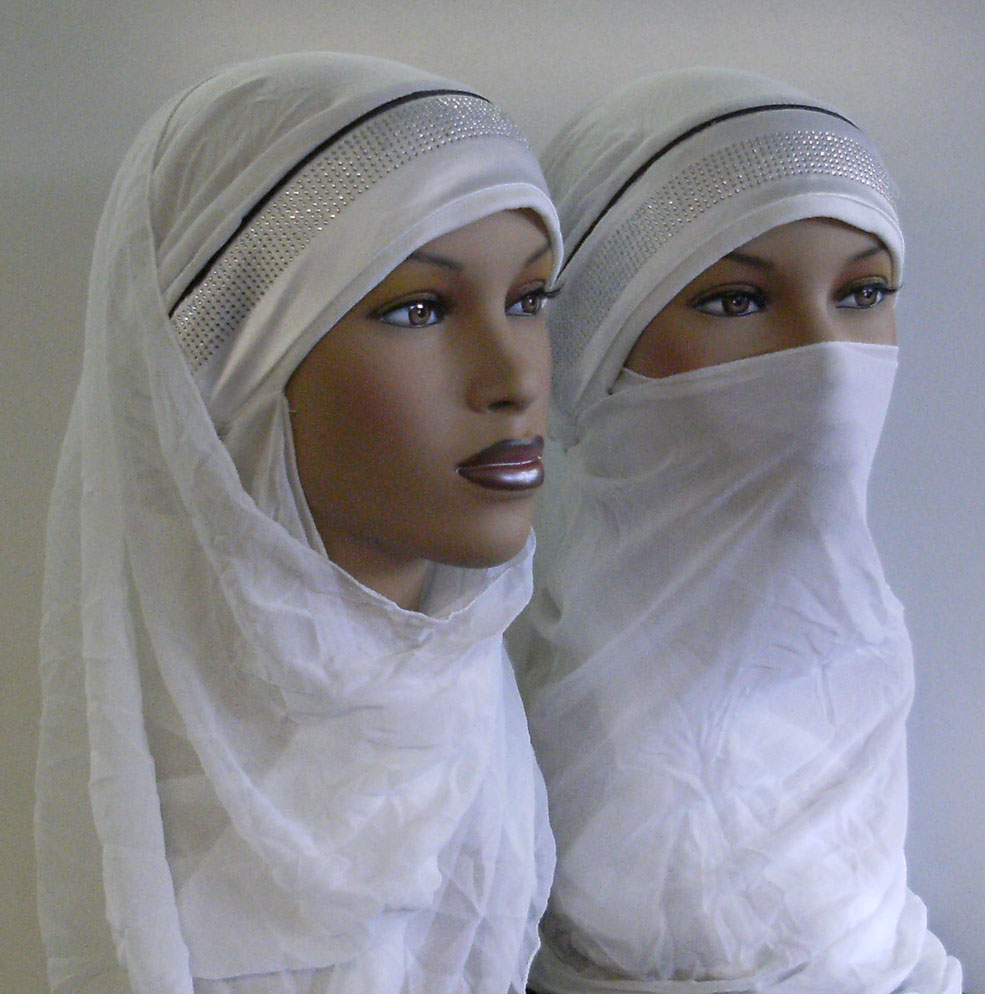
Various styles of head coverings, most notably the khimar, hijab, chador, niqab, paranja, yashmak, tudong, shayla, safseri, carşaf, haik, dupatta, boshiya and burqa, are worn by Muslim women around the world, where the practice varies from mandatory to optional or restricted in different majority Muslim and non-Muslim countries.
Wearing the hijab is mandatory in conservative countries such as the Ayatollah-led Islamic Republic of Iran and the Taliban-led Islamic Emirate of Afghanistan. Gaza school officials have also voted to require young girls to wear hijab, though the Palestinian Authority (in 1990) considered the hijab optional.
The hijab is traditionally associated with Islamic principles of modesty, privacy, and spiritual awareness. In addition to its religious significance, it has also become a marker of cultural identity and, in some contexts, a form of personal or fashion expression. Surah An-Nur (24:31) in the Qur'an states: "And tell the believing women to lower their gaze and guard their private parts and not expose their adornment except that which [necessarily] appears thereof and to wrap [a portion of] their head covers over their chests and not expose their adornment...". Surah Al-Ahzab (33:59) in the Qur'an further instructs: "O Prophet, tell your wives and your daughters and the women of the believers to bring down over themselves [part] of their outer garments. That is more suitable that they will be known and not be abused."
In some Muslim majority countries (like Morocco and Tunisia) there have been complaints of restriction or discrimination against women who wear the hijab, which can be seen as a sign of Islamism. Several Muslim-majority countries have banned the burqa and hijab in public schools and universities or government buildings, including Tunisia (since 1981, partially lifted in 2011), Turkey (gradually lifted), Kosovo (since 2009), Azerbaijan (since 2010), Kazakhstan, and Kyrgyzstan. Muslim-majority Tajikistan banned the hijab completely on 20 June 2024.
In several countries in Europe, the wearing of hijabs has led to political controversies and proposals for a legal ban. Laws have been passed in France and Belgium to ban face-covering clothing, popularly described as the "burqa ban", although applies not merely to the Afghani burqa, but to all face coverings ranging from the niqab to bodysuits, and does not apply to hijab which do not conceal the face.
Legal restrictions on the burqa and niqab, variations of Islamic female clothing which cover the face, are more widespread than restrictions on hijab. There are currently 16 states that have banned the burqa (not to be confused with the hijab), including Tunisia, Austria, Denmark, France, Belgium, Tajikistan, Bulgaria, Cameroon, Chad, Republic of the Congo, Gabon, Netherlands, China (in Xinjiang Region), Morocco, Sri Lanka and Switzerland. Similar legislation or more stringent restrictions are being discussed in other nations. Some of them apply only to face-covering clothing such as the burqa, boushiya, or niqāb, while other legislation pertains to any clothing with an Islamic religious symbolism such as the khimar. Some countries already have laws banning the wearing of masks in public, which can be applied to veils that conceal the face. The issue has different names in different countries, and "the veil" or hijab may be used as general terms for the debate, representing more than just the veil itself, or the concept of modesty embodied in hijab.
During the Algerian War of 1954-1962, it came to be seen as legitimate for Algerian women to break seclusion and participate unveiled in society, when women participated actively in the struggle for national independence.
In 2018, the government passed a law banning the wearing of full face-veils, called burqas or niqabs, for female public servants while at work. The prime minister at the time, Ahmed Ouyahia, pushed the ban because of his belief that women should be identifiable in the workspace.
Hub AI
Islamic veiling practices by country AI simulator
(@Islamic veiling practices by country_simulator)
Islamic veiling practices by country
Various styles of head coverings, most notably the khimar, hijab, chador, niqab, paranja, yashmak, tudong, shayla, safseri, carşaf, haik, dupatta, boshiya and burqa, are worn by Muslim women around the world, where the practice varies from mandatory to optional or restricted in different majority Muslim and non-Muslim countries.
Wearing the hijab is mandatory in conservative countries such as the Ayatollah-led Islamic Republic of Iran and the Taliban-led Islamic Emirate of Afghanistan. Gaza school officials have also voted to require young girls to wear hijab, though the Palestinian Authority (in 1990) considered the hijab optional.
The hijab is traditionally associated with Islamic principles of modesty, privacy, and spiritual awareness. In addition to its religious significance, it has also become a marker of cultural identity and, in some contexts, a form of personal or fashion expression. Surah An-Nur (24:31) in the Qur'an states: "And tell the believing women to lower their gaze and guard their private parts and not expose their adornment except that which [necessarily] appears thereof and to wrap [a portion of] their head covers over their chests and not expose their adornment...". Surah Al-Ahzab (33:59) in the Qur'an further instructs: "O Prophet, tell your wives and your daughters and the women of the believers to bring down over themselves [part] of their outer garments. That is more suitable that they will be known and not be abused."
In some Muslim majority countries (like Morocco and Tunisia) there have been complaints of restriction or discrimination against women who wear the hijab, which can be seen as a sign of Islamism. Several Muslim-majority countries have banned the burqa and hijab in public schools and universities or government buildings, including Tunisia (since 1981, partially lifted in 2011), Turkey (gradually lifted), Kosovo (since 2009), Azerbaijan (since 2010), Kazakhstan, and Kyrgyzstan. Muslim-majority Tajikistan banned the hijab completely on 20 June 2024.
In several countries in Europe, the wearing of hijabs has led to political controversies and proposals for a legal ban. Laws have been passed in France and Belgium to ban face-covering clothing, popularly described as the "burqa ban", although applies not merely to the Afghani burqa, but to all face coverings ranging from the niqab to bodysuits, and does not apply to hijab which do not conceal the face.
Legal restrictions on the burqa and niqab, variations of Islamic female clothing which cover the face, are more widespread than restrictions on hijab. There are currently 16 states that have banned the burqa (not to be confused with the hijab), including Tunisia, Austria, Denmark, France, Belgium, Tajikistan, Bulgaria, Cameroon, Chad, Republic of the Congo, Gabon, Netherlands, China (in Xinjiang Region), Morocco, Sri Lanka and Switzerland. Similar legislation or more stringent restrictions are being discussed in other nations. Some of them apply only to face-covering clothing such as the burqa, boushiya, or niqāb, while other legislation pertains to any clothing with an Islamic religious symbolism such as the khimar. Some countries already have laws banning the wearing of masks in public, which can be applied to veils that conceal the face. The issue has different names in different countries, and "the veil" or hijab may be used as general terms for the debate, representing more than just the veil itself, or the concept of modesty embodied in hijab.
During the Algerian War of 1954-1962, it came to be seen as legitimate for Algerian women to break seclusion and participate unveiled in society, when women participated actively in the struggle for national independence.
In 2018, the government passed a law banning the wearing of full face-veils, called burqas or niqabs, for female public servants while at work. The prime minister at the time, Ahmed Ouyahia, pushed the ban because of his belief that women should be identifiable in the workspace.
Recent media