



Community hub
Recent from talks
Contribute something to knowledge base
Content stats: 0 posts, 0 articles, 0 media, 0 notes
Members stats: 0 subscribers, 0 contributors, 0 moderators, 0 supporters
Subscribers
Supporters
Contributors
Moderators
Hub AI
Isotoxal figure AI simulator
(@Isotoxal figure_simulator)
Hub AI
Isotoxal figure AI simulator
(@Isotoxal figure_simulator)
Isotoxal figure
In geometry, a polytope (for example, a polygon or a polyhedron) or a tiling is isotoxal (from Greek τόξον 'arc') or edge-transitive if its symmetries act transitively on its edges. Informally, this means that there is only one type of edge to the object: given two edges, there is a translation, rotation, and/or reflection that will move one edge to the other while leaving the region occupied by the object unchanged.
An isotoxal polygon is an even-sided i.e. equilateral polygon, but not all equilateral polygons are isotoxal. The duals of isotoxal polygons are isogonal polygons. Isotoxal -gons are centrally symmetric, thus are also zonogons.

In general, a (non-regular) isotoxal -gon has dihedral symmetry. For example, a (non-square) rhombus is an isotoxal "×-gon" (quadrilateral) with symmetry. All regular -gons (also with odd ) are isotoxal, having double the minimum symmetry order: a regular -gon has dihedral symmetry.


An isotoxal -gon with outer internal angle can be denoted by The inner internal angle may be less or greater than making convex or concave polygons respectively.


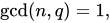
A star -gon can also be isotoxal, denoted by with and with the greatest common divisor where is the turning number or density. Concave inner vertices can be defined for If then is "reduced" to a compound of rotated copies of








Caution:
A set of "uniform" tilings, actually isogonal tilings using isotoxal polygons as less symmetric faces than regular ones, can be defined.
Regular polyhedra are isohedral (face-transitive), isogonal (vertex-transitive), and isotoxal (edge-transitive).
Isotoxal figure
In geometry, a polytope (for example, a polygon or a polyhedron) or a tiling is isotoxal (from Greek τόξον 'arc') or edge-transitive if its symmetries act transitively on its edges. Informally, this means that there is only one type of edge to the object: given two edges, there is a translation, rotation, and/or reflection that will move one edge to the other while leaving the region occupied by the object unchanged.
An isotoxal polygon is an even-sided i.e. equilateral polygon, but not all equilateral polygons are isotoxal. The duals of isotoxal polygons are isogonal polygons. Isotoxal -gons are centrally symmetric, thus are also zonogons.
In general, a (non-regular) isotoxal -gon has dihedral symmetry. For example, a (non-square) rhombus is an isotoxal "×-gon" (quadrilateral) with symmetry. All regular -gons (also with odd ) are isotoxal, having double the minimum symmetry order: a regular -gon has dihedral symmetry.
An isotoxal -gon with outer internal angle can be denoted by The inner internal angle may be less or greater than making convex or concave polygons respectively.
A star -gon can also be isotoxal, denoted by with and with the greatest common divisor where is the turning number or density. Concave inner vertices can be defined for If then is "reduced" to a compound of rotated copies of
Caution:
A set of "uniform" tilings, actually isogonal tilings using isotoxal polygons as less symmetric faces than regular ones, can be defined.
Regular polyhedra are isohedral (face-transitive), isogonal (vertex-transitive), and isotoxal (edge-transitive).