
Recent from talks
Israelian Hebrew
Knowledge base stats:
Talk channels stats:
Members stats:
Israelian Hebrew
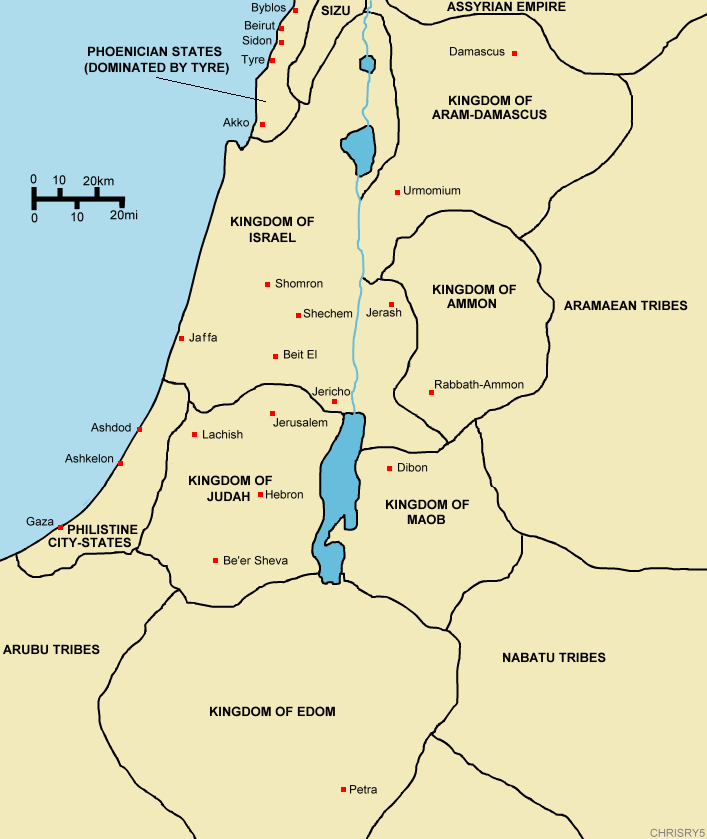
Israelian Hebrew (or IH) is a northern dialect of biblical Hebrew (BH) proposed as an explanation for various irregular linguistic features of the Masoretic Text (MT) of the Hebrew Bible. It competes with the alternative explanation that such features are Aramaisms, indicative either of late dates of composition, or of editorial emendations. Although IH is not a new proposal, it only started gaining ground as a challenge to older arguments to late dates for some biblical texts since about a decade before the turn of the 21st century: linguistic variation in the Hebrew Bible might be better explained by synchronic rather than diachronic linguistics, meaning various biblical texts could be significantly older than many 20th century scholars supposed.
What constitutes linguistic irregularity in the MT is not in dispute, nor is the affinity of many these features to aspects of Aramaic. What distinguishes the theories is a historical question of language contact. It is known that the Kingdom of Judah (from which name the Jewish people are known), suffered a defeat at the hands of the Aramaic speaking neo-Babylonian Empire, which involved deportation according to standard Babylonian practice. This language contact is recognised by all scholars, as are the resultant Aramaisms in late Biblical Hebrew (LBH). What the IH proposal explains, which LBH does not, is the Aramaisms (and other features) that appear in texts that many scholars would consider antedated the period of exile in Babylon. The two theories are thus not incompatible, which is why they co-existed throughout the 20th century. However, the more recent work does pose a challenge to the traditional dating of some specific texts in the Bible, the Song of Songs in particular.
The reconstruction of IH proposes that diachronic phonetic shifts in ancient Israelite dialects varied geographically, with northern shifts attesting a number of isoglosses with Aramaic and other northwest Semitic languages.
The assumed proto-Semitic phoneme ṯ̣ [θʼ] shifts to ṣ [sʼ] in standard biblical Hebrew (SBH), but to ṭ [tʼ] in Aramaic. So original proto-Semitic nṯ̣r ("guard" or "keep") becomes nṣr (נצר) in SBH, but nṭr (נטר) in Aramaic. However, the form nṭr is found in several places in the Bible—in Leviticus 19:18, Jeremiah 3:5,12, Nahum 1:2 and Psalm 103:9—though it has the sense "be angry" in these places. Brown–Driver–Briggs (1907) and the Hebrew and Aramaic Lexicon of the Old Testament (1994–99) treat nṭr as a coinage derivative from nṯ̣r—hence "keep one's anger"— though Ludwig Koehler and Walter Baumgartner's earlier lexicon (Lexicon in Veteris Testamenti libros, 1958) took a different approach. Irrespective of whether or not SBH coined (or borrowed) this root to convey the sense of "be angry", the Bible also attests the use of nṭr in exactly the same sense as the proto-Semitic word nṯ̣r. The question is, is this latter data evidence of early assimilation of Aramaic in the north, or alternatively of late composition or editorial emendation, after Imperial Aramaic started to replace SBH in post-exilic Kingdom of Judah in the south?
Various irregularities in the morphology of words attested in BH also show affinities with languages neighbouring ancient Israel to the north.
The relative pronoun in SBH is asher (אשר ’ăšer), and in Mishnaic Hebrew (MH) is sh– (–ש). LBH appears to represent a transition stage: the latter form appears, but inconsistently. The Song of Songs is unusual in that it uses –ש consistently, with the sole exception of its first verse, which functions as a title. The Phoenician and Ammonite cognate is אש.
The irregular second-person feminine singular independent pronoun אתי appears as the Ketiv in several IH texts including Judges 17:2, 1 Kings 14:2, and 2 Kings 4:16, 4:23, 8:1.
Nominalization of verbs (the paradigm example being qātal, קטל) by forming a feminine nomen actionis (qətîlāh, קטלה) is common in MH, but rare in SBH.
Hub AI
Israelian Hebrew AI simulator
(@Israelian Hebrew_simulator)
Israelian Hebrew
Israelian Hebrew (or IH) is a northern dialect of biblical Hebrew (BH) proposed as an explanation for various irregular linguistic features of the Masoretic Text (MT) of the Hebrew Bible. It competes with the alternative explanation that such features are Aramaisms, indicative either of late dates of composition, or of editorial emendations. Although IH is not a new proposal, it only started gaining ground as a challenge to older arguments to late dates for some biblical texts since about a decade before the turn of the 21st century: linguistic variation in the Hebrew Bible might be better explained by synchronic rather than diachronic linguistics, meaning various biblical texts could be significantly older than many 20th century scholars supposed.
What constitutes linguistic irregularity in the MT is not in dispute, nor is the affinity of many these features to aspects of Aramaic. What distinguishes the theories is a historical question of language contact. It is known that the Kingdom of Judah (from which name the Jewish people are known), suffered a defeat at the hands of the Aramaic speaking neo-Babylonian Empire, which involved deportation according to standard Babylonian practice. This language contact is recognised by all scholars, as are the resultant Aramaisms in late Biblical Hebrew (LBH). What the IH proposal explains, which LBH does not, is the Aramaisms (and other features) that appear in texts that many scholars would consider antedated the period of exile in Babylon. The two theories are thus not incompatible, which is why they co-existed throughout the 20th century. However, the more recent work does pose a challenge to the traditional dating of some specific texts in the Bible, the Song of Songs in particular.
The reconstruction of IH proposes that diachronic phonetic shifts in ancient Israelite dialects varied geographically, with northern shifts attesting a number of isoglosses with Aramaic and other northwest Semitic languages.
The assumed proto-Semitic phoneme ṯ̣ [θʼ] shifts to ṣ [sʼ] in standard biblical Hebrew (SBH), but to ṭ [tʼ] in Aramaic. So original proto-Semitic nṯ̣r ("guard" or "keep") becomes nṣr (נצר) in SBH, but nṭr (נטר) in Aramaic. However, the form nṭr is found in several places in the Bible—in Leviticus 19:18, Jeremiah 3:5,12, Nahum 1:2 and Psalm 103:9—though it has the sense "be angry" in these places. Brown–Driver–Briggs (1907) and the Hebrew and Aramaic Lexicon of the Old Testament (1994–99) treat nṭr as a coinage derivative from nṯ̣r—hence "keep one's anger"— though Ludwig Koehler and Walter Baumgartner's earlier lexicon (Lexicon in Veteris Testamenti libros, 1958) took a different approach. Irrespective of whether or not SBH coined (or borrowed) this root to convey the sense of "be angry", the Bible also attests the use of nṭr in exactly the same sense as the proto-Semitic word nṯ̣r. The question is, is this latter data evidence of early assimilation of Aramaic in the north, or alternatively of late composition or editorial emendation, after Imperial Aramaic started to replace SBH in post-exilic Kingdom of Judah in the south?
Various irregularities in the morphology of words attested in BH also show affinities with languages neighbouring ancient Israel to the north.
The relative pronoun in SBH is asher (אשר ’ăšer), and in Mishnaic Hebrew (MH) is sh– (–ש). LBH appears to represent a transition stage: the latter form appears, but inconsistently. The Song of Songs is unusual in that it uses –ש consistently, with the sole exception of its first verse, which functions as a title. The Phoenician and Ammonite cognate is אש.
The irregular second-person feminine singular independent pronoun אתי appears as the Ketiv in several IH texts including Judges 17:2, 1 Kings 14:2, and 2 Kings 4:16, 4:23, 8:1.
Nominalization of verbs (the paradigm example being qātal, קטל) by forming a feminine nomen actionis (qətîlāh, קטלה) is common in MH, but rare in SBH.
Recent media